

How Bible translation ministries steward restricted gifts is not a niche accounting question. It is one of the clearest tests of whether a ministry treats donor intent as a form of covenant faithfulness before God and neighbor. When a giver designates funds for translation work, audio Scripture, a specific language community, or consultant training, they are not purchasing influence; they are entrusting a ministry with a holy obligation.
Restricted giving is also where good intentions and operational reality sometimes collide. Translation projects run across borders, across calendars, and across unpredictable variables: government permissions, literacy levels, team health, security concerns, and the slow work of community review. Mature stewardship does not deny those pressures. It governs them with transparent policies, disciplined accounting, and a posture that honors both donor intent and the people the ministry serves.
Restricted gifts are a matter of truthfulness before God
Donor intent is a promise, not a preference
Scripture consistently treats truthfulness in financial matters as a spiritual issue, not merely a technical one. “It is required of stewards that they be found faithful” (1 Corinthians 4:2). In restricted giving, faithfulness means the ministry does what it said it would do with what was given, or it returns to the donor for permission when circumstances change.
Christian donors often frame restricted gifts as obedience: a desire to put weight behind the Great Commission, to support an unreached language group, or to help a local church receive Scripture in the tongue of the heart. That spiritual seriousness is precisely why ministries must resist a common temptation: to treat restrictions as flexible once the funds have arrived. The strictness is not legalism; it is integrity.
Restrictions can serve the mission or distort it
Christians genuinely disagree about how much restriction is healthy. Some donors restrict because they want clarity and measurable progress. Others restrict because they distrust overhead or fear that “general” gifts disappear into bureaucracy. The field has also had to reckon with the fact that excessive restriction can unintentionally weaken a ministry’s capacity to care for staff, maintain security standards, or invest in translation quality.
Wise stewardship names that tension openly. A ministry can honor donor intent while still teaching donors what it actually costs to translate Scripture responsibly—community testing, linguistic consulting, translation checking, safeguarding, and long-term Scripture engagement.

The mechanics of stewardship begin with accounting discipline
Fund accounting and clear gift acceptance policies
Restricted gifts require more than goodwill. They require fund accounting systems that can track revenue and expenses by restriction, along with written gift acceptance policies that define what restrictions the ministry can and cannot accept. When those policies are absent, the ministry may accept a restricted gift that cannot be executed without compromising quality or safety.
Across our verification work at Most Trusted, the ministries that meet The Most Trusted Standard tend to have three practical safeguards in place: documented gift acceptance procedures, internal controls that reduce the risk of misclassification, and regular reconciliation between project budgets and restricted fund balances.
Time lags and multi-year projects require careful communication
Bible translation is rarely a twelve-month effort. Donors sometimes assume that “restricted to translation” means immediate spending, but translation quality depends on a sequence: orthography work, exegesis and drafting, community review, consultant checking, and publication and distribution planning. A mature ministry communicates that sequence so donors do not mistake patience for inactivity.
This is also where the “overhead” debate can mislead. The widely cited “Overhead Myth” statement—signed by Charity Navigator, GuideStar, and the BBB Wise Giving Alliance—argues that overhead ratios alone are a poor measure of nonprofit performance and can create harmful incentives to underinvest in infrastructure and evaluation Charity Navigator. Translation ministries, especially, need reliable systems and trained reviewers; underfunding those elements can compromise accuracy and long-term credibility.
How healthy ministries handle changes without violating donor trust
Reallocation requires consent, not creative interpretation
The hard cases reveal a ministry’s character. A language program may become inaccessible due to conflict. A partner church may face sudden persecution. A translator may need to relocate. In those situations, restricted funds can become “stuck” unless the ministry has a process for donor communication and consent.
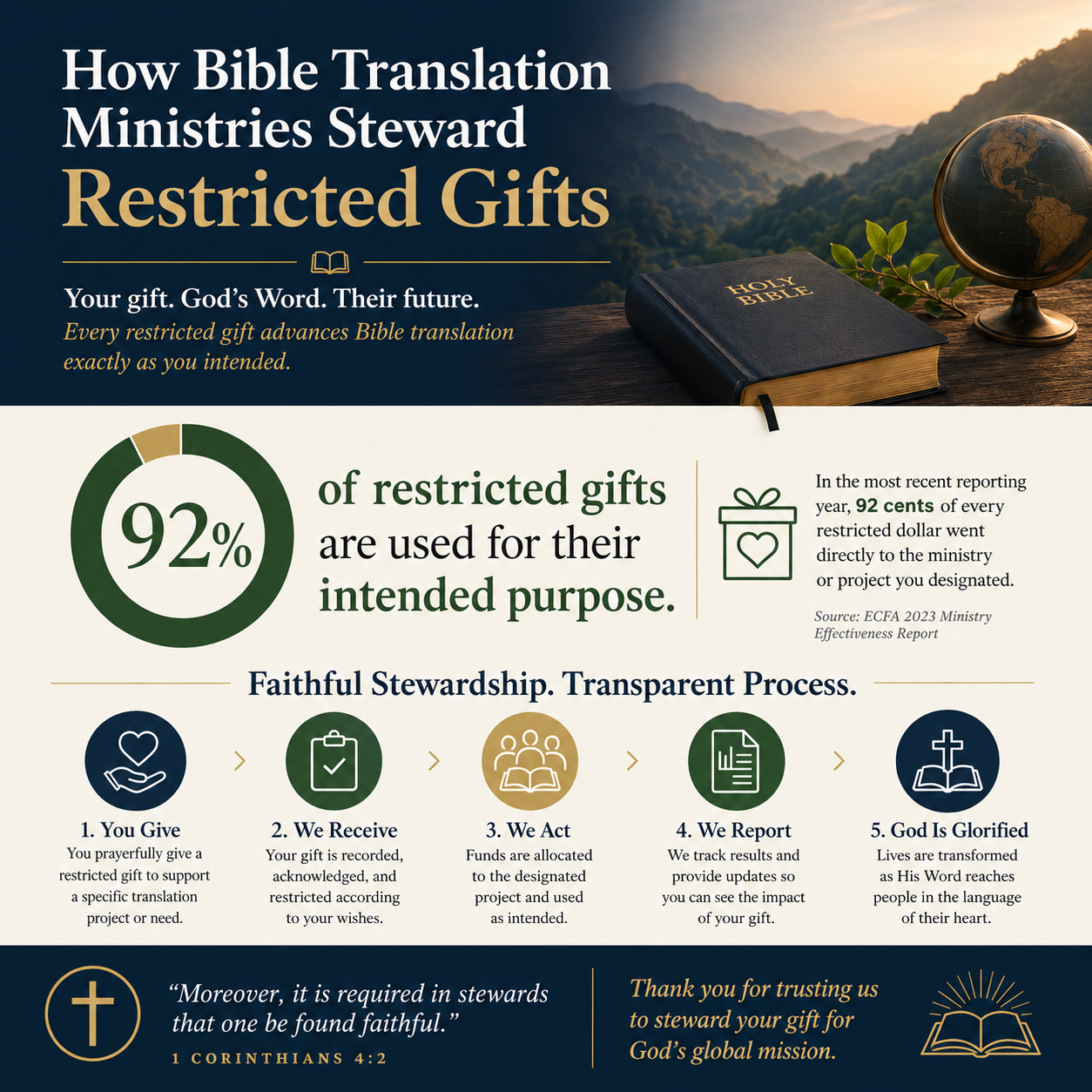
Best practice is straightforward: if the ministry cannot fulfill the original restriction as stated, it seeks donor permission to redirect the funds to a closely aligned purpose, or it offers a refund. Some organizations build this into gift agreements with carefully written contingency language, but contingency language is not a blank check. It should be narrow, mission-consistent, and written in plain terms a donor can understand.
Cost allocation must be principled and documented
Many translation expenses legitimately support multiple restricted projects: shared linguistic consultants, secure communications, training workshops, and quality assurance processes. The ethical question is not whether shared costs exist; it is whether the ministry allocates them with a defensible methodology and documents the rationale.
We look for cost allocation policies that are consistent over time and reviewed by finance leadership and, where appropriate, the board. A ministry that changes allocation methods opportunistically—especially in response to cash pressure—undercuts donor trust even if the spending remains “mission-related.” Faithfulness requires consistency.
What donors should look for in reporting and transparency
Restricted fund balances should make sense
Restricted giving creates a balance-sheet reality: if a ministry receives restricted funds faster than it can responsibly spend them, restricted net assets rise. That can be appropriate, particularly for multi-year translation commitments. But it should be explainable. If a ministry carries very large restricted balances without clear project timelines, donors have reason to ask whether funds are being solicited beyond current capacity.
Public financial statements and an independent audit are not a complete guarantee of integrity, but they are meaningful signals. The Internal Revenue Service requires most nonprofits to file an annual Form 990, which includes information about revenue, governance, and, for many organizations, audited financials or audit disclosures IRS. Donors do well to read these documents with an eye toward restricted assets, related-party transactions, and the clarity of explanations.
Program reporting should connect spending to real milestones
Translation ministries sometimes report in ways that are spiritually uplifting but operationally vague: stories of impact without verifiable progress markers. Mature reporting does both. It honors the human reality of translation work—community ownership, Scripture engagement, and pastoral use—while also giving donors project milestones that correspond to real stages of translation.
A donor should not need insider knowledge to understand what their restricted gift supported. Clear reporting commonly includes:
- the language and community served, with appropriate security discretion
- the stage of translation work completed during the reporting period
- how funds were applied across major cost categories
- material risks or delays, explained without spin
- the next planned milestone and expected timeframe
Transparency is not the same as publicity. Some translation contexts require confidentiality to protect local believers. Healthy ministries explain what they cannot disclose and why, rather than using “security” as a blanket excuse for thin accountability.
How Most Trusted evaluates stewardship of restricted gifts
What The Most Trusted Standard expects
Most Trusted exists to help Christian donors give with confidence. We evaluate ministries against The Most Trusted Standard, a 15-criteria framework that examines faith commitments, financial integrity, governance, and transparency and effectiveness. Restricted gift stewardship touches multiple criteria at once because it sits at the intersection of theology and finance: truth-telling, internal controls, board oversight, and honest reporting.
In practice, we look for evidence that restrictions are honored at three levels: policy, systems, and outcomes. Policy includes gift acceptance standards and reallocation procedures. Systems include fund accounting, reconciliations, and audit processes. Outcomes include donor communications that match actual spending and project results.
Where donors can apply this in their giving
Donors who care about Bible translation often want to support specific languages or strategic regions. That desire can be faithful and wise. It also requires discernment. A ministry can be genuinely orthodox and sincerely mission-driven while still being administratively immature.
For donors assessing organizations in this space, the broader landscape matters. Our coverage of Bible Translation Ministries addresses the distinctive operational and theological questions that shape this field. Funding patterns and common revenue pressures also shape how restrictions are handled; our analysis of How Bible Translation Ministries Are Funded provides context that helps donors interpret financial statements and appeals with greater clarity.
FAQs for How Bible translation ministries steward restricted gifts
Is it wrong to give a restricted gift to a Bible translation ministry?
No. Restricted gifts can be an expression of careful stewardship and a targeted commitment to a particular people group or translation objective. The key is whether the restriction is realistic and whether the ministry has the policies and accounting systems to honor it without distorting priorities or underfunding essential shared costs.
What should a ministry do if it cannot complete the project my restricted gift supported?
A trustworthy ministry should contact the donor, explain the change in circumstances, and request permission to redirect the funds to a closely aligned purpose. If permission cannot be obtained or the donor declines, the ministry should offer an appropriate refund or follow a clearly disclosed, ethically narrow contingency clause that was communicated at the time of the gift.
Faithful stewardship protects donors and honors the communities served
Restricted gifts are one of the most direct ways Christian donors participate in the work of making Scripture accessible. They are also one of the easiest places for misunderstandings, pressure-driven shortcuts, or administrative weakness to erode trust. The ministries that steward restricted gifts well treat donor intent as an obligation before God, build systems that can bear the weight of that obligation, and communicate with candor when realities change.



