

Why Bible distribution ministries partner with local churches is ultimately a question about how Scripture travels from printed paper into lived discipleship. Donors are right to ask whether a ministry’s model strengthens the church or quietly substitutes for it, because Bible distribution can either deepen congregational life or bypass it.
Christians genuinely disagree about the best way to get Bibles into hard places. Some emphasize speed and scale: ship, deliver, count. Others emphasize presence: teach, shepherd, accompany. The most credible ministries refuse the false choice. They treat distribution as a means toward the church’s calling to “make disciples… teaching them to observe all that I have commanded you” (Matthew 28:19–20), not as an end measured only in units delivered.
Local churches are the ordinary means God uses to gather and form his people
Distribution serves a doctrine of the church
The New Testament assumes that Christians are formed in identifiable communities with recognized leaders, ordinances, and discipline. Bibles matter because God speaks through his Word, yet Scripture’s pattern is not isolated access but gathered reception: “Devote yourself to the public reading of Scripture, to exhortation, to teaching” (1 Timothy 4:13). That public, accountable life is precisely what local churches are constituted to provide.
When Bible distribution is decoupled from the church, it risks turning Scripture into a private artifact rather than the charter document of a covenant community. Churches, by contrast, can integrate Bibles into preaching, catechesis, small groups, pastoral care, and the slow work of repentance and holiness. That is not administrative preference; it is a theological conviction about how God ordinarily nurtures faith.
Church partnership protects against a thin view of conversion
Donors often encounter compelling stories of first-time Bible access: a single New Testament in a village, one family reading at night, a seeker’s questions turning toward Christ. We should thank God for those moments. Yet the church’s task does not stop at first contact. A distribution model that is partnered with local churches is structurally oriented toward baptism, ongoing teaching, and the formation of elders and deacons over time.
Historically, Christian movements that endure tend to be those that develop local leadership and durable congregations. Even where parachurch ministries play an essential role, the healthiest ones aim to serve the church’s long-term capacity, not to replace it.
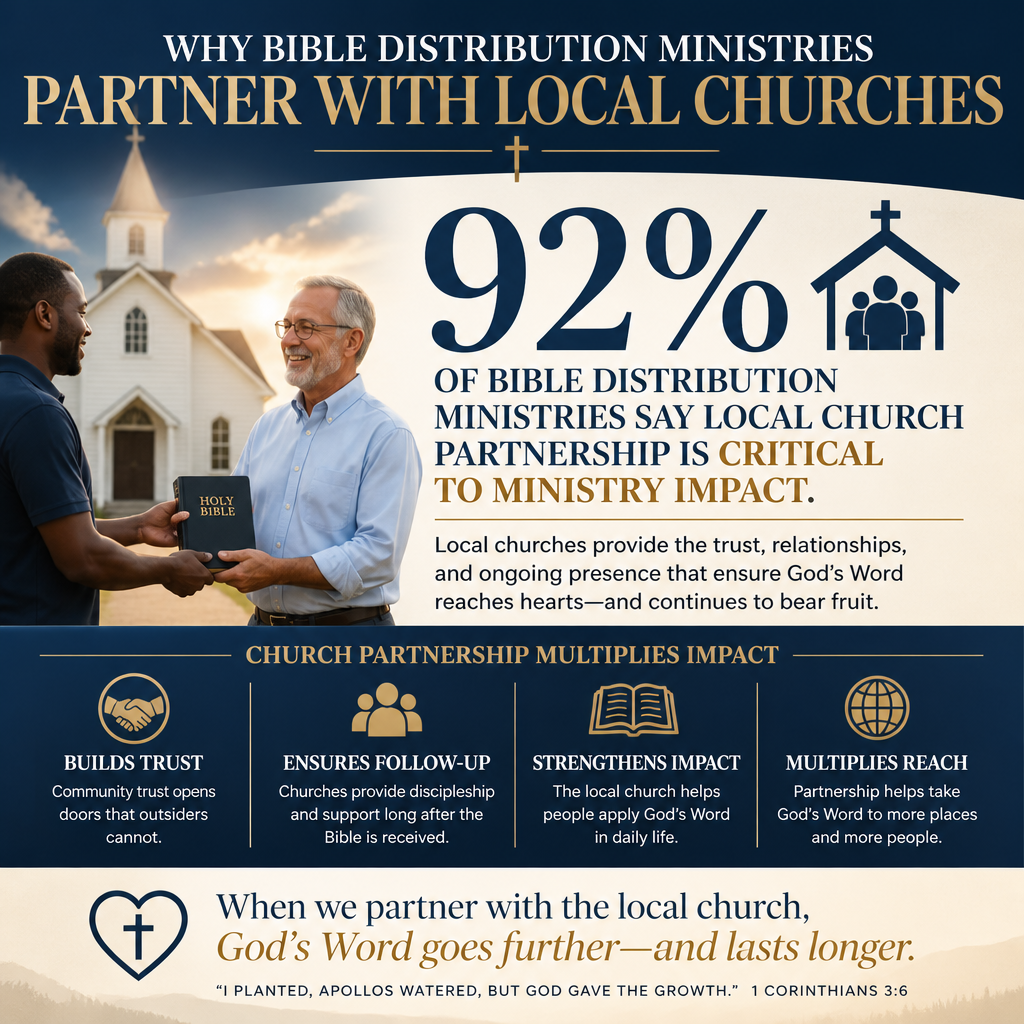
Church partnerships improve stewardship by aligning incentives and accountability
Counting Bibles is not the same as measuring ministry fruit
Bible distribution is unusually vulnerable to simplistic metrics. A donor can understand “10,000 Bibles delivered” in a way that is harder with “faithfulness in discipleship.” Yet Scripture itself cautions against confusing immediate activity with enduring fruit (1 Corinthians 3:6–7). When distribution ministries partner with churches, they place their work inside a setting where fruit is more visible: attendance, pastoral follow-up, teaching ministries, and the slow stabilization of a believing community.
The harder question is not whether Bibles arrived at a port or were handed to a contact person. The harder question is whether those Bibles are read, taught, and incorporated into the life of a congregation. Church-based distribution is not a guarantee of fruit, but it creates conditions where outcomes can be responsibly observed.
Local networks reduce the risk of diversion and resale
In many contexts, Scriptures are valuable commodities. That creates a predictable risk: diversion into secondary markets, “free” goods becoming revenue streams, or distribution shaped by local politics rather than pastoral need. Churches are not immune to these pressures. Still, a credible distribution ministry can often achieve better controls through local church networks than through anonymous channels, because a church has an identity to protect and relationships to maintain.
Across our verification work at Most Trusted, the ministries that meet The Most Trusted Standard tend to document how they mitigate diversion risk: clear chain-of-custody practices, localized verification, and policies for pricing when subsidized sales are used instead of free distribution. Mature donors should not treat these questions as cynical; they are ordinary stewardship in a fallen world.

- Clear criteria for recipient selection through local pastoral leadership
- Documented handoff processes and distribution logs
- Training for church leaders on responsible distribution and follow-up
- Policies that address resale, corruption, and political interference
- Feedback loops that allow churches to report gaps, misuse, or unmet demand
Partnership strengthens contextual discipleship rather than exported Christianity
The church is better positioned to match translation, literacy, and teaching
“Bible access” is not a single variable. Translation quality, dialect differences, reading levels, literacy, and local teaching traditions all affect whether a Bible can actually be received. A ministry headquartered in the West can make wise decisions, but local churches often know which translation is trusted, whether audio Scripture is necessary, and what complementary resources will help new readers learn the storyline of Scripture.
Literacy is a particularly important variable. UNESCO estimates that adult literacy worldwide is in the mid-80 percent range, leaving hundreds of millions of adults unable to read with ease, especially in rural areas and among women in some regions (UNESCO). In such settings, distributing printed Bibles without partnering with churches that can facilitate oral learning, audio Scripture groups, or basic literacy support may serve fewer people than donors assume.
Church-based distribution reduces cultural distortion
Christians have long debated the risks of cultural export in missions: when the gospel arrives wrapped in foreign assumptions about politics, economics, or social norms. Bible distribution has its own version of that risk. A model that privileges external decision-making can unintentionally define “success” in ways that fit donor expectations more than local realities.
Church partnership provides a partial corrective because churches are embedded in their communities and must live with the consequences of ministry decisions. They can discern how to distribute in ways that do not inflame local tensions, endanger new believers, or place undue burdens on women and children who may be targeted for possessing Christian materials.
For donors exploring the broader landscape of Bible Distribution Ministries, we maintain a central reference point that situates distribution within ecclesial and stewardship questions: Bible Distribution Ministries.
In high-risk contexts, churches provide relational security and pastoral cover
Security realities are not optional considerations
In restricted environments, a Bible can be both a source of life and a source of risk. Distributing Scriptures without careful local discernment can expose recipients to surveillance, confiscation, job loss, or violence. Some donors prefer not to think in these terms, yet serious partnership models must treat security as part of loving one’s neighbor.
Local churches are often best positioned to judge what is safe: whether to distribute publicly or privately, which households are prepared to bear risk, and how to embed distribution within existing patterns of Christian gathering. External ministries can contribute expertise and resources, but the church carries pastoral responsibility for the flock in that place.
Pastoral follow-up is a form of protection
When a person receives a Bible in a hostile context, the next questions matter: Where do we meet? How do we pray? What do we do if family members oppose faith? A distribution model that ends at delivery can leave new believers isolated. Churches can provide the relational infrastructure that helps a person endure and grow—often quietly, without public metrics.
Even in lower-risk settings, pastoral care remains essential. Many first-time Bible readers misunderstand genre, confuse covenantal contexts, or encounter hard passages that can destabilize faith when read alone. Churches can interpret Scripture in community, which is one reason God gives teachers to the church (Ephesians 4:11–13).
For donors, church partnership is a meaningful signal of credibility, but it still must be verified
“We work with local churches” can be true and still be vague
Nearly every ministry knows donors value local partnership, so the phrase appears in many appeals. The field has had to reckon with the difference between symbolic partnership and operational partnership. A ministry may distribute “through churches” while making all key decisions externally, offering minimal training, and providing little reporting back to the local body.
Responsible donors should ask for specificity: Which churches? Under what agreements? What training is offered? How is distribution tracked? What happens when a pastor reports misuse or pressure from local officials? Clarity here is not distrust; it is stewardship.
Verification should examine faithfulness and integrity together
At Most Trusted, we evaluate Christian nonprofits against The Most Trusted Standard, a 15-criteria framework covering faith commitments, financial integrity, governance, and evidence of transparency and effectiveness. For Bible distribution ministries, church partnership intersects with all of those areas. A ministry’s doctrine of the church shapes its model; its financial controls shape whether distribution is credible; its governance determines whether it can resist donor-driven pressure for inflated numbers.
Donors should also resist the simplistic “overhead” debate. The most respected evaluators have warned that judging organizations primarily by overhead ratios can mislead donors and pressure ministries to underinvest in systems that protect integrity (BBB Wise Giving Alliance). In Bible distribution, underinvestment in controls can mean diversion, inaccurate reporting, or avoidable risk to recipients.
What this means in practice is that the best question is not merely “Do they partner with churches?” but “Does their partnership model produce accountable distribution and church-anchored discipleship?” Those are related, but not identical.
Donors who want to understand how responsible distribution models operate across settings will find that these questions recur across the wider category of How Bible Distribution Ministries Reach the World.
FAQs for Why Bible distribution ministries partner with local churches
Is partnering with local churches always better than direct distribution?
Not always. In some emergency settings or where churches are very small, persecuted, or geographically sparse, direct distribution may be necessary as a first step. The more decisive issue is whether distribution is connected to accountable discipleship and pastoral care over time. When direct distribution is used, mature ministries typically build a plan for follow-up through local believers as soon as conditions allow.
What should donors ask a Bible distribution ministry about its church partnerships?
Donors should ask for specifics: how partner churches are selected; what training and expectations are in place; how distribution is tracked; what safeguards address diversion and coercion; and what evidence exists that recipients are being connected to Christian community. Where security permits, donors can also ask for examples of reporting from local church leaders and how the ministry incorporates feedback into future distributions.
Church partnership keeps Bible distribution ordered toward the church’s calling
Bible distribution ministries partner with local churches because Scripture is given not only to be possessed but to be heard, taught, obeyed, and embodied in a people. Partnership does not remove the need for careful verification, clear controls, and honest reporting. It does, however, align distribution with the ordinary means God uses to gather and mature his saints, which is the standard mature Christian donors should expect.



