

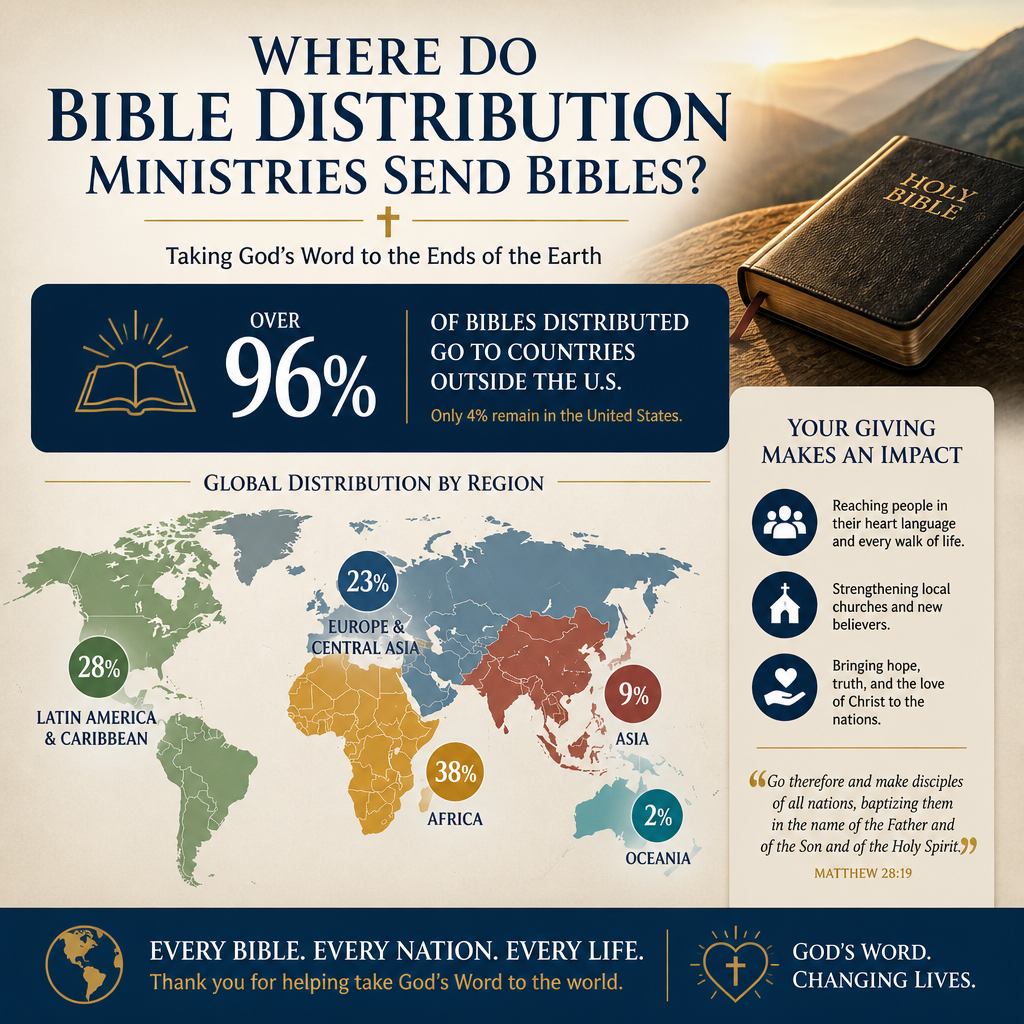
Where do Bible distribution ministries send Bibles? For Christian donors, the question is not idle curiosity. It is a stewardship question about logistics, strategy, and theological intent: whether the ministry is placing Scripture where people can actually receive it, read it, and gather under it as the people of God.
The answer is broader than many assume. Bibles move through formal shipping channels and informal networks, to public institutions and house churches, to refugee camps and prisons, to regions with functioning book markets and to places where possession can carry real risk. Mature Bible distribution work holds a simple conviction—“faith comes from hearing, and hearing through the word of Christ” (Romans 10:17)—and then wrestles with the practical realities of language, access, security, and local church partnership.
1. The map is shaped by language, access, and the local church
Scripture distribution follows the boundaries of comprehension
Most Bible distribution is not first a question of geography; it is a question of language. Ministries often begin with translation availability and literacy, then ask where existing church networks can responsibly receive and steward Scripture. The modern translation movement has made real progress, but the work is unfinished. As of recent reporting, thousands of languages still lack a full Bible, and many more lack any Scripture portion, which necessarily affects where printed Bibles can meaningfully be sent. The most reliable way to track this ecosystem is through the translation organizations that maintain global datasets, such as Wycliffe Global Alliance.
Where languages are present but literacy is limited, Bible distribution ministries may prioritize audio Scripture, literacy training, or Scripture engagement work alongside printed texts. This is not a retreat from the printed Bible; it is an insistence that “sending Bibles” includes ensuring real access to the Word.
Access is not only physical but political and social
Some of the most strategically important destinations are also the most complex: closed countries, regions with active conflict, and places where Christian minorities experience pressure. Bible distribution ministries operating in such contexts rarely publicize routes or end locations in detail, because disclosure can endanger recipients. Donors should not equate confidentiality with evasiveness; they should evaluate whether the ministry has credible controls, mature risk management, and accountable partnerships.
Many ministries use external assessments of religious freedom and persecution risk to inform their strategy. One widely used index is the annual reporting from Open Doors, which documents pressure and violence affecting Christians in many countries. We do not treat any single index as definitive, but reputable field reporting helps donors understand why some ministries cannot speak as openly as others about where shipments land.

2. Common destination channels include churches, prisons, and displaced communities
Local churches and training networks
The most straightforward and, often, most durable destination for Bibles is the local church: congregations, pastors, and church-planting networks that can distribute Scripture with teaching, discipleship, and community accountability. In practice, this may mean shipping bulk quantities to denominational hubs, seminaries, or regional church associations, then distributing through known leaders.
Donors should expect to see evidence that the ministry is not merely delivering books but serving the church’s formation: pastor training partnerships, follow-up plans, Scripture engagement resources, and reporting that shows how Bibles are stewarded after arrival.
Prisons, jails, and reentry ministries
Another major channel is correctional ministry. Facilities frequently allow Bibles and Christian literature even where other religious materials face stricter controls, and chaplaincy programs can provide organized distribution. The United States illustrates the scale of the need: the prison and jail population remains large by global standards, with millions cycling through incarceration each year. For baseline context on U.S. incarceration levels, donors can consult the Bureau of Justice Statistics.
Here, Bible distribution intersects with pastoral care, trauma, and reentry support. Many ministries pair Bible provision with correspondence courses, mentoring, and post-release church connection. The distribution point is important, but so is the ecosystem that helps a person remain in the Word when the institution is no longer structuring the day.
Refugee and displaced populations
Displacement creates both openness and vulnerability: people lose community structures and may be newly receptive to hope, while also facing exploitation and instability. Bible distribution ministries often work through humanitarian partners, local churches near camps, and diaspora congregations. These settings also raise hard questions about consent and coercion. Donors should look for ministries that make clear distinctions between unconditional aid and voluntary spiritual engagement, and that respect host-country laws and the dignity of displaced persons.
For donors tracking the global displacement landscape, UNHCR provides comprehensive reporting on refugee and internally displaced populations.
3. Some Bibles are shipped openly, others move through sensitive pathways
Open distribution in stable environments
In many countries, Bible importation is ordinary commerce. Ministries may ship containers to national warehouses, work with customs brokers, and distribute through bookstores, churches, and conferences. In these contexts, the stewardship question often centers on cost efficiency, local market effects, and whether free distribution unintentionally undercuts local Christian publishers.
Christians genuinely disagree about the best approach here. Some argue that free Bibles are an urgent mercy for the poor. Others argue that long-term health may require supporting local publishing and retail ecosystems so Scripture remains available without outside subsidy. Wise ministries can articulate why they choose one approach in a given setting, and how they mitigate harm.
Sensitive distribution where possession carries risk
In other environments, Bible distribution requires discretion. The issue is not romanticism about secrecy; it is protection of local believers and leaders. Practices vary: discreet hand-carry distribution by vetted travelers, micro-distribution through trusted house church networks, or the use of digital Scripture where print is difficult to move. These approaches raise governance and accountability concerns for donors, because normal documentation can be limited.
This is where verification becomes particularly valuable. Across our work at Most Trusted, we see stronger ministries doing three things in sensitive contexts: (1) they maintain clear internal controls even when external disclosure is constrained, (2) they have accountable local partnerships rather than personality-driven channels, and (3) they provide donors with a credible explanation of what can and cannot be reported without endangering others.
4. The harder question is whether Bibles arrive with integrity and follow-through
Distribution can be sincere and still be ineffective
Counting shipped Bibles is not the same as ensuring received Bibles. Donors have learned, sometimes painfully, that international shipping can produce impressive numbers while masking waste, diversion, or misalignment with local need. A container can be “delivered” and still sit in a warehouse, be resold in a market, or be distributed without any plan for church connection.
Quality Bible distribution ministries think in terms of chain-of-custody, contextual demand, and downstream engagement. The goal is not only to place Scripture in someone’s hands, but to make it plausible that the person will be able to read it, understand it, and be gathered into the life of the church.
What donors should look for in reporting
The most credible reporting does not rely on inflated stories. It provides a consistent picture of where Bibles go, how partners are vetted, and how the ministry learns from failures. Practical indicators include shipping documentation where appropriate, partner agreements, post-distribution audits in lower-risk settings, and a theology of ministry that refuses to separate “getting Bibles out” from forming disciples.
We recommend donors read Bible distribution reporting with the same seriousness Scripture applies to stewardship. Jesus’ teaching assumes that accountability is not optional for those entrusted with resources (Luke 16:10–12). Transparency is not a marketing preference; it is a moral obligation shaped by the fear of the Lord.
- Clarity on destination categories (churches, prisons, schools, refugees) rather than vague “worldwide” claims
- Partner vetting processes that are specific and repeatable
- Evidence of follow-through such as Scripture engagement, training, or church connection
- Honest limits on what can be publicly disclosed in restricted contexts
- Controls against diversion including audits or spot checks where feasible
Donors who want a broader view of the ecosystem can explore How Bible Distribution Ministries Reach the World, where we address common operational models and recurring integrity questions.
5. How Most Trusted assesses Bible distribution claims
The Most Trusted Standard and what it tests
Most Trusted exists because donors deserve more than reassurance. We evaluate Christian nonprofits against The Most Trusted Standard, a 15-criteria framework that examines faith commitments, financial integrity, governance and leadership, and transparency and effectiveness. For Bible distribution ministries, this includes the specific question donors are asking here: not merely where Bibles are intended to go, but whether the ministry can substantiate where they actually go.
In practice, stronger ministries tend to show coherence between theology and operations. They treat local believers as partners rather than endpoints. They account for the real costs of translation, printing, shipping, and customs. They acknowledge contextual risks without using risk as a shield from accountability.
A mature theology of distribution resists two temptations
The first temptation is triumphalism: assuming that volume alone is a proxy for faithfulness. The second is cynicism: assuming that because misuse is possible, the entire enterprise is suspect. Scripture calls the church to neither posture. The Word of God is living and active (Hebrews 4:12), and Christian stewards are accountable for how resources are managed in service of that Word.
What this means for donors is straightforward. We can honor bold gospel ambition while still asking for evidence. We can celebrate access to Scripture while still insisting on integrity. Those instincts are not in tension; they are mutually reinforcing.
For related research and verified perspectives across the field, readers can also consult Bible Distribution Ministries.
FAQs for Where do Bible distribution ministries send Bibles
Do Bible distribution ministries send Bibles to schools?
Some do, particularly where Christian schools, seminaries, or public institutions explicitly allow religious texts. In many settings, ministries focus on churches and church leaders rather than public schools, both to respect legal constraints and to ensure Scripture is paired with teaching and discipleship. Donors should look for clear policies that distinguish between church-based education and public institutions, and for reporting that shows how permissions are obtained and documented.
How can donors know Bibles are not being resold or diverted?
No ministry can eliminate risk entirely, especially in complex supply chains. Responsible ministries reduce risk through partner vetting, written distribution agreements, periodic audits where feasible, and reporting that is consistent over time rather than driven by isolated stories. Where public detail is limited for security reasons, donors can still ask whether the ministry has board oversight, internal controls, and credible third-party financial review consistent with The Most Trusted Standard.
Giving with confidence requires more than a destination list
Bible distribution ministries send Bibles to churches, prisons, displaced communities, and many other channels shaped by language, law, and local partnership. The more decisive question for Christian donors is whether those destinations are served with integrity: whether Scripture is delivered in ways that protect believers, strengthen the church, and withstand scrutiny. That is the kind of confidence Most Trusted exists to support, so that generosity can be both earnest and well-governed.



