
How Bible distribution ministries reach the world is not primarily a question of logistics. It is a question of ecclesiology, stewardship, and spiritual realism: how the church carries the Word of God across languages, borders, and pressures without confusing quantity with fruit. Donors often feel the weight of the moment—gospel need is vast, attention is fragmented, and the public trust environment for nonprofits is strained. The wise response is neither cynicism nor sentimentality, but disciplined generosity anchored in truth.
Scripture gives the church both mandate and method. The Great Commission is inseparable from Jesus’ command to teach disciples “to obey everything I have commanded you” (Matthew 28:20). Bible distribution is one way the church serves that teaching work, placing Scripture where the Spirit ordinarily uses it—read, heard, preached, translated, and obeyed. Yet the same Bible that compels generosity also commands discernment: “test the spirits” (1 John 4:1) and “be wise as serpents and innocent as doves” (Matthew 10:16). Mature donors ask not only where Bibles go, but how they arrive, who receives them, and what accountable partnership looks like over time.
Distribution is a supply chain and a discipleship strategy
The public picture of Bible distribution is often a container ship, a cargo plane, or a box of printed New Testaments. Those are real tools, but serious ministries operate with a broader theory of change: Scripture in the hands of local believers, embedded in local church life, supported by translation and literacy, and protected by prudent risk management. The difference matters, because “sending Bibles” can become a substitute for more demanding, slower work—training pastors, strengthening congregations, and ensuring Scripture is understood within the whole counsel of God.
Across our verification work at Most Trusted, ministries that meet The Most Trusted Standard tend to articulate distribution as part of a coherent ecosystem: translation when needed, production matched to language and demand, local church channels for delivery, and follow-through that can be evidenced rather than merely asserted. Donors should expect clarity on the ministry’s assumptions: Is the aim initial access, ongoing supply for churches, emergency replacement after loss, or equipping for evangelism and discipleship?
Scripture access is uneven, and language still defines the frontier
The world is not “reached” evenly. In some regions, Bibles are inexpensive and plentiful; in others, legal restriction, poverty, and language barriers make access fragile. The translation landscape illustrates the point. The remaining gap is not only about printing capacity, but about languages where people cannot read Scripture because it does not yet exist in the language they actually speak at home. For donors, this is where strategy often begins.
For example, progress and remaining need are commonly tracked by organizations that coordinate translation work across traditions. As of recent reporting, a large portion of the world’s languages still lack a full Bible, while many have some Scripture portions but not the complete canon. Donors looking for sober, field-level data often begin with the global translation status maintained by organizations such as Wycliffe Global Alliance (Wycliffe Global Alliance).
Closed contexts require operational discipline, not theatrics
In restricted environments, the moral temptation runs in both directions: either to romanticize risk for fundraising, or to downplay risk in a way that endangers local believers. The ministries worthy of trust treat security as pastoral care. They avoid unnecessary exposure of partners, refrain from publishing identifying details, and build distribution methods that fit the local church’s realities.
Donors should expect hard questions to be welcomed: How do partners assess surveillance risks? What training is provided for safe storage and discreet distribution? What is the plan when shipments are seized or local leaders are pressured? Mature answers rarely make for dramatic marketing, but they are often the difference between sustainable ministry and avoidable harm.
Where ministries send Bibles and why those decisions are contested
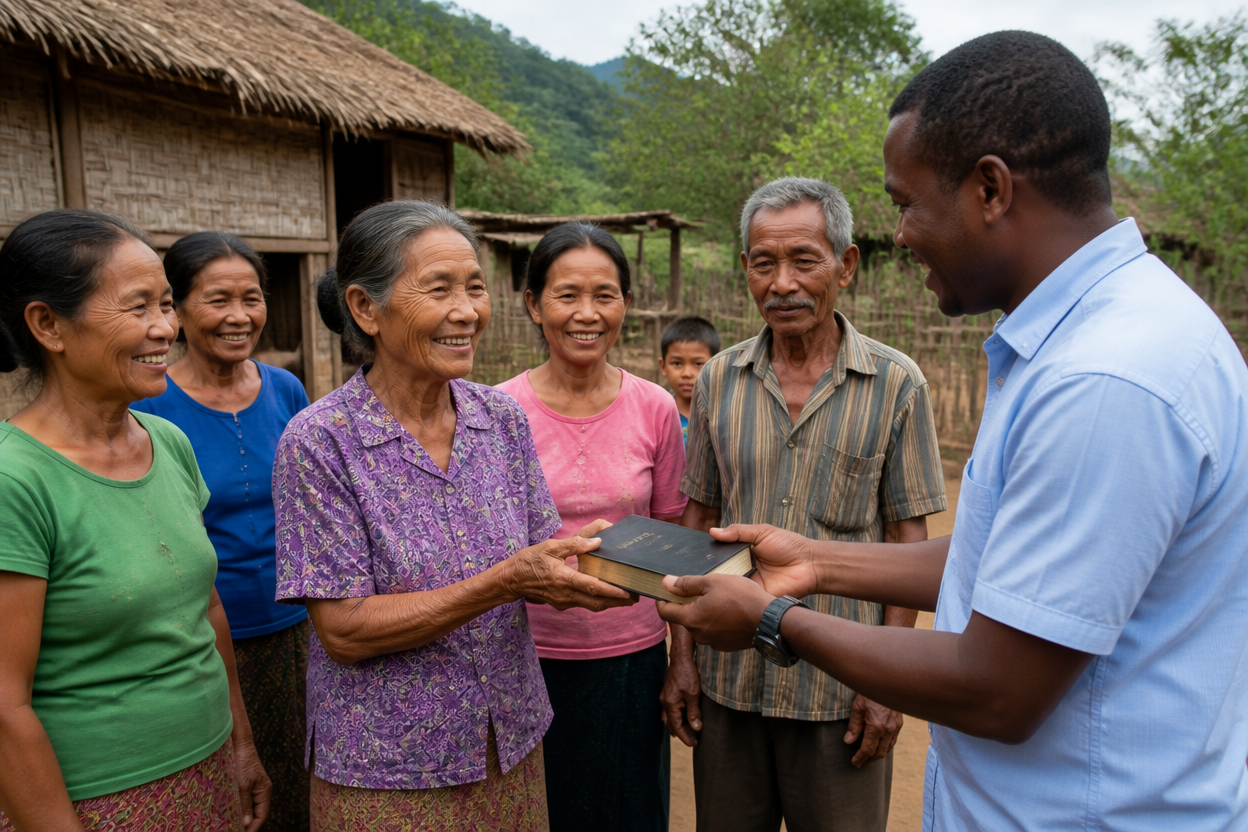
Choosing target countries is not a simple map exercise. Christians genuinely disagree about priority: unreached people groups versus areas with existing church networks, refugee corridors versus long-term community development, urban centers versus rural regions. Some donors want maximum “gospel marginal impact.” Others prioritize strengthening persecuted believers. Still others focus on children and youth. The field has had to reckon with the reality that different goals require different channels and different accountability measures.
Responsible targeting typically combines several inputs: church-request signals from local leaders, legal constraints, language readiness, shipping feasibility, and the presence of trusted in-country distribution capacity. Ministries that operate with integrity document their decision logic rather than treating “need” as self-evident. Needs are real; prioritization is the question.
Request-driven distribution and the authority of local churches
One of the most important markers of health is whether distribution is fundamentally request-driven and church-anchored. When local churches ask for Scripture for new believers, for preaching, or for children’s ministry, distribution becomes a service to the church rather than an external program imposed upon it. That posture aligns with the New Testament’s pattern of honoring local leadership, even amid weakness and hardship.
This is also where donors can guard against a subtle but common distortion: treating the Bible as a standalone “product drop” rather than as the living Word entrusted to a people who read it in community. A ministry that can name its church partners, describe how requests are validated, and explain how Scripture is used after delivery is generally working from a more defensible theology of the church.
Crisis regions and the difference between urgency and opportunism
Wars, disasters, and displacement create real spiritual and material crises, and Scripture can be a profound means of comfort and endurance. But crisis also creates a fundraising environment in which speed is rewarded and verification is neglected. Donors should distinguish between ministries that have pre-existing networks and those that appear only when cameras arrive.
When ministries respond well in crisis regions, distribution is usually integrated with local pastoral care: chaplaincy, trauma-informed discipleship, and coordination with churches and relief actors already serving. That integration helps prevent a familiar harm: treating suffering communities as an audience rather than as neighbors. For donors who want a sober view of the global displacement context, the UN Refugee Agency provides ongoing reporting on forced displacement levels and trends (UNHCR).
How Bibles physically move and what safe delivery requires
Distribution methods vary by context. In open countries, ministries may ship pallets to established church networks, Bible societies, or denominational hubs. In fragile states, smaller shipments may move through regional warehouses or be carried in discreet quantities. In restricted contexts, believers may rely on small-scale, relational distribution that avoids patterns likely to be flagged. Each method has trade-offs in cost, speed, security, and stewardship.
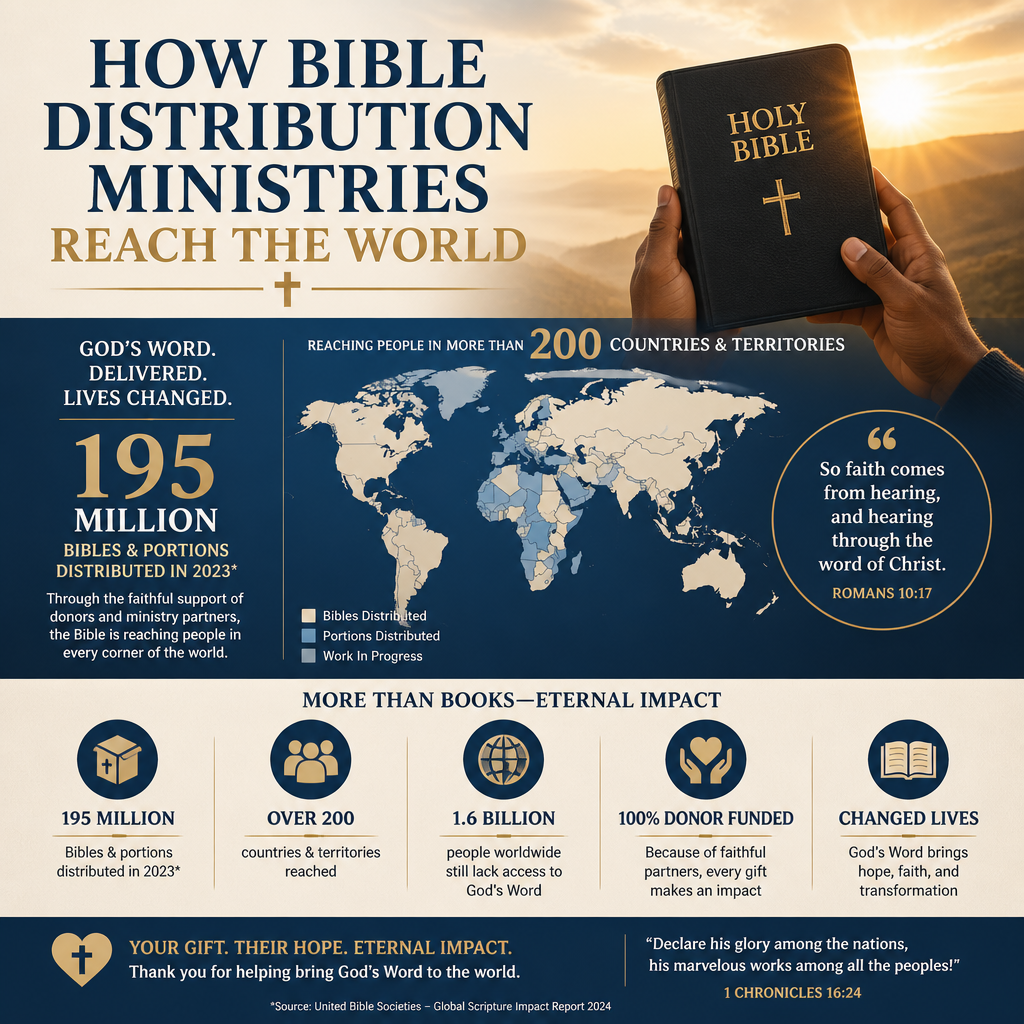
Donors sometimes assume that “more direct” is always better. In practice, the safest and most accountable route is often through carefully selected intermediaries who can document receipt, manage storage, and ensure Scripture is distributed without coercion or resale. The question is not whether a method sounds heroic, but whether it reduces risk to local believers and increases confidence that Bibles reach intended recipients.
Printing and shipping versus local production
Physical production decisions are frequently misunderstood. Shipping printed Bibles from donor countries can be appropriate when local capacity is absent or when economies of scale meaningfully reduce cost. Yet local or regional printing can shorten supply chains, reduce customs complications, and support contextual formats (bindings, paper quality, font sizes, study helps) that match local needs.
Donors should ask for the reasoning: Why print here rather than there? How are vendors selected? Is there competitive bidding? Are there controls to prevent conflicts of interest? In ministries that align with The Most Trusted Standard, procurement practices are usually documented, and the ministry can explain why its approach is both financially prudent and contextually wise.
Digital Scripture is real access, but not a universal substitute
Smartphone access has changed the distribution conversation. Digital Scripture can move instantly, bypass shipping, and reach diaspora communities in ways paper cannot. Yet digital access is not evenly distributed; it can be surveilled; and it depends on electricity, data costs, device access, and literacy. In some contexts, a printed Bible is still the safest, most shareable, least fragile technology.
For donors, the correct frame is not “print versus digital,” but “appropriate access for this people in this place.” Mature ministries typically use both, while being clear about the pastoral realities that make one format more faithful in a given context.
What donors should evaluate before funding global distribution
Christian donors give under God, not under marketing. That conviction leads to practical due diligence. The stronger question is not whether a ministry can move a large number of units, but whether it can demonstrate responsible stewardship of money, truthfulness in reporting, and faithfulness to the church. The modern donor environment has been shaped by real scandals in the wider nonprofit sector, and donors are right to demand evidence.
At Most Trusted, we exist to help donors give with confidence by evaluating Christian nonprofits against The Most Trusted Standard, a 15-criteria framework across Faith Foundation, Financial Integrity, Governance and Leadership, and Transparency and Effectiveness. When donors are considering Bible distribution work, those criteria become especially concrete: doctrinal clarity, audited financials, independent board governance, truthful impact claims, and verifiable distribution practices.
Transparency about impact is more than counting shipments
Counting Bibles is not meaningless, but it is not synonymous with discipleship. Ministries should be careful not to imply that distribution guarantees conversion or church growth, because Scripture itself distinguishes between sowing and harvest, and because spiritual fruit is ultimately God’s work. What can be measured responsibly is whether Bibles were delivered as claimed, whether recipients were identified through credible channels, and whether local partners report use consistent with the ministry’s purpose.
Donors should also reward honesty about limits. In closed contexts, for example, ministries may not be able to provide granular public reporting without endangering people. The correct response is not to abandon accountability, but to require alternative forms of verification: third-party audits, secure documentation reviewed privately, and governance structures that can credibly oversee sensitive work.
Partnership models reveal theology and risk posture
Why ministries partner with local churches is not merely pragmatic. It is theological. The church is Christ’s appointed instrument for proclamation, baptism, teaching, and discipline. Distribution that bypasses the church tends to create isolated readers without a community of interpretation or care; distribution that serves the church tends to strengthen preaching, catechesis, and pastoral formation.
Partnership also distributes risk. When a ministry depends on a single charismatic in-country gatekeeper, donors should be cautious. When it works through multiple accountable church networks with documented controls, the ministry is often more resilient and less vulnerable to fraud or coercion.
For readers evaluating organizations in this space, our work on Bible Distribution Ministries provides a framework for thinking about verification questions that are specific to Scripture access efforts.
Faithful reach is measured by truth, not by spectacle
How Bible distribution ministries reach the world is ultimately a question of whether they honor the Word they distribute. Faithful reach is not theatrical. It is patient translation work, careful production, disciplined security, credible local partnership, and truthful reporting to the church that funds it. Donors can insist on that standard without becoming suspicious or ungenerous.
Christian stewardship is meant to be both confident and discerning: confident because the Word of God does not return empty, discerning because “it is required of stewards that they be found faithful” (1 Corinthians 4:2). The ministries most worthy of support tend to be those that can show, with evidence and humility, how Scripture moves from press to pulpit to people in ways that strengthen Christ’s church.



