

When Christian donors ask how do Bible distribution ministries use donations, they are usually asking a deeper stewardship question: what actually happens between the gift and a Bible placed in someone’s hands. The answer is not a single line item. Most Bible distribution work is a chain of costs, decisions, and partnerships that can either honor the church’s mission or quietly erode it.
Scripture treats the handling of resources as a spiritual matter, not mere administration. Paul’s collection for the saints was governed by a concern “that no one should blame us about this generous gift” and by the practice of sending approved brothers to carry it (2 Corinthians 8:20–21). The principle is enduring: faithful ministry requires both gospel purpose and demonstrable integrity.
Donations usually fund a full pathway from acquisition to access
Bibles are often subsidized rather than simply purchased
A common misunderstanding is that Bible distribution is mostly the cost of printing. In practice, many ministries are underwriting access. That may mean purchasing Scripture portions at negotiated rates, funding translation work, or paying for formats that match local literacy and context, such as audio Scripture, large print, or study editions for pastors.
The field also includes multiple “last mile” models. Some ministries ship containers of printed Bibles; others equip churches to distribute locally; others combine Scripture with trauma care materials, prison programming, or discipleship groups. The donor question is not whether a ministry “prints Bibles,” but whether its approach credibly moves Scripture from availability to use.
Core expenses often look ordinary because the work is operational
Bible distribution is frequently a logistics discipline wrapped in a theological mandate. Warehousing, freight, customs compliance, in-country transport, and inventory controls are rarely inspirational, but they determine whether Bibles arrive on time, arrive legally, and arrive without diversion.
Where ministries serve restricted or high-risk contexts, the pathway can include security training, data protection, and careful partner vetting. Those costs can be appropriate. What donors should resist is opacity. A ministry should be able to explain, in plain terms, what it funds and why those expenses are necessary for faithful access.

Printing and production are real costs, but not the only material ones
Paper, binding, and quality control affect longevity and stewardship
The cheapest Bible is not always the most responsible choice. Low-quality paper and binding can mean rapid deterioration in climates with humidity, heat, and heavy use. A Bible that falls apart within a year can become a recurring cost borne by donors and churches.
Quality control also matters because errors in formatting, missing pages, or poor readability undermine trust and use. Mature organizations treat production as a stewardship decision: the goal is not minimal cost but faithful durability aligned to context.
Translation and licensing can be significant and morally weighty
Translation is not only linguistic; it is theological. Donors should expect ministries funding translation to describe their translation philosophy, oversight, and doctrinal accountability. In addition, licensing arrangements can affect whether a translation can be printed locally, distributed digitally, or used in discipleship materials without friction.

The donor’s question becomes: does the ministry pursue access with integrity, and does it respect the local church’s need for Scripture that is both understandable and faithful?
Distribution requires governance, controls, and credible local partnerships
“Last mile” distribution is where both impact and risk concentrate
The most sensitive point in Bible distribution is the handoff: from container to community, from shipment to shepherd. That is also where risks concentrate—diversion into resale markets, favoritism, political capture, or well-intentioned chaos that overwhelms local leaders.
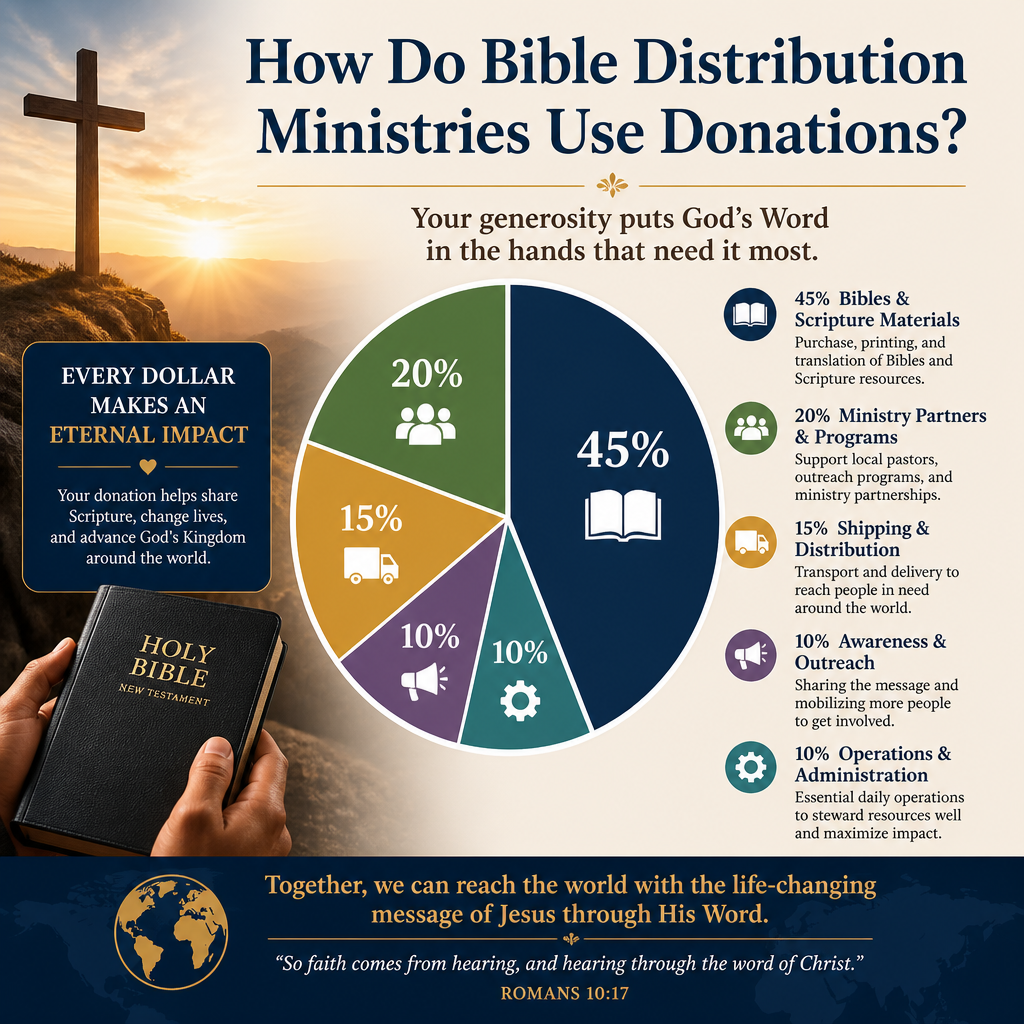
Ministries with mature controls treat distribution as accountable ministry, not merely generosity. They can explain how they select partners, how they document deliveries, and how they prevent misuse without imposing burdens that undermine local dignity and agency.
Sound models honor the local church rather than bypass it
Christians genuinely disagree about the best delivery model in every setting, particularly where the church is small, persecuted, or fragmented. Yet a consistent principle holds: Scripture distribution should strengthen the church’s ministry rather than replace it. The healthiest approaches usually involve local pastors, trusted networks, and clear expectations about how materials will be used.
Donors evaluating this work will often benefit from stepping back to the broader ecosystem of Bible Distribution Ministries and asking where a specific organization fits: translation, printing, logistics, church equipping, digital access, or integrated discipleship.
Overhead is not the enemy, but secrecy and misaligned incentives are
The overhead question is better framed as accountability and capacity
Many donors have been trained to equate low “overhead” with faithfulness. The nonprofit field has had to reckon with the fact that this instinct can punish the very capacities that prevent failure: financial controls, safeguarding policies, cybersecurity, and competent leadership. Charity Navigator, Candid, and the BBB Wise Giving Alliance publicly argued that overhead ratios are a poor standalone measure of nonprofit performance in their joint “Overhead Myth” statement.Charity Navigator
For Bible distribution, capacity is not optional. If a ministry ships internationally, it needs compliance and documentation. If it operates in sensitive regions, it needs risk management. If it handles donor-restricted gifts, it needs accounting discipline that can withstand scrutiny.
Donor restrictions and “cost per Bible” claims require careful reading
“$X puts a Bible in someone’s hands” is not automatically misleading, but it is often incomplete. Sometimes it reflects only print cost, excluding freight and in-country distribution. Sometimes it assumes a particular edition or destination. Sometimes it is a genuine blended average across multiple programs.
We recommend treating cost claims as prompts for questions rather than as proof of effectiveness. The more a ministry relies on simplified unit-cost marketing, the more donors should ask for definitions and reconciliation to audited financials.
- What does the stated cost include and exclude?
- Is the figure tied to audited financial statements or internal estimates?
- Are Bibles given free, subsidized, or sold at a local price point?
- How does the ministry prevent diversion or resale where that risk is known?
- How does it confirm that distributions align with local church leadership?
What trustworthy reporting looks like under The Most Trusted Standard
Evidence should connect money, activity, and spiritual purpose
Donors are right to expect more than inspirational stories. Scripture does not reduce ministry to metrics, but it does require honesty. A credible Bible distribution ministry should be able to connect the dots between donations received, Bibles produced or procured, distribution activities completed, and the partnerships that make use plausible.
Across our verification work at Most Trusted, the ministries that meet The Most Trusted Standard tend to publish clear financials, define programs precisely, and describe controls without theatricality. They do not treat transparency as marketing; they treat it as stewardship before God and neighbor.
Healthy transparency names limitations and avoids inflated spiritual causality
Bible distribution has to resist two equal errors: treating the Bible as a mere commodity, and treating distribution counts as a proxy for discipleship. The ministry can count what it distributes; it cannot count conversions with the same certainty. Mature reporting distinguishes outputs from outcomes, and it avoids implying that a shipped Bible is the same as a read Bible, much less a formed disciple.
Many donors also want to understand how a ministry handles digital distribution, which can extend access dramatically but introduces questions of security, censorship, and unintended exposure. A serious organization will explain its risk posture, not merely celebrate reach.
Donors who want to apply consistent discernment across organizations often benefit from comparing ministries within How to Give Wisely to Bible Distribution Ministries, where the core questions of integrity, governance, and effectiveness become clearer when viewed side by side.
FAQs for How do Bible distribution ministries use donations
Do Bible distribution ministries usually give Bibles away for free?
Many do, especially in low-income settings or where access is constrained. Others use cost-sharing, selling at a modest local price through churches or book tables to support sustainability and reduce resale incentives. The most important question is not “free versus sold,” but whether the model fits the local context, honors the church, and is explained transparently in financial reporting.
Should donors prioritize the lowest cost per Bible?
Not by itself. Low unit costs can reflect genuine efficiency, but they can also exclude critical components such as freight, partner training, safeguarding, or follow-up discipleship resources. The better approach is to ask what is included, how the figure reconciles to audited statements, and what controls protect the integrity of distribution. The goal is faithful access, not merely inexpensive activity.
Stewardship requires asking what the gift truly funds
Bible distribution is a holy ambition carried out through ordinary means: contracts, shipping routes, partner agreements, and accountability systems. Donations can fund genuine access to Scripture, or they can fund an attractive story with insufficient controls. Mature Christian giving insists on more than good intentions. It asks whether the ministry’s financial life is worthy of the gospel it seeks to proclaim.



