
What Bible distribution ministries do in closed countries is rarely visible to the donors who fund the work, and that is not an accident. In many settings, public visibility is not a mark of effectiveness but a threat to local believers, local partners, and the long-term presence of the gospel.
Christians have always had to translate the command to “make disciples of all nations” into concrete, sometimes costly practice (Matthew 28:19–20). Where governments restrict Christian activity, Bible distribution becomes a discipline of wisdom as much as zeal: a set of choices about security, stewardship, local ownership, and truthfulness that must be made under pressure.
Closed countries create ministry constraints donors rarely see
Restricted access changes the meaning of ordinary logistics
In open contexts, distributing Scripture can look like procurement, shipping, warehousing, and public handoff through churches. In closed countries, those same tasks become a security problem. Borders are monitored, communications are surveilled, and association can be criminalized. The closer a distribution plan resembles a Western nonprofit supply chain, the easier it is to map, disrupt, and prosecute.
Most ministries therefore design distribution around small batches, redundant pathways, and local networks that do not require a single visible “center.” This is not romantic, and it is not always efficient in the short term. It is a practical response to real threat, including arrest, confiscation, deportation, and the social penalties borne by converts and their families.
Legal and ethical lines are not identical everywhere
Closed countries are not uniform. Some restrict Christian publishing but tolerate private possession. Others restrict proselytism while allowing registered churches. A subset criminalizes conversion itself. Ministries must decide what faithfulness looks like in each environment: how to honor governing authorities where possible (Romans 13:1) while refusing to treat Christ’s lordship as negotiable (Acts 5:29).
Christians genuinely disagree about tactics, especially when distribution involves operating without official permission. The harder question is not whether the Word should go forth, but what methods respect the dignity and agency of local believers rather than making them the expendable edge of a foreign strategy.
What Bible distribution ministries actually do on the ground
They translate, format, and produce Scripture for real readers
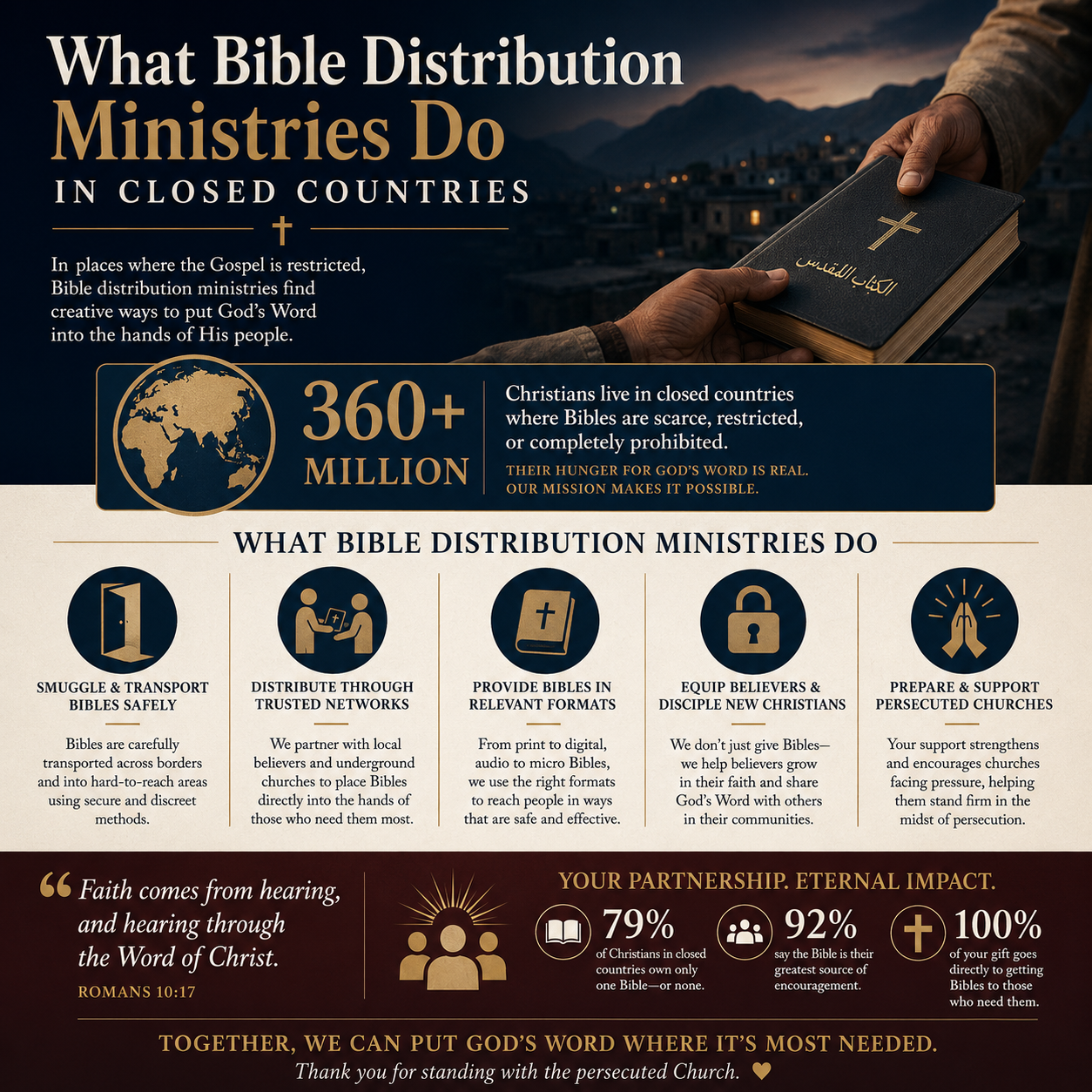
Distribution begins long before a Bible is handed to a new believer. Many closed contexts are multilingual, and the “heart language” of a community may not match the national language taught in schools. Ministries often invest in translation, revision, typesetting, and the production of formats people can safely use: small-print editions, portions, audio Scripture, or discreet digital files.
Across the global translation community, the remaining need is substantial. More than three billion people still lack the full Bible in their primary language, according to Wycliffe Bible Translators. Donors should understand that “distribution” frequently includes the less visible work of making Scripture accessible, accurate, and durable for the next decade, not merely the next shipment.
They move Scripture through relationships, not campaigns
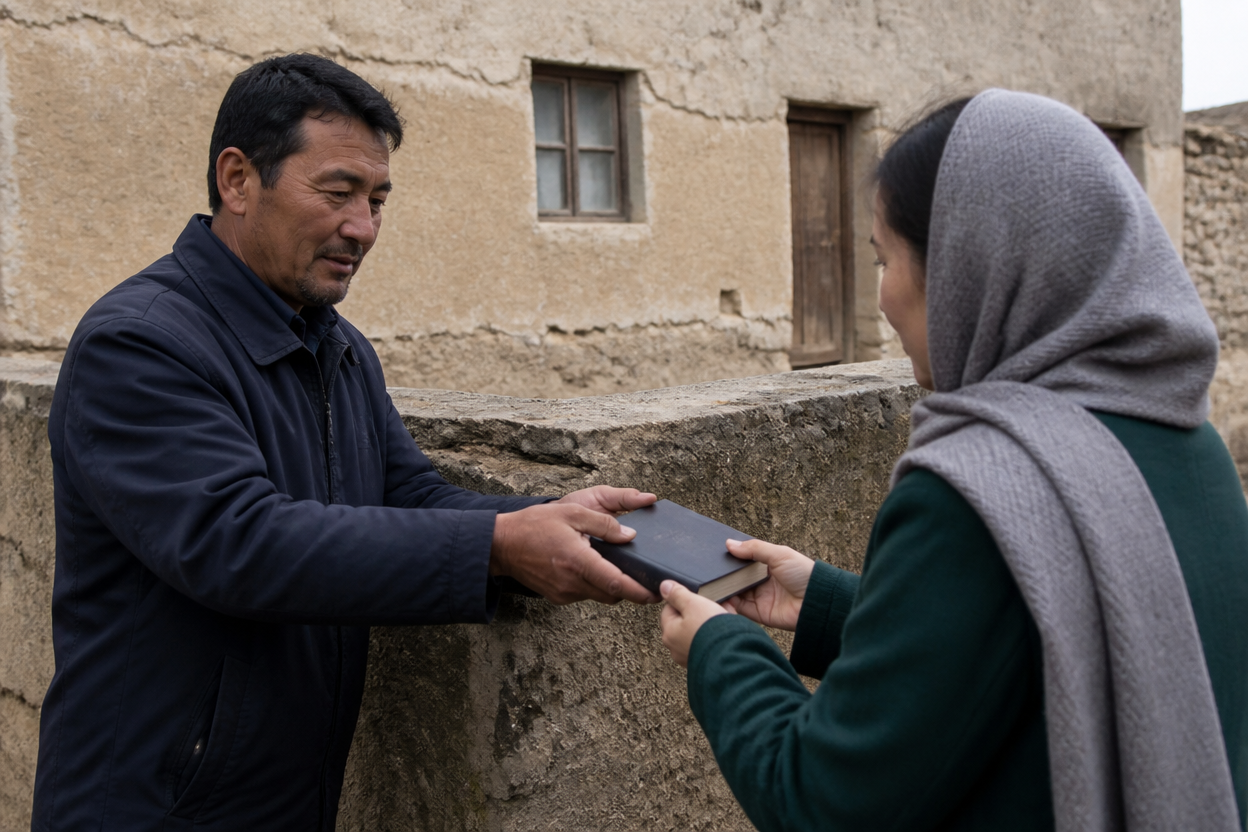
In closed countries, Scripture typically travels at the speed of trust. Local pastors, small-group leaders, diaspora believers, and discreet social networks become the channels. Ministries may train local believers in safe handling, small group Scripture engagement, and trauma-aware discipleship—because receiving a Bible is often the beginning of risk, not the end of it.
Some ministries work through business-as-mission models or humanitarian programs where Christian presence is tolerated. Others support indigenous church networks that already exist. The distinctive feature is not a flashy method; it is the quiet discipline of protecting people while refusing to reduce them to distribution statistics.
- Context-specific translation and revision for local languages and dialects
- Discreet production choices: size, cover, labeling, and packaging
- Multiple distribution paths rather than a single centralized route
- Training for local believers in security, storage, and Scripture engagement
- Follow-up discipleship resources that do not depend on public gatherings
Donors who want a broader map of this ministry category can begin with Bible Distribution Ministries, where we track patterns donors should recognize across organizations working in high-risk contexts.
Security, truthfulness, and accountability in high-risk environments
Secrecy can be necessary, but it can also become a shield against scrutiny
Closed-country work requires confidentiality. Names, locations, photos, and travel details can expose believers to harm. Yet donors have a legitimate concern: confidentiality can be used to avoid accountability. Serious ministries do not treat those tensions lightly. They build internal controls that allow meaningful oversight without publishing operational details that would endanger others.
Across our verification work at Most Trusted, we observe that ministries worthy of confidence differentiate between “cannot disclose publicly” and “cannot disclose to qualified reviewers under appropriate safeguards.” A mature organization can provide audited financials, board oversight records, and documented program logic while still protecting field partners.
Measuring effectiveness must respect the people being served
In a closed country, the metrics donors often ask for—precise locations, named partner churches, photos of recipients—can be irresponsible. At the same time, donors should not be asked to fund work that cannot be evaluated at all. Credible ministries measure outcomes in ways that do not expose individuals: anonymized distribution records, independent third-party confirmations, and longitudinal indicators of Scripture engagement and discipleship where feasible.
Some donors have absorbed a simplistic expectation that “more Bibles” automatically equals “more mature churches.” The field has had to reckon with the reality that distribution without discipleship, or without local leadership development, can produce shallow access rather than enduring formation. Scripture is never a mere commodity; it is given to form a people.
How funding works when access is restricted
Costs and timelines are often higher than donors assume
Closed environments are expensive and slow. Safe travel routes may add time. Redundant channels may add cost. Printing locally may be cheaper but may carry political risk; importing may be safer for quality control but riskier at borders. Ministries also face currency volatility, customs disruption, and sudden policy shifts.
Donors should resist the instinct to treat overhead ratios as a primary proxy for faithfulness. The nonprofit sector has explicitly warned against that reduction. Charity Navigator, BBB Wise Giving Alliance, and GuideStar jointly argued that focusing on overhead can mislead donors and harm nonprofit effectiveness, in their “Overhead Myth” statement hosted by Charity Navigator. In closed-country work, competent security planning, staff training, legal review, and careful finance systems are not distractions from mission; they are part of stewarding lives and resources.
Partnership models shape both risk and fruit
Many Bible distribution ministries do not “run programs” in the way donors picture. They fund and supply networks they do not control in a managerial sense. That can be a strength: local believers retain agency, contextual wisdom, and long-term presence. It can also create vulnerability: funds can be harder to trace, reporting can be uneven, and governance failures can be concealed behind distance.
What this means in practice is that donors should evaluate not only passion and stories, but also the quality of partnership due diligence. A ministry’s theology of the church should show up in its posture toward local leaders—neither paternalistic control nor hands-off romanticism, but accountable collaboration.
For donors assessing the range of approaches and common trade-offs, How Bible Distribution Ministries Reach the World provides additional context on how organizations adapt methods across cultures and risk profiles.
How donors can give with confidence without demanding unsafe disclosure
Ask for the kinds of verification that responsible ministries can provide
Closed-country ministries should not be expected to disclose operational details that would expose partners. They should be expected to demonstrate governance strength, financial integrity, and transparent communication about what can and cannot be shared. Donors can ask for audited financial statements, clear board oversight, conflict-of-interest policies, restricted fund practices, and evidence that the organization can withstand crisis without improvising ethics.
At Most Trusted, our role is to help donors give with confidence by evaluating ministries against The Most Trusted Standard, a 15-criteria framework across Faith Foundation, Financial Integrity, Governance and Leadership, and Transparency and Effectiveness. For closed-country work, the central question is whether the ministry’s confidentiality is disciplined and accountable rather than opaque and convenient.
Look for signs of spiritual seriousness rather than merely tactical cleverness
Closed countries reward clever tactics in the short run. The church’s long-term health requires more than tactical competence. Mature Bible distribution ministries speak clearly about what Scripture is for: not simply access, but obedience, worship, repentance, and the building up of local churches through the ordinary means of grace.
The donors best positioned to help are those who fund the unglamorous necessities: careful translation, durable production, secure distribution, and patient discipleship. These investments often produce fewer public stories and more quiet endurance, which is closer to the New Testament pattern than many modern fundraising expectations.
FAQs for What Bible distribution ministries do in closed countries
How can a donor verify impact if a ministry cannot share names and locations?
Responsible ministries can provide meaningful verification without exposing partners: audited financials, documented internal controls, anonymized distribution records, independent third-party confirmations, and coherent program logic that ties distribution to Scripture engagement and discipleship. Donors should be wary of ministries that invoke security to avoid all scrutiny, and equally wary of donors who demand details that would put believers at risk.
Is it biblically faithful to work in countries where Bible distribution is restricted by law?
Scripture holds together respect for governing authorities (Romans 13:1) and obedience to God when commands conflict (Acts 5:29). Faithful Christians disagree about specific tactics, and wise ministries do not pretend the ethical questions are simple. The most credible organizations articulate clear principles, practice careful risk assessment, and refuse to treat local believers as expendable instruments of foreign ambition.
A sober, hope-filled work deserves sober, accountable support
What Bible distribution ministries do in closed countries is often quiet work done under real constraint, with real consequences for real people. The church should not romanticize that reality, nor should donors retreat into cynicism because they cannot see everything. Faithful giving in this category means insisting on accountable governance and financial integrity while honoring the security needs that closed contexts impose.
When donors fund disciplined, locally grounded distribution paired with durable discipleship, they participate in the church’s long obedience to Christ’s command—trusting that the Word will not return empty, even when it travels by hidden paths (Isaiah 55:11).



