
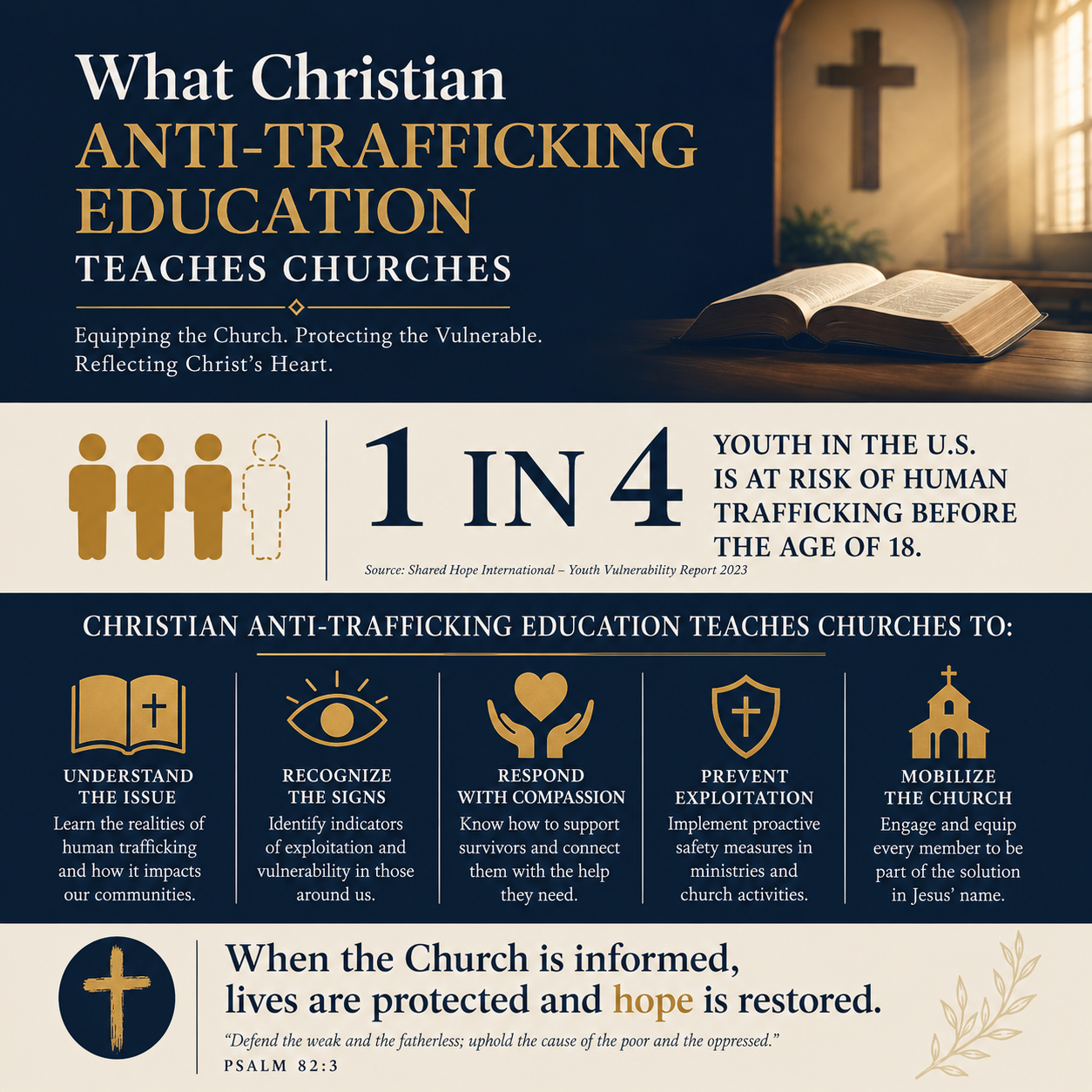
What Christian anti-trafficking education teaches churches is that prevention is not a softer alternative to rescue; it is often the most faithful and least glamorous form of protection. The church’s instinct is rightly merciful toward those already harmed, yet Scripture also forms God’s people to recognize the conditions that make exploitation possible and to interrupt them before they harden into patterns of sin.
For Christian donors, this raises a stewardship question. Prevention and education work is harder to photograph and slower to measure than a dramatic intervention. It also carries risks—misinformation, moral panic, and program models that confuse awareness with effectiveness. The church needs education that is both theologically serious and operationally disciplined.
Anti-trafficking education forms churches to think in categories of discipleship
Education corrects sentimental narratives with sober truth
Many church members first encounter trafficking through emotionally potent stories that flatten the reality: a stranger kidnapping a child from a parking lot, or a cinematic rescue as the normative pattern. Christian anti-trafficking education teaches churches to replace trope with truth: most trafficking is driven by coercion, fraud, and vulnerability; much of it is facilitated by ordinary systems; and prevention often requires painstaking, local work.
That correction is not cynicism. It is a form of love. Scripture refuses both naivete and despair. Jesus names the reality of wolves and false shepherds, and he also commands a shepherd’s vigilance (John 10). In that frame, education becomes discipleship: training congregations to see the world as it is, and to respond with informed courage rather than reactive fear.
Education turns “awareness” into pastoral responsibility
Churches learn that awareness alone can become a substitute for action. Wearing a ribbon, hosting a screening, or circulating statistics is not the same as reducing risk for real people. Mature education presses churches toward concrete pastoral responsibilities: strengthening families, equipping youth, establishing safeguarding policies, and partnering with credible local professionals.
This is one reason donors should treat education ministries as more than communications shops. The strongest work is tied to the church’s ordinary callings—preaching repentance, forming character, caring for the vulnerable, and practicing wise governance. If a program cannot explain how it changes practice inside a local congregation, it is often closer to marketing than ministry.

Prevention work teaches churches how exploitation actually happens
Traffickers exploit instability more often than they create it
Anti-trafficking education regularly confronts churches with an uncomfortable theme: exploitation usually attaches itself to existing fragility—family breakdown, homelessness, addiction, prior abuse, immigration precarity, and untreated mental illness. When churches treat trafficking as an external monster rather than a predatory logic that feeds on vulnerability, they misunderstand where prevention must begin.
Some realities are consistently borne out in public data. Youth who are disconnected from stable support are at higher risk for exploitation, and the systems that touch them—child welfare, juvenile justice, schools—become key prevention partners. For donors, this means prevention may look like funding trauma-informed mentoring, safe housing, and family strengthening as much as funding an anti-trafficking “campaign.”
Online harm is a pastoral and parental discipleship problem
Education also teaches churches that the digital environment is not peripheral. The National Center for Missing and Exploited Children reported more than 36 million CyberTipline reports in 2023, a figure that reflects the scale of online child sexual exploitation reporting, not a single type of crime or a simple count of victims National Center for Missing and Exploited Children. Churches cannot treat this as a distant law-enforcement matter; it is increasingly intertwined with youth formation, pornography exposure, and secrecy.
That intersection is contested terrain in Christian communities. Some emphasize technological controls; others emphasize heart formation and accountability. Wise education holds both: age-appropriate guardrails and a discipleship culture where confession is possible without collapse into shame. Donors should expect ministries to speak with equal clarity about safeguarding practices and spiritual formation.
Education exposes the difference between moral urgency and moral panic
Bad information harms survivors and misdirects the church
Christians genuinely disagree about which messages are most helpful in mobilizing the church. But the field has had to reckon with the cost of sensational claims: they can flood hotlines with false reports, erode trust with local agencies, and create fear-driven parenting rather than wise vigilance. Anti-trafficking education at its best trains churches to verify before amplifying and to avoid collapsing complex crimes into a single narrative.
The reality of trafficking is grievous without exaggeration. The International Labour Organization estimates that forced labor generates enormous illicit profits globally, underscoring that exploitation is sustained by economic incentives as well as cruelty International Labour Organization. The response, therefore, must be more than outrage; it must be competence. Churches learn to distinguish between what is emotionally compelling and what is operationally true.
Education must be survivor-informed without becoming survivor-dependent
Many ministries rightly elevate survivor leadership. Yet education also teaches a necessary boundary: survivors are not a limitless public resource. A church event that relies on a survivor’s testimony as its primary content can unintentionally commodify trauma. Better models include survivor-informed curricula, paid survivor consultants, and careful attention to consent, readiness, and long-term care.
Donors can help here by funding the less visible costs that protect dignity: counseling, time away from public speaking, staff training in trauma stewardship, and safeguarding policies that prevent “testimony demand.” A ministry serious about prevention will treat survivors as whole persons, not as proof points.
Strong education pushes churches toward governance, policies, and partnerships
Church safeguarding is not optional, and it is not merely legal compliance
Education repeatedly brings churches back to a plain truth: abuse prevention inside the church is part of anti-trafficking prevention. Exploitation thrives where power is unchecked, where victims are disbelieved, and where institutions protect themselves. Churches that speak about trafficking but ignore safeguarding at home undercut their own witness.
In practice, education should lead to policies and disciplined routines, not only public statements. The specific safeguards will vary by context, but donors can look for whether a ministry equips churches to implement basics such as:
- Clear child protection policies and reporting procedures
- Screening and training for staff and volunteers
- Two-adult and observable-environment standards for children and youth
- Documented partnerships with local child advocacy or victim-service organizations
- Leadership accountability when allegations arise
Partnership humility is a maturity marker
Trafficking cases are complex. Education teaches churches to respect role clarity: the church is not law enforcement, not a forensic interviewer, and not a substitute for licensed clinical care. Faithful engagement is often collaborative—working with school counselors, social workers, survivor-serving nonprofits, and police units when appropriate.
This is also where donor discernment matters. Some ministries promise access, operations, or outcomes they cannot responsibly deliver. Ministries that do prevention well tend to name their boundaries clearly, invite external accountability, and demonstrate referral pathways rather than improvising crisis responses.
Donors learn to fund prevention with verification, not vibes
Education is only as trustworthy as the ministry behind it
Because anti-trafficking language carries moral weight, it can mask weak governance or unclear outcomes. Across our verification work at Most Trusted, we see that prevention and education ministries are strongest when they can show alignment between message and method: orthodox theology expressed through ethical fundraising, transparent reporting, prudent financial controls, and leadership that welcomes scrutiny.
Our evaluations apply The Most Trusted Standard, a 15-criteria framework that examines faith commitments, financial integrity, governance and leadership, and transparency and effectiveness. The point is not bureaucracy; it is protection—of survivors, of donors, and of the church’s public credibility.
What funding prevention should purchase
Donors sometimes ask for the single best metric for education work. The harder truth is that prevention outcomes are partly counterfactual: the best result is often what does not happen. That does not excuse vagueness. It requires ministries to define plausible, measurable proximate outcomes: policy adoption, training completion, referral quality, and sustained partnerships.
What this means in practice is that donors should favor ministries that can answer concrete questions: How many churches adopted safeguarding policies after training? What follow-up occurs six months later? How are materials reviewed for accuracy? How are survivors protected from overexposure? Donors looking for vetted options can situate this work within Christian Anti-Trafficking Ministries, where prevention is understood alongside survivor care and advocacy.
Prevention also sits within a broader set of practices churches are learning to take seriously, including training for pastors, youth leaders, and volunteers. That wider context matters for donors seeking coherence rather than one-off events. Many donors begin by examining credible work in Prevention and Education in Christian Anti-Trafficking Ministries and then asking whether a ministry’s governance and reporting match its public claims.
FAQs for What Christian anti-trafficking education teaches churches
Is awareness ministry enough to count as anti-trafficking work?
Awareness can be a first step, but education that stops at emotional engagement rarely reduces risk. Strong anti-trafficking education equips churches to change practices: safeguarding policies, referral pathways, youth discipleship around sexuality and technology, and durable partnerships with local professionals. Donors should ask what the ministry expects to be different in a church six months after the training.
How can donors tell whether an anti-trafficking education ministry is responsible?
Responsible ministries demonstrate accuracy, role clarity, and accountability. They cite credible sources, avoid sensational claims, protect survivor dignity, and show evidence of follow-through beyond a single event. They also welcome external verification. Most Trusted exists to help donors give with confidence by evaluating ministries against The Most Trusted Standard, where governance and transparency are treated as essential to faithful outcomes.
A church that learns prevention learns maturity
Christian anti-trafficking education teaches churches that love of neighbor includes foresight: strengthening families, guarding children, discipling young people in truth, and refusing the false choice between compassion and competence. Donors who fund this work well are not funding noise. They are funding formation—churches becoming the kind of communities where exploitation has fewer places to hide.



