
When Christian donors ask what accreditation child sponsorship ministries should have, they are usually asking a deeper question: what kind of verification is strong enough to deserve a long-term, relational commitment made in Christ’s name. Child sponsorship is not a one-time gift. It is a promise, repeated month after month, often for years, and it touches a living child, a family system, and a local church or community network.
The harder reality is that “accreditation” in the child sponsorship world can mean several different things. Some credentials are rigorous, independent, and public about standards. Others function more like membership badges, with limited disclosure and limited enforcement. Serious Christian stewardship requires more than a logo on a website. It requires evidence that a ministry’s theology, governance, child protection, finances, and program outcomes are being examined by someone other than the ministry itself.
Accreditation is not one thing and donors should know what it can and cannot prove
In the United States, many Christian child sponsorship ministries are registered as 501(c)(3) nonprofits. That legal status matters, but it is not accreditation. The IRS does not certify program quality, child safety, or truthfulness in donor communications. It primarily regulates tax-exempt compliance and prohibited private benefit.
What this means in practice is that donors should distinguish among three categories: (1) legal compliance, (2) independent standards and accountability, and (3) demonstrated program integrity on the ground. Each category contributes something different to trustworthiness, and none is sufficient by itself.
Legal registration is necessary but thin
A ministry that is a legitimate nonprofit should be able to show it is in good standing in its jurisdiction, file required returns, and follow basic charitable solicitation rules where applicable. The IRS itself is explicit that tax-exempt status is not a government endorsement of the organization’s work or claims. A mature donor reads “501(c)(3)” as a starting point, not a seal of excellence.
Independent accountability is where accreditation begins to matter
Accreditation becomes meaningful when standards are external, clear, and enforceable. Strong accreditors publish expectations, require evidence, investigate complaints, and impose consequences. Weak accreditors exist primarily to help organizations signal credibility without submitting to hard scrutiny.
Across our verification work at Most Trusted, we find that the ministries donors can rely on most tend to embrace accountability even when it is inconvenient. They treat it as a form of discipleship: “Therefore, having put away falsehood, let each one of you speak the truth with his neighbor” (Ephesians 4:25). This is not marketing polish. It is moral formation applied to institutional life.

Baseline external standards donors can reasonably expect
Not every trustworthy child sponsorship ministry will hold the same set of accreditations. The field is global, regulatory environments differ, and some excellent organizations choose not to pursue particular badges. Still, several external standards are widely recognized as meaningful indicators of financial integrity and governance discipline.
ECFA and similar faith-based financial accountability standards
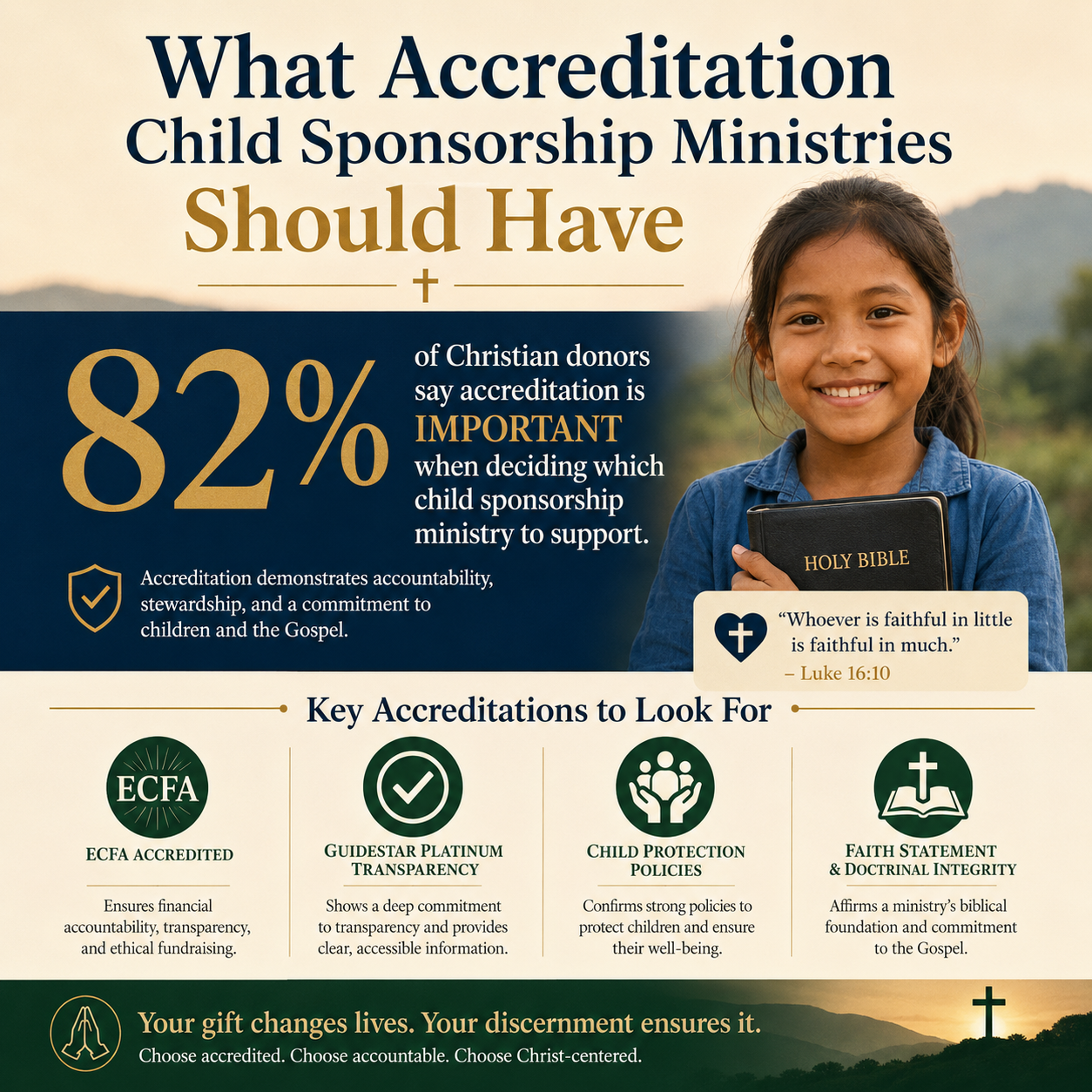
For U.S.-based evangelical ministries, accreditation with the Evangelical Council for Financial Accountability is one of the most recognizable signals of financial accountability. ECFA publishes standards and requires member organizations to demonstrate compliance across governance, financial oversight, and truthful communication. Donors can assess ECFA’s role and membership approach directly through the organization’s published materials at https://www.ecfa.org.
ECFA membership is not a substitute for deeper questions about child protection and program effectiveness. It is, however, a meaningful indicator that financial statements, board structures, and fundraising practices are being reviewed against defined expectations.
BBB Wise Giving Alliance and public charity standards
Some child sponsorship ministries seek review against the BBB Wise Giving Alliance Standards for Charity Accountability. This can be especially helpful for donors who want a non-sectarian, publicly explained set of expectations around governance, finances, and truthfulness in appeals. The standards are accessible through https://give.org.
Donors should still read carefully. Meeting broad charity standards does not automatically address the distinctive risks of child-focused international work: safeguarding, local partner oversight, and the accuracy of sponsorship representations.
Audited financial statements and accessible Form 990
An independent audit by a reputable firm is not “accreditation” in a formal sense, but it is one of the clearest, verifiable markers of financial integrity. In the U.S., larger nonprofits also file Form 990 returns, which are public in practice and often easy to access. The IRS provides official information on exempt organizations and filings at https://www.irs.gov/charities-non-profits/tax-exempt-organization-search.
We recommend donors treat the presence of an audit and transparent filings as a non-negotiable baseline for sizable organizations. For smaller ministries, donors should at least expect meaningful financial reporting, board oversight, and a credible pathway toward stronger external review as the organization grows.
For child sponsorship, safeguarding and ethical fundraising matter as much as finances
Child sponsorship introduces moral hazards that do not exist in the same way for other charitable models. The ministry holds sensitive information about a child. It communicates that child’s story to donors. It may facilitate letters, gifts, photos, and visits. The risk is not only financial misuse; it is the exploitation of children’s images, the creation of unhealthy donor-child dynamics, or local pressures that harm families.
Child safeguarding policies should be explicit and enforceable
We recommend that donors look for ministries that publish child safeguarding policies and can describe how those policies are implemented across staff, volunteers, partners, and contractors. Strong practice includes screening, training, incident reporting pathways, survivor-centered responses, and independent investigation mechanisms when allegations arise.
Internationally, frameworks such as the Keeping Children Safe standards have shaped best practice for safeguarding in organizations working with children. Donors can review that framework directly at https://www.keepingchildrensafe.global. Not every ministry will be formally certified, but the concepts—clear codes of conduct, risk assessment, reporting, and accountability—are increasingly understood as essential.
Truthful sponsorship communications should be tested, not assumed
Christians genuinely disagree about how to describe the relationship a sponsor has with a child and what “supporting a child” means in program terms. Some models use pooled community funding while maintaining individual sponsorship relationships. Others provide more direct child-and-family allocations. Neither approach is inherently dishonest, but both can become dishonest if communications imply individualized funding when the model does not provide it.
Donors should ask whether the ministry explains, in plain language, how funds are allocated and what sponsorship does and does not guarantee. If the ministry pools funds, it should say so without euphemism. If it provides direct benefits, it should describe those benefits concretely and disclose constraints. What we are after is truthfulness, not a particular operational model.
- Written safeguarding policy and code of conduct publicly available
- Clear rules for photos, stories, and children’s personal information
- Documented staff and volunteer screening and training
- Independent reporting channels and incident response procedures
- Transparent explanation of how sponsorship dollars are allocated
International operations require accountability that crosses borders
Child sponsorship is frequently implemented through local partners—church networks, community-based organizations, schools, or health clinics. This is often a strength, because it honors local agency and embeds care within community relationships. It is also a risk, because donor-country oversight can become nominal while actual practice happens far from view.
Partner due diligence and monitoring should be described with specificity
We recommend donors look for ministries that can articulate partner selection criteria, contractual expectations, financial controls, and on-site monitoring. Vague language about “trusted partners” is not enough. Mature ministries describe how they assess partner governance, child safety readiness, financial management capacity, and theological alignment where relevant.
Some ministries operate with a field office structure. Others work through affiliate networks. Either can be done well. What matters is whether responsibility is clearly assigned and whether performance is measured with integrity rather than with internal optimism.
Data integrity and outcomes should be visible, even when imperfect
Donors sometimes ask for definitive proof that sponsorship “works.” The honest answer is that outcomes measurement is difficult. Families are complex. Communities change. Attribution is not simple. Yet difficulty is not an excuse for silence.
Verifiable evidence suggests that family-based and community-based interventions can improve child outcomes, but the quality of evidence varies by program type and context. A responsible ministry should show what it measures—school attendance, health visits, child protection indicators, spiritual formation activities where appropriate—and should be candid about limitations. When claims are too sweeping, trust should narrow accordingly.
For donors evaluating the broader landscape of Child Sponsorship Ministries, the question is not whether every metric is perfect. It is whether the ministry has built a culture where truth is more valuable than fundraising momentum.
How The Most Trusted Standard approaches accreditation and verification
Accreditation can be an important signal, but it is not the whole of trustworthiness. Our work at Most Trusted is designed to help Christian donors assess ministries against The Most Trusted Standard, a 15-criteria framework across four domains: Faith Foundation, Financial Integrity, Governance and Leadership, and Transparency and Effectiveness. The point is not to replace existing accreditors; it is to evaluate whether a ministry’s public claims and internal controls align with the moral seriousness of Christian stewardship.
We look for corroborated accountability, not borrowed credibility
Some organizations display a long list of affiliations that communicate credibility without demonstrating oversight. Our team distinguishes between memberships, certifications, and independent reviews with enforcement. We also look for whether key documents are accessible: audited financials, annual reports, board information, policies, and program explanations.
When accreditation is present, we ask what it actually required. When it is absent, we ask what other forms of rigorous accountability exist. A ministry may be excellent and still lack a particular credential, especially outside the U.S. The absence should prompt questions, not immediate condemnation.
We treat child protection and truthful communications as moral essentials
Child sponsorship sits close to Scripture’s insistence that God hears the cry of the vulnerable and judges those who exploit them. “Whoever receives one such child in my name receives me” (Matthew 18:5). The standard is not merely that the ministry avoids scandal. The standard is that it orders its policies, training, and communications to protect children and to honor the truth.
Donors who want to think carefully about the practical wisdom of supporting a sponsorship program will often benefit from reading How to Give Wisely to Child Sponsorship Ministries, especially when weighing questions about pooled funding, community development models, church partnership, and the ethics of representation.
FAQs for What accreditation child sponsorship ministries should have
Is ECFA accreditation enough to trust a child sponsorship ministry?
ECFA accreditation is a meaningful signal of financial accountability and governance expectations, particularly among evangelical ministries. It is not sufficient by itself for child sponsorship, because safeguarding, ethical storytelling, partner oversight, and the accuracy of sponsorship representations require additional scrutiny. We recommend treating ECFA as a strong positive indicator while still asking child-specific questions.
What if a ministry has no accreditation at all but seems faithful and effective?
Some faithful ministries operate in contexts where formal accreditation is uncommon or financially burdensome. The question becomes whether the organization has other forms of external accountability and transparent evidence: independent audits when feasible, clear governance, published policies, safeguarding systems, and candid program reporting. If a ministry resists any meaningful outside review, donors should be cautious, because trust without verification is easily manipulated even by well-intentioned leaders.
A credible accreditation posture is a posture of submission to truth
Christian donors are not searching for perfection; they are searching for integrity. The most trustworthy child sponsorship ministries do not treat accountability as a fundraising device. They treat it as submission to truth under God, expressed through transparent finances, disciplined governance, rigorous safeguarding, and honest communications about what sponsorship does. Accreditation can help, but it matters most when it reflects a ministry’s deeper willingness to be examined, corrected, and held to its word.



