
What the Bible says about relief and mercy giving is both bracingly simple and pastorally complex: God commands his people to act with compassion toward the vulnerable, and he also warns against forms of “help” that reinforce injustice, dependency, or pride. For Christian donors, that tension is not theoretical. Relief dollars move quickly, emotions run high, and the public consequences of a gift can be substantial.
Scripture gives more than isolated proof texts. It gives a moral architecture: God’s character, the dignity of image-bearers, the vocation of work, the obligations of community, and the priority of truth. When Christian donors give in a way that honors that architecture, mercy becomes more than an impulse. It becomes a disciplined expression of love.
Mercy is grounded in the character of God, not in donor sentiment
God’s self-description shapes our giving
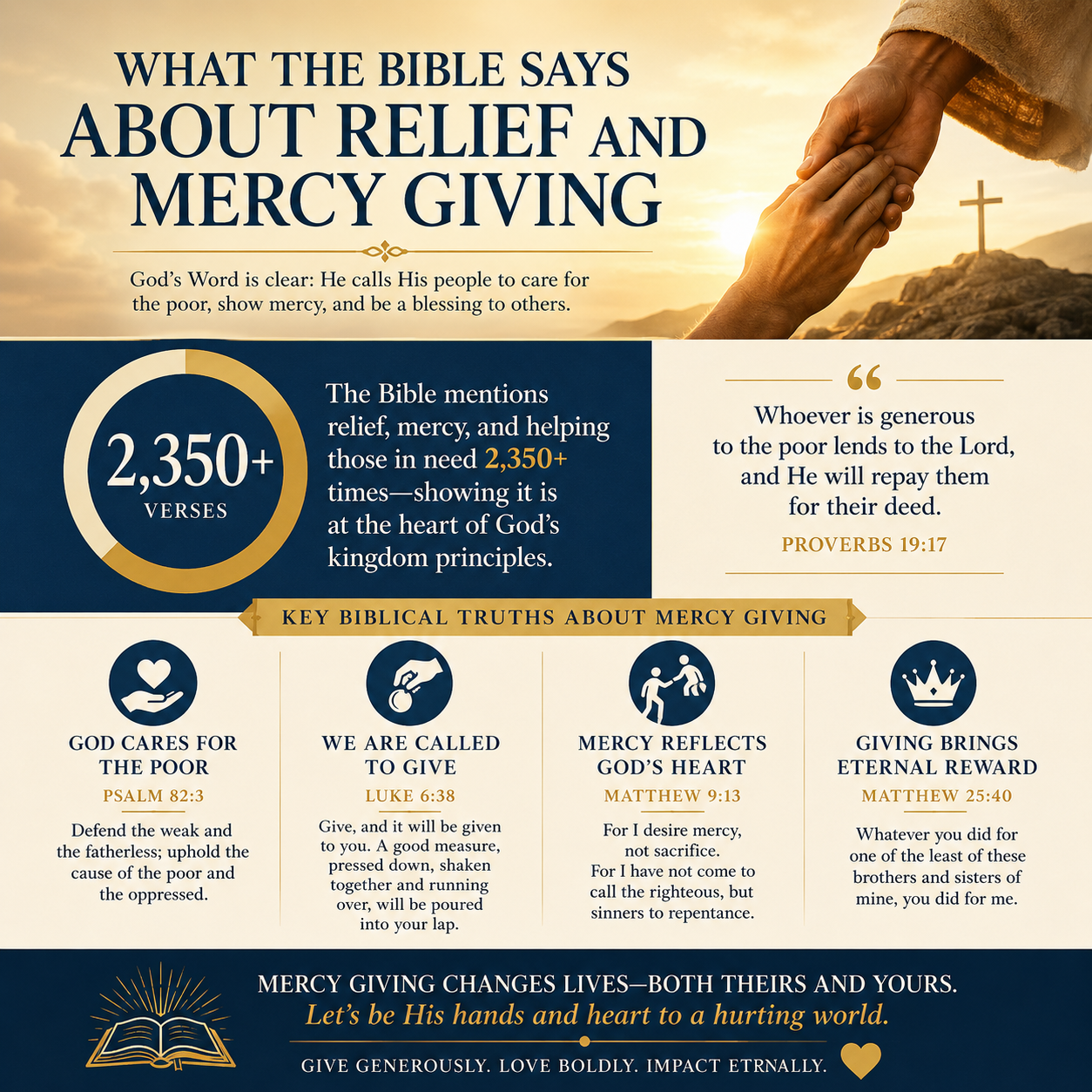
In the Old Testament, God repeatedly identifies himself as the defender of those without power: the sojourner, the widow, and the fatherless (Deuteronomy 10:18). The Psalms praise the Lord who “executes justice for the oppressed” and “gives food to the hungry” (Psalm 146:7–9). Mercy giving is not philanthropy with a Christian accent; it is an act of imitation rooted in who God is.
That is why Scripture treats compassion as a matter of covenant faithfulness. God’s people are commanded to open their hands to the poor (Deuteronomy 15:7–11). The prophets condemn those who maintain religious forms while neglecting the hungry and oppressed (Isaiah 58:6–10; Amos 5:21–24). Christian donors rightly feel urgency here: giving is not merely optional benevolence, but obedience.
Mercy is personal, but it is not private
Jesus’ parable of the Good Samaritan (Luke 10:25–37) refuses any attempt to define “neighbor” downward. The Samaritan’s compassion is concrete: he binds wounds, pays costs, and ensures follow-through. Yet the parable also exposes a temptation familiar to donors—confusing moral seriousness with proximity. The Samaritan acts without institutional gatekeeping, but he still uses an innkeeper and a payment arrangement to secure care. Mercy can be immediate and still be accountable.
The New Testament frames this as a visible mark of living faith. James insists that pure religion includes caring for widows and orphans in their affliction (James 1:27) and that words without help are empty (James 2:14–17). Mercy giving is one of the public fruits that should make Christian confession credible.
Relief and development are distinct biblical questions
Emergency relief is not a full theory of poverty
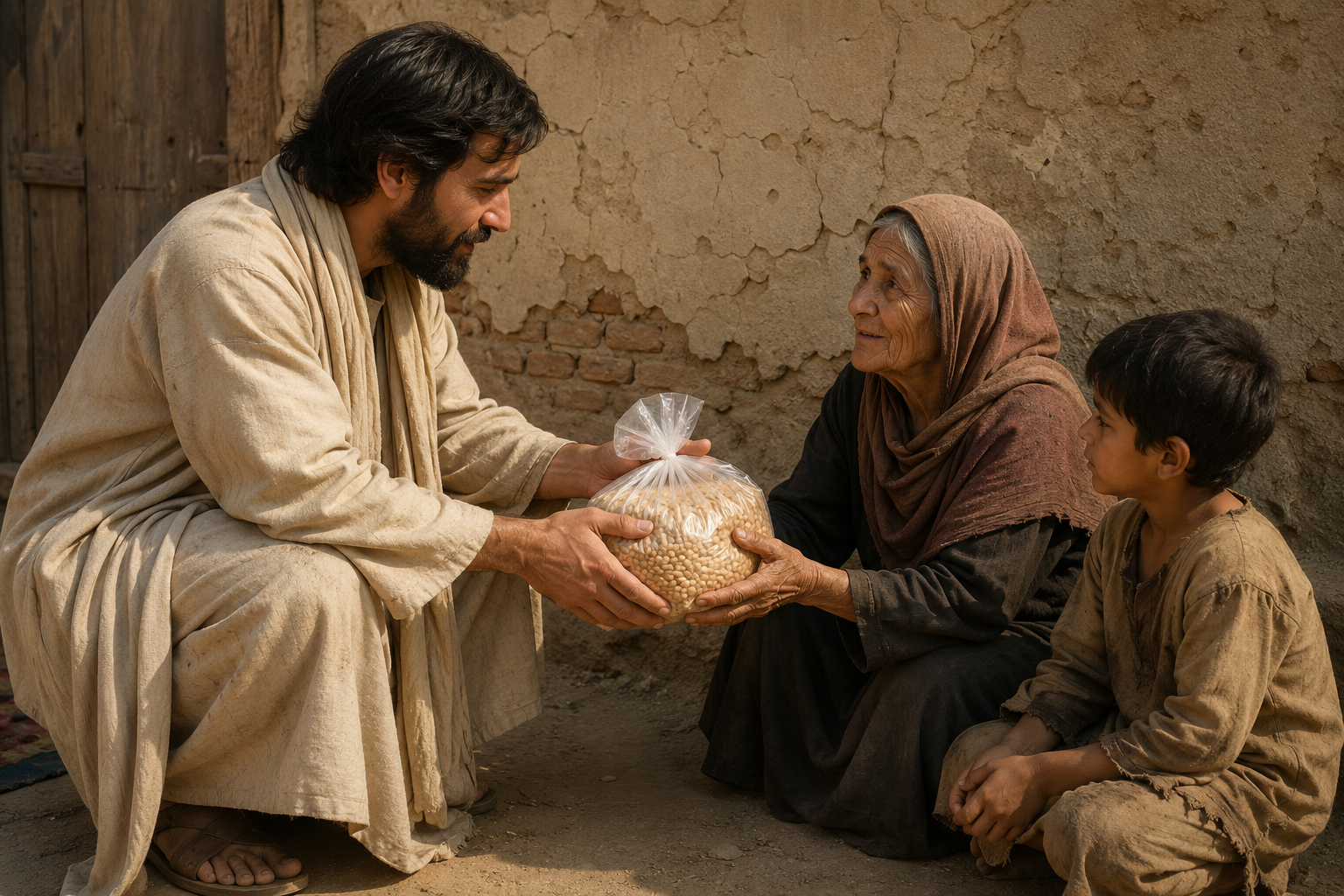
The Bible acknowledges moments when crisis overwhelms ordinary means. Joseph’s grain policies in Genesis anticipate famine management; the early church organized material support across regions when need was acute (Acts 11:27–30). In those settings, immediate provision is not indulgence. It is life-preserving mercy.
Christian donors often fund relief because suffering is visible and time-sensitive. That instinct aligns with Scripture. The moral question is not whether to respond, but how to respond in a way that protects dignity and does not create long-term harm.
Development requires patience, local agency, and truth
Scripture also assumes that ordinary human life includes work, responsibility, and community structures that sustain households over time. Paul’s admonition in 2 Thessalonians 3:10 (“If anyone is not willing to work, let him not eat”) is not a slogan for cutting off compassion. It is a warning against subsidizing idleness in a functioning community when able-bodied people refuse responsibility. Mercy that ignores agency can undercut the very neighbors it seeks to serve.
Modern Christian practice has had to reckon with the same distinction. The When Helping Hurts framework, articulated by Steve Corbett and Brian Fikkert, argues that some well-intentioned aid can worsen poverty by fostering dependency and undermining local initiative. That claim is debated in particulars, but the core caution fits biblical categories: help must be truthful about what people need and respectful of what people can do.
Scripture’s strongest warnings are about injustice, not merely need
Mercy giving must not bypass justice
The prophets repeatedly treat poverty as a spiritual and legal crisis, not only an economic one. Those who “trample on the poor” and manipulate markets come under God’s judgment (Amos 8:4–6). The command to give is paired with the command to order society rightly—honest weights, fair courts, and protection for those without political power.
For donors, this means we should be cautious about giving models that relieve symptoms while leaving predation intact. A food distribution is good; a food distribution that funds corrupt intermediaries or legitimizes abusive leadership is not morally neutral. Scripture’s logic presses us to ask: are we alleviating suffering in a way that also resists wrongdoing?
The church’s care for the poor was organized and discerning
Acts 6 records a distribution system for widows that required structure and oversight. The apostles did not treat administration as beneath spiritual leadership; they appointed qualified servants to ensure equitable care. That passage is not a modern nonprofit manual, but it does establish a principle: mercy ministries should be governable, and fairness should be verifiable.
In our work at Most Trusted, we see donors grow more confident when mercy claims are matched with evidence—clear eligibility criteria, local partnerships, safeguarding practices, and reporting that can withstand scrutiny. The ministries that meet The Most Trusted Standard tend to treat administration as a form of love: not bureaucratic distance, but the disciplined work that keeps compassion honest.
Christian donors should measure faithfulness, not just efficiency
Stewardship includes competence, but it is more than ratios
Jesus commends faithful stewardship and condemns negligence (Matthew 25:14–30). That should shape donor expectations: a ministry receiving sacrificial gifts should demonstrate basic competence in financial controls, oversight, and evaluation. Yet Scripture also warns against substituting measurable outputs for moral faithfulness. Some goods are not easily reduced to unit costs without deforming them.
Modern philanthropy has learned this lesson in its own way. The “Overhead Myth” letter—signed by GuideStar, Charity Navigator, and the BBB Wise Giving Alliance—warns donors not to treat overhead percentages as the primary indicator of effectiveness, because doing so can punish responsible investment in infrastructure and accountability GuideStar. Christian donors can affirm the point while still insisting on integrity: spending must be appropriate to the mission, and claims must be supportable.
What due diligence looks like for mercy and relief giving
In the relief and development space, speed and complexity create unique vulnerabilities: fraud after disasters, weak local governance, and incentives to publish emotionally compelling stories that outpace verified facts. Donor diligence is not cynicism; it is stewardship.
- Confirm the ministry can distinguish emergency relief from long-term development in its program design.
- Look for governance practices that can withstand crisis pressure: independent oversight, documented approvals, and clear conflict-of-interest rules.
- Ask whether beneficiaries have meaningful agency: feedback channels, local leadership, and culturally grounded plans.
- Evaluate truthfulness in communications: careful photography and storytelling, consent practices, and avoidance of inflated impact claims.
- Prefer ministries that can show learning over time: what failed, what changed, and what improved.
Donors exploring Christian Relief and Development Ministries often discover that the best ministries do not promise simplicity. They promise integrity—clear decisions, honest limits, and a consistent commitment to protect those they serve.
Mercy giving is a spiritual practice shaped by the cross and resurrection
We give because Christ gave himself
Paul roots Christian generosity in the gospel itself: “Though he was rich, yet for your sake he became poor” (2 Corinthians 8:9). Mercy giving is not only a response to human need; it is a participation in Christlike self-giving. That foundation guards donors from both pride and despair. We are not saviors. We are witnesses to the Savior.
In the same passage, Paul urges careful administration “so that no one should blame us” about the gift being collected (2 Corinthians 8:20–21). Spiritual generosity and careful accountability are not competing virtues. Scripture binds them together.
Christian donors must hold compassion and truth together
Relief and mercy giving can be distorted by partial truths. Some donors over-spiritualize poverty, treating it primarily as a heart problem and minimizing structural injustice. Others treat poverty primarily as an economic system failure and minimize sin, broken relationships, and spiritual need. Christians genuinely disagree about emphasis, and the field has real debates about what “works.”
What this means in practice is that mature mercy giving will fund both immediate aid and long-term restoration—discipleship where it is welcomed, local church strengthening where it is appropriate, and practical interventions that restore health, livelihoods, and safety. For donors who want that kind of coherence, the convictions behind Biblical Stewardship in Christian Relief and Development Giving matter: not as a slogan, but as a framework for decisions that can bear moral weight.
FAQs for What the Bible says about relief and mercy giving
Does the Bible require Christians to give to the poor even if a ministry seems inefficient?
Scripture requires generosity and compassion, but it also requires stewardship and honesty. The New Testament models careful administration of gifts (2 Corinthians 8:20–21) and organized distribution (Acts 6). When a ministry cannot account for funds, cannot explain its model, or repeatedly makes claims it cannot support, donors have reason to redirect their giving toward more trustworthy channels without abandoning the obligation to care for the poor.
How should Christian donors think about helping without creating dependency?
The Bible affirms both immediate mercy and the dignity of work, responsibility, and community life. Emergency relief that preserves life is plainly good. Long-term support should be designed to strengthen households and local institutions rather than replace them. Many donors find it helpful to apply distinctions similar to the When Helping Hurts framework: relief for crises, rehabilitation for restoration, and development that builds local capacity over time.
Mercy giving that honors Scripture will be both compassionate and accountable
What the Bible says about relief and mercy giving is not merely that Christians should feel compassion, but that we should practice a form of compassion ordered by truth. God’s concern for the vulnerable is explicit, and so is his hatred of injustice and hypocrisy. Christian donors serve the poor best when giving is shaped by the character of God, the pattern of the cross, and the patient discipline of stewardship. That is the kind of mercy that can endure beyond the crisis moment and bear faithful witness over time.



