

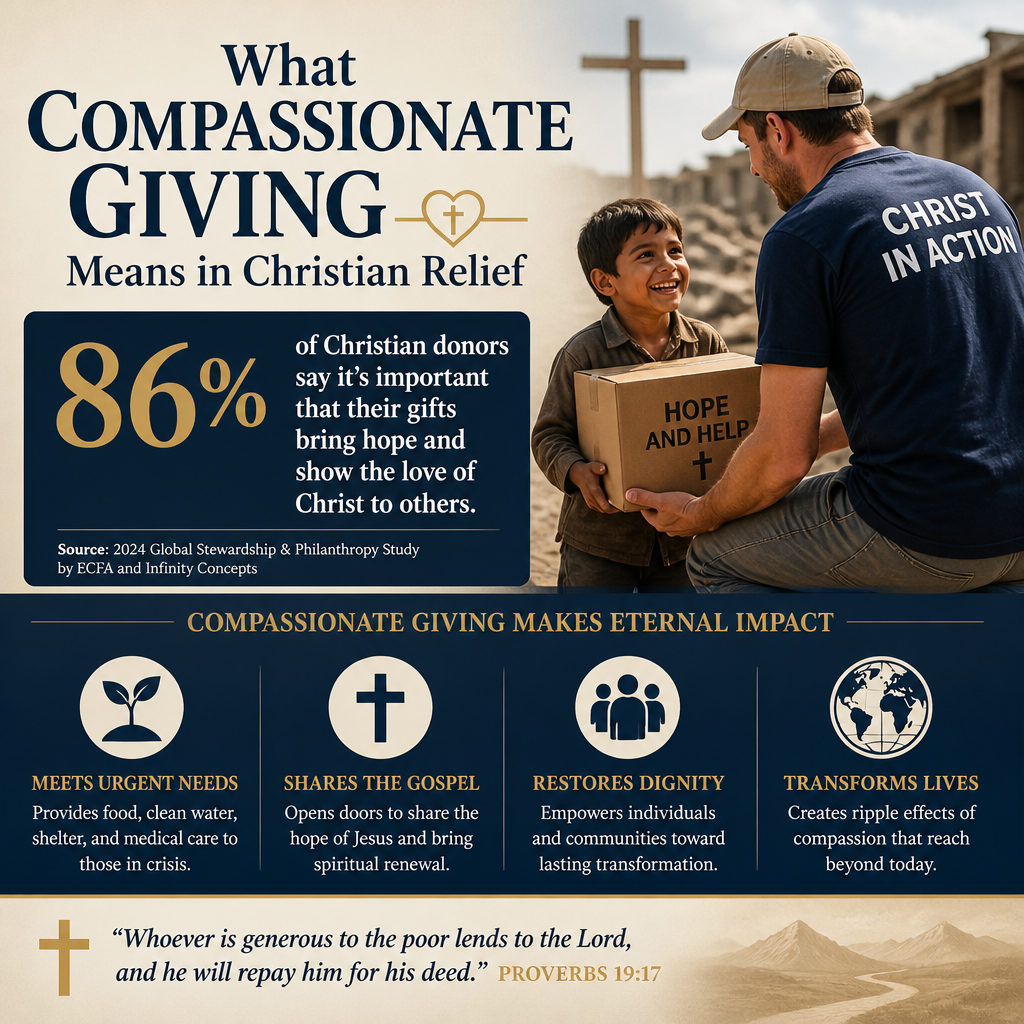
What compassionate giving means in Christian relief is not sentimental generosity, but love disciplined by truth. Christian donors are not only trying to relieve suffering; we are trying to do so in a way that honors the image of God in those we serve, resists pride, and bears fruit that remains. Compassion that is merely immediate can still wound. Compassion that is accountable, patient, and rooted in Scripture can become a genuine instrument of mercy.
In Christian relief and development, the tension is real: the needs are urgent, the stories are compelling, and the moral claim of the poor is difficult to evade. Yet donors also know that money can distort incentives, create dependency, displace local leaders, or fund organizations that are less faithful than their marketing suggests. Compassionate giving must therefore include moral seriousness about outcomes, integrity, and the character of the ministry being funded.
Compassion begins with the God who sees
Mercy is an attribute before it is an impulse
Scripture grounds compassion in God’s own character. The Lord identifies himself as “merciful and gracious, slow to anger, and abounding in steadfast love” (Exodus 34:6). Christian relief is not primarily a philanthropic trend; it is an expression of the church’s theological conviction that the world is God’s, human beings bear his image, and suffering matters to him.
That foundation guards donors from two opposite errors. One is cynicism that treats relief as futile or naïve. The other is romanticism that treats relief as morally uncomplicated. The Psalms hold both realism and hope: “The Lord is near to the brokenhearted” (Psalm 34:18), and yet the brokenhearted remain in need of tangible help. Compassionate giving recognizes lament and acts anyway.
Christian compassion refuses to reduce people to problems
Relief work can subtly train donors to think in abstractions: “the hungry,” “the displaced,” “the poor.” Scripture insists on persons, not categories. The Good Samaritan does not assist a “case”; he assists a man with wounds, dignity, and a future (Luke 10:25–37). Compassionate giving therefore asks whether a ministry’s programs protect agency, strengthen families, and honor local communities rather than treating them as backdrops for donor emotion.
What this means in practice is that donors should favor ministries that can articulate how they avoid dependency and paternalism. The When Helping Hurts framework, articulated by Steve Corbett and Brian Fikkert, has reshaped much of the field by clarifying how relief, rehabilitation, and development differ, and how misapplied “help” can harm relationships and long-term outcomes.https://whenhelpinghurts.org/

Compassionate giving is both urgent and patient
Relief is sometimes necessary and sometimes destructive
Christians genuinely disagree about where emergency relief should end and longer-term development should begin. The disagreement is not merely technical; it reflects different risk tolerances and different theological instincts about immediacy versus sustainability. Yet a basic distinction matters: in acute crisis, providing food, shelter, and medical care can be the faithful choice. Outside of crisis, continued free distribution can undercut local markets, weaken social responsibility, and shift community expectations away from mutual obligation.
Compassionate giving therefore asks a ministry to explain its decision rules. When do they move from free distribution to cash assistance, livelihood restoration, or locally led programs? How do they avoid repeating a short-term relief model for years because it is easier to communicate to donors? The sharper the criteria, the less likely compassion will become a funding habit that leaves communities stuck.
Patience is part of Christian love
Development work often looks unimpressive. It can involve long timelines, imperfect progress, and outcomes that cannot be captured by a single photograph. Yet Scripture trains donors not to despise slow faithfulness. “Let us not grow weary of doing good, for in due season we will reap” (Galatians 6:9). Compassionate giving accepts that the most respectful form of assistance is sometimes the least dramatic.
Across our verification work at Most Trusted, we observe that the ministries that meet The Most Trusted Standard tend to describe both their goals and their limitations with clarity. They do not promise permanent transformation in a quarter. They explain why certain outcomes take time, how they evaluate progress, and what they will change when evidence suggests a program is not working as intended.
Compassion must be accountable to real-world effects
Effectiveness is a moral question, not a technocratic one
Christian donors sometimes fear that attention to measurement will crowd out compassion. The better concern is the opposite: compassion without accountability can become self-protective. If a program consistently produces harm, or fails to produce the outcomes it claims, continuing to fund it is not “grace.” It is negligence in stewardship.
The field has had to reckon with hard lessons. In some contexts, institutional care for children has been shown to produce worse developmental outcomes than family-based care. A large body of research synthesized by the Bucharest Early Intervention Project found significant developmental differences for children raised in institutional settings compared with those placed in foster care, even when basic material needs were met.https://www.bucharestearlyinterventionproject.org/
That does not mean every residential program is identical, or that every country has sufficient foster systems. It does mean donors should not assume that funding “an orphanage” is automatically compassionate. Compassionate giving asks whether a ministry is strengthening family preservation, kinship care, foster networks, or reintegration where safe and possible.
Transparency builds the trust compassion requires
Donors are often told to judge a ministry by a single ratio. That approach is both simplistic and easily manipulated. The “Overhead Myth” statement—signed by Charity Navigator, GuideStar, and the Better Business Bureau Wise Giving Alliance—argues that overhead ratios alone do not capture nonprofit performance and can create harmful incentives.https://www.charitynavigator.org/
Christian donors should still care about cost discipline, but compassionate giving goes further: it asks whether reporting is clear, whether leaders invite scrutiny, and whether results are described with candor. Ministries worthy of trust explain what success looks like, what was learned, and what was changed. They do not treat donors as a funding audience to be managed.
Compassionate giving is also protection against spiritual and organizational drift
Faith foundation matters in relief work
Relief and development ministries operate in morally complex environments: conflict zones, disaster response, public-private partnerships, and cross-cultural settings with competing values. In that environment, a ministry’s confessional clarity and theological commitments are not peripheral. They shape how staff view people, whether evangelism is coercive or integrated with integrity, and how leaders define “success.”
For donors seeking ministries aligned with their convictions, clarity matters: What is the ministry’s statement of faith? How does it train staff for ethical practice? What does it believe about the church, human dignity, and the relationship between word and deed? These questions help donors avoid funding organizations whose public tone is Christian but whose operational assumptions are indistinguishable from secular humanitarianism.
Donors considering this landscape can orient themselves through Christian Relief and Development Ministries, where we track patterns donors commonly face and the accountability signals that tend to matter most over time.
Governance is compassion for the vulnerable and for donors
Compassionate giving does not ignore power. Relief work often concentrates authority: funds flow quickly, decisions are made far from the field, and beneficiaries have limited recourse if something goes wrong. Strong governance—independent oversight, conflicts-of-interest policies, and clear lines of accountability—is therefore not administrative trivia. It is protection for people with the least ability to protect themselves.
The same is true for donors. A ministry can do inspiring work and still be structurally vulnerable to leadership failure, financial opacity, or mission drift. Compassionate giving therefore asks for board competence, ethical safeguards, and transparent reporting. When governance is weak, donors are asked to substitute goodwill for verification, and that is an unreasonable burden.
How Christian donors can practice compassionate giving with confidence
Questions that respect both urgency and stewardship
Donors often feel forced to choose between heart and head. Christian stewardship refuses that divide. Scripture commands compassion and also insists on prudence: “The simple believes everything, but the prudent gives thought to his steps” (Proverbs 14:15). Compassionate giving can be expressed through a set of disciplined questions that do not smother mercy but direct it.
- Is this situation relief, rehabilitation, or development? If it is not acute crisis, what prevents dependency or market harm?
- Who holds authority locally? Are local churches, community leaders, and institutions shaping decisions and owning outcomes?
- What evidence is offered? Are there clear metrics, evaluations, or credible learning practices rather than only stories?
- How is integrity protected? Are there audited financials, conflicts-of-interest policies, and meaningful board oversight?
- Is the ministry candid about limits? Do they acknowledge what they cannot do, and what has not worked?
Verification serves compassion by lowering the cost of discernment
Most donors do not have the time to read every financial statement, interview leadership, or assess program claims across countries and crises. That reality is not a moral failure; it is a constraint of ordinary life. What matters is whether donors respond to that constraint with willful ignorance or with wise delegation.
Most Trusted exists to serve that discernment. We evaluate Christian nonprofits against The Most Trusted Standard, a 15-criteria framework spanning faith foundation, financial integrity, governance and leadership, and transparency and effectiveness. The aim is not suspicion for its own sake. The aim is to make it easier for donors to give with a clear conscience, knowing their compassion is paired with credible accountability.
Donors who want a stewardship lens specific to relief and development can also consult Biblical Stewardship in Christian Relief and Development Giving, where we focus on the moral decisions that recur in this category: urgency, dignity, partnership, and the long arc of outcomes.
FAQs for What compassionate giving means in Christian relief
Should compassionate giving prioritize evangelism or humanitarian outcomes?
Christian donors may weight this differently, and ministries vary in calling and context. Compassionate giving should refuse a false choice: Scripture commends both the proclamation of Christ and tangible mercy. The practical donor question is whether a ministry’s approach is ethically coherent—never coercive, never manipulative—and whether it serves people as image-bearers rather than as means to an institutional end.
Is it unspiritual to evaluate a relief ministry’s governance and finances?
It is spiritually appropriate. Scripture treats stewardship, honesty, and accountability as moral obligations, not optional administrative preferences. Evaluating governance and finances is one way donors love neighbors they may never meet, because strong oversight reduces the likelihood that funds will be misused and beneficiaries will be exposed to preventable harm.
A form of compassion that can bear scrutiny
Christian relief will always involve urgency, imperfect information, and hard trade-offs. Compassionate giving does not pretend otherwise. It brings Scripture’s moral seriousness to the act of funding, insisting that love of neighbor includes dignity, truthfulness, and responsibility for outcomes. When donors pair generous hearts with disciplined verification, compassion becomes more than intent; it becomes a credible form of mercy.



