
Biblical stewardship in Christian relief and development giving is not merely a budgeting discipline. It is a spiritual matter of trust: whether we believe the Lord owns what we hold, and whether our giving reflects his purposes rather than our impulses. The New Testament pairs compassion with accountability—generosity that is sincere, and administration that is honorable (2 Corinthians 8:20–21).
Most donors who support relief and development ministries feel a weight that is both moral and personal. Needs are visible, crises are urgent, and opportunities to help arrive faster than most households can discern. The harder question is not whether Christians should give. Scripture settles that. The harder question is how to give in ways that honor God, protect the vulnerable, and withstand scrutiny over time.
Stewardship begins with God’s ownership and a purpose for giving
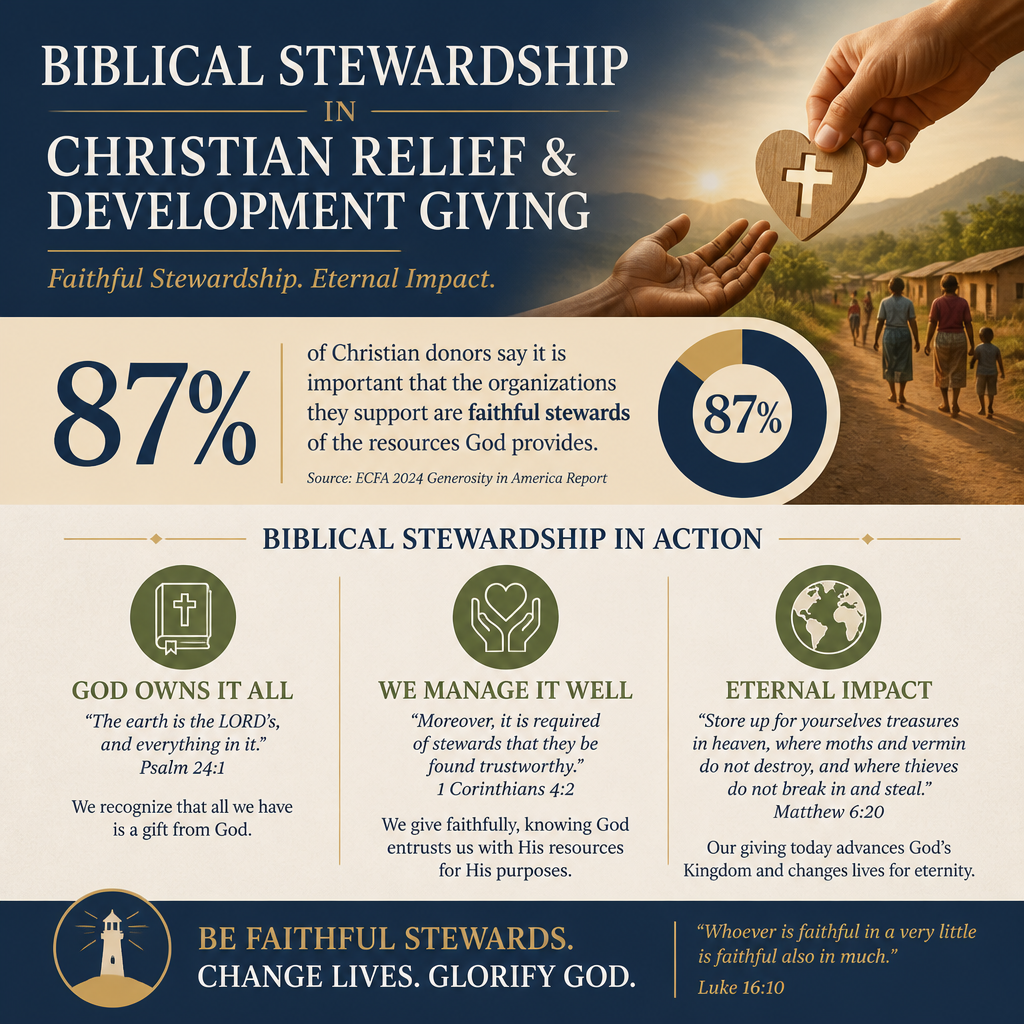
Christian stewardship starts with a basic confession: “The earth is the LORD’s and the fullness thereof” (Psalm 24:1). We are not owners who may be generous when convenient; we are stewards who will give an account. Jesus’ parable of the talents frames stewardship as faithful management under a returning Master (Matthew 25:14–30). Relief and development giving sits inside that same moral architecture.
What this means in practice is that donors should resist two distortions that often travel with crisis-driven generosity. The first is a functional belief that urgency excuses discernment. The second is a belief that emotional sincerity sanctifies ineffective or even harmful action. Scripture commends compassion, but it also condemns negligent care. “Whoever closes his ear to the cry of the poor will himself call out and not be answered” (Proverbs 21:13). Yet Scripture also insists on “what is honorable… in the sight of man” (2 Corinthians 8:21). The Bible is not embarrassed by careful administration.
Mercy is commanded, but it is not a blank check
Jesus binds love of neighbor to concrete action (Luke 10:25–37). The early church organized famine relief across regions (Acts 11:27–30). James is unsparing: faith without works is dead (James 2:14–17). Mature donors can affirm every one of these texts and still ask hard questions about what their dollars actually produce. Asking those questions is not cynicism; it is stewardship.
Stewardship requires formation, not only reaction
Relief appeals often arrive as moral emergencies. Donors may feel that if they hesitate, they are failing to love. But biblical stewardship forms habits over time: setting aside resources, giving proportionately, and giving thoughtfully (1 Corinthians 16:1–2). The goal is not hesitation; it is readiness—so that when genuine emergencies arise, Christians can act quickly without abandoning discernment.

Wise relief and development giving names the field’s real tensions
Christian donors often carry two convictions that can pull against each other: we should help now, and we should not harm. The modern relief and development field has had to reckon with the fact that well-intentioned aid can entrench dependency, distort local economies, or reward corrupt intermediaries. These are not merely technical problems; they are moral problems because they affect human dignity.
Relief and development are not the same task
Relief is urgent, short-term assistance meant to preserve life and stabilize communities after shocks—war, displacement, famine, natural disaster. Development is longer work: restoring livelihoods, strengthening institutions, improving health systems, and increasing resilience. Donors commonly fund “relief” that is actually long-term subsidization, or “development” that is actually short-term distributions without durable capacity. A biblically stewarded gift respects the difference.
Dignity is not optional
Scripture grounds human worth in the image of God (Genesis 1:27). That conviction should shape program choices. Some interventions treat people as passive recipients; others treat them as agents with responsibilities and capacities. The “When Helping Hurts” framework, articulated by Steve Corbett and Brian Fikkert, has reshaped Christian thinking by arguing that poverty is often relational and systemic, not merely a lack of goods. Donors do not need to agree with every application of that framework to recognize its central caution: help that bypasses local ownership can degrade the very people it intends to serve.

Donors genuinely disagree about priorities, and Scripture gives categories
Some Christian donors prioritize evangelism integrated with compassion. Others prioritize impartial humanitarian response in the name of common grace and public credibility. Scripture holds together both proclamation and mercy: Jesus preached the kingdom and healed the sick; the apostles taught sound doctrine and organized material relief. The question is not whether “word” or “deed” matters. The question is whether a ministry’s stated theological commitments match its actual practice, and whether its practices are accountable to the church and to observable outcomes.
Stewardship includes verification: money, governance, and truth-telling
Christians are not called to suspicion, but neither are we permitted to be naive. The New Testament commends integrity in handling funds precisely because temptation is predictable (John 12:4–6; 1 Timothy 6:10). Churches and donors should expect ministries to welcome scrutiny as a form of discipleship and protection.
Financial integrity is more than an overhead ratio
Donors are often told to judge ministries by “how much goes to programs.” That impulse can become a shortcut that rewards underinvestment in systems, controls, and evaluation. The “Overhead Myth” letter, signed by leaders from GuideStar, Charity Navigator, and the Better Business Bureau Wise Giving Alliance, warned that overhead ratios are a poor measure of performance and can create perverse incentives for nonprofits to underinvest in capacity. See the statement hosted by the BBB Wise Giving Alliance: BBB Wise Giving Alliance.
Stewardship asks better questions: Are financial statements timely and externally reviewed? Are restricted gifts handled with care? Is there evidence of internal controls? Does the board provide real oversight rather than ceremonial approval? A ministry can spend “little on overhead” and still be careless, opaque, or unstable. Conversely, a ministry may spend appropriately on administration and still deliver high-impact work with integrity.
Governance is a spiritual safeguard
Christian donors often focus on charismatic founders, compelling stories, and urgent needs. Governance can feel secondary. Yet governance is where many ministries either mature or unravel. Independent board oversight, documented conflict-of-interest policies, and clear executive accountability are not secular intrusions. They are instruments of honesty, consistency, and restraint—qualities Scripture esteems.
Across our verification work at Most Trusted, we observe that ministries that meet The Most Trusted Standard tend to treat governance as discipleship. They welcome questions, document decisions, and submit leaders to structures that prevent isolation. Where governance is weak, donors may still see short-term results, but the risks accumulate quietly: financial misstatements, mission drift, reputational crises, and beneficiaries harmed by unmanaged programs.
Transparency is part of truthfulness
Christian ministries trade in moral claims. They ask donors to trust that funds are used as promised and that stories are told accurately. Transparency is not marketing; it is truth-telling. Mature ministries publish clear descriptions of programs, costs, safeguards, and limitations. They do not hide behind spiritual language to avoid ordinary accountability. If a ministry cannot explain what it does and how it measures whether it is helping, donors should pause.
Practices donors can adopt without outsourcing their conscience
Discernment is not a one-time test; it is a posture. Christian donors can adopt a few disciplined practices that honor both urgency and accountability, especially when giving to relief and development ministries.
Clarify the purpose of each gift
Many households give from several “buckets” without naming them. It is steadier to decide: What portion of our giving supports the local church? What portion supports global relief? What portion supports long-term development? Scripture does not provide a modern allocation formula, but it does give priorities: the household of faith (Galatians 6:10), the poor (Proverbs 19:17), and the spread of the gospel (Matthew 28:18–20). Naming purposes reduces the chance that the latest crisis displaces commitments that are also biblical.
Ask ministry-specific questions that correspond to real risks
Relief and development work carries predictable vulnerabilities: cash distribution risks, procurement fraud, poor partner vetting, child protection failures, inflated reporting, and dependency dynamics. Donors do not need to be specialists, but we should ask questions that match the work:
- How does the ministry select and monitor local partners?
- What safeguards exist for children and vulnerable adults, and are staff trained to follow them?
- How are needs assessed so that aid does not undercut local markets or community initiative?
- What does “success” mean here, and what evidence is collected to test it?
- How does the ministry handle complaints from beneficiaries and whistleblowers?
Asking these questions is consistent with the biblical call to prudence. “The prudent sees danger and hides himself, but the simple go on and suffer for it” (Proverbs 27:12).
Give with both compassion and patience
Emergency relief invites immediate action, and Christians should be prepared to respond. But development is rarely fast. The donor’s temptation is to demand dramatic stories on a quarterly cadence. Ministries then feel pressure to report easily countable outputs rather than durable outcomes. Patience is not passivity; it is the willingness to fund the slow work of rebuilding livelihoods, strengthening local leadership, and restoring communities after trauma.
Stewardship also includes knowing when to stop giving. If a ministry will not provide basic documentation, refuses external review, or consistently overpromises, donors should move on. Mercy does not require enabling dysfunction.
Stewardship that honors Christ in public
Christian relief and development giving is watched by a skeptical world and by suffering neighbors. The church’s credibility is not the highest good, but it is not irrelevant. Paul’s concern to avoid blame in administering gifts (2 Corinthians 8:20–21) was explicitly missional: the gospel should not be discredited by financial negligence.
Most Trusted exists to help donors give with confidence by evaluating ministries against The Most Trusted Standard, a 15-criteria framework across Faith Foundation, Financial Integrity, Governance and Leadership, and Transparency and Effectiveness. Donors still must pray, discern, and decide; verification cannot replace conscience. But careful review can keep compassion tethered to truth.
For donors considering how relief and development fits within a broader portfolio of mercy, missions, and church support, our work across Christian Relief and Development Ministries reflects a consistent pattern: the most trustworthy ministries combine theological clarity with operational sobriety. They act quickly when crises strike, and they build structures that make speed accountable. That combination is not accidental. It is stewardship shaped by the fear of the Lord and love of neighbor.



