
Why Christians give to relief and development ministries is ultimately a question about discipleship under pressure: what love of neighbor requires when suffering is acute, and what wisdom requires when needs are chronic. Christian donors are often pulled between two legitimate instincts—urgent compassion for the person in front of us, and sober realism about what actually helps over time.
Scripture will not allow us to resolve that tension by retreating into sentiment or cynicism. The God who identifies himself as defender of the vulnerable also commands honest weights and measures. For mature Christian giving, mercy and truth have to travel together.
Mercy is not optional in Christian discipleship
The biblical pattern joins proclamation and provision
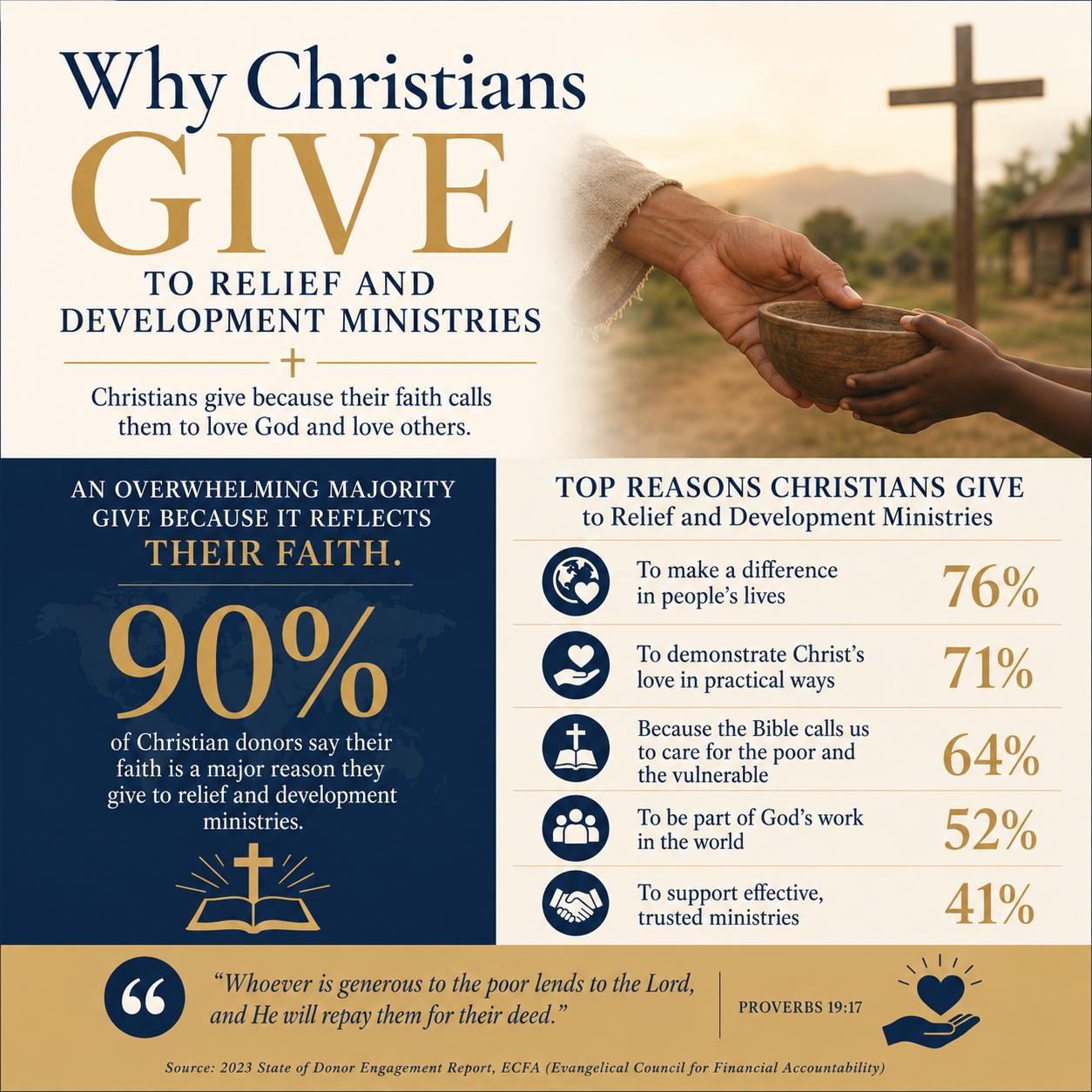
Across the biblical witness, care for the poor is not a peripheral virtue for especially tender-hearted believers. It is a repeated sign of covenant faithfulness. Israel’s law required provision for the gleaner and the stranger; the prophets condemned those who maintained religious forms while neglecting justice (Isaiah 58). Jesus’ own ministry intertwines the announcement of the Kingdom with tangible mercy—feeding the hungry, touching the unclean, restoring the outcast.
The early church assumed that generosity would be visible and costly. Paul’s collection for famine-stricken believers in Jerusalem is not framed as optional benevolence but as a concrete expression of unity in Christ (2 Corinthians 8–9). Relief and development ministries, at their best, sit inside that same pattern: local churches and Christian organizations translating confession into costly care.
Compassion requires presence, not abstraction
One reason Christian donors give to relief and development is that suffering becomes personal when it is named. A famine is a headline until it becomes a mother with an empty pantry. A displacement crisis is a statistic until it becomes a family worshiping in a tent. Christian giving often begins where abstraction ends.
This is not manipulation; it is the moral work of attention. The parable of the Good Samaritan does not commend the priest and Levite for maintaining a cautious distance from a complex situation. It commends the neighbor who stops, sees, and pays (Luke 10:25–37). Many donors recognize that a disciplined life of giving is one way to resist the spiritual anesthetic of comfort.

Relief and development address different kinds of need
Relief is for crisis, development is for capacity
Christians also give because they have learned—sometimes through painful missteps—that not all needs are the same. Relief is appropriate when people cannot help themselves: earthquakes, conflict displacement, epidemic disease, sudden job loss after a disaster. Development is appropriate when people can and should contribute to their own recovery: rebuilding livelihoods, strengthening local agriculture, improving health systems, training community leaders.
The When Helping Hurts framework, articulated by Steve Corbett and Brian Fikkert, helped many churches and donors name this distinction with clarity. It has also pressed Christian givers to ask a harder question than “Did we send something?”—namely, “Did our giving strengthen or weaken the agency, dignity, and long-term resilience of our neighbors?”
The humanitarian landscape is sobering
Scale is part of what drives Christian giving in this space: the needs are not small. The United Nations High Commissioner for Refugees reports that forced displacement has reached more than 120 million people worldwide, a level that represents not only immediate suffering but long-term destabilization for families and host communities alike UNHCR. Christian donors often give because they understand that the church’s mercy cannot be confined to local proximity when global crises are displacing entire peoples.
At the same time, global scale can invite simplistic solutions. Cash transfers may be more appropriate than shipping goods. Local procurement may serve communities better than imported surplus. Partnering with indigenous churches can be more sustainable than building parallel structures. Mature donors give because they want their mercy to be competent.
Wise giving requires moral seriousness about outcomes
Christian donors have learned to ask what helps
Relief and development work has had to reckon with unintended harm: dependency, market disruption, corruption, paternalism, and short-term projects that unravel when funding cycles end. These are not arguments against giving; they are arguments against careless giving. A donor who has seen a well-funded project fail is often not less compassionate, but more determined to fund interventions that endure.
Evidence-based practice is not a secular replacement for faith. It is one way we honor truth-telling. Christians do not fear reality. We believe creation has moral texture and causal structure, and that wise action respects both. That is why credible ministries increasingly measure outputs and outcomes, and why sophisticated donors ask to see what is being measured and what is being learned.
The overhead conversation needs to mature
Many donors were formed on a simplistic assumption that the “best” ministry is the one with the lowest administrative and fundraising costs. The nonprofit sector has pushed back on that assumption for good reason. The “Overhead Myth” letter—signed by GuideStar, Charity Navigator, and the BBB Wise Giving Alliance—argues that overhead ratios are a poor proxy for effectiveness and can create perverse incentives that weaken organizations Candid GuideStar.
Christian donors should still care about stewardship and discipline, but mature stewardship asks better questions. Is financial reporting timely and intelligible? Are controls strong enough to prevent fraud? Is leadership accountable? Are programs evaluated honestly? Underinvesting in governance, finance, security, or staff development can be a form of negligence, not virtue.
Trust is a spiritual and practical necessity
Donors carry real risks, and ministries do too
Christians give to relief and development ministries because we cannot personally inspect every field site, verify every report, or sit in every board meeting. We necessarily rely on trust—trust that funds are handled with integrity, that results are reported truthfully, that beneficiaries are treated with dignity, and that theology does not drift into a generic humanitarianism untethered from Christian conviction.
Yet trust is not blind. Scripture is candid about the temptations that surround money and power. The New Testament insists on honorable conduct “not only in the Lord’s sight but also in the sight of man” (2 Corinthians 8:21). For donors, that means verification is not suspicion; it is prudence in service of love.
What we examine at Most Trusted
Most Trusted exists because donors should not have to choose between speed of compassion and seriousness of due diligence. We evaluate Christian nonprofits against The Most Trusted Standard, a 15-criteria framework that examines faith foundation, financial integrity, governance and leadership, and transparency and effectiveness. The goal is not to create a new class of “perfect” ministries, but to clarify which organizations demonstrate the habits that protect donors, beneficiaries, and long-term mission.
Across our verification work, we observe that ministries worth supporting tend to share several traits:
- Clear theological commitments paired with appropriate humility in cross-cultural settings
- Decision-making authority that is documented and accountable
- Financial statements and policies that are understandable, current, and internally consistent
- Program reporting that distinguishes activity from actual results
- Safeguarding practices that treat beneficiaries as neighbors, not as content
Many Christian donors begin by following compelling stories. Mature donors learn to place those stories inside structures of accountability. This is one reason donors benefit from engaging the broader ecosystem of vetted ministries within Christian Relief and Development Ministries.
Christian donors give because hope has a public shape
Giving is a witness to the Kingdom
Christian relief and development giving is not only a response to need; it is also a declaration about reality. We believe the world is not closed to grace. We believe Christ is making all things new, and that his people should be found doing the kinds of works that fit that future. Mercy is not the gospel, but it is a fitting fruit of the gospel, and it makes the church’s proclamation harder to dismiss as mere talk.
There is also a pastoral dimension. Many donors carry a quiet ache: a sense that their comfort is fragile and their generosity too small. Giving to relief and development ministries is one way Christians practice freedom from fear. It teaches us that our security is not finally held by savings, but by the God who provides daily bread.
Stewardship includes discernment, not only sacrifice
Christians genuinely disagree about how to balance evangelism and social action, how to measure spiritual fruit, and how to weigh immediate relief against long-term development. These are not trivial disagreements; they reflect real differences in theology, context, and prudential judgment. The answer is not to stop giving. The answer is to give with eyes open, to support ministries that can explain their theory of change, and to remain accountable to Scripture’s commands about justice, truthfulness, and neighbor-love.
Donors who want to deepen this kind of discernment often benefit from continued formation in Biblical Stewardship in Christian Relief and Development Giving, where stewardship is treated as moral reasoning under the lordship of Christ, not merely as an emotional response to compelling needs.
FAQs for Why Christians give to relief and development ministries
Should Christian relief ministries prioritize evangelism over aid?
Christians should not separate what Scripture holds together. The church is commanded to proclaim Christ and to practice mercy. In some contexts, overt evangelistic activity may endanger local believers or beneficiaries, and wise leaders will assess risk carefully. The more reliable question for donors is whether a ministry’s faith foundation is clear, whether it serves people without coercion, and whether it partners respectfully with local churches where possible.
How can donors tell whether a relief and development ministry is trustworthy?
Trustworthiness is usually visible in habits: transparent reporting, accountable governance, consistent financial documentation, and credible evidence that programs achieve their stated aims. Donors can ask for audited financials when appropriate, review leadership and board independence, and look for safeguarding policies. Independent verification can also help, particularly when donors cannot personally evaluate field operations; this is a central reason Most Trusted assesses ministries against The Most Trusted Standard.
Giving that honors both compassion and truth
Christians give to relief and development ministries because Scripture commands mercy, because human suffering is real, and because hope in Christ refuses to remain private. The task for donors is not to choose between heart and head, but to bring both under obedience: compassion that moves toward suffering, and discernment that funds what truly helps.



