
What survivor care Christian anti-trafficking ministries provide is not a single service but a sustained continuum of protection, healing, and restoration. Donors often meet the issue through an arrest story, a rescue narrative, or a fundraising appeal; survivor care begins where headlines end, and it requires patient, trauma-informed work that honors both human dignity and real-world constraints.
Scripture’s logic is not ambiguous: the God who “executes justice for the oppressed” and “gives food to the hungry” also “sets the prisoners free” (Psalm 146:7). Christian ministry in this space is a form of neighbor-love that refuses to reduce a survivor to a case file, a statistic, or a success story. The question for donors is not whether compassion is warranted, but whether a ministry’s care model is credible, accountable, and structurally capable of doing what it promises.
Survivor care begins with safety, stability, and rights
Immediate protection is a ministry competence, not only a moral impulse
In mature anti-trafficking work, “care” starts with safety planning and stabilization. That can include crisis response, secure housing arrangements, emergency transportation, and coordination with law enforcement when the survivor chooses to engage. Because traffickers frequently use threats, debt, and coercive control, ministries that treat safety as an afterthought can unintentionally expose survivors to renewed harm.
Christian donors sometimes expect care to look like hospitality and warmth alone. Those matter. But survivor care also requires protocols: intake procedures, confidentiality standards, secure recordkeeping, staff training, and a clear decision-making chain when risks escalate. The ministries that meet The Most Trusted Standard tend to document these safeguards and demonstrate that survivor well-being governs operational choices, even when that reduces “shareable” stories.
Legal advocacy is often inseparable from healing
Survivors may need help obtaining protective orders, navigating immigration questions, clearing criminal records tied to exploitation, or accessing victim compensation. This is one reason survivor care is rarely inexpensive or fast. It can involve trained advocates, trauma-informed attorneys, and sustained case management through a maze of systems that were not designed for people coming out of coercion.
Donors should also recognize that the anti-trafficking ecosystem includes government-defined standards and processes. In the United States, the federal definition of “severe forms of trafficking in persons” shapes eligibility for certain protections and services, and ministries that work responsibly will understand those categories even when they serve beyond them. See the U.S. Department of State’s definition and framework at U.S. Department of State.

Effective care is trauma-informed and clinically integrated
Trauma-informed care is a discipline with boundaries
Trafficking often produces complex trauma. Many survivors carry layered histories of childhood abuse, intimate partner violence, substance use, or homelessness that preceded exploitation. Trauma-informed care does not mean “soft” expectations; it means an approach that understands triggers, prioritizes choice and agency, and avoids re-enacting control dynamics through coercive programming.
In practice, this shapes everything: the language staff use, how consequences are applied in housing programs, how conflict is handled, and how spiritual care is offered without manipulation. Donors can listen for whether a ministry is formed by established trauma frameworks rather than intuition alone. The Substance Abuse and Mental Health Services Administration’s widely used trauma-informed principles are a baseline reference point at SAMHSA.
Clinical partnerships matter, even for strongly discipleship-oriented ministries
Many Christian ministries rightly emphasize discipleship, community, and the hope of the gospel. But faithful theology does not eliminate the need for competent clinical care. Survivors may need licensed counseling, psychiatric evaluation, addiction treatment, and medical care for injuries and chronic conditions. A ministry does not need to employ every specialist, but it should have reliable referral pathways and memoranda of understanding with qualified providers.

This is an area where donors should ask unglamorous questions. Are counselors licensed? Is there clinical supervision? Are staff trained to recognize suicidal ideation, dissociation, or acute withdrawal? A ministry can be deeply Christian and still cause harm if it substitutes spiritual language for professional competence where clinical care is required.
Long-term restoration requires housing, work, and community
Housing is not an “add-on” to survivor care
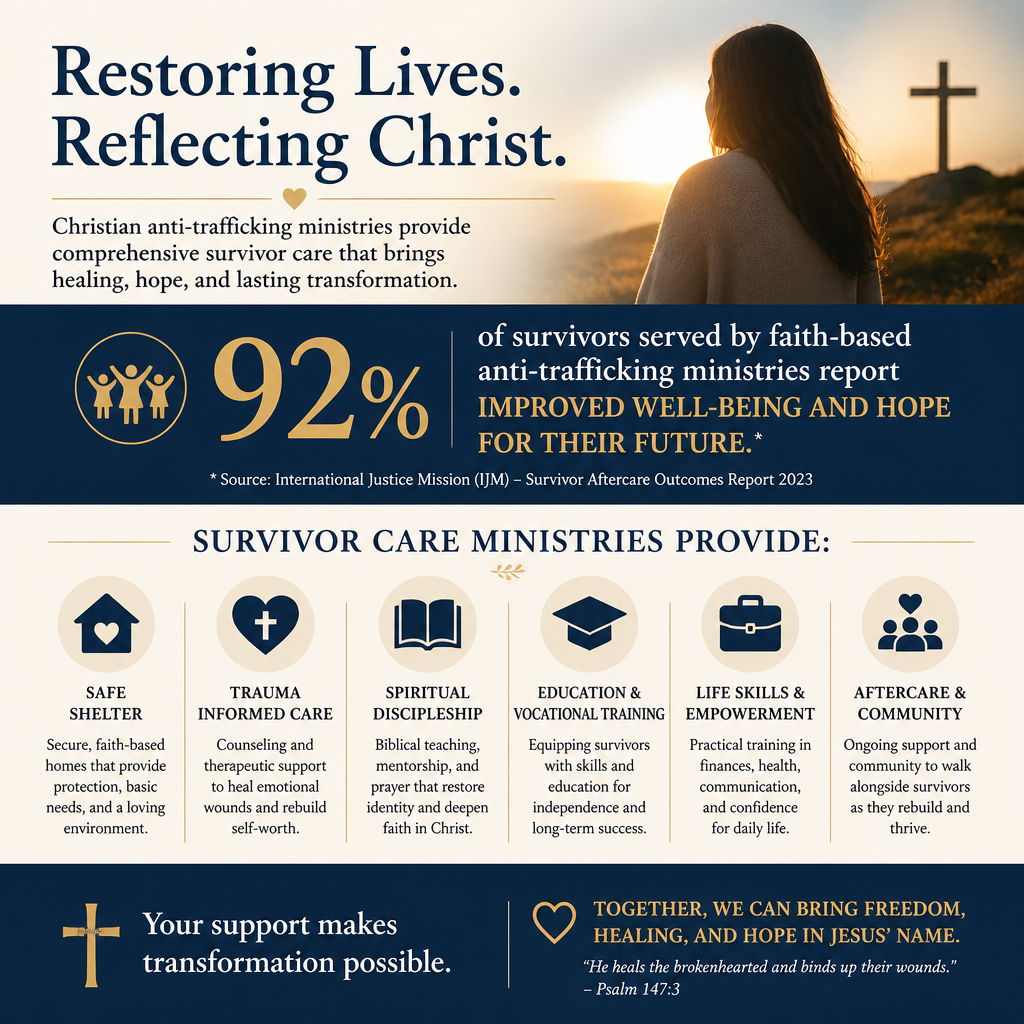
Without stable housing, nearly every other intervention becomes fragile. Many ministries provide or fund emergency shelter, transitional housing, or long-term residential programs. Each model has trade-offs. Residential programs can offer structure and safety, but they can also become overly controlling if they are not intentionally designed around survivor agency and informed consent. Scattered-site housing can preserve independence, but it can raise safety and isolation risks if support is thin.
Donors should also recognize the financial pressure housing creates. Secure facilities, trained staff, insurance, and 24/7 coverage quickly push budgets upward. The question is not whether overhead exists; it is whether the organization is honest about its real costs and governed responsibly as it carries them.
Economic empowerment is often the hinge of lasting freedom
Survivor care frequently includes education support, job readiness training, resume coaching, interview preparation, and connections to employers willing to offer dignified work. Some ministries operate social enterprises; others partner with local businesses. The strongest models do not treat employment as a quick win. They address barriers such as gaps in work history, criminal records tied to exploitation, childcare needs, and transportation.
We recommend donors look for programs that measure progress in ways that respect complexity: retention, wage growth, sustained housing stability, and reduced vulnerability to re-exploitation. When donors want a single number, ministries are tempted to overpromise. Christian wisdom requires patience for slow rebuilding.
- Stable housing pathways that match safety needs and survivor choice
- Case management that coordinates medical, legal, and social services
- Education support from GED to vocational training to higher education
- Employment partnerships that prioritize dignity and realistic expectations
- Community integration that reduces isolation without forcing disclosure
Spiritual care must be offered with consent and theological maturity
The gospel cannot be used as a lever
Christian donors often ask, rightly, whether ministries “share Christ.” The more precise question is how spiritual care is practiced with survivors whose agency has been violated. Faithful ministries offer spiritual care as invitation, not leverage. They refuse to tie housing, counseling, legal help, or food to participation in religious activities. They also train staff to avoid using spiritual authority to pressure disclosure, forgiveness timelines, or reconciliation in unsafe situations.
This is not a concession to secularism; it is congruent with Christian ethics. Jesus does not coerce. The New Testament’s vision of pastoral leadership is marked by gentleness and integrity, not domination (1 Peter 5:2–3). Ministries with theological maturity understand that spiritual trauma can be part of a survivor’s story, especially when exploitation involved religious manipulation.
Local church partnerships should reduce risk, not add it
Many survivor care programs connect survivors to churches for community, discipleship, and practical support. This can be profoundly stabilizing, but it also introduces risks: curiosity, untrained “helpers,” and pressure to share testimony before a survivor is ready. Responsible ministries train church partners, establish confidentiality norms, and curate relationships carefully.
For donors seeking a broader orientation to responsible Christian engagement against trafficking, our coverage of Christian Anti-Trafficking Ministries addresses common models and frequent points of confusion.
What donors should verify before funding survivor care
Evidence of competence is usually found in governance and transparency
Survivor care is emotionally weighty, and that weight can make donors vulnerable to compelling stories. A healthier approach is to fund what is verifiable: governance that can withstand crisis, financial integrity that can sustain long-term care, and transparency that resists exaggeration. At Most Trusted, our verification work evaluates ministries against The Most Trusted Standard, a 15-criteria framework that tests whether an organization’s faith commitments, finances, leadership practices, and reporting habits are aligned with the responsibilities they claim.
Donors can ask direct questions without cynicism: Who provides oversight for survivor-facing staff? How are critical incidents documented and reviewed? What are the organization’s safeguarding policies for minors and vulnerable adults? How does the board handle conflicts of interest and executive accountability? A ministry may do beautiful work and still need stronger systems; donors should not finance fragility.
Outcome reporting should be honest about limitations
Christians genuinely disagree about what “success” should mean in anti-trafficking work. Some emphasize rescues and prosecutions; others prioritize prevention and long-term stability; many aim for a balanced portfolio. The field has also had to reckon with inflated claims and poor measurement. For that reason, donors should view sweeping numbers with caution, especially if a ministry’s public reporting lacks methodology.
Reliable ministries report outcomes with definitions, time horizons, and humility about what cannot be attributed to any one program. When data is shared, it should protect survivor privacy. When stories are shared, consent should be explicit and documented. Where donors want deeper focus on care models, our work on Survivor Care in Christian Anti-Trafficking Ministries names recurring strengths and recurring failure points we see across the sector.
For a grounded sense of the scale and complexity of trafficking globally, donors can consult the International Labour Organization’s estimates on forced labor and exploitation at International Labour Organization. The purpose of such data is not to inflate urgency for fundraising, but to anchor strategy in reality.
FAQs for What survivor care Christian anti-trafficking ministries provide
What is the difference between rescue and survivor care?
Rescue refers to the immediate interruption of exploitation, often involving law enforcement and crisis response. Survivor care refers to the longer, comprehensive work that follows: safety planning, housing, medical and mental health care, legal advocacy, and sustained support toward stability. Many ministries participate in both, but mature organizations distinguish the competencies and risks of each rather than collapsing everything into a single dramatic moment.
How can Christian donors support survivor care without funding harmful practices?
Christian donors can prioritize organizations that document safeguarding policies, maintain strong governance, and report outcomes with clarity rather than hype. Funding unrestricted or flexible support can be appropriate when an organization has demonstrated financial integrity and transparency, because survivor care costs are often unpredictable. Donors can also ask whether spiritual care is offered by consent, whether clinical services are licensed or responsibly partnered, and whether survivor privacy is protected in communications.
A faithful donor posture toward survivor care
Survivor care is one of the clearest places where Christian compassion must be disciplined by truth. The work calls for courage, competence, and the refusal to treat human beings as instruments for a cause. When donors fund survivor care that is trauma-informed, clinically responsible, spiritually mature, and governed with integrity, they participate in a form of justice that reflects the character of God—steadfast, patient, and ordered toward restoration.



