
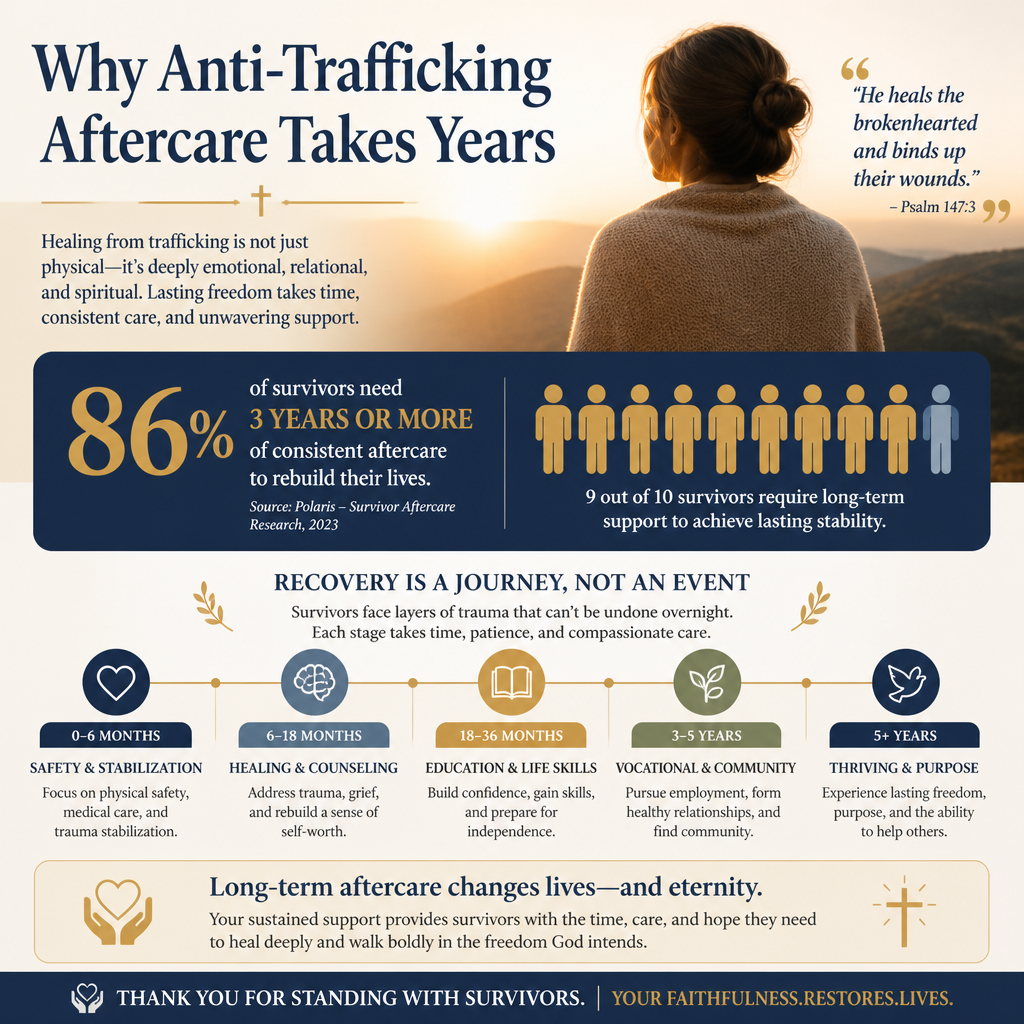
Why anti-trafficking aftercare takes years is not primarily a question of organizational efficiency. It is a question of what severe, repeated trauma does to the human person—body, mind, relationships, and spiritual imagination—and what it takes to rebuild what exploitation has deliberately dismantled.
Christian donors often want to act decisively and quickly, and that instinct can be morally healthy. Scripture commends urgent mercy. Yet the same Scriptures that command rescue also teach patience with restoration: “a bruised reed he will not break” (Isaiah 42:3). Aftercare is the bruised-reed work of long obedience, where progress is real but rarely linear, and where faithful care must outlast the crisis moment.
Aftercare is not a program phase, it is a rebuilding of the person
Trafficking targets agency, attachment, and identity
Trafficking is not only a set of crimes; it is a system of coercion designed to seize agency. Survivors may have been conditioned through violence, threats, debt bondage, isolation, and repeated violations of boundaries. The outcomes often resemble complex trauma, including disrupted attachment, hypervigilance, dissociation, and impaired executive functioning. These dynamics cannot be “counseled away” in a quarter or two; they require sustained, skilled, relational care.
The field has had to reckon with the difference between short-term stabilization and long-term integration. Stabilization may mean safe housing, medical attention, and immediate legal protection. Integration involves rebuilding decision-making, healthy relationships, and meaningful work. Ministries that speak candidly about this distinction tend to set more realistic expectations for donors and volunteers.
Time is part of what safety means
In our verification work at Most Trusted, we observe that credible aftercare organizations treat time as a protective factor. Survivors often need long stretches of predictable routines, consistent boundaries, and trustworthy adults before deeper therapeutic work can be safely undertaken. This is not reluctance to “get to outcomes.” It is a recognition that safety is experienced over time, not merely provided in a moment.
For donors evaluating ministries in Christian Anti-Trafficking Ministries, this is a central interpretive key: a slower pace is frequently evidence of prudence rather than drift, especially when the ministry can show clear safeguards, survivor-centered practices, and sober reporting.

Trauma recovery is measurable, but it is rarely linear
Relapse and re-exploitation are predictable risks
Survivors may return to exploiters, engage in survival behaviors that look self-destructive, or resist services that outsiders perceive as obviously beneficial. These patterns are not proof that “aftercare is not working.” They are often part of the trauma bond and the economics of coercion, where an exploiter has controlled housing, transportation, and access to basic needs.
Research and service-provider practice consistently emphasize the role of long-term support networks, not merely acute intervention. Government frameworks reflect this complexity. For example, the U.S. Department of Health and Human Services describes human trafficking as involving force, fraud, or coercion and highlights the need for comprehensive victim services that can include housing, medical care, mental health care, and legal assistance U.S. Department of Health and Human Services, Office on Trafficking in Persons.
What donors call outcomes, clinicians often call capacity
Donors rightly ask for outcomes: job placement, education credentials, stable housing, family reunification. Those are meaningful. Yet trauma-informed practice also tracks capacities that precede the visible milestones: emotional regulation, healthy boundaries, impulse control, and the ability to trust safe authority. These capacities are not “soft” outcomes; they are the infrastructure of sustainable freedom.
The harder question for Christian philanthropy is whether we will fund the infrastructure or only the headline. Ministries can be pressured to report quick wins, which quietly incentivizes serving those easiest to place rather than those most harmed. Serious aftercare leaders resist this pressure, even when it costs them in donor appeal.
Legal, medical, and economic realities stretch timelines
The justice process moves at the pace of courts, not compassion
Aftercare often unfolds alongside criminal investigations, immigration proceedings, restraining orders, custody matters, and restitution claims. Court calendars, evidentiary requirements, and continuances can extend for years. Survivors may need accompaniment for hearings, transportation, safety planning, and ongoing case management. A ministry that prepares a survivor for a marathon rather than a sprint is practicing honesty, not pessimism.
Even where legal protections exist, access can be uneven. The U.S. Department of Justice outlines federal anti-trafficking enforcement and victim support resources, but actual local capacity depends on trained personnel and coordinated systems U.S. Department of Justice, Human Trafficking.
Livelihood is often the slowest and most decisive factor
Trafficking is sustained by economic vulnerability. Aftercare that ends with temporary shelter but no path to stable income can leave survivors exposed to re-exploitation. Job readiness may require GED completion, trauma-informed workforce development, treatment for substance use disorders, and basic life skills that were never safely learned.
Christian donors sometimes underestimate how expensive it is to fund genuine stability: rent support, childcare, transportation, and ongoing counseling. These costs do not fit neatly into a single fiscal year narrative. They do, however, fit the biblical pattern of restoration that includes material provision, not merely spiritual counsel (James 2:15–16).
Faith-shaped care adds depth, not speed
Theological language must be handled with extraordinary care
Christian aftercare is at its best when it refuses to instrumentalize survivors for testimonies or fundraising. The gospel never requires a survivor to perform gratitude or accelerated sanctification. Survivors may carry spiritual injury: coercion wrapped in religious language, shame imposed by abusers, or deep confusion about God’s presence. A ministry may be doctrinally orthodox and still spiritually unsafe if it pressures disclosure, demands premature forgiveness, or treats trauma symptoms as moral failures.
Across our verification work, ministries that meet The Most Trusted Standard tend to show humility in how Scripture is applied in counseling contexts. They distinguish between proclamation and pastoral care, and they ensure survivors have meaningful choice about spiritual activities. That posture is not a concession to secular norms; it is consistent with Christian ethics of dignity and consent.
Community rebuilding requires more than a Sunday invitation
Survivors often need a carefully supported re-entry into community. Healthy church connection can be profoundly stabilizing, but it can also be disorienting if it is rushed or if congregations are unprepared for trauma responses. Mature aftercare organizations cultivate partnerships with churches that understand boundaries, confidentiality, and the difference between friendship and informal counseling.
What this means in practice is that timelines lengthen when ministries do the slow work of building safe, trained community around a survivor rather than simply offering a referral. Long-term freedom is not only an internal state; it is a set of reliable relationships.
What responsible donors should look for in long-term aftercare
Indicators of seriousness rather than slogans
Because aftercare takes years, donors need evaluation tools that reward faithful durability rather than marketing velocity. Most Trusted exists to help donors give with confidence by evaluating ministries against The Most Trusted Standard, a 15-criteria framework across Faith Foundation, Financial Integrity, Governance and Leadership, and Transparency and Effectiveness. The aim is not cynicism; it is stewardship shaped by truthfulness.
In Survivor Care in Christian Anti-Trafficking Ministries, the ministries most worthy of sustained partnership usually share a recognizable set of practices:
- Clear safeguarding policies, including confidentiality protocols and boundaries around storytelling and photography
- Trauma-informed clinical care, with licensed professionals or formal supervision structures
- Documented case management practices that coordinate legal, medical, and vocational supports
- Realistic, non-sensational reporting that distinguishes short-term stabilization from long-term outcomes
- Governance and financial practices that reduce the risk of charismatic overreach or donor-driven mission drift
Questions that protect both survivors and donors
Christian donors are often torn between urgency and due diligence. The tension is legitimate: the need is immediate, and the harms of poorly designed programs are real. The donor’s task is to ask questions that are patient enough to honor survivors and specific enough to detect risk. Ministries should be able to explain their model of care, their referral network, their clinical oversight, and how they handle setbacks without punishing survivors or manipulating donors.
We also recommend attending to what a ministry does not do. A refusal to promise fast transformations can be a mark of integrity. A refusal to publish identifiable survivor stories can be a mark of protection. In a cause area shaped by public emotion, restraint is often a virtue.
FAQs for Why anti-trafficking aftercare takes years
Should we stop giving if a ministry cannot show quick success stories?
Not necessarily. Quick stories can be real, but they can also be selectively reported. A stronger approach is to ask whether the ministry can demonstrate consistent care processes, appropriate clinical oversight, and transparent outcome definitions over time. Aftercare often advances through stability, reduced crises, sustained housing, and durable employment—measures that do not always produce immediate narratives but can reflect genuine restoration.
How can donors fund long-term aftercare without creating dependency?
Dependency is not avoided by shortening care; it is avoided by designing care toward increasing agency. Funding that supports education, job readiness, mental health treatment, and stable housing can be explicitly time-bound and capacity-building. Donors can also prioritize ministries that coordinate with public benefits and local services when appropriate, so philanthropic dollars strengthen a survivor’s pathway to independence rather than replacing it.
The patience that restoration requires
Anti-trafficking work often begins with a rescue impulse, and that impulse can reflect Christian courage. Aftercare requires a different courage: the willingness to remain when the story becomes less dramatic and more costly. Years of faithful, competent care are not a failure of strategy. They are often the necessary shape of love when the image of God in a survivor has been targeted for destruction and must be rebuilt with reverence, truthfulness, and time.



