
What safe housing looks like in Christian anti-trafficking ministries is more than a locked door and a quiet bed. It is a carefully governed, trauma-informed environment where survivors are protected from further exploitation, given meaningful agency, and surrounded by Christian love that refuses to confuse control with care.
Donors often feel the weight of two responsibilities at once. The first is the biblical command to “seek justice” and “bring justice to the fatherless” (Isaiah 1:17). The second is the sobering reality that housing can heal or harm, depending on design, leadership, and accountability. The field has had to reckon with failures: unsafe placements, spiritual coercion, weak screening, and ministries that promise “rescue” while neglecting the long work of restoration.
Safe housing begins with protection that is legally and operationally credible
Safety is not a vibe; it is a system. In anti-trafficking residential programs, survivors often face credible threats from traffickers, coercive partners, or networks that have previously located them through social media, family contacts, or informal community ties. Housing must be built on protocols that can withstand scrutiny from law enforcement, child welfare authorities, licensing bodies, and trauma clinicians.
Location, confidentiality, and controlled access are baseline safeguards
Programs typically maintain strict address confidentiality, controlled visitor policies, and limits on digital exposure. These measures can feel severe to donors who want a home-like atmosphere, but traffickers frequently use technology and social connections to reassert control. The National Human Trafficking Hotline has documented how traffickers commonly rely on threats, isolation, and surveillance to maintain exploitation, which is why a survivor’s physical environment and communications boundaries matter from day one National Human Trafficking Hotline.
Protection also includes secure transportation procedures, staff trained to recognize grooming and triangulation, and crisis planning for attempts to contact or retrieve a resident. When a ministry cannot clearly articulate these basics, donors should assume the program is operating on goodwill rather than professional readiness.
Legal compliance is part of moral seriousness
Christian compassion does not excuse ignoring regulatory frameworks designed to protect vulnerable people. Depending on the population served, credible safe housing may require state licensing for residential care, mandatory reporting training, and compliance with child protection standards. For minors, the legal obligations are non-negotiable; for adults, they remain materially relevant because restraining a survivor’s movement or communication can drift into unlawful practice even when motivations are sincere.
Safe housing is not only “security.” It is documented, reviewed, and auditable practice. Across our verification work at Most Trusted, ministries that meet The Most Trusted Standard can explain who oversees policy, how incidents are reported, and how compliance is monitored without defensiveness or ambiguity.

Safe housing is trauma-informed, not control-driven
Trafficking is not merely a sequence of bad events; it is sustained coercion that alters a person’s sense of self, trust, and bodily autonomy. A Christian home that intends healing must resist replicating the dynamics of domination that trafficking imposed, even inadvertently through rigid rules, shaming language, or spiritualized compliance.
Trauma-informed care respects the survivor’s agency
A common tension in residential programs is the impulse to “stabilize” through heavy restriction: phone bans, blanket prohibitions, enforced schedules, or immediate pressure to recount trauma. Some structure is appropriate. But a credible program can explain why each restriction exists, how it is reviewed, and how it is tailored rather than assumed. The Substance Abuse and Mental Health Services Administration defines trauma-informed care around safety, trustworthiness, peer support, collaboration, empowerment, and cultural considerations—principles that translate directly into residential ministry practice SAMHSA.
What this means in practice is that residents have meaningful choices: how and when to engage services, what goals they prioritize, and which supports feel safe. Staff do not mistake compliance for healing. And progress is measured by stability, relationships, and functioning over time, not merely by rule adherence.
Boundaries protect residents and staff alike
Trauma-informed ministries also guard against a different hazard: relational overreach. Survivors may attach quickly to a caregiver; staff may respond with rescuing instincts that blur roles. Safe housing builds clear relational boundaries, documented supervision structures, and limits on private communications between staff and residents. This is not clinical coldness; it is ethical love. Scripture’s call to shepherding includes sober warnings about power, partiality, and exploitation of the vulnerable (Ezekiel 34).
Safe housing integrates clinical excellence with Christian formation that is not coercive
Christian donors rightly hope survivors will encounter Christ’s healing. The harder question is how to pursue Christian spiritual care in a way that honors the survivor’s conscience and avoids manipulating dependence. When a person needs a bed, food, and protection, the power imbalance is real. Spiritual care must therefore be offered as invitation, not condition.
Clinical partnerships are not a concession to secularism
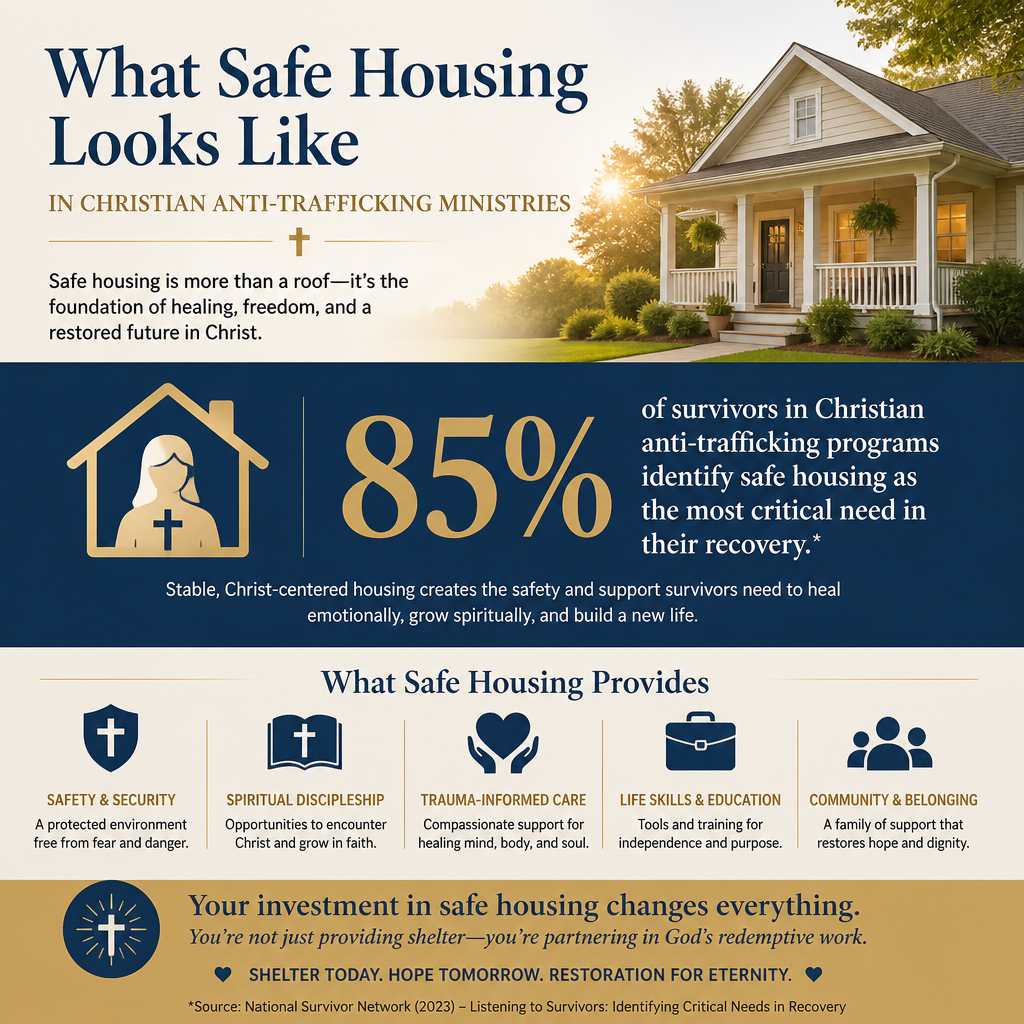
Many survivors need evidence-based mental health care: trauma therapy, substance use treatment, psychiatric evaluation, and medical services. Christian ministries do not lose their Christian identity by partnering with qualified clinicians. They demonstrate humility about what they can and cannot provide.
Some programs employ licensed counselors; others maintain referral relationships with local providers. Either model can be sound if it includes consistent case coordination and clear confidentiality practices. Safe housing also recognizes that “successful” care may involve medication management, extended treatment timelines, and setbacks that do not fit donor expectations for quick transformation.
Christian discipleship must honor freedom and dignity
A credible program can clearly distinguish between spiritual support and program compliance. Bible studies, worship opportunities, and pastoral counseling can be offered generously while never being required for basic services. Residents should be able to decline without losing privileges, safety, or standing. Forced religiosity has produced scandals in multiple sectors of care; Christian anti-trafficking ministries must not repeat them under a banner of zeal.
Safe housing, at its best, embodies the character of Christ: truth without coercion, holiness without humiliation, and mercy that does not bargain with a person’s vulnerability (Matthew 12:20).
Safe housing is governed with transparency, accountability, and measurable outcomes
Residential care is one of the highest-risk environments in nonprofit work because it combines vulnerable residents, high staff discretion, and often limited external visibility. Strong governance and transparent reporting are not administrative preferences; they are moral protections.
Governance must be strong enough to constrain good intentions
Effective boards oversee policy, review incidents, and ensure the program is not built around a charismatic founder whose judgment goes unchecked. Safe housing programs have written grievance processes for residents, third-party reporting channels, and documented responses to allegations. They do not treat questions as attacks.
This is one place donors can apply The Most Trusted Standard with clarity. When we evaluate ministries, we look for evidence of independent oversight, responsible financial practices, and transparent disclosure—especially for programs that involve residential control and high confidentiality.
Transparency should be survivor-protective, not donor-performative
Christian donors often see marketing that centers dramatic rescues, before-and-after testimonies, or identifiable survivor stories. The ethical problems are obvious: retraumatization, public exposure, and a subtle conversion of pain into fundraising currency. Safe housing programs protect privacy with rigor, obtain informed consent, and avoid storytelling practices that would compromise safety.
Donors who want a broader landscape view of how ministries structure care can review Survivor Care in Christian Anti-Trafficking Ministries as a category and compare models with a more disciplined lens than emotional appeal allows.
Safe housing plans for long-term stability, not only immediate refuge
A bed tonight matters. But safe housing that ends at shelter can unintentionally set survivors up for instability tomorrow. The field has learned that survivors often face layered obstacles: criminal records, damaged credit, gaps in employment, immigration complications, child custody disputes, and chronic health concerns. A “safe” house that does not plan for reintegration can become a holding pattern.
Aftercare is where many programs succeed or fail
Strong programs plan exit pathways from the beginning: vocational training, education, job placement support, legal advocacy, and step-down housing. They coordinate with local churches carefully, recognizing that well-meaning volunteers may lack training for trauma dynamics and confidentiality needs.
Long-term stability also requires attention to relapse risk, re-contact attempts by exploiters, and the survivor’s own complex attachments. The International Labour Organization has estimated that forced labor generates substantial illegal profits globally, a reminder that trafficking is not only interpersonal evil but also an economic system with incentives that persist after a survivor leaves a program International Labour Organization.
What donors can responsibly ask before funding residential care
Christian donors do not need to become specialists to ask serious questions. Safe housing ministries should welcome them.
- What licensing, accreditation, or external oversight applies to this residential program, and how is compliance documented?
- How are staff vetted, trained, supervised, and held accountable, including background checks and ongoing performance review?
- What is the resident grievance process, and can residents report concerns to an independent party?
- How does the program define trauma-informed care, and which clinical partners or licensed professionals are involved?
- How is Christian spiritual care offered without coercion or conditionality for services?
- What outcomes are tracked beyond occupancy, such as stable housing, employment, education progress, and reduced re-exploitation risk?
Donors who want to situate these questions within the broader work of prevention, intervention, and restoration can also reference Christian Anti-Trafficking Ministries for a wider map of program types and risks.
FAQs for What safe housing looks like in Christian anti-trafficking ministries
Should a Christian safe house require church attendance or Bible study participation?
Requiring religious participation as a condition of shelter or basic services is ethically fraught because residents are not operating from equal power. Christian formation is a gift, not a toll. Safe housing can offer worship, Scripture, pastoral counseling, and Christian community as invitation while ensuring residents can decline without punishment, loss of services, or diminished standing.
Is more security always better in a trafficking safe house?
Security measures are sometimes necessary, but they should be specific, reviewed, and proportionate. Overly restrictive policies can mirror the control dynamics of trafficking and impede healing. Credible programs can explain the purpose of each restriction, how it is tailored to individual risk, and how resident agency is gradually strengthened as safety increases.
A faithful picture of safety is accountable love
Safe housing in Christian anti-trafficking ministries is best understood as accountable love: protection that is operationally real, care that is trauma-informed, spiritual support that honors conscience, and governance that welcomes scrutiny. Donors serve survivors well when they fund not only compassion, but also the quiet infrastructures that keep compassion from becoming harm.



