
Survivor care in Christian anti-trafficking ministries is the long, demanding work of helping men, women, and children move from exploitation toward safety, stability, and restored agency. For Christian donors, the central question is not whether aftercare matters, but what faithful and effective care actually requires when trauma, legal vulnerability, and spiritual injury converge.
The field has had to reckon with a difficult truth: rescue is often the shortest chapter in a survivor’s story. Aftercare is where the stakes become clearest—because it is where ministries either honor survivors as image-bearers with hard-won dignity, or unintentionally recreate control, dependence, and shame under religious language. Mature donor discernment starts by understanding what survivor care entails, what it costs, and what evidence of integrity looks like over time.
Survivor care is a long-term ministry of restoration, not a rescue moment
Scripture’s vision of liberation is not thin. God’s deliverance is both immediate and covenantal—breaking chains and then leading people patiently toward worship, community, and ordered life. Anti-trafficking aftercare that is faithful to that vision will be slow, relational, and structurally supported, not driven by urgency alone. That pace can be difficult for donors formed by dramatic narratives, but it is closer to the moral realism of the Psalms than to the logic of a campaign.
Trafficking creates layered harm: physical injury, complex trauma, threats against family, coercive debt, isolation from social supports, and often criminal records tied to exploitation. Survivor care must respond across those layers without collapsing the person into a “case.” What this means in practice is that a ministry’s aftercare model should be legible: clear eligibility criteria, defined services, and a plausible pathway from crisis to stability. Vague language about “rescue and restore” is not enough.
Trauma-informed care is a theological commitment to truth-telling
“Trauma-informed” has become fashionable language in nonprofit communication, but it reflects a basic Christian ethic: love does not demand that a wounded person perform wellness to be welcomed. Trauma-informed survivor care typically includes consistent routines, predictable boundaries, choice wherever possible, and staff trained to recognize triggers and dissociation. It also means ministries do not weaponize spiritual practices—forcing public testimony, requiring immediate forgiveness, or attaching spiritual worth to compliance.
Complex trauma is widely recognized in clinical literature, and the U.S. Substance Abuse and Mental Health Services Administration describes trauma as having “lasting adverse effects” on functioning and well-being; their framework emphasizes safety, trustworthiness, peer support, collaboration, and empowerment SAMHSA. Ministries need not become clinics, but those who do survivor care well generally take these principles seriously and translate them into policies, staff formation, and daily practice.
Aftercare must protect agency, not replace one form of control with another
Christians genuinely disagree about how directive a residential program should be, especially in early-stage stabilization. There are real trade-offs: too little structure can expose survivors to relapse, re-recruitment, and unsafe relationships; too much structure can recreate coercion and dependence. The question is not whether there are rules, but whether rules are transparent, proportionate, consistently applied, and oriented toward survivor agency rather than staff convenience.
Healthy programs typically make the pathway explicit: what a resident can expect in the first weeks, what milestones allow increased independence, and what rights the survivor retains throughout. Donors should expect ministries to explain how they handle conflict, exit decisions, contact with family, and the use of phones, transportation, and social media—areas where control has historically been abused in some settings.

Core components of Christian aftercare include safety, counseling, and practical stabilization
Survivor care is often described in categories—safe housing, counseling, legal advocacy, job training—but in reality these services interlock. A survivor cannot sustain therapy without stable housing; cannot keep employment without reliable transportation; cannot pursue schooling while threatened by a trafficker; cannot engage spiritually if staff confuse discipleship with compliance. Strong ministries build a coherent system rather than a menu of disconnected programs.
Safe housing is a ministry of protection with enforceable safeguards
Safe housing is more than a bed. It includes security planning, confidentiality protocols, visitor policies, and coordination with law enforcement when appropriate. It also requires careful attention to the dynamics inside the home: peer conflict, trauma responses, and cultural or language barriers. Ministries that provide housing should be able to describe staff-to-resident ratios, overnight supervision, staff training, and how they screen and supervise volunteers.
Housing models vary—short-term emergency shelter, transitional homes, foster care partnerships, and longer-term supportive housing. Donors should not assume that “longer” is always better; sometimes the wisest approach is a staged pathway with step-down support. The more residential and restrictive the model, the more donors should insist on governance guardrails: grievance procedures, outside accountability, and written rights for residents.
Trauma counseling requires funding that is steady and realistic
High-quality counseling is costly because it depends on trained professionals, clinical supervision, and continuity of care. Some ministries employ licensed clinicians; others fund therapy through partner providers. Either model can be responsible, but donors should ask what ensures quality: licensure requirements, evidence-based modalities used with discernment, and clear referral pathways for psychiatric care, addiction treatment, or complex medical needs.
The U.S. National Human Trafficking Hotline notes that survivors often have urgent needs including shelter, counseling, medical care, and legal services, and that service provision is a critical part of response systems National Human Trafficking Hotline. A ministry’s budget should reflect that reality. If a program describes intensive counseling but shows minimal program expense for clinical services, donors should ask clarifying questions about who provides care and how it is funded.
Legal and practical stabilization are often the hinge points
Survivors routinely face legal complexity: immigration status, criminal records tied to exploitation, restraining orders, custody issues, and restitution. Ministries may provide in-house legal advocacy, maintain pro bono networks, or partner with specialized organizations. Donors should look for competence and humility here. Poor legal guidance can expose survivors to retaliation or jeopardize cases.
Practical stabilization can sound mundane, but it is frequently decisive: replacing identification documents, navigating healthcare systems, paying for transportation, securing childcare, and building basic financial capability. Christians sometimes underrate these needs as “not spiritual.” Yet Scripture consistently treats embodied provision as an expression of love, not a distraction from it.
Discipleship and spiritual care must be voluntary, survivor-centered, and accountable
Christian ministries rightly believe trafficking is not only a crime but a spiritual assault on human dignity. Survivors may carry moral injury, shame, disorientation about God, and fear of judgment. Spiritual care, done well, offers truth without pressure and mercy without manipulation. Done poorly, it reinforces the very dynamics of control that trafficking exploited.
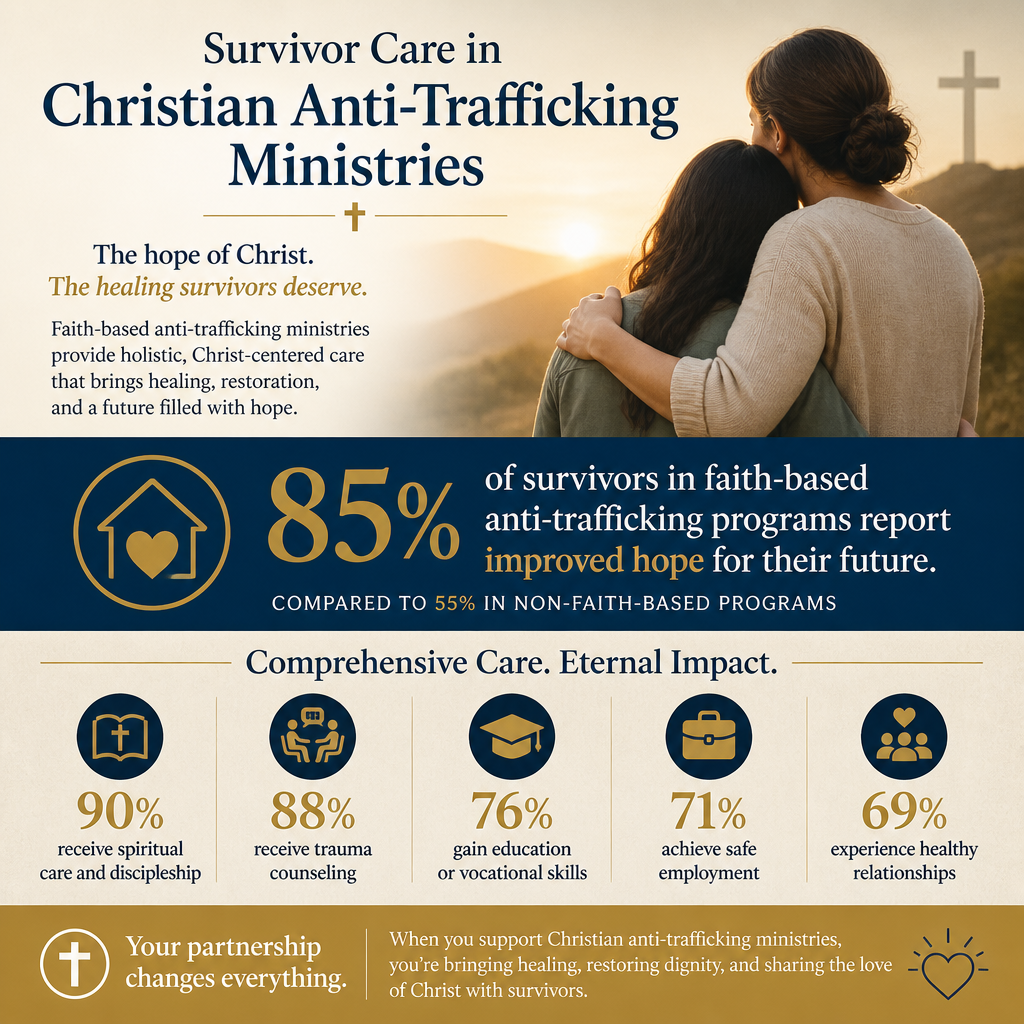
The harder question is how a ministry practices explicitly Christian formation while honoring consent, especially when services are residential or when survivors have few alternatives. Ethical Christian aftercare makes spiritual participation invitational, not required as a condition of safety or services. It also creates space for survivors who are not ready for overt spiritual engagement, without treating them as projects or second-class residents.
Avoiding coercion is not theological compromise
Some donors worry that voluntary discipleship weakens gospel witness. That concern deserves a careful response. The New Testament pattern is not compelled piety; it is proclamation, persuasion, and patient formation in community. Forced religious activities can produce outward compliance and inward resentment, and they can place a survivor back into the role of appeasing an authority figure to remain safe.
Ministries that meet a high standard of integrity typically articulate spiritual care in language of invitation: access to pastoral counseling, trauma-sensitive Bible engagement, prayer upon request, church connection when desired, and spiritual direction that respects the survivor’s pace. The ministry can be unapologetically Christian while refusing to exploit dependence.
Church partnership is valuable, and it must be carefully governed
Local churches can provide mentoring, community, employment connections, and long-term belonging. They can also unintentionally cause harm if volunteers are undertrained, boundaries are unclear, or survivors are treated as inspiring stories for public consumption. Wise ministries establish policies that protect confidentiality, limit public exposure, and train church partners in trauma awareness and appropriate boundaries.
Where churches provide housing or volunteer teams, donors should look for written agreements, background checks, and supervision structures. A ministry’s willingness to say “no” to well-intended but unsafe volunteer involvement is often a marker of maturity.
Measuring spiritual care requires discretion, not spectacle
Donors sometimes ask ministries to report conversion counts or dramatic testimony metrics. For survivor care, that pressure can be spiritually and ethically corrosive. It can reward sensational storytelling and undermine confidentiality. A more faithful posture is to ask whether spiritual care is offered, whether it is survivor-directed, and whether there are safeguards against spiritual abuse.
Accountable ministries often have spiritual care policies, training for staff on pastoral boundaries, and clear guidance about testimony and fundraising communications. They may still share stories, but with consent procedures that are meaningful, not perfunctory, and with details altered to prevent identification.
Donor discernment depends on verifiable integrity, not compelling narratives
Survivor care is expensive, long-term, and difficult to summarize. That makes it vulnerable to marketing that foregrounds “rescues,” dramatic raids, or simplified success stories. Donors committed to faithful stewardship should reframe the question from “Is this ministry inspiring?” to “Is this ministry trustworthy, and is its model coherent with what survivors actually need?” That is precisely where independent verification can serve the Church.
Most Trusted evaluates Christian nonprofits against The Most Trusted Standard, a 15-criteria framework that examines faith commitments, financial integrity, governance and leadership practices, and transparency and effectiveness. In aftercare ministries, those categories become concrete questions: Who has authority over survivor-facing decisions? How are complaints handled? Are finances audited and clearly reported? Are outcomes described honestly without overstating causality?
Financial integrity should match the realities of long-term care
Healthy survivor care does not look “efficient” in the way some donors expect. Residential staffing, clinical services, legal advocacy, and security protocols require sustained overhead. The nonprofit sector has broadly rejected simplistic overhead ratios as a proxy for impact; Charity Navigator, GuideStar, and the BBB Wise Giving Alliance jointly warned donors against judging charities primarily by administrative and fundraising percentages Charity Navigator. For aftercare, that warning is not theoretical—it is directly tied to safety and quality.
Donors should still expect disciplined financial management: clear financial statements, appropriate reserves, separation of duties, and governance oversight. But a ministry that spends responsibly on trained staff, supervision, and compliance may be more protective of survivors than a ministry that advertises unusually low overhead.
Governance and safeguarding are not secondary concerns
Aftercare ministries operate with significant power over vulnerable people. That makes governance quality and safeguarding policies central, not peripheral. Donors should look for independent board oversight, documented safeguarding procedures, mandatory reporting compliance, background checks, and staff training. Where a ministry provides housing, the safeguards should be even more explicit.
Christians should also expect clarity about partnerships with law enforcement and the limits of ministry competence. Some survivors fear police because of past corruption, arrest, or immigration concerns; others need protection and legal advocacy. Ministries should be able to explain their approach without ideological slogans.
Transparency and outcomes should be honest about what can be measured
Outcome measurement in survivor care is difficult. Confidentiality limits what can be shared, and “success” is rarely linear. Relapse, returning to an abusive relationship, or leaving a program early are not simple indicators of failure; they can reflect survival strategies formed under coercion and fear. Mature ministries report outcomes with appropriate humility and context, and they avoid turning complex human lives into a clean spreadsheet.
At the same time, donors should expect more than stories. Ministries can report credible indicators without violating privacy: retention rates by program phase, service utilization, safety planning completion, employment and education milestones, and referral follow-through. They can also describe external evaluations or partnerships with qualified providers. When a ministry cannot articulate any outcomes beyond anecdote, discernment becomes difficult.
Giving that strengthens survivor care
Christian donor support can either stabilize aftercare or destabilize it. Restricted gifts tied only to visible “rescues” can starve the long-term work that keeps survivors safe. Pressure for dramatic stories can incentivize exposure. The most constructive giving is patient, flexible, and matched to the ministry’s actual cost structure.
For donors seeking a wider view of this field, the most coherent place to begin is our work on Christian Anti-Trafficking Ministries. The ministries that merit long-term confidence are typically those that treat survivor care as a sacred trust: governed carefully, funded realistically, and practiced with a theology that honors both truth and time.



