

What success looks like in Bible study ministries is not primarily a question of attendance or content quality. It is a question of whether Scripture is being received in faith, rightly handled, and obeyed in ways that endure. Donors fund Bible study because they believe “the word of God is living and active” (Heb. 4:12), and because they want their generosity to serve spiritual formation rather than religious consumption.
The difficulty is that Bible engagement is both measurable and resistant to simplistic metrics. Knowledge can increase without love. Group participation can expand without repentance. A ministry can publish excellent materials while overlooking safeguarding, leadership integrity, or financial stewardship. The New Testament’s own measure is demanding: “Be doers of the word, and not hearers only” (James 1:22). Serious donors should expect ministries to pursue that standard with disciplined evidence, not vague stories.
1 Success begins with faithfulness to the text and the gospel
Many ministries can produce a study guide; fewer can demonstrate that their teaching consistently submits to the authority of Scripture and the good news of Christ. In donor terms, the first question is not “Is this popular?” but “Is this faithful?” The church has always treated doctrine and discipleship as inseparable. When Paul exhorted Timothy to “rightly handle the word of truth” (2 Tim. 2:15), he connected careful interpretation to public credibility and pastoral responsibility.
Doctrinal clarity is not sectarianism
Christians genuinely disagree about secondary matters of theology, methodology, and spiritual gifts. A mature Bible study ministry does not pretend those disagreements vanish. It states its theological commitments plainly, handles disputed texts with humility, and avoids manipulating participants by presenting contested conclusions as the only faithful option. Donors should look for a ministry that can articulate its confessional center—Trinity, incarnation, atonement, resurrection, salvation by grace through faith—and that can show how its curriculum and training protect that center over time.
Hermeneutics and accountability matter
Success also includes mechanisms that reduce the risk of doctrinal drift: editorial review, qualified theological oversight, and transparent correction when errors are identified. Across our verification work at Most Trusted, we observe that ministries meeting The Most Trusted Standard tend to treat theological review not as branding, but as governance: clear responsibility, clear processes, and clear documentation.

2 Success is transformation that can be described and tested
Bible study ministries often feel pressure to prove spiritual fruit quickly. Yet Scripture describes growth that is organic, sometimes slow, and often costly. The question is not whether transformation can be quantified neatly, but whether a ministry can describe what it seeks, how it expects Scripture to shape people, and how it tests whether that is occurring.
Move beyond knowledge gains alone
Knowledge matters. Jesus commands teaching obedience to everything he commanded (Matt. 28:20). Still, an exclusive focus on information can produce confident consumers rather than humble disciples. Success looks like participants who increasingly read the Bible with Christ at the center, interpret responsibly, and apply with integrity in home, church, work, and public life.
Evidence can be spiritual without being vague
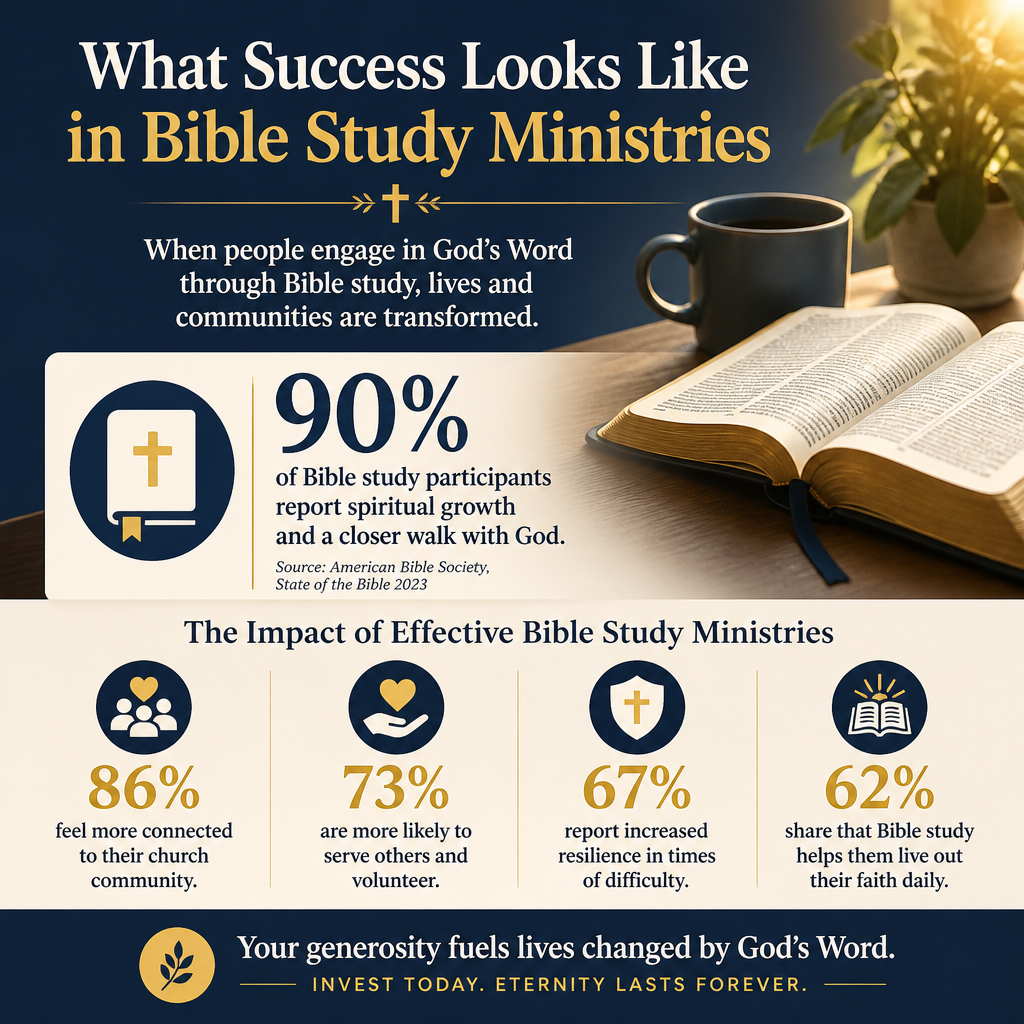
Donors should not demand laboratory-level proof for sanctification, but they should expect disciplined signs: pre- and post-assessments of Bible literacy, documented discipleship pathways, and follow-up that tests retention and practice. A ministry can also use qualitative evidence well—structured interviews, facilitated testimonies, and pastor feedback—when it is collected consistently and reported with honesty about limits.
Where ministries cite the broader landscape, the most responsible ones differentiate between national trends and their own outcomes. For example, many Christian leaders reference declining Scripture engagement in the United States; when they do, they should point readers to a named source such as the American Bible Society’s annual State of the Bible research (American Bible Society).
3 Success includes the integrity of the learning environment
Bible study does not occur in a vacuum. It occurs in rooms, in small groups, in mentoring relationships, and increasingly in digital communities. The ministry’s culture—how leaders are selected, how power is handled, how vulnerable people are protected—shapes whether Scripture is heard as good news or weaponized for control.
Safety and safeguarding are spiritual issues
Ministries that work with minors, trauma survivors, incarcerated people, or those in crisis carry heightened responsibilities. Success includes written safeguarding policies, background checks where appropriate, reporting mechanisms, and training that matches the context. These are not administrative distractions; they are part of what it means to love one’s neighbor. Donors should expect clarity about how a ministry responds when harm occurs, not only how it celebrates when growth occurs.
Small-group health can be evaluated
Many Bible study ministries depend on volunteer facilitators. Success looks like leaders who are trained to ask good questions, to keep Christ central, to avoid speculative teaching, and to refer participants to pastoral care when needs exceed a small group’s competence. In practice, donors can ask whether the ministry audits a sample of groups, reviews facilitator performance, and tracks participant retention without treating people as numbers.
For donors exploring the broader landscape of programs and approaches, our coverage of Bible Study and Engagement Ministries addresses the distinct models used by local churches, parachurch organizations, and global translation-and-distribution efforts.
4 Success is organizational stewardship that sustains the mission
Spiritual fruit does not excuse weak stewardship. In Scripture, leaders are judged not only by message but by character and trustworthiness. Donors have legitimate questions about how a ministry handles money, governs itself, and communicates results. The modern nonprofit sector has also had to reckon with the “overhead” debate; the most credible voices now caution donors against simplistic overhead ratios as a proxy for effectiveness. The widely cited “Overhead Myth” letter—signed by leaders from GuideStar, Charity Navigator, and the BBB Wise Giving Alliance—argues that overhead alone is a poor indicator of performance (BBB Wise Giving Alliance).
Financial integrity is part of discipleship
Ministries should budget in ways that match their stated strategy: curriculum development costs should be explained, translation projects should have transparent scopes, and fundraising expenses should be proportionate and candidly reported. Donors should expect audited financial statements or appropriate reviewed statements, clear conflict-of-interest policies, and a board that can demonstrate real oversight rather than rubber-stamping leadership decisions.
Governance and transparency protect the gospel witness
When a Bible study ministry fails publicly, the reputational damage is not contained to one organization. It becomes a stumbling block for people already skeptical of Christian institutions. The Most Trusted Standard evaluates ministries across Faith Foundation, Financial Integrity, Governance and Leadership, and Transparency and Effectiveness because mature stewardship requires all four to be present together. Donors should be wary of ministries that offer sweeping claims about impact but resist basic questions about leadership accountability, compensation practices, or independent board governance.
5 Success is impact that is coherent across the ministry ecosystem
Bible study ministries rarely operate alone. They intersect with local churches, seminaries, mission agencies, prison chaplaincies, campus ministries, women’s and men’s discipleship networks, and international partners. Success includes a ministry’s ability to serve the church rather than compete with it, and to strengthen pastors rather than displace pastoral responsibility.
Church partnership is a meaningful indicator
A ministry can demonstrate success by showing how it equips local leaders: training pastors and lay teachers, offering biblically faithful materials that complement church preaching, and maintaining a posture of service. Donors should ask whether the ministry has clear partnership expectations, feedback loops with churches, and guardrails that keep celebrity dynamics from distorting discipleship.
What donors can ask for without distorting the mission
Many donors hesitate to ask detailed questions because they fear pushing ministries toward shallow metrics. Yet careful questions can honor the mission by clarifying what is being pursued. We recommend asking for evidence in categories that fit Bible engagement rather than forcing a commercial model of “ROI.”
- Doctrinal and curriculum oversight: Who approves teaching content, and how are corrections handled?
- Participant formation outcomes: What changes does the ministry expect to see, and how does it assess them over time?
- Leader development: How are facilitators trained, evaluated, and supported?
- Safeguarding and care: What policies exist for vulnerable participants and for reporting misconduct?
- Financial and governance practices: What independent oversight, audits, and conflict-of-interest protections are in place?
Donors who want a more technical view of measurement in this space can consult our coverage of How Bible Study and Engagement Ministries Measure Impact, where we outline common indicators, their strengths, and the ways they can be misused.
FAQs for What success looks like in Bible study ministries
Is attendance growth a reliable sign of success in Bible study ministries?
Attendance growth can indicate accessibility, effective mobilization, or strong partnerships, and it should not be dismissed. Yet it is not a reliable measure of spiritual formation on its own. Donors should treat attendance as an output, then ask for evidence of faithfulness to Scripture, leader development, safeguarding, and durable changes in practice that align with the ministry’s stated discipleship aims.
What should donors do when a ministry reports only stories and no data?
Stories are appropriate for Bible engagement work, but stories without a disciplined method can conceal selection bias. Donors can ask how testimonies are collected, whether negative feedback is tracked, and what consistent indicators the ministry uses year over year. A ministry worthy of trust will welcome those questions, explain the limits of its measurement, and still provide concrete evidence that its practices and stewardship match its claims.
Success worth funding is success that can withstand light
The Bible calls the church to both faithfulness and fruit: “Watch your life and doctrine closely” (1 Tim. 4:16). For donors, success in Bible study ministries looks like ministries that handle the Word reverently, form people patiently, protect participants carefully, and steward resources transparently. When ministries can show that coherence under scrutiny, Christian giving becomes not a wager on charisma, but a confident act of stewardship before God.



