

How Bible study and engagement ministries measure impact is not a peripheral question for Christian donors; it sits near the heart of faithful stewardship. Scripture commends generosity, but it also commends discernment—testing what is presented as true, and seeking fruit that accords with repentance and love. Donors are right to ask whether reported results reflect genuine formation, not merely religious activity.
The harder question is that “impact” in Bible engagement work is partly visible and partly hidden. Attendance can be counted; repentance cannot be tallied like a ledger entry. Yet ministries still owe donors honest evidence: clear aims, credible indicators, and transparent reporting. The ministries that meet The Most Trusted Standard tend to be candid about what can be measured directly, what must be inferred, and what ultimately belongs to the Lord’s judgment rather than a dashboard.
Impact measurement begins with a theological definition of fruit
Bible engagement ministries are not primarily distributing information. They are serving the church’s long formation—helping people hear and obey the Word of God, individually and in community. That means “success” cannot be reduced to output counts alone. A ministry that reports only the number of studies completed may be describing reach, not transformation.
Scripture’s own categories press ministries toward deeper clarity. Jesus tied fruit to abiding and obedience (John 15). James tied hearing to doing, and doctrine to mercy (James 1–2). Paul tied teaching to endurance, character, and love that builds up (1 Corinthians 8; Galatians 5). A serious impact model starts by naming which kinds of fruit a particular program is aimed at cultivating, and which kind it is not claiming to produce.
Outputs, outcomes, and formation are not the same thing
Most donors can sense the difference, but ministries often blur the line in fundraising language. Outputs are the activities delivered: classes held, Scriptures distributed, small groups launched, digital sessions completed. Outcomes are the near-term changes plausibly connected to those outputs: increased Scripture reading, improved comprehension, greater confidence to study, stronger habits of prayer and community participation. Formation is the deeper trajectory: Christlike maturity over time, evidenced in relationships, integrity, and persevering faith.
Good reporting distinguishes these layers. It also avoids the opposite error—speaking only in spiritual generalities with no verifiable markers. Mature ministries treat measurement as a servant of truth, not a substitute for it.
Donors should expect explicit theories of change
A credible ministry can explain, in plain language, how its activities are expected to lead to the outcomes it reports. For example: “Trained facilitators + a structured inductive study process + peer accountability” may reasonably lead to improved Scripture engagement habits. That causal chain is testable, at least in parts. When ministries skip this step, donors are left with inspirational stories but no way to judge whether the model is coherent.
Across our verification work at Most Trusted, we observe that ministries with clearer theories of change also tend to have clearer boundaries: they resist claiming spiritual outcomes that their programs are not designed to produce.

What ministries can measure with integrity
Bible engagement sits in a domain where measurement is possible but easy to distort. Counting only what is easiest to count can pull a ministry toward shallow definitions of progress. Counting what is most spiritually meaningful can become speculative. The ethical center is to measure what is appropriate to the ministry’s calling, to use tools that minimize bias, and to report limits as clearly as results.
Participation and retention tell donors about credibility, not holiness
Attendance, completion rates, and retention are not the goal of Bible engagement, but they matter. They show whether a program is accessible, whether leaders are dependable, and whether participants judge the experience worth sustaining. In local-church-adjacent programs, retention can also reveal whether a ministry is quietly extracting people from congregational life or strengthening it.
The best ministries interpret these metrics modestly. A rising completion rate may indicate improved curriculum design or leader training. It does not prove spiritual maturity. Conversely, a lower completion rate does not automatically signal failure; it may reflect a ministry choosing to work among populations with instability, trauma, persecution, or economic precarity.
Scripture engagement can be tracked without reducing the Bible to a habit app
Many ministries measure frequency of Bible reading, time in Scripture, or consistency of participation in guided study. These measures are imperfect, but they are not meaningless. Habit formation is often a necessary precondition for deeper learning and obedience, particularly for new believers.
Some ministries use validated survey tools to assess engagement and perceived change. Donors should ask which tools are used, how questions are phrased, and whether results are compared over time. When results are self-reported, ministries should say so plainly and avoid overstating certainty.
Learning gains can be assessed responsibly
When a ministry’s aim includes biblical literacy—understanding the storyline of Scripture, core doctrines, and sound interpretation—pre/post assessments can be appropriate. The danger is turning discipleship into a test-prep enterprise. The safeguard is alignment: assessment should match what the ministry actually taught, and it should be one indicator among several, not the ultimate proof of maturity.
In settings such as prisons, recovery programs, or cross-cultural training environments, basic comprehension and interpretive skills can be a meaningful intermediate outcome. Donors can reasonably expect ministries to report such learning outcomes with humility and clarity.
The limits and moral hazards of measuring spiritual growth
Christians genuinely disagree about how directly spiritual growth can be measured. Some traditions are comfortable tracking outward disciplines and community participation as meaningful signs. Others warn that metrics can incentivize hypocrisy or confuse performance with grace. Both concerns deserve respect.
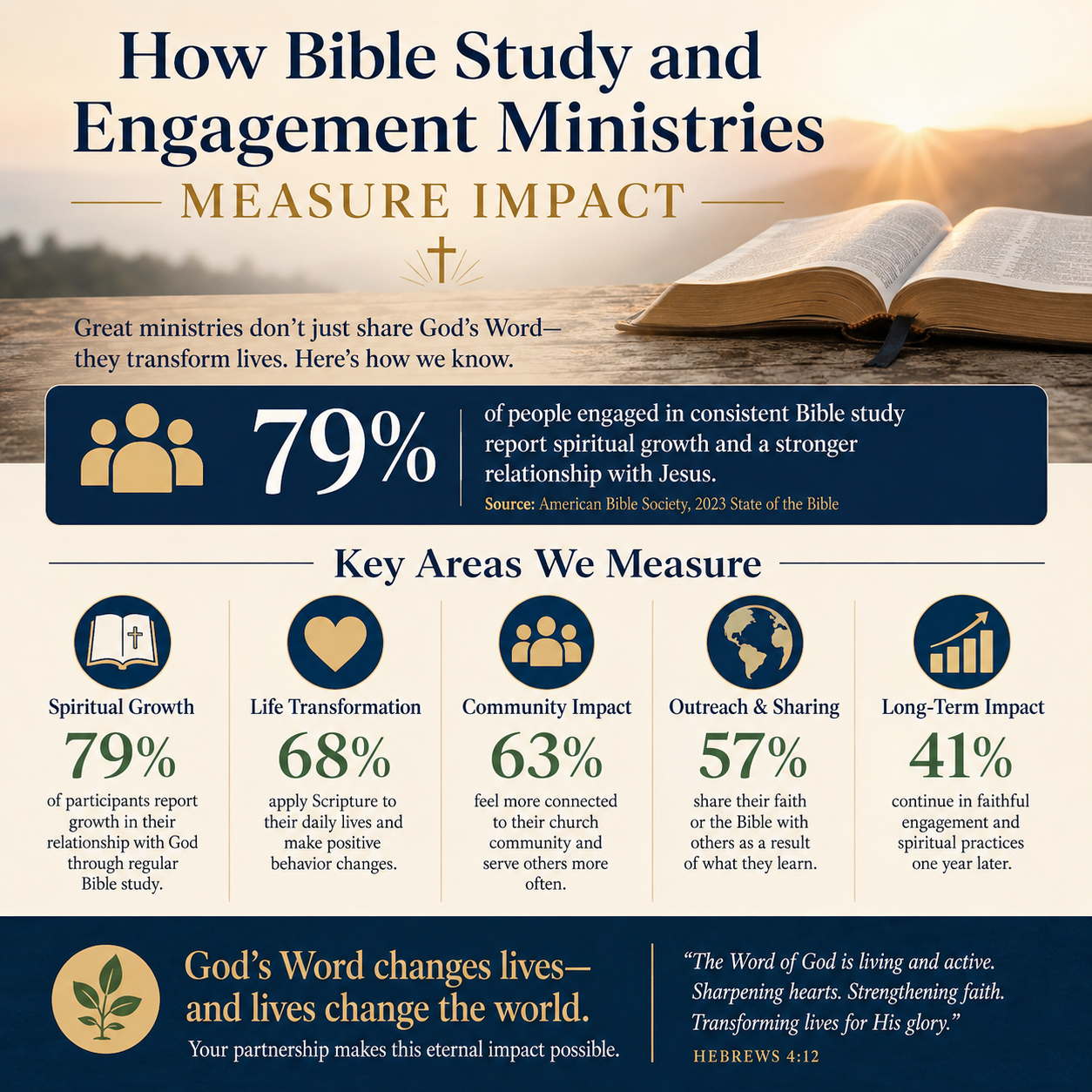
What this means in practice is that donors should look for ministries that acknowledge measurement limits rather than disguising them. A ministry that claims to quantify “heart change” with precision is likely either naïve or motivated by fundraising pressure.
Self-reporting is valuable but vulnerable to bias
Most Bible engagement outcomes rely at least partly on self-report: participants report increased understanding, stronger habits, reduced anxiety, repaired relationships, or greater confidence to share faith. These testimonies matter. They are also subject to social desirability bias—the tendency to tell leaders what seems expected.
Better ministries design feedback loops that reduce pressure: anonymous surveys, third-party evaluation when feasible, and triangulation with other indicators (such as sustained participation, leader observations, or downstream involvement in church life). They also avoid presenting anecdotal stories as if they were representative data.
Attribution is complicated and should be treated as such
Discipleship rarely has a single cause. A participant’s growth may be shaped by preaching, family crisis, counseling, friendships, and the Spirit’s work, alongside a Bible study program. It is appropriate for a ministry to claim contribution—“we played a role”—more than exclusive causation—“we produced this change.”
When donors read impact reports, the central question is whether the ministry’s claims match the evidence. Responsible reporting uses careful language: “participants reported,” “we observed,” “we tracked,” and “we can reasonably infer,” rather than sweeping assertions.
Numbers can be weaponized unless governance restrains them
Impact pressure can tempt ministries to inflate counts, redefine terms midstream, or report only favorable results. The solution is not cynicism; it is governance and transparency. A board that asks hard questions, audited financials, clear definitions, and a culture that treats truth-telling as a spiritual discipline are not “administrative overhead.” They are part of faithful ministry.
This is one reason our evaluation work at Most Trusted places measurement inside a broader integrity framework. Evidence of effectiveness cannot be separated from financial integrity, governance, and theological clarity without inviting distortion.
What donors should ask for in an impact report
Donors do not need a ministry to publish academic studies. They should expect intelligible reporting that a thoughtful elder, missions committee, or foundation officer could scrutinize. The goal is not to burden ministries with paperwork; it is to honor the people served, the donors who give sacrificially, and the Lord who loves truth in the inward being.
Clear definitions and consistent timeframes
Ask how the ministry defines key terms: “engaged,” “participant,” “graduate,” “small group,” “Scripture distributed,” “church partner,” and “leader trained.” Then ask whether those definitions stayed consistent year over year. Shifting definitions can create the illusion of growth.
Timeframes matter as well. Reporting monthly app sessions is different from reporting annual active users; reporting “decisions” is different from reporting six-month retention in a study community. A ministry can report multiple time horizons, but it should not blur them.
Balanced dashboards that include quality indicators
Healthy dashboards often combine reach metrics (how many served), depth metrics (what participants actually completed), and quality metrics (leader training completion, facilitator-to-participant ratios, follow-up contact rates, or partnership health with local churches). In cross-cultural settings, quality indicators may include translation review processes, theological review, and safeguarding standards for volunteers and minors.
When possible, donors should also look for evidence that the ministry listens: participant satisfaction, complaint mechanisms, and documented program adjustments based on feedback. Improvement over time is often more credible than a single perfect snapshot.
Transparency that matches the moral weight of the work
Because Scripture engagement ministries often work with vulnerable populations—incarcerated individuals, survivors of abuse, refugees, or children—impact reporting must protect privacy and avoid exploitation. Stories should be used with consent, with identities protected when needed, and without turning a person’s pain into fundraising copy.
The ministries that meet The Most Trusted Standard tend to publish impact updates that are frank about challenges: leader burnout, uneven group health, technological barriers, and the slow nature of formation. Such candor is not a weakness; it is a mark of seriousness.
For donors seeking a broader view of this ministry category, we maintain editorial and verification coverage for Bible Study and Engagement Ministries in a way that prioritizes theological clarity, governance integrity, and verifiable effectiveness.
Faithful measurement serves truth, not fundraising
Bible engagement ministries measure impact well when they refuse two temptations at once: the temptation to reduce formation to what is countable, and the temptation to avoid measurement because it is hard. Scripture calls God’s people to walk in the light. For donors, the practical test is whether a ministry’s reported outcomes are tethered to clear aims, credible indicators, and transparent limits.
When measurement is treated as a form of truth-telling—under accountable leadership and within a theologically serious understanding of fruit—it becomes a gift. It helps donors give with confidence, helps ministries improve with humility, and helps the church pursue the kind of maturity that cannot be manufactured, only cultivated under the Word of God.



