

What outcomes Bible engagement ministries report to donors often reveal as much about a ministry’s theological clarity as about its measurement habits. Donors are not only funding distribution, translation, or programs; they are underwriting a claim about what God does through his Word in real communities, over time, under the ordinary means of grace.
That claim is difficult to quantify without shrinking discipleship into whatever fits a dashboard. Yet Scripture does not treat fruit as imaginary or unknowable. Jesus taught that trees are known by their fruit, and the New Testament expects observable outcomes: repentance, perseverance, growth in love, and the public credibility of the gospel. The harder question is how ministries report outcomes with integrity, resisting both exaggeration and an anemic minimalism that reports only activity.
Outcomes reporting begins with theological honesty about what can be measured
Distinguishing activities, outputs, and outcomes
The cleanest donor reporting distinguishes three layers. Activities are what staff and volunteers do. Outputs are immediate deliverables, such as the number of Scripture portions distributed or small groups launched. Outcomes are the changes that follow, such as sustained engagement with Scripture, improved biblical literacy, or observable life and community transformation.
Many Bible engagement ministries report outputs because outputs are easier to count and verify. Counting Bibles printed or sessions delivered is not wrong. But donors rightly want to know whether the ministry’s stated mission is being advanced, not merely whether programs were executed.
Resisting false precision without retreating into vagueness
Christian donors are often wary of the secular nonprofit habit of treating all spiritual realities as inaccessible to evidence. That wariness is understandable, but the remedy is not to claim certainty where there is none. A mature approach names what is measurable, what is partially measurable, and what must be discerned through credible qualitative evidence.
Across our verification work at Most Trusted, the ministries that meet The Most Trusted Standard tend to explain their outcomes model plainly: what they expect to change, why they expect it to change, how they look for evidence, and what they do when results are mixed. This candor is more persuasive than inflated certainty.
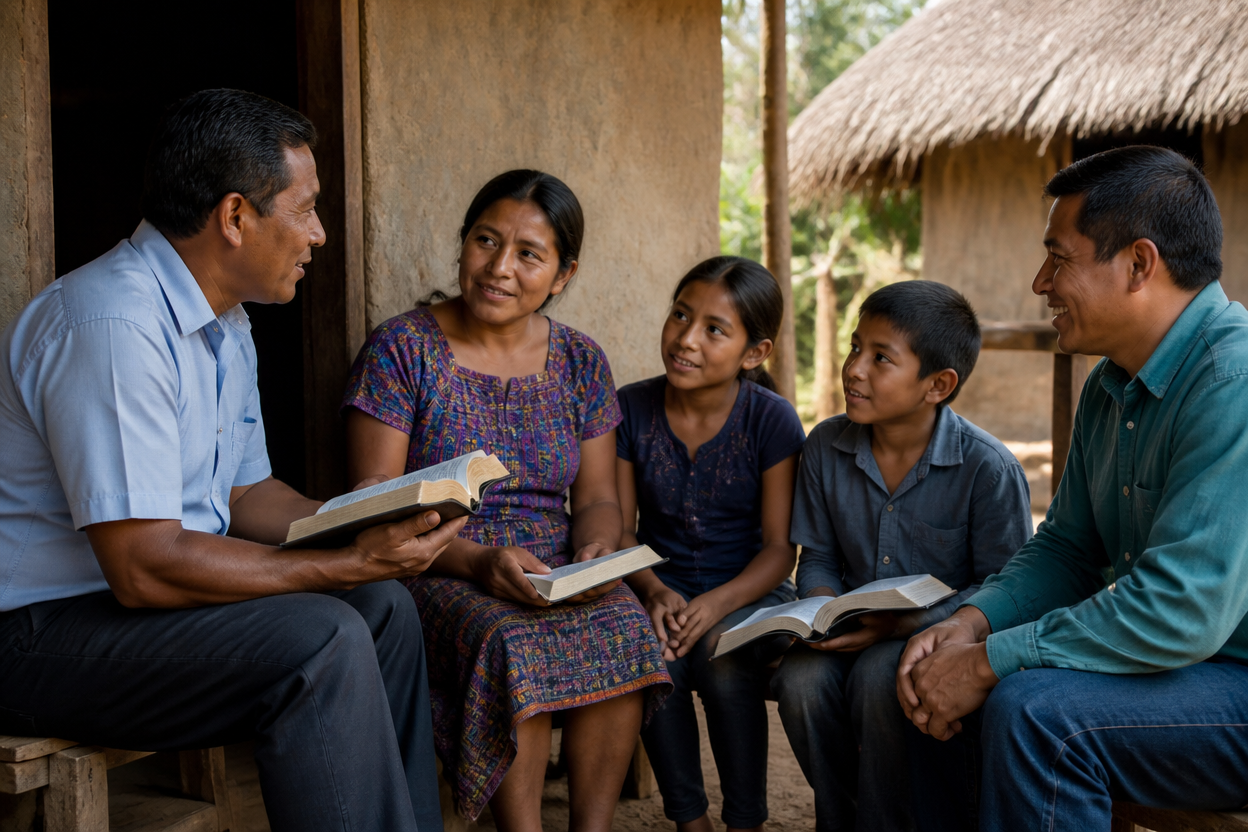
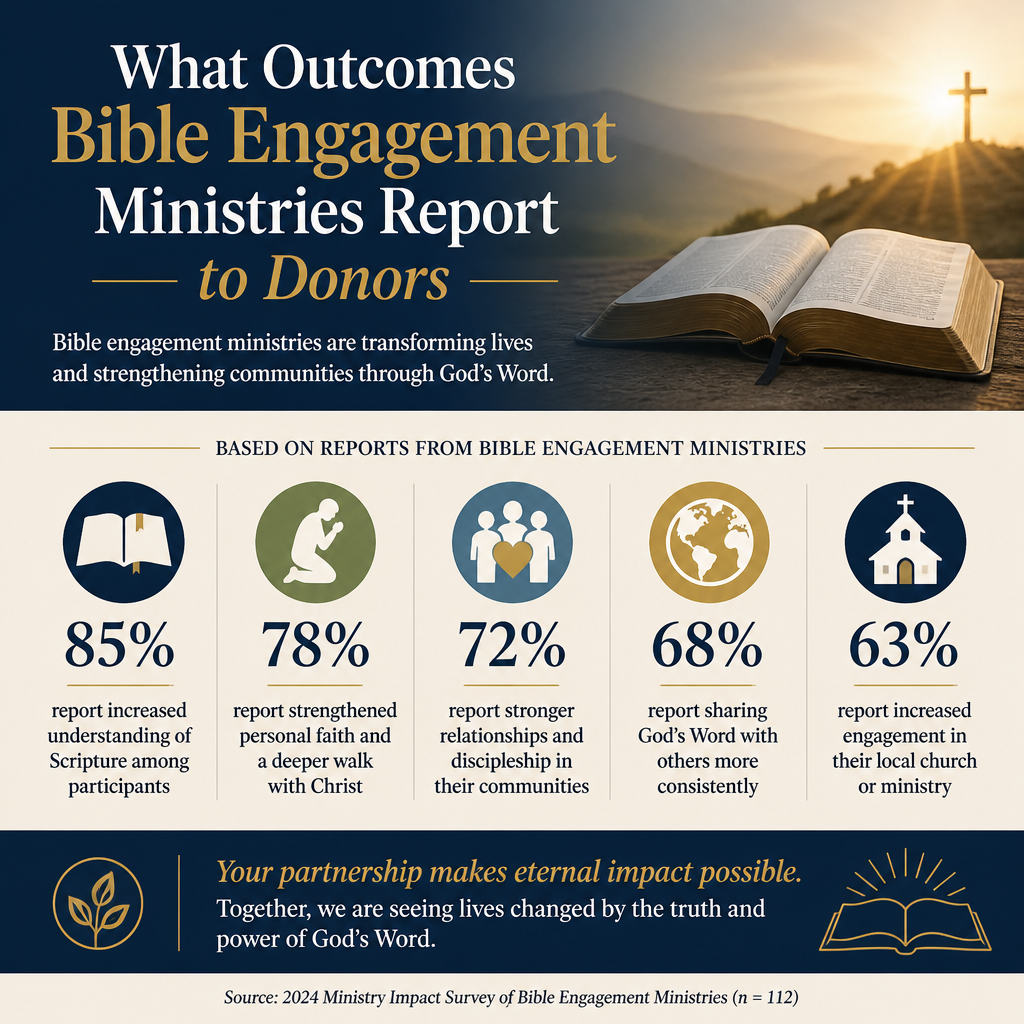
Common outcomes Bible engagement ministries report and what they can credibly mean
Scripture access and use as proximate outcomes
For many ministries, the first reported outcomes relate to access and use: translation milestones reached, first-time access for language groups, distribution into hard-to-reach communities, app installs, listening sessions completed, or consistent participation in a reading plan. These can be legitimate proximate outcomes when the ministry’s theory of change is explicit that access and use are means, not ends.
Donors should ask whether “use” is defined carefully. A download is not the same as sustained reading. A one-time group attendance is not the same as formation. Strong reporting defines terms, explains the measurement method, and avoids sliding between categories.
Biblical literacy and comprehension outcomes
Some Bible engagement ministries report growth in biblical literacy: increased understanding of the storyline of Scripture, improved grasp of doctrine, or greater confidence in handling the text. These outcomes can be measured more directly through pre- and post-assessments, structured interviews, or classroom-style evaluations, provided instruments are appropriate to context and language.
Even here, donors should be careful not to confuse knowledge acquisition with discipleship. Scripture calls for renewed minds, but it also calls for obedience and love. Ministries that report literacy outcomes well typically pair them with indicators of practice, community, and perseverance.

Discipleship and life transformation outcomes
The outcomes donors most want to hear about are often the most vulnerable to overclaiming: repentance, forgiveness, restored relationships, resistance to addiction, generosity, reconciliation across social divides, and endurance under suffering. These are not unmeasurable, but they are rarely reducible to a single number.
Credible reporting often uses multiple forms of evidence: longitudinal follow-up, testimonies with corroborating detail, pastoral or leader observation, and where appropriate, social indicators such as retention in a local church community. The aim is not to prove conversion mathematically, but to report responsibly on fruit that can be observed without violating conscience or confidentiality.
What sophisticated donors should expect in credible outcome claims
Evidence that survives questions about attribution
Bible engagement ministries operate amid many influences: family systems, economic stress, local church leadership, political instability, and other ministries. Donors should expect ministries to acknowledge this complexity rather than implying that one program directly caused every positive change.
Stronger reporting uses language of contribution rather than total causation and describes comparison points where possible. For example, a ministry might compare outcomes between cohorts that completed a program and those that began but did not complete, or it may track changes over time in the same participants.
Integrity about selection bias and who is being reached
Many programs disproportionately retain participants who are already motivated, literate, or socially stable. Ministries should name who tends to persist and who tends to drop out, then show what they are doing about it. This is particularly important when donor materials highlight extraordinary stories that may not represent typical participants.
When donors engage the broader landscape of Bible Study and Engagement Ministries, it becomes clear that “reach” is not a single variable. Reaching the already-formed is not the same challenge as reaching the unreached or the newly literate. Outcome claims should be commensurate with the ministry’s actual audience.
Examples of outcomes categories ministries report and how to read them
A short outcomes menu donors often see
In donor communications, outcomes often cluster into recognizable categories. These categories are not automatically credible or questionable; their trustworthiness depends on definitions, methods, and transparency about limitations.
- Engagement depth: frequency and duration of Scripture reading or listening, completion rates, sustained participation over months
- Formation practices: adoption of prayer habits, participation in Christian community, increased confession and reconciliation behaviors
- Leadership multiplication: new facilitators trained, groups reproduced, local leaders teaching the text faithfully
- Church integration: increased connection to healthy local churches, baptism preparation processes, ongoing pastoral care
- Community effects: reduced conflict in households, mutual aid practices, reconciliation initiatives anchored in Scripture
Digital engagement outcomes require special caution
Many Bible engagement ministries now report digital outcomes: app users, sessions, daily active users, time in app, or reading plan completions. These can be useful, but donors should treat them as indicators of attention, not automatic evidence of formation. A person can consume religious content without yielding to Scripture’s authority.
A helpful external reference point is that digital engagement metrics are common in the broader Bible ecosystem. For example, YouVersion reports large-scale usage trends and yearly engagement patterns, which can help donors understand what “normal” looks like in mass-market Bible engagement. See the YouVersion Bible App site for how they describe their engagement reporting: https://www.youversion.com/.
How Most Trusted evaluates outcome reporting under The Most Trusted Standard
Transparency and effectiveness without reducing ministry to numbers
Most Trusted exists because donors need a disciplined way to evaluate ministries that claim spiritual fruit. Under The Most Trusted Standard, we examine whether a ministry’s outcome reporting is coherent with its mission, honest about methods, and transparent about limitations. We do not require ministries to pretend that sanctification can be captured fully in a spreadsheet, but we do expect them to tell the truth in ways donors can test.
This typically includes clarity on what is tracked, what is not tracked, how data is collected, how stories are selected, and whether negative or mixed outcomes are ever reported. Ministries that never report setbacks, attrition, or contextual barriers are not necessarily thriving; they may simply be curating.
Guardrails against the most common donor-facing distortions
The donor economy creates predictable pressures: the temptation to privilege the dramatic story, the tendency to equate scale with faithfulness, and the impulse to treat outputs as outcomes. Our team looks for guardrails that address these pressures directly, including governance practices that constrain overstatement and reporting practices that are consistent year over year.
Donors evaluating ministries in the category of How Bible Study and Engagement Ministries Measure Impact should expect more than polished narratives. The best ministries show their work: they define their terms, share their instruments when appropriate, and invite informed scrutiny.
FAQs for What outcomes Bible engagement ministries report to donors
What is the difference between reporting outputs and reporting outcomes in Bible engagement?
Outputs describe what a ministry delivered, such as Bibles distributed, groups launched, or lessons taught. Outcomes describe what changed because of those efforts, such as sustained Scripture engagement, increased biblical comprehension, or observable shifts in life and community patterns. Both matter, but outcomes are closer to the ministry’s mission claims, so they require clearer definitions and more careful evidence.
Should donors expect Bible engagement ministries to prove spiritual transformation with data?
No faithful ministry can “prove” regeneration or sanctification in a scientific sense, and Scripture does not require that kind of proof. Donors can reasonably expect evidence that a ministry is acting with integrity: transparent methods, credible indicators, corroborated stories, and honest acknowledgment of limits. The point is not to eliminate mystery, but to avoid exaggeration and to steward donor trust.
Giving that honors the Word and the truth
Christian donors give to Bible engagement ministries because we believe God’s Word is living and active, and because we want that Word to be heard, understood, and obeyed in homes, churches, and communities. Outcome reporting serves that hope only when it is disciplined by truthfulness: careful definitions, credible evidence, and the humility to name what cannot be claimed. The most trustworthy ministries report fruit in ways that withstand scrutiny because they fear the Lord more than they fear a disappointing quarterly update.



