

Why Bible study ministries track attendance and retention is not a question about organizational fussiness. It is a question about spiritual stewardship: whether the ministry is helping people remain under the Word long enough for durable formation to take root. Mature donors have learned that sincere activity can still drift into inefficiency, misdirection, or quiet fruitlessness if no one measures whether people are actually staying and growing.
The New Testament’s vision of discipleship is not momentary exposure but continuing devotion. Luke summarizes the early church by saying, “They devoted themselves to the apostles’ teaching” (Acts 2:42). Devotion implies time, repetition, and perseverance. Attendance and retention are imperfect, but they are among the few measurable signals that a ministry is creating conditions where devotion can plausibly happen.
Attendance is a proxy for access to the means of grace
Bible study ministries cannot confer regeneration, and they cannot reduce sanctification to metrics. Yet they can ask whether people are placing themselves regularly where Scripture is taught, discussed, and applied. Attendance is one of the simplest ways to test whether a ministry is actually reaching people consistently rather than merely enrolling them once.
Attendance does not measure maturity but it does measure presence
Christians genuinely disagree about how much weight to place on measurable participation. Some fear that counting attendance smuggles in a consumer logic. That caution has merit. Still, a ministry that does not know whether participants are showing up week after week is operating without basic situational awareness. Attendance is not the goal; it is a check on whether the ministry’s stated purpose has a plausible channel to operate through.
This is where thoughtful donors ask concrete questions. How is attendance recorded: by sign-in, by facilitator report, by digital participation logs? What counts as “attendance” in a hybrid context? Are there patterns by age, language, or location that reveal barriers to access? Without some disciplined attention, ministries can confuse broad interest with sustained engagement.
Participation patterns can reveal pastoral problems early
Attendance trends can expose problems a leader may not see from the front of the room. A steady drop-off after week two may indicate unclear expectations, poor group matching, or leaders who are unprepared. A mid-semester slide may reflect curriculum misfit, relational breakdown, or schedule conflicts. Those are not merely operational issues; they are pastoral issues because they shape whether people remain connected to the teaching and to the body.
For donors seeking to understand Bible Study and Engagement Ministries in a comprehensive way, it is often helpful to view measurement practices alongside theology, governance, and financial integrity. We maintain a curated landscape of Bible Study and Engagement Ministries for that reason.

Retention tests whether the ministry is forming durable discipleship habits
Retention is a more demanding measure than attendance because it asks about continuity over time. A ministry can gather a crowd for an initial launch; it is harder to sustain a cohort through the difficult work of learning Scripture, practicing prayer, confessing sin, and bearing one another’s burdens. Retention is not identical to faithfulness, but it is aligned with the reality that discipleship typically occurs through persistence.
Retention aligns with a biblical understanding of perseverance
The New Testament repeatedly connects genuine faith with endurance. The parable of the sower warns of early growth that withers under pressure (Mark 4:16–17). Hebrews exhorts believers to “hold fast” (Hebrews 10:23). Bible study ministries are not the arbiters of saving faith, but they do serve the church by creating structures that help people remain rooted in Scripture rather than living on spiritual novelty.
Retention also guards donors from a common distortion: mistaking initial enthusiasm for long-term fruit. A ministry can report high enrollment, high social media activity, and impressive launch events while quietly losing most participants by the third meeting. Tracking retention forces honesty about whether the ministry’s model actually sustains people.
Measuring retention requires careful definitions
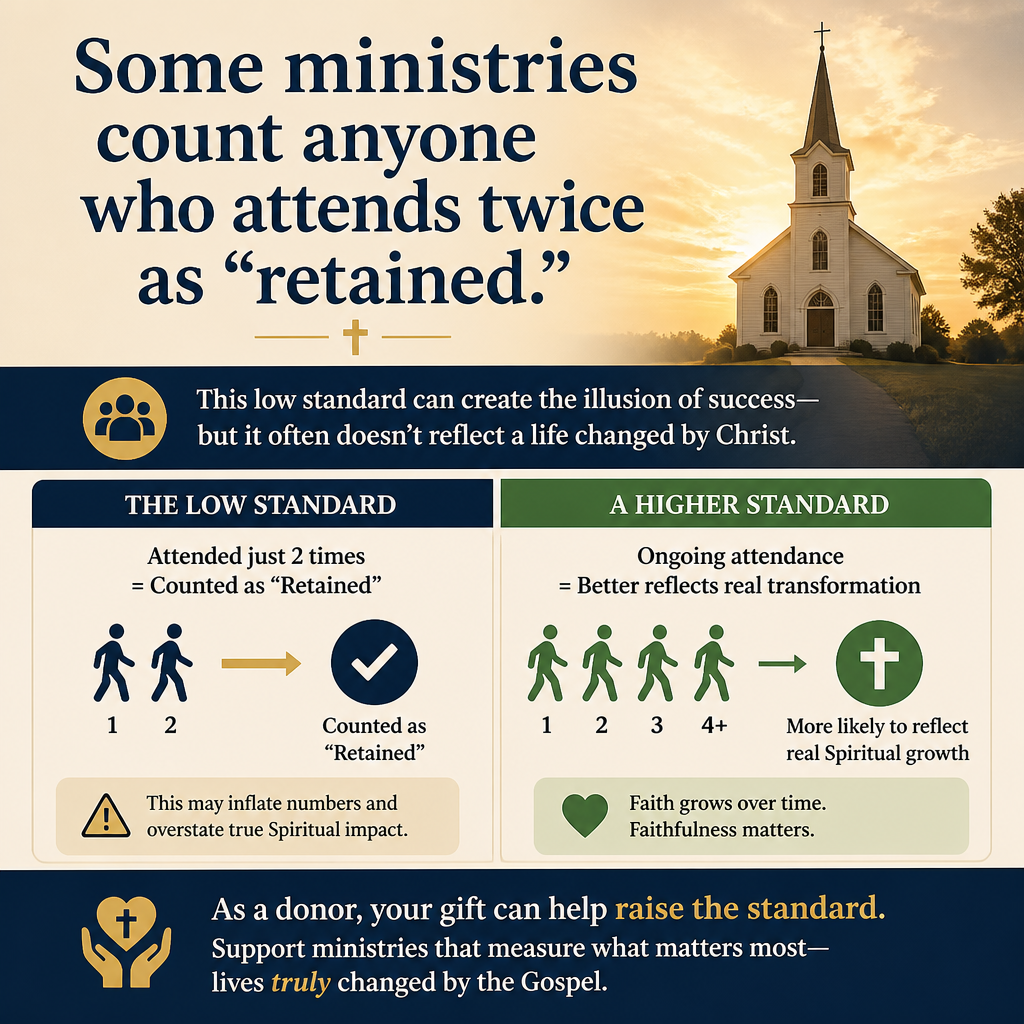
Retention can be defined in shallow or meaningful ways. Some ministries count anyone who attends twice as “retained.” Others track completion of an eight-week study, a full semester, or a multi-year pathway. Each definition has trade-offs. Shorter windows are easier to measure and may capture early engagement, but they can flatter models that do not build lasting habits. Longer windows are more spiritually relevant, but they require better data practices and patient interpretation.
Wise ministries distinguish between “churn” caused by life circumstances and churn caused by the program itself. Moves, health crises, and family responsibilities will always affect retention. Tracking does not eliminate these realities; it helps leaders avoid blaming participants for what may be fixable in the ministry’s design.
Donors need credible signals of effectiveness without reducing ministry to numbers
Many Christian donors have become wary of inflated impact claims. That wariness is justified. The temptation is not only to exaggerate conversions or growth; it is to report activity metrics that imply transformation without demonstrating it. Attendance and retention are not sufficient evidence of spiritual fruit, but they can serve as credibility tests: does the ministry have a stable, engaged community where deeper outcomes could reasonably be pursued and observed?
Attendance and retention are necessary but never sufficient
A crowded room can still be spiritually thin. A high retention rate can still reflect a pleasant social experience without biblical depth. This is why serious measurement pairs quantitative participation with qualitative and pastoral indicators: Scripture comprehension, prayer habits, confession and accountability, reconciliation, vocational faithfulness, and integration into the local church. Donors should expect ministries to say plainly what attendance can and cannot prove.
We also recommend that donors look for humility in reporting. Ministries that acknowledge limits often have stronger internal discipline than ministries that speak as if spiritual formation can be graphed with certainty. In our verification work at Most Trusted, the ministries that meet The Most Trusted Standard tend to treat measurement as a tool for truth-telling rather than as a fundraising instrument.
External expectations for accountability are increasing
Even within Christian philanthropy, expectations for evidence have changed. The broader nonprofit sector has also pushed toward clearer reporting, and donors have been shaped by that culture. The “Overhead Myth” letter, signed by GuideStar, BBB Wise Giving Alliance, and Charity Navigator, criticized simplistic overhead ratios and urged donors to focus on outcomes and transparency rather than administrative minimalism. That joint statement is widely cited in philanthropic practice and can be found through the signatories’ sites, including GuideStar.
The point is not to import secular evaluation uncritically. It is to recognize that donors now expect ministries to explain how they know whether their efforts are working. Attendance and retention are among the first answers a serious ministry should be able to give.
Attendance and retention can reveal hidden equity and access barriers
Bible study ministries often serve a mixed body: new believers and mature saints, the highly educated and the under-resourced, native speakers and immigrants, those with stable schedules and those working multiple jobs. Without attendance and retention data, ministries can unintentionally design studies that fit only the most flexible and resourced participants. The result is a quieter form of exclusion.
Who leaves first often tells the truth about the model
Tracking retention by cohort can expose patterns that otherwise remain invisible. If young parents drop out disproportionately, the issue may be childcare, timing, or the lack of family-integrated options. If participants with lower literacy leave early, the curriculum may presume educational familiarity rather than teaching the Bible in accessible ways. If second-language participants churn quickly, the ministry may need trained facilitators, translation support, or a different pace.
Done well, this kind of tracking is not bureaucratic. It is a form of neighbor love because it asks whether the ministry’s design burdens certain participants more than others. James’s warning against partiality in the assembly (James 2:1–4) is not limited to seating arrangements; it extends to the structures a ministry builds that either welcome or inadvertently filter out the vulnerable.
Digital participation adds complexity, not an excuse to stop measuring
Hybrid and online studies can widen access for homebound believers, rural participants, and those whose work schedules make in-person attendance difficult. They also complicate measurement. A “view” is not the same as participation, and a logged-in user is not necessarily attentive. Ministries that treat digital access seriously define meaningful engagement: for example, presence for a significant portion of the session, contribution to discussion, completion of reflection questions, or participation in prayer.
Donors should not penalize a ministry for wrestling with these definitions. They should ask whether the ministry has honest categories and whether leaders use the data to improve care rather than to inflate reach.
What good tracking practices look like under serious verification
Tracking attendance and retention becomes spiritually corrosive when it drifts into control, pride, or public comparison. It becomes spiritually constructive when it is ordered to truth, service, and accountable stewardship. Under The Most Trusted Standard, we look for measurement that is coherent with theology and governed with integrity.
Healthy measurement is integrated with leadership accountability
Good tracking is not merely a spreadsheet; it is part of how leaders steward people. That means leaders can answer basic questions without evasion: How many groups are active? How many participants attend consistently? Where are the pressure points? What is being done to train facilitators? What guardrails exist to prevent leaders from manipulating numbers to please donors?
This is one reason we place measurement within a broader evaluation of transparency and effectiveness, financial integrity, governance, and faith foundation. A ministry can have accurate attendance counts and still be untrustworthy if leadership is not accountable or finances are opaque. For donors who want to understand what credible measurement looks like across the field, we maintain editorial coverage on How Bible Study and Engagement Ministries Measure Impact.
A few practices donors can reasonably expect
- Clear definitions of attendance and retention, including the time window used and what counts as completion.
- Consistency over time in how data is collected so trends are meaningful and not artifacts of changing methods.
- Participant privacy protections and limited access to identifiable information, especially in sensitive contexts.
- Leader training that treats tracking as pastoral care and stewardship rather than performance pressure.
- Balanced reporting that pairs participation numbers with qualitative evidence of Scripture engagement and integration into church life.
These expectations do not require a ministry to adopt sophisticated analytics. They require moral seriousness: a willingness to be accountable for whether people are actually being served over time.
FAQs for Why Bible study ministries track attendance and retention
Is tracking attendance unspiritual or legalistic?
It can be, if it becomes a substitute for pastoral discernment or a mechanism for coercion. But it does not have to be. Attendance tracking can be a simple act of care: noticing who is present, who is drifting, and who may need encouragement or practical support. In the New Testament, shepherding includes attentiveness to people, not only to teaching content (John 10:14–15).
What should donors ask a Bible study ministry to report besides attendance and retention?
Donors can ask how the ministry assesses Scripture engagement and formative outcomes without claiming false precision. Examples include facilitator observations, participant reflections, evidence of prayer and mutual care within groups, completion of reading plans or study work, and pathways that connect participants to a local church. The aim is not to quantify sanctification, but to see whether the ministry’s model plausibly supports ongoing obedience to Christ.
Stewardship requires more than good intentions
Bible study ministries track attendance and retention because discipleship is ordinarily sustained, not instantaneous, and because donors deserve truthful signals about whether a ministry’s work is actually reaching people over time. Numbers cannot capture the hidden work of the Spirit, but neither should they be dismissed when they illuminate whether people are remaining under the Word. When tracking is governed with humility and integrity, it becomes one more way a ministry resists illusion and serves the church with accountable care.



