
What makes a Bible translation accurate is not a single test, but a disciplined set of judgments about meaning, language, and authority. For Christian donors who fund Bible translation ministries, “accuracy” is not an abstract academic preference; it is a stewardship question about whether communities will receive Scripture that faithfully conveys what God has spoken, without avoidable distortion. The stakes are pastoral and missional because “faith comes from hearing, and hearing through the word of Christ” (Romans 10:17).
The field has learned to be precise about what accuracy can and cannot mean. No translation is identical to the original Hebrew, Aramaic, and Greek, because languages do not map one-to-one and cultures do not share identical assumptions. Accuracy, therefore, is best understood as faithfulness: a translation that reliably communicates the meaning of the source text in the receptor language, with transparent choices where ambiguity or controversy cannot be eliminated.
Accuracy begins with the right source text and disciplined exegesis
Before a translation team chooses words in a target language, it must decide what it is translating and how it will handle textual and interpretive questions. Scripture’s inspiration does not remove the need for careful textual criticism and exegesis; it requires it. The Protestant tradition has long insisted that the church is “reformed and always reforming according to the Word of God,” which includes the humility to test our assumptions in the light of the text.
Textual basis is not a footnote for specialists
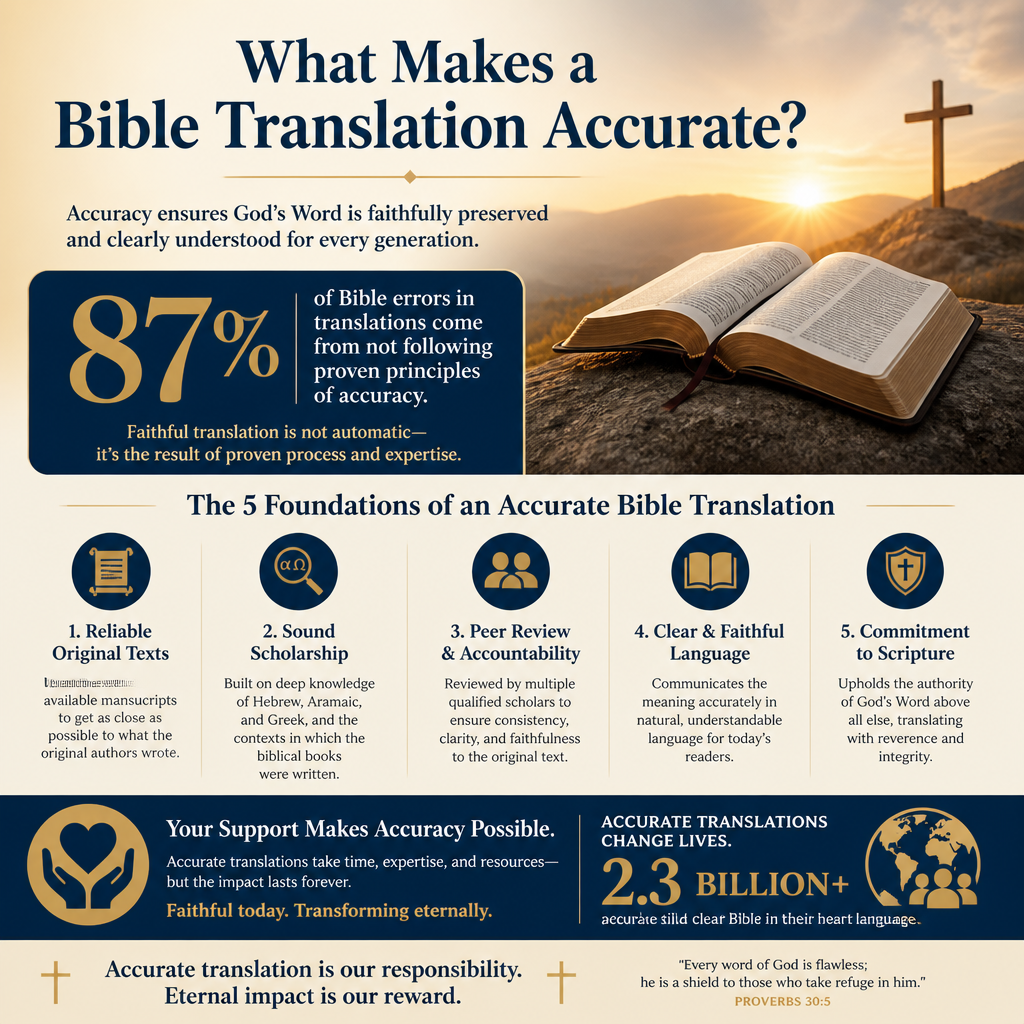
Most modern translations work from critical editions of the Hebrew Bible and the Greek New Testament that reflect a wide range of manuscript evidence. Donors do not need to adjudicate scholarly disputes line by line, but it is reasonable to ask ministries which textual base they use and why, how they document significant variants, and whether the team includes qualified biblical scholars who can weigh evidence rather than defaulting to tradition or novelty.
Exegesis must precede expression
Accuracy requires that translation decisions follow from careful interpretation of the original text in context: grammar, discourse, genre, and canonical theology. A translation can be linguistically fluent and still be inaccurate if it consistently presses the text into a preferred theological or cultural mold. Faithful translation resists that temptation by building in peer review, consulting checks, and documented rationale where interpretive options exist.
Translation philosophy shapes what accuracy looks like in practice
Christians genuinely disagree about how best to render Scripture in another language, and some of that disagreement is principled. Translation philosophy sits on a spectrum. On one end is more form-based translation, which tries to preserve sentence structure and lexical patterns where possible. On the other end is more meaning-based translation, which prioritizes communicating the intended sense naturally in the target language. Accuracy is not confined to one end of that spectrum, but every choice has costs.
Formal correspondence preserves patterns but can mislead
More form-based approaches can help readers see repeated terms and literary structures that matter for interpretation. Yet in many languages, a form-based rendering can create unnatural, ambiguous, or even incorrect meaning because the borrowed structure carries different implications. The result can be a translation that looks “literal” to outsiders but is not actually clear or faithful for insiders.
Functional equivalence clarifies meaning but requires restraint
More meaning-based approaches can communicate accurately when they are disciplined by the text and the theological intent of the passage. But they can also invite over-interpretation: adding explanations that belong in teaching rather than in the translation itself. The harder question is whether a project has adequate safeguards to prevent meaning-based clarity from becoming theological commentary in disguise.
Donors who want to understand how these debates play out in ministry practice will benefit from following the broader field of Bible Translation Ministries, where strategy, theology, and accountability intersect in concrete ways.
Accuracy requires linguistic and cultural competence, not only sincerity
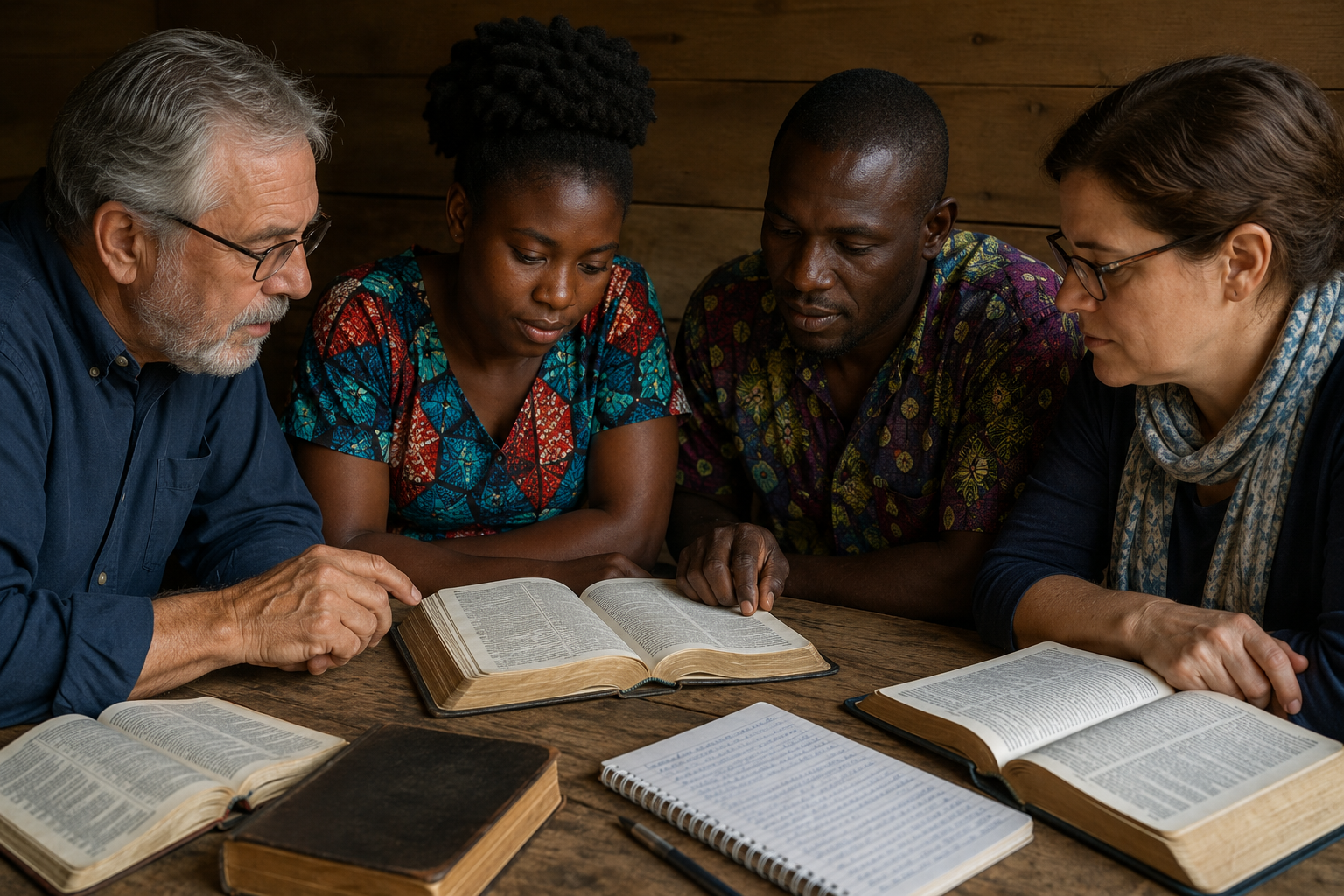
Bible translation is not only a theological task; it is a linguistic one. The incarnation itself honors the reality that communication happens inside particular languages and cultures. A ministry can be deeply committed to the authority of Scripture and still produce an inaccurate translation if it lacks rigorous linguistic method, adequate testing, or mature community engagement.
Key terms must be tested, not merely chosen
Accuracy is often lost not in dramatic doctrinal passages but in high-frequency theological terms: “faith,” “righteousness,” “repent,” “covenant,” “spirit,” “elders,” “justify.” Some languages lack direct equivalents; some have near equivalents that carry unhelpful connotations. Responsible teams test candidate terms in community settings, check for semantic range, and revise when comprehension data shows consistent misunderstanding.
Back-translation and community review are tools, not guarantees
Many projects use back-translation to allow consultants to see how a draft reads when rendered back into a language of wider communication. This can reveal problems, but it can also miss them, because back-translation can smooth over ambiguities the receptor community experiences. Accuracy is strengthened when back-translation is paired with comprehension testing among representative readers and listeners, including women and men, different age groups, and both church leaders and newer believers.
Doctrinal fidelity and transparency are essential when rendering contested passages
The Bible contains passages that are contested in translation because languages carry different social and theological freight. These are precisely the places where donors should expect ministries to show their work. Accuracy is not only about getting something “close enough”; it is about honoring the text’s authority even when the result is costly, complex, or unpopular.
Christological and Trinitarian texts require careful handling
Rendering terms that touch on Christ’s identity and the life of the Trinity is not an area for improvisation. Accuracy does not require importing later doctrinal vocabulary into every language, but it does require avoiding renderings that collapse essential distinctions Scripture maintains. Translation teams should be able to articulate how their choices relate to the historic confession of the church and how they prevent avoidable misunderstanding in contexts where syncretism or rival religious claims are present.
Gender language and kinship terms raise real translation tensions
Discussions about gender language in translation often generate more heat than light. The issue is not whether a ministry is “conservative” or “progressive,” but whether it preserves the meaning and theological intent of the original text. In some receptor languages, a literal rendering of “brothers” may naturally include women; in others it may not. Likewise, kinship terms used of God and Christ are theologically loaded and culturally complex. Responsible ministries document how they made decisions, what alternatives they rejected, and what guardrails they used to prevent doctrinal drift.
- Documented translation principles that explain how the team treats ambiguity, figurative language, and key theological terms.
- Qualified linguistic and biblical scholarship with named roles, not anonymous “experts.”
- Comprehension testing that includes representative community sampling and reports actionable findings.
- Independent consultant checks with authority to require revision when fidelity or clarity breaks down.
- Transparent handling of contested renderings through footnotes, appendices, or published decision rationales where feasible.
Donor diligence belongs to stewardship, and verification can strengthen it
Christian donors are not called to become translation scholars, but we are called to faithful stewardship. Jesus’ parable of the talents commends careful, accountable management of what the Master entrusts (Matthew 25:14–30). In practice, that means asking whether a ministry’s claims about accuracy are matched by verifiable processes, governance, and transparency.
Accuracy claims should be matched by observable process
Across our verification work at Most Trusted, we see a consistent pattern: ministries that welcome external scrutiny tend to be clearer about their methods and more careful about outcomes. This is not because transparency guarantees quality, but because opacity makes it difficult for any stakeholder to identify and correct problems early. The ministries most worthy of donor confidence can describe their workflow from initial drafting to consultant checking to final publication, and they can show evidence that the process was actually followed.
Translation quality is linked to financial and governance integrity
Translation projects span years. They require stable funding, careful budgeting, and clear lines of decision-making. When governance is weak or finances are opaque, quality often suffers: consultant checks get shortened, testing rounds are reduced, and deadlines become controlling. Donors should feel freedom to ask for audited financials, clear project reporting, and board oversight that treats quality as a theological responsibility, not merely a deliverable.
Because many donors support multiple ministry types, it helps to understand Bible translation work in its operational realities. The wider category of How Bible Translation Ministries Work is where questions of staffing, field partnership, publication formats, and long-term support become visible.
FAQs for What makes a Bible translation accurate
Is a more literal Bible translation always more accurate?
Not necessarily. A more form-based translation can preserve useful patterns from the original languages, but it can also produce misleading meaning if the receptor language uses different grammar, idioms, or discourse conventions. Accuracy is better measured by faithfulness to the intended meaning of the source text, supported by transparent methods, consultant review, and comprehension testing.
What should donors ask a Bible translation ministry about accuracy?
Donors can ask which source texts and translation principles the ministry uses, what qualifications and roles the team members hold, how consultant checking and community testing are conducted, and how contested renderings are handled and documented. It is also reasonable to ask for evidence of governance and financial practices that protect quality over the long life of a translation project.
Accuracy is faithfulness made visible
An accurate Bible translation is one the church can trust to carry God’s Word into another language without avoidable loss or distortion. That kind of accuracy is not secured by slogans about being “literal” or “readable,” but by reverent attention to the text, rigorous linguistic method, transparent decision-making, and accountable stewardship. For donors, supporting that work is not only generosity; it is participation in the long obedience of making Scripture accessible with integrity.



