
Ethical storytelling in Bible translation ministries begins with a sober recognition: stories are not merely fundraising tools. They are moral acts that either honor or exploit the image of God in the people whose lives we describe. Christian donors rightly want to see tangible fruit from translation work, but Scripture warns that the tongue can bless and curse, build up and destroy (James 3:9–10).
The modern communications environment rewards immediacy, emotional intensity, and simplified narratives. Bible translation, however, is rarely simple. The work stretches across years, requires careful linguistic and theological judgment, and depends on local leadership that deserves more than cameo appearances in donor-facing media. The harder question is not whether a story is effective, but whether it is true in the full sense: truthful in facts, fair in representation, and faithful to Christian love of neighbor.
Truthfulness is more than factual accuracy
Ministry communications can be factually correct and still ethically compromised. A photograph can be real and a quote can be genuine, yet the overall message can mislead through selective emphasis, omission, or exaggeration. Ethical storytelling requires that the story told is the story that is actually happening.
Avoid the temptation to simplify complexity into a fundraising script
Bible translation ministries face real constraints: literacy levels, oral preference, diaspora dynamics, security concerns, denominational tensions, and long-term training needs for local translators and reviewers. When communications compress that complexity into a familiar script of “outsiders bring the Bible to people who have none,” donors may feel clarity, but local churches may experience distortion. In many contexts, believers have Scripture portions, oral Scripture, or access to related languages; what they lack may be a trusted translation in their mother tongue or the training capacity to sustain Scripture engagement.
Responsible ministries name what is actually missing and why it matters. They explain how translation relates to discipleship, church formation, and long-term theological resilience. They resist implying that a single printing or dedication ceremony equals durable fruit.
Distinguish outcomes, outputs, and aspirations
Donors are accustomed to clear reporting, but translation work often moves in phases: language survey, orthography development, exegesis and drafting, community testing, consultant checks, publication, and Scripture engagement. Ethical storytelling keeps those categories distinct. A completed New Testament is an output; Scripture use in worship and family life is an outcome; “revival is coming” is an aspiration that should be expressed with theological humility.
When ministries present aspirations as outcomes, they risk training donors to expect spiritual claims on demand. Scripture does not require that. The New Testament consistently honors sowing and endurance, not only harvest.
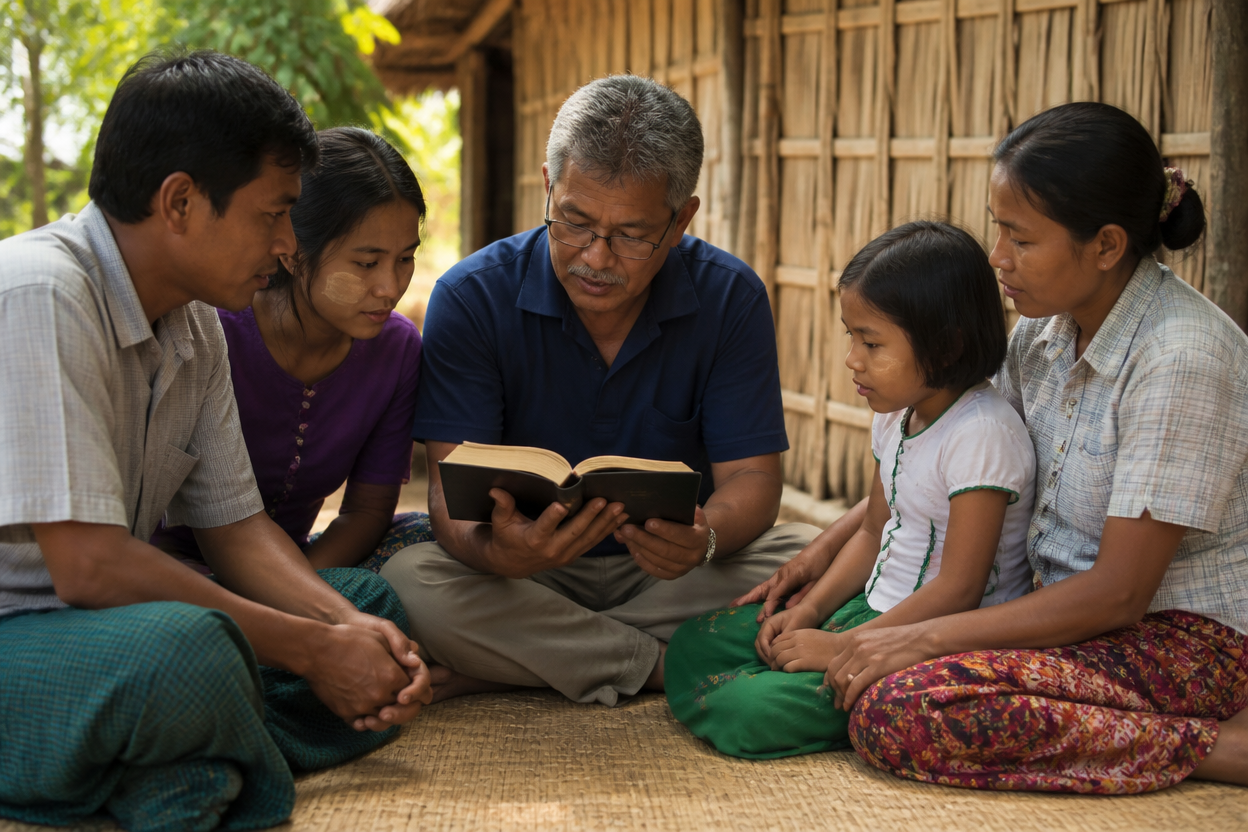
Image-bearing people must never become content
The core ethical question is not whether a story “works,” but whether it treats a person as a neighbor rather than a means. The Incarnation dignifies embodied human life; Christian communication should not do what Christian theology forbids—reducing people to instruments for someone else’s purpose.
Consent must be meaningful, not procedural
Many ministries collect photo releases. Ethical practice goes further. Meaningful consent includes comprehension, freedom from coercion, and clarity about downstream use. In cross-cultural settings, a signature may not reflect genuine understanding, especially where power distance is high or where association with foreign organizations carries risks.
In some Bible translation contexts, identifiable stories can increase vulnerability. That includes reputational harm in tightly knit communities, risk from extremist actors, or complications with government authorities. When the cost of “being featured” is borne by local believers while the benefit accrues to foreign fundraising, Christian ethics demands restraint.
Refuse poverty porn and spiritual voyeurism
Donors have legitimate compassion. Yet images and narratives that linger on suffering for emotional effect can become a form of consumption. Ethical storytelling avoids portraying communities as helpless, primitive, or defined primarily by lack. It also avoids framing local Christians as exotic spiritual specimens for donor inspiration.
In Luke 10, Jesus’ parable of the Good Samaritan is not permission to turn a wounded man into a marketing asset. It is a summons to costly love. Communications should form donors toward faithful solidarity, not merely trigger pity.
Faithful stories honor local agency and shared leadership
Bible translation is often collaborative across churches, networks, and technical partners. Ethical storytelling should reflect that reality rather than centering outside actors as the main protagonists. Donors can celebrate global partnership without being invited into a savior narrative.
Center local translators and churches without tokenizing them
Many donor stories feature local voices only as quotes that confirm the outsider’s project. Ethical practice treats local leaders as co-authors of the narrative. That can mean allowing local teams to set the themes that matter, to correct misunderstandings, and to decide what should remain private.
We also recommend resisting a common communications shortcut: presenting a single individual as the embodiment of an entire people group. That can unintentionally create representative burdens and expose individuals to community tensions. A more faithful approach is to describe communal processes—testing passages with varied groups, integrating feedback, and pursuing broad church reception over time.
Be transparent about what outsiders do and do not control
Donors often ask, “What did our gift accomplish?” That is a stewardship question, and it deserves a clear answer. Ethical storytelling answers without exaggerating donor agency. Funds may support training, consultant review, software, salaries, or printing. They rarely “deliver the Bible” single-handedly.
Across our verification work at Most Trusted, we observe that ministries that communicate with integrity are willing to describe shared responsibility plainly: local churches and translators lead in-language decisions; consultant checks safeguard accuracy; governance and financial oversight protect donor trust; Scripture engagement efforts cultivate use. This clarity tends to build donor confidence rather than diminish it.
Good stewardship includes honest measurement and honest limits
Ethical storytelling does not avoid evidence; it refuses to weaponize it. Donors should expect ministries to report progress with appropriate specificity, while acknowledging what cannot be proven, what is still emerging, and what remains contested in the field.
Use data to serve truth, not to manufacture certainty
Bible translation ministries often reference the scale of remaining work. Responsible communicators ground such claims in credible, accessible sources and avoid inflated precision. For example, many ministries cite the status of languages with and without Scripture based on global tracking efforts such as Ethnologue and related partners; if a ministry uses those numbers, it should cite them transparently and avoid implying that every “language” represents a single, homogeneous community or a uniform translation need. When donors see careful sourcing, they are less likely to be manipulated by urgency marketing and more likely to sustain long-term partnership.
The translation field also wrestles with questions donors should be allowed to see: How do we define “Scripture access” in oral cultures? How should ministries evaluate the impact of a translation on church maturity rather than only distribution counts? These are not embarrassments; they are the normal contours of serious work.
Report what safeguards exist when stories cannot be verified publicly
Security-sensitive environments create a genuine tension. Ministries may be unable to name locations, show faces, or provide detailed public documentation. Ethical storytelling does not use secrecy as a blank check. It explains, in general terms, what internal controls exist: independent audits, board oversight, partner verification, secure field reporting processes, and third-party consultant review.
This is one reason donors seek independent verification. Most Trusted exists to help donors give with confidence by evaluating ministries against The Most Trusted Standard, a 15-criteria framework spanning faith commitments, financial integrity, governance and leadership, and transparency and effectiveness. For donors engaging Bible translation ministries, these criteria often surface whether a ministry’s storytelling aligns with its actual accountability structures rather than floating free of them.
What donors should ask for before funding a story-driven appeal
Ethical storytelling is easier to affirm in principle than to evaluate in practice. Donors can ask for concrete signals that a ministry’s communications are constrained by Christian ethics, not only shaped by marketing incentives. The goal is not suspicion. The goal is stewardship shaped by love of truth.
A short set of questions that reveal posture and practice
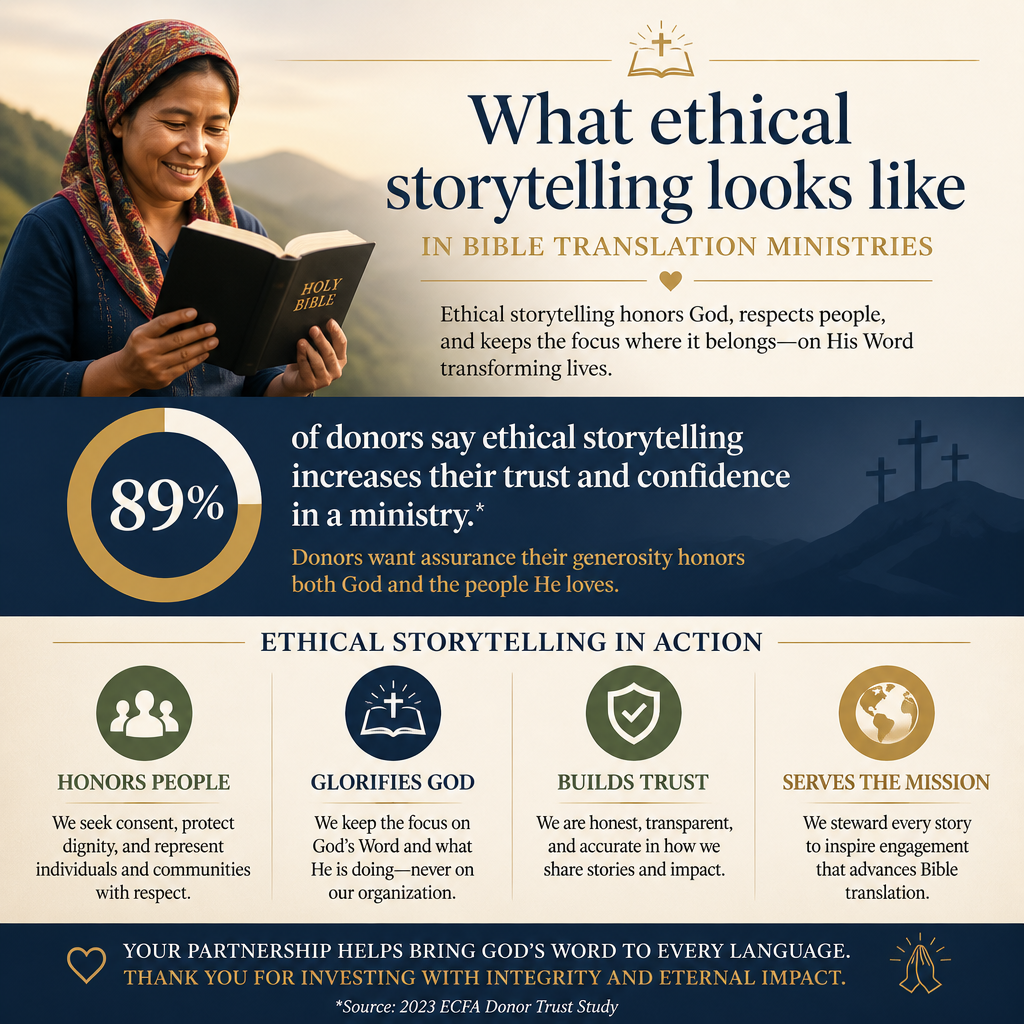
- How does the ministry obtain informed consent for photos, testimonies, and names, especially in vulnerable settings?
- What guidelines restrict the use of children’s images and personal trauma narratives?
- Who reviews stories for accuracy and cultural fairness, including local leaders when possible?
- How does the ministry handle security risks while still providing accountable reporting?
- Does the ministry distinguish clearly between translation milestones and long-term Scripture engagement outcomes?
Where to situate these questions in broader due diligence
Story ethics should not be isolated from the rest of a ministry’s integrity. Communications practices often mirror governance practices. Ministries with mature boards and clear financial controls tend to be more disciplined about permissions, privacy, and claims. Ministries that treat oversight as a burden may treat story subjects similarly.
For donors evaluating the wider landscape of Bible Translation Ministries, the question is not only whether the mission is biblical. It is whether the ministry’s methods—including its public narratives—are consistent with the character of the God whose Word it seeks to translate.
Ethical storytelling is also central to Accountability and Ethics in Bible Translation Ministries. Donor confidence grows when ministries can articulate not only what they do, but what they refuse to do: exaggerate results, endanger partners, commodify suffering, or imply that the gospel depends on donor sentiment rather than the Spirit’s work through faithful labor.
FAQs for What ethical storytelling looks like in Bible translation ministries
Is it unethical for Bible translation ministries to use emotional stories in fundraising?
Emotion is not the problem; manipulation is. Scripture commands compassion, and it is appropriate for donors to feel the weight of spiritual need and human suffering. Storytelling becomes unethical when it relies on exaggeration, strips people of dignity, uses identifiable details without meaningful consent, or frames communities as props for donor motivation rather than neighbors to be honored.
How can donors evaluate story credibility when security concerns limit details?
Donors can look for a ministry’s willingness to describe safeguards even when it cannot disclose identities: independent financial audits, strong board oversight, documented field reporting, and credible external partnerships. Donors can also seek third-party verification where available. In our work at Most Trusted, security constraints are not disqualifying by themselves, but vague claims without accountable controls should be treated as a warning sign.
The stories we tell should sound like the truth
Bible translation ministries rightly invite donors into sacred work. The Word of God deserves communications that reflect God’s character: truthful, careful, and respectful of the people for whom that Word is being translated. Ethical storytelling does not diminish urgency; it purifies it, so that Christian generosity is formed by love of neighbor and love of truth rather than by pressure and spectacle.



