

In Christian counseling ministries, sponsoring counseling means underwriting real clinical care for people who cannot responsibly afford it. It is a form of mercy that treats emotional and spiritual suffering as a genuine burden in the Body of Christ, and it asks donors to fund access with the same seriousness we bring to funding missions, discipleship, and material relief.
Most donors understand the category of scholarship support in Christian education or camp ministry. Counseling sponsorship is similar in structure but different in stakes: the “product” is not an event, but a carefully bounded relationship where trauma histories, marital breakdown, addiction, grief, and suicidal ideation may be present. Funding it well requires clarity about theology, ethics, and accountability.
What counseling sponsorship actually pays for
Fee support that preserves dignity and clinical integrity
At its simplest, counseling sponsorship is a designated fund that reduces or covers a client’s fee for a set number of sessions. The ministry may call this a scholarship, a benevolence fund, or subsidized care. The purpose is not to make counseling “cheap,” but to make appropriate care possible without forcing families into unsafe financial trade-offs or pressuring counselors to work indefinitely without pay.
In practice, this support often includes more than the 50-minute hour. It can fund intake assessments, clinical documentation, case consultation, supervision for interns, and—when needed—referrals for higher levels of care. A mature ministry will be explicit about what sponsorship covers and what it does not, especially in crisis scenarios where emergency services and hospital systems belong to a different category of care.
A model that sits between charity and healthcare
Christian counseling ministries operate in a complicated space. They are not simply churches offering informal pastoral conversations, and they are not simply medical providers. Many integrate prayer and Scripture with evidence-based practice, and they must hold both theological conviction and clinical standards in the same hand. Sponsorship programs are one way ministries maintain that balance: donors fund access, while counselors maintain professional boundaries and a coherent plan of care.
This complexity is also why mature donors ask different questions here than they might ask of a children’s ministry or a food pantry. The counseling room is private by necessity, which makes governance, policies, and external accountability more important, not less.

Why access is a Christian responsibility and a public health reality
Mercy that honors the whole person
Scripture’s call to bear one another’s burdens is not limited to visible needs. The Psalms give voice to anguish, fear, and despair without embarrassment. Jesus meets people in suffering that is spiritual, emotional, and physical, and he does not treat those categories as competitors. A well-designed sponsorship fund is one way churches and Christian donors say, with substance, that mental and relational suffering matters to God and to his people.
Christians genuinely disagree about how to name certain conditions and how to interpret the relationship between sin, suffering, and diagnosis. That disagreement does not remove the obligation to help. It increases the obligation to support ministries that can hold theological seriousness alongside clinical competence, without collapsing into reductionism on either side.
The gap between need and care is measurable
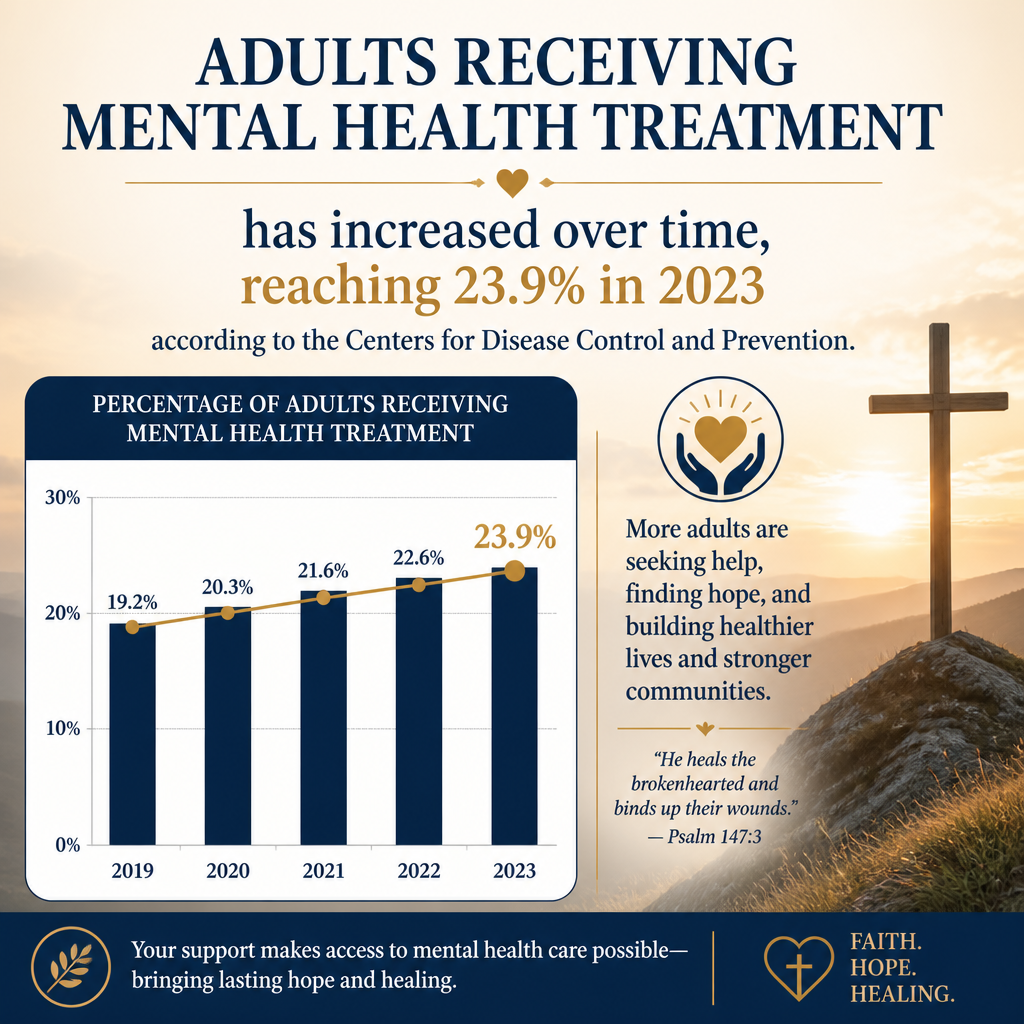
Access is not a theoretical concern. The share of U.S. adults receiving mental health treatment has increased over time, reaching 23.9% in 2023 according to the Centers for Disease Control and Prevention. Yet receipt of any treatment does not guarantee timely, affordable, or clinically appropriate care—especially for lower-income families, rural communities, and those seeking counseling consistent with Christian conviction.
Financial barriers remain central. The American Psychological Association has repeatedly documented that cost and insurance limitations are major reasons people delay or forgo care. Christian counseling ministries often step into that gap, particularly when clients want integration with faith and when local provider networks are limited.
How sponsorship is structured in healthy Christian counseling ministries
Common mechanisms donors should recognize
Across our verification work at Most Trusted, we observe a few patterns in programs that sustain access without eroding clinical standards. Sponsorship tends to be structured rather than improvised, and it is usually governed by written policies that protect both the client and the counselor.
- Sliding-scale fee schedules tied to income and household size, with defined floors and ceilings.
- Scholarship funds that cover a percentage of sessions for a defined period, often 6–12 sessions at a time.
- Matching grants where a donor underwrites a portion of client fees during a campaign window.
- Church partnership funds where congregations contribute to a pool used for referrals from their community.
- Targeted sponsorship for high-need categories such as trauma recovery, marriage stabilization, or post-abortion care.
These structures are not merely administrative. They reduce favoritism, limit dependency, and set expectations for measurable care plans.
Boundaries that prevent confusion and harm
The harder question is what sponsorship should not become. It should not become a donor’s influence over clinical decisions, a sponsor’s access to private information, or a quiet expectation that clients must perform gratitude to keep receiving care. Ethical ministries separate funding decisions from clinical decisions and treat client confidentiality as non-negotiable.
This is where donors sometimes need to recalibrate expectations. In a counseling ministry, the most meaningful outcomes are often slow and internal: fewer panic attacks, restored sleep, reduced conflict, sustained sobriety, renewed capacity for work, an ability to pray again without shame. These changes are real, but they are not always easily photographed or publicly narrated.
What accountable sponsorship looks like under The Most Trusted Standard
Transparency without violating confidentiality
Counseling ministries cannot report the way an overseas school project can. A mature donor should not ask for case notes or personal stories as proof. The right question is whether the ministry can show verifiable evidence of stewardship and effectiveness without exposing clients.
The ministries that meet The Most Trusted Standard tend to publish clear information about governance, finances, leadership accountability, and program design. They also show that they understand the difference between aggregate reporting and testimonial marketing. When stories are shared, they are handled with consent, appropriate anonymity, and an aversion to emotional manipulation.
Financial integrity and program discipline
Sponsorship funds are especially vulnerable to sloppy accounting if a ministry is not disciplined. Donors should look for restricted-fund controls, documented scholarship criteria, and board-level oversight. Many counseling ministries also depend on a mix of earned revenue (client fees), philanthropy (scholarships), and church partnerships. That blended model can be healthy, but it must be explained plainly.
What this means in practice is that a donor’s due diligence should not stop at “how many sessions did you fund.” The better question is whether the ministry’s financial model can continue offering subsidized care without burning out counselors or disguising deficits. The Stanford Social Innovation Review has long noted that nonprofit sustainability is often undermined by unrealistic funding expectations and chronic underinvestment in capacity. Counseling ministries feel that pressure acutely because clinical labor is skilled and costly.
For donors evaluating counseling ministries more broadly, our research on Christian Counseling Ministries frames what healthy governance, faith foundation, and transparent reporting tend to look like in this category.
How donors can give wisely without turning care into a transaction
Give toward access and toward quality
Sponsoring counseling is most faithful when it is not merely a subsidy for demand, but a support for faithful, competent care. That means donors sometimes fund less visible lines in a budget: clinical supervision, counselor training, secure record systems, and policies that protect clients. Donors who only want the direct session count may unintentionally pressure a ministry to underinvest in what keeps counseling safe.
Christians also disagree about the degree to which counseling should be explicitly evangelistic in session. Some ministries integrate prayer and Scripture directly; others practice a quieter integration that honors a client’s spiritual state and the ethical boundaries of clinical care. Donors can support ministries aligned with their convictions, but they should still evaluate whether those convictions are carried with humility, competence, and a refusal to coerce.
Ask questions that respect the counseling room
Wise sponsorship is relational without being intrusive. Donors can ask for aggregate outcomes, waitlist length, scholarship utilization rates, counselor credentials, and safeguarding policies. They can ask how crises are triaged, when referrals are made, and how the ministry coordinates with churches without sharing private details. They can also ask how the ministry prevents the “free care” category from becoming second-tier care.
Donors often find it helpful to situate counseling sponsorship within the wider question of access and equity. Our coverage of Funding Care Access in Christian Counseling outlines the common models and the recurring risks that serious donors should keep in view.
FAQs for What sponsoring counseling means in Christian counseling ministries
Does sponsoring counseling mean paying for therapy instead of discipleship?
No. Sponsoring counseling is not a rival to discipleship but a form of care that can make discipleship possible for people overwhelmed by trauma, anxiety, addiction, or relational collapse. The best Christian counseling ministries understand their role as complementary to the local church, with clear boundaries about what belongs in clinical care and what belongs in pastoral formation.
How can a donor evaluate impact when confidentiality limits reporting?
Donors should look for aggregate reporting and organizational evidence rather than personal disclosure: scholarship policies, counselor qualifications and supervision structures, safeguarding protocols, financial statements, and governance transparency. A ministry’s ability to meet The Most Trusted Standard in these areas is often a better indicator of faithful stewardship than a collection of compelling stories.
Funding counseling as a work of mercy with accountable stewardship
Sponsoring counseling means paying for clinically competent, ethically governed care to reach people who would otherwise go without it. Done well, it honors the image of God in those who suffer, strengthens families and churches, and treats generosity as stewardship rather than sentiment. The task for donors is not merely to fund sessions, but to support ministries that can sustain access while protecting the integrity of the counseling room.



