

What populations Christian counseling ministries serve most is not a question of marketing segmentation. It is a question of pastoral theology under pressure: where suffering concentrates, where stigma persists, and where the church has enough presence to offer care that is both clinically responsible and spiritually faithful.
For donors, the practical question follows quickly. Which populations are being served with competence, safeguards, and honest outcome reporting, and which populations are being served mainly because they are easiest to reach or easiest to fund? Across our verification work at Most Trusted, we see that the strongest ministries name their primary populations clearly, articulate referral boundaries, and fund the less-visible work that does not produce tidy stories.
1. Individuals and families facing acute crisis
Many Christian counseling ministries meet people at the moment when coping strategies collapse: suicidal ideation, panic, trauma exposure, domestic violence, sudden loss, or a psychiatric break. These are the cases that most directly test a ministry’s clinical triage and governance, because the moral impulse to “be present” must be paired with appropriate escalation and mandatory reporting.
Trauma and complicated grief
Trauma is common in the general population, and ministries often become a first stop because they are accessible, relational, and spiritually intelligible. Yet trauma care requires more than sincerity. A trauma-informed posture includes screening, stabilization, and referral pathways when symptoms indicate PTSD, dissociation, or co-occurring substance use.
Donors should pay attention to whether a ministry’s counselors are supervised and trained for trauma modalities, and whether the ministry differentiates pastoral counseling from licensed clinical treatment. The distinction is not a concession to secular categories; it is a form of loving truthfulness about what a ministry can responsibly provide.
Safety planning and higher levels of care
When a person is at risk of self-harm or harm to others, ministries must have protocols that do not depend on individual discretion. In the United States, suicide remains a leading cause of death, and it is especially tragic because it often presents in silence or shame. The CDC reports that suicide was among the leading causes of death in 2022 in the U.S. (CDC Suicide Facts).
Donors can reasonably ask whether the ministry has 24/7 crisis guidance, established relationships with local emergency services, and clear documentation practices. Good intentions are not a substitute for systems.

2. Couples and marriages under strain
A large share of Christian counseling demand comes through marriages in distress. This is partly because marriage is a theological and communal reality in the church, not only a private contract. It is also because marital conflict often becomes the presenting problem for deeper issues: untreated depression, trauma histories, financial stress, sexual dysfunction, or addiction.
High-conflict couples and the limits of conjoint counseling
Not every couple is an appropriate candidate for standard marriage counseling. Where there is coercive control, ongoing affairs, or patterns of intimidation, conjoint sessions can intensify harm. Mature ministries screen for domestic abuse and differentiate “mutual conflict” from “power and control,” then design care plans accordingly.
This is an area where donors can unintentionally underwrite harm if they reward ministries that promise quick reconciliation without safeguards. Scripture’s call to reconciliation does not nullify God’s concern for the oppressed, nor does it require a victim to endure danger as a display of spiritual maturity.
Premarital and early-marriage formation
Many ministries serve engaged couples and newlyweds through structured premarital counseling, marriage mentoring, and skills-based interventions. This is preventative care, and it is often more scalable than intensive therapy. It can also reduce downstream need if it includes honest assessment around family-of-origin patterns, expectations, sexuality, and communication.
Donors often prefer prevention because it feels more hopeful and less crisis-driven. The tension is that prevention is harder to measure in the short term. Ministries that meet The Most Trusted Standard tend to acknowledge this and still publish what they can: participation rates, completion, and follow-up touchpoints that show whether couples remain connected to care.
3. Adolescents and young adults
Christian counseling ministries frequently serve teens and young adults because the youth ministry pipeline surfaces mental health needs, and because parents are actively seeking care that aligns with their faith. This population brings clinical complexity: rapid development, identity formation, family systems, and elevated risk for anxiety, depression, and self-harm.
Anxiety, depression, and the reality of rising demand
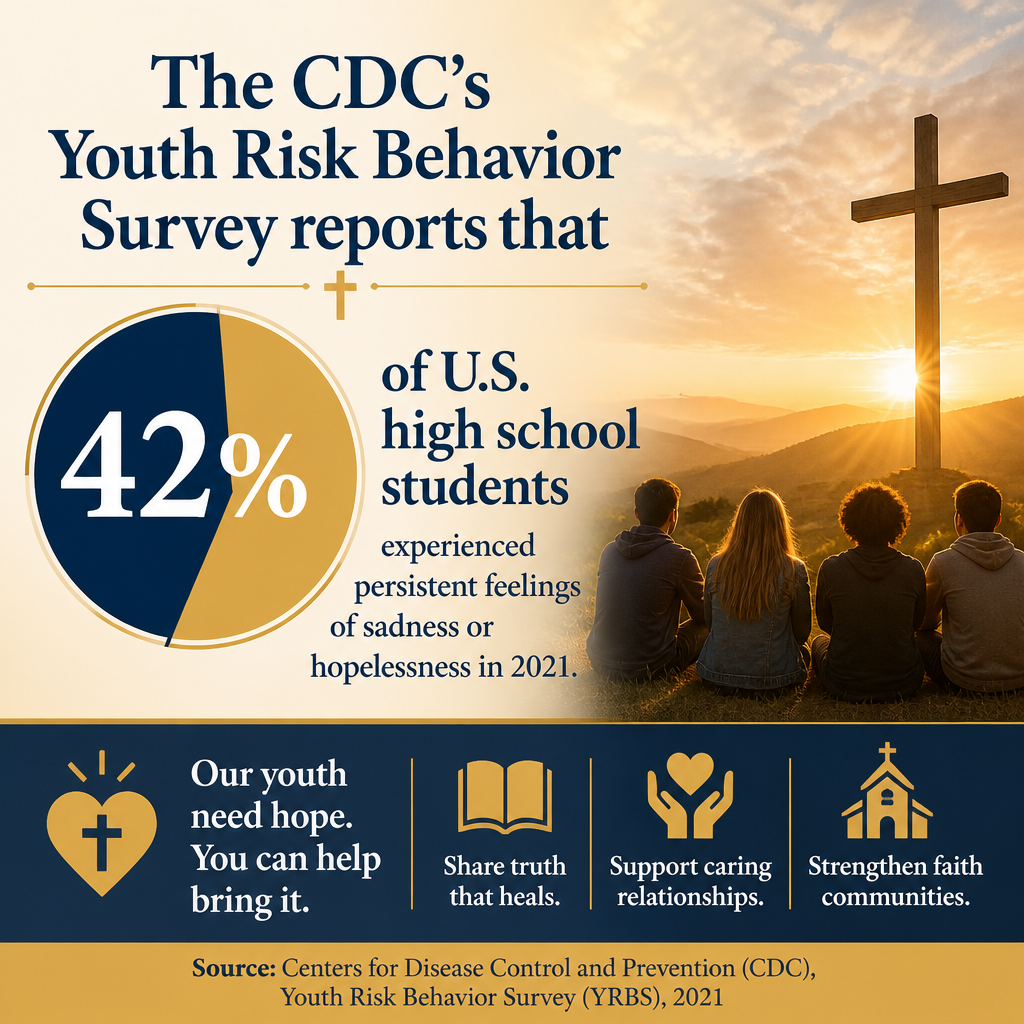
The demand signal is not ambiguous. In the U.S., a significant share of high school students report persistent feelings of sadness or hopelessness, and mental health-related distress has become a central pastoral burden in many congregations. The CDC’s Youth Risk Behavior Survey reports that in 2021, 42% of U.S. high school students experienced persistent feelings of sadness or hopelessness (CDC Youth Risk Behavior Survey).
Donors should look for ministries that engage parents appropriately, document informed consent, and respect legal requirements around minors. Excellence here is not merely compliance; it is discipleship that honors children as image-bearers who deserve competent care.
College students and emerging adults
College campuses and early-career life stages often intensify mental health strain: isolation, pressure, substance exposure, and questions of vocation and belief. Christian counseling ministries serving this group commonly offer short-term counseling, group therapy, and referral partnerships with university counseling centers and local clinicians.
This is also where theology can be misused if it is reduced to a simplistic explanation for suffering. Serious ministries hold together spiritual formation and psychological insight without collapsing one into the other.
4. Communities facing structural barriers to care
Christian counseling ministries are increasingly drawn toward populations who cannot readily access care through standard channels: uninsured families, underinsured workers, rural communities, immigrants, and communities of color underserved by the mental health workforce. This work is costly because it requires sliding-scale models, bilingual clinicians, and long-term partnerships.
Low-income clients and the arithmetic of affordability
Affordability is not a secondary issue; it is a gatekeeper. When counseling becomes a luxury good, the poor are functionally excluded from one of the basic supports that can stabilize families and prevent downstream crises. The U.S. Health Resources and Services Administration identifies mental health as a major component of Health Professional Shortage Areas, reflecting access constraints that ministries often feel directly (HRSA Health Professional Shortage Areas).
Donors should ask how a ministry funds subsidized sessions without creating perverse incentives or exhausting clinicians. The “Starvation Cycle,” described by Goggins Gregory and Howard, is a recurring nonprofit pattern in which chronic underfunding leads to weakened capacity and poor outcomes (Stanford Social Innovation Review). Counseling ministries are not immune; under-resourced clinical care tends to produce long waitlists, high counselor turnover, and inconsistent supervision.
Rural communities and church-based access points
Rural settings often face a double constraint: fewer licensed providers and higher stigma around mental health care. Churches can become trusted entry points for help, which is an opportunity and a responsibility. A church-based referral network can connect individuals to competent care while maintaining confidentiality and resisting gossip.
For donors, the question is whether the ministry has credible local partnerships, not merely a desire to “serve rural America.” This is a place where measured modesty is often a mark of integrity.
5. People navigating spiritual conflict and moral injury
Christian counseling ministries often serve people whose suffering is explicitly spiritual: scrupulosity, spiritual abuse, church conflict, doubt, shame, and moral injury. This population is frequently overlooked in mainstream clinical settings, where spiritual language may be misunderstood or pathologized.
Spiritual abuse and church-related trauma
Christians genuinely disagree about how to describe and measure “spiritual abuse,” and some language in this space is used too loosely. Yet the underlying reality is not in dispute: religious authority can be weaponized, and the wounds can resemble trauma responses. Healthy ministries treat these cases with seriousness, avoid reflexive defense of institutions, and help clients rebuild trust without demanding premature reconciliation.
Donors should watch for ministries that have clear safeguarding policies and independent governance. When a counseling ministry is tightly controlled by the same leadership structures implicated in harm, the conflict of interest is not theoretical.
Addiction, compulsive behaviors, and shame-based cycles
Addiction ministry and counseling ministry frequently overlap: pornography compulsion, substance use, gambling, and disordered eating. The church’s historic vocabulary of sin and repentance can be clarifying, but it can also be misapplied if it becomes a blunt instrument that ignores trauma, neurobiology, and environmental triggers.
Strong ministries integrate spiritual care with evidence-based treatment principles, appropriate group accountability, and referral to medical or psychiatric providers when needed. Donors should not assume that “Christian” automatically means “competent,” nor that “clinical” automatically means “spiritually safe.” Discernment is required.
For donors evaluating who is being served and how, we recommend a short set of questions that reveal whether the ministry’s population focus is matched by adequate safeguards and capacity:
- Which populations are primary, and which are secondary or referral-only?
- What credentials, supervision, and continuing education are required for counselors serving high-risk cases?
- How does the ministry screen for abuse, suicidality, and severe mental illness, and what happens when those are present?
- What is the financial model for subsidized care, and how are clinician workloads protected?
- How does the ministry measure outcomes without reducing people to metrics?
Many donors begin with population burden, then move quickly to institutional trust. That is reasonable. At Most Trusted, we evaluate ministries against The Most Trusted Standard, examining faith foundation, financial integrity, governance and leadership, and transparency and effectiveness, because counseling is one of the domains where moral aspiration must be paired with verifiable structures.
For readers comparing ministries across the wider landscape of Christian Counseling Ministries, population served is a meaningful indicator, but not a sufficient one. Two ministries may both serve adolescents, for example, while only one has consistent clinical supervision, a documented crisis protocol, and a transparent financial model that can sustain subsidized sessions.
Population focus also intersects with how care is funded. Sliding-scale counseling can be faithful and effective, but it requires donors who understand what they are underwriting: licensed staff, supervision, secure record systems, and time-intensive care that does not scale like a media ministry. For donors thinking through Funding Care Access in Christian Counseling, the central question is not simply “How many people were served?” but “Was care accessible without becoming unsafe, superficial, or financially brittle?”
FAQs for What populations Christian counseling ministries serve most
Do Christian counseling ministries mainly serve church members?
Many do, because churches are a primary referral channel and because trust often begins in a congregational relationship. Yet a substantial number serve the broader community through sliding-scale clinics, school partnerships, pregnancy centers, or referral networks. Donors should ask for a clear breakdown of who is eligible for services and whether evangelistic expectations are placed on clients as a condition of care.
Which populations are most expensive for counseling ministries to serve well?
High-acuity clients are typically the most resource-intensive: people with trauma histories, active suicidality, severe depression, domestic violence situations, or co-occurring addiction. These cases require trained clinicians, supervision, longer treatment arcs, and reliable referral pathways. Ministries that claim to serve these populations without demonstrating safeguards and partnerships should be treated cautiously.
Serving the vulnerable requires both compassion and verification
Christian counseling ministries most often serve people in crisis, couples under strain, young people navigating formative years, communities blocked from care by cost and geography, and believers burdened by spiritual conflict. The church has a genuine opportunity to embody mercy here, but the opportunity carries risk when ministries overpromise or underbuild the structures that protect clients.
For donors, the wisest posture is not suspicion, but disciplined trust. Giving with confidence means funding ministries that can name their populations, show their safeguards, and sustain their model over time—so that compassion remains not only sincere, but safe and effective.



