
When Christian counseling ministries refer to clinical care, donors are watching a ministry make a judgment call at the intersection of discipleship, suffering, and clinical risk. Referral is not a retreat from Christian conviction. Done well, it is a form of pastoral responsibility: recognizing limits, protecting the vulnerable, and ensuring that serious mental illness receives competent treatment.
The harder question is how donors can tell the difference between a prudent, ethically grounded referral practice and a vague handoff that leaves people unsupported. Across our verification work at Most Trusted, we have found that referral policies are often one of the most revealing windows into a counseling ministry’s maturity, governance, and theological seriousness.
Referral is a theological and ethical obligation, not a failure of faith
Christian care names both spiritual formation and creaturely limits
Scripture never treats human finitude as a surprise to be overcome by spiritual force. We are “dust” (Psalm 103:14), and the church is an embodied community called to wise, ordered love. Christian counseling ministries serve people whose pain includes sin, suffering, trauma, and biological vulnerability. The ministry’s calling is not to deny complexity, but to respond with truth and mercy.
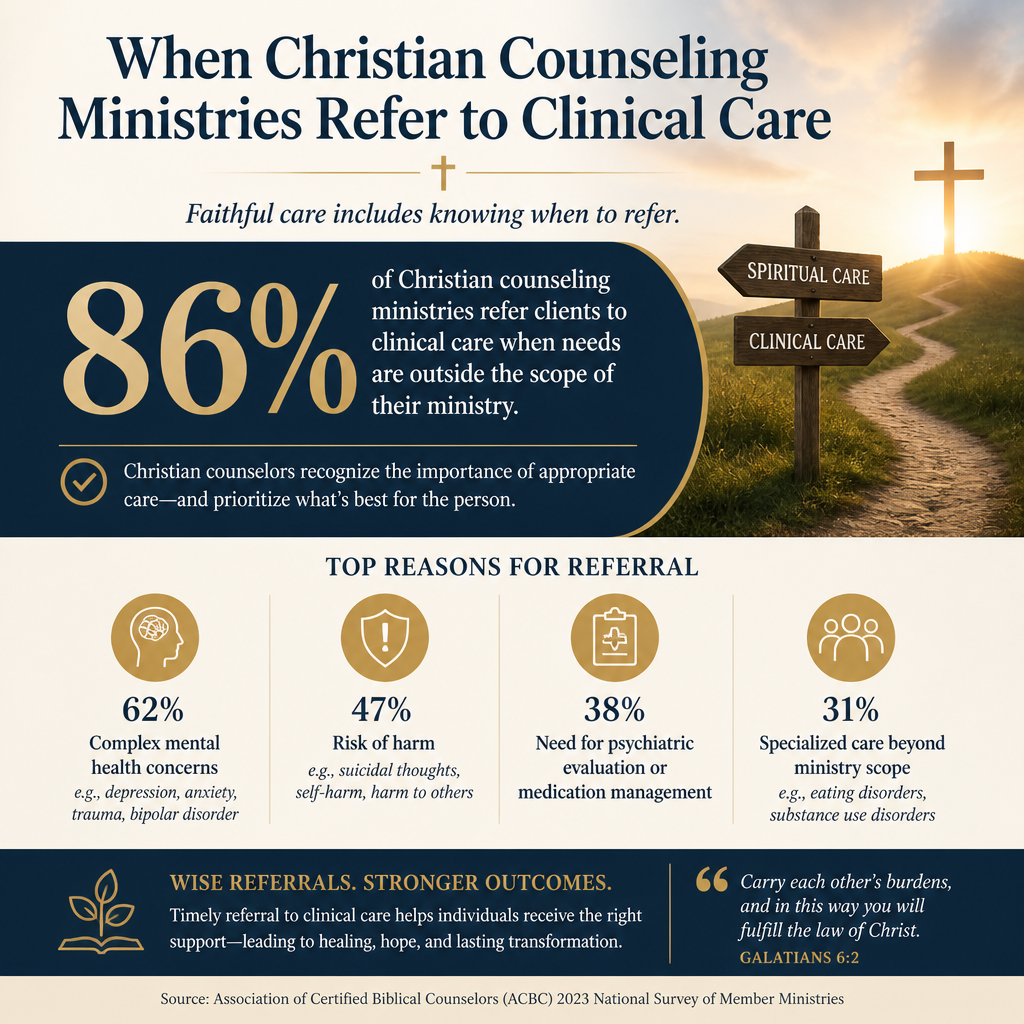
Referral becomes necessary when the presenting concern is beyond the ministry’s competence, scope, or legal ability. A lay counseling model may be faithful and effective for grief support, marriage mentoring, or spiritual direction, yet inappropriate for acute psychosis, unmanaged bipolar disorder, severe eating disorders, or active suicidality. The ministry that refuses referral under a banner of “faith” may be confusing spiritual authority with clinical competence.
Clinical care can be part of a Christian ministry of presence
Christians genuinely disagree about how to integrate therapy, psychiatry, and spiritual care. Some worry clinical frameworks will crowd out repentance, worship, and the hope of sanctification. Others worry that spiritual language will be used to bypass trauma and delay necessary treatment. Donors should not expect simplistic alignment. They should expect transparent principles, careful boundaries, and a ministry posture that honors both the soul and the body.
What this means in practice is that referral is often the mechanism by which a ministry preserves its distinct calling. The ministry can remain explicitly Christian in counsel, prayer, and moral teaching while also insisting that complex clinical conditions are treated by trained professionals. That combination is not compromise. It is integrity.

When referral is clinically necessary and what a ministry should do first
Common referral triggers donors should understand
A responsible ministry does not wait until a crisis becomes unmanageable. It trains staff and volunteers to recognize clear referral triggers and to act quickly. At minimum, a ministry should have written procedures for risk screening and escalation, including what happens after hours and who has authority to initiate an emergency response.
We recommend that donors look for ministries that treat the following as non-negotiable referral or escalation categories, with documented protocols:
- Active suicidal ideation with intent, plan, or access to means
- Homicidal ideation or credible threats of harm
- Psychosis, mania, or severe dissociation impairing reality testing
- Substance withdrawal risks or severe substance use disorder requiring medical oversight
- Ongoing abuse with immediate safety concerns, especially involving children
For reference, the U.S. Substance Abuse and Mental Health Services Administration maintains crisis guidance and treatment resources, including the 988 Suicide and Crisis Lifeline and standards for behavioral health crisis care SAMHSA.
Referral should preserve continuity rather than abandon the counselee
Referral can be clinically correct and pastorally harmful if it functions as a dismissal. A ministry can remain meaningfully involved without practicing outside its competence. Appropriate involvement may include prayer, coordination with the client’s pastor, practical support from the church, and spiritual care that complements clinical treatment.
The ministry’s documentation matters here. Donors should expect to see clear limits on confidentiality, informed consent procedures, and a plan for follow-up after the referral. Without those, even well-intentioned referral can collapse into silence.
What high-integrity referral partnerships look like
A referral network is a governance and quality issue
A mature ministry does not improvise referrals in the moment. It builds relationships with licensed clinicians, psychiatric prescribers, inpatient and intensive outpatient programs, and community resources. This is not simply an operational detail. It is a governance issue because it reflects whether leadership has anticipated foreseeable risks and created accountable systems to address them.
Within Christian Counseling Ministries, we often see the strongest organizations maintain a vetted directory of referral partners. Vetting typically includes license verification, scope of practice, crisis availability, alignment on basic ethical standards, and clarity about communication channels. Where theological fit is important to the ministry, it is discussed openly rather than assumed.
Integration without confusion of roles
The healthiest partnerships preserve role clarity. The clinical provider is responsible for clinical diagnosis and treatment. The ministry is responsible for spiritual care consistent with its mission, delivered within defined competencies. Donors should be wary when a ministry blurs these lines: volunteers offering quasi-clinical treatment, leaders making medication judgments, or biblical language used to pressure a counselee away from evidence-based care.
Christians can affirm that common grace includes medical knowledge and psychological science without granting those fields ultimate authority. A ministry that can articulate this distinction tends to refer well. It does not treat referral as capitulation; it treats it as part of a larger ecology of care in the body of Christ.
Donor due diligence on referral practices using The Most Trusted Standard
What to ask and what credible documentation looks like
Donors often ask whether a counseling ministry is “biblical.” The better question is whether its practices are both theologically faithful and verifiably responsible. Referral practices are one of the simplest areas to assess because good intentions are not enough; systems must exist.
Within The Most Trusted Standard, referral maturity tends to show up across several criteria: clear faith commitments that do not excuse negligence, financial integrity in how counseling fees and scholarships are handled, leadership accountability for safety and compliance, and transparency about outcomes and limitations. These are not abstract virtues. They determine whether vulnerable people are protected when the ministry encounters high-risk situations.
Practical donor questions include:
- Does the ministry have written referral and crisis protocols, and are they reviewed regularly?
- Who provides supervision, and what qualifications do they hold?
- How does the ministry handle mandated reporting and safeguarding requirements?
- What training do lay counselors receive on risk screening and boundaries?
- Does the ministry follow up after referral to ensure continuity of care?
When a ministry answers these questions with specificity, it is usually because the board and executive leadership have required it. When answers are vague, it often signals governance weakness rather than merely a communications gap.
Guardrails against common failures in the sector
The sector has had to reckon with cases where ministries promised more than they could deliver, handled crises informally, or operated without adequate supervision. Even when no wrongdoing is present, a counseling ministry can drift into the “starvation cycle,” a pattern in which donor expectations for low overhead pressure organizations to underinvest in training, supervision, and systems that protect clients. Stanford Social Innovation Review has described this dynamic and its consequences for nonprofit performance and integrity Stanford Social Innovation Review.
Donors who want to expand care access should not unintentionally reward under-resourcing. Referral networks, clinical supervision, secure recordkeeping, and safeguarding training cost money. A ministry that cannot explain these investments is often a ministry that has not made them.
Funding referral pathways as part of care access
Referral is often where the financial burden shifts to the counselee
One reason referral is emotionally difficult is that it can move a person from a low-cost ministry setting into a higher-cost clinical environment. That transition is often where families discover the limits of insurance networks, provider availability, and out-of-pocket affordability. In many communities, it is also where waitlists appear, especially for psychiatry and specialized trauma treatment.
Donors can help most by funding the connective tissue: care coordination, subsidized clinical slots with trusted providers, transportation assistance, and partnerships that reduce friction in moving from ministry care to clinical care. The point is not simply to pay for therapy sessions; it is to prevent vulnerable people from falling through the gap between the church’s compassion and the healthcare system’s constraints.
Investments that strengthen access without weakening accountability
Within Funding Care Access in Christian Counseling, the most constructive donor strategies tend to fund capacity rather than sentiment. This includes underwriting supervisor time, improving intake and triage, building scholarship funds with clear eligibility criteria, and supporting referral agreements with licensed providers.
Donors should also expect ministries to communicate limits candidly. A ministry that promises universal access without acknowledging clinical capacity, licensure boundaries, and crisis constraints is more likely to place both counselees and volunteers at risk. Transparency here is not a branding choice; it is an ethical duty.
FAQs for When Christian counseling ministries refer to clinical care
Does referring to clinical care mean a ministry is not truly Christian counseling?
No. Referral can reflect a ministry’s commitment to truthfulness about competence and its responsibility to protect the vulnerable. Christian counseling is not defined by refusing medical or psychological care. It is defined by faithfulness to Christ in how counsel is given, how suffering is understood, and how love of neighbor is practiced, including through appropriate escalation to licensed treatment.
What should donors look for to confirm referrals are handled responsibly?
Donors should look for written protocols, qualified supervision, documented safeguarding and mandated reporting practices, and a vetted referral network. Responsible ministries explain how they assess risk, how they maintain continuity of care after referral, and how governance holds leadership accountable for compliance and client safety. When these elements are present, referral is typically a sign of maturity rather than retreat.
Referral done well is a form of Christian stewardship
When Christian counseling ministries refer to clinical care, they are often making an unseen decision that protects a life, a family, and the integrity of the church’s witness. Donors should not reward ministries for appearing self-sufficient. They should reward ministries that tell the truth about what they can do, build trustworthy partnerships for what they cannot, and maintain accountable systems so that compassion remains tethered to responsibility.
Most Trusted exists to help donors give with confidence by evaluating ministries against The Most Trusted Standard. In counseling work especially, that confidence is rarely built on inspiring stories alone. It is built on verifiable practices that honor both the gospel and the gravity of human need.



