

What share of donations funds Bible distribution work is a stewardship question before it is a marketing question. Donors are not merely purchasing printed pages; they are participating in the church’s vocation to make God’s Word known, in ways that are faithful, financially honest, and practically effective.
The harder reality is that “Bible distribution” is not a single activity with a single cost profile. A ministry may print Bibles, translate Scripture into new languages, ship pallets across borders, partner with local churches, train leaders to disciple new readers, or build digital delivery tools. Each choice changes the share of donations that reaches what donors commonly call “the field,” and each choice carries theological and ethical implications.
Start with definitions that can be verified
What donors usually mean by Bible distribution work
In donor conversations, “Bible distribution work” often means the direct costs of getting Scripture into people’s hands: printing, procurement, freight, warehousing, customs, and last-mile delivery. In audited financial statements, those costs may be captured under program services, but the program line can also include training, discipleship materials, local partner support, translation work, and monitoring.
This definitional gap matters because overhead ratios can be manipulated by classification choices. A ministry can report an impressive “program percentage” by moving legitimate administrative work into program categories, or by understating the true costs required to manage grants, prevent diversion, and maintain safeguarding and financial controls. Sophisticated donors do not ask only for a percentage; they ask for a transparent and consistent method.
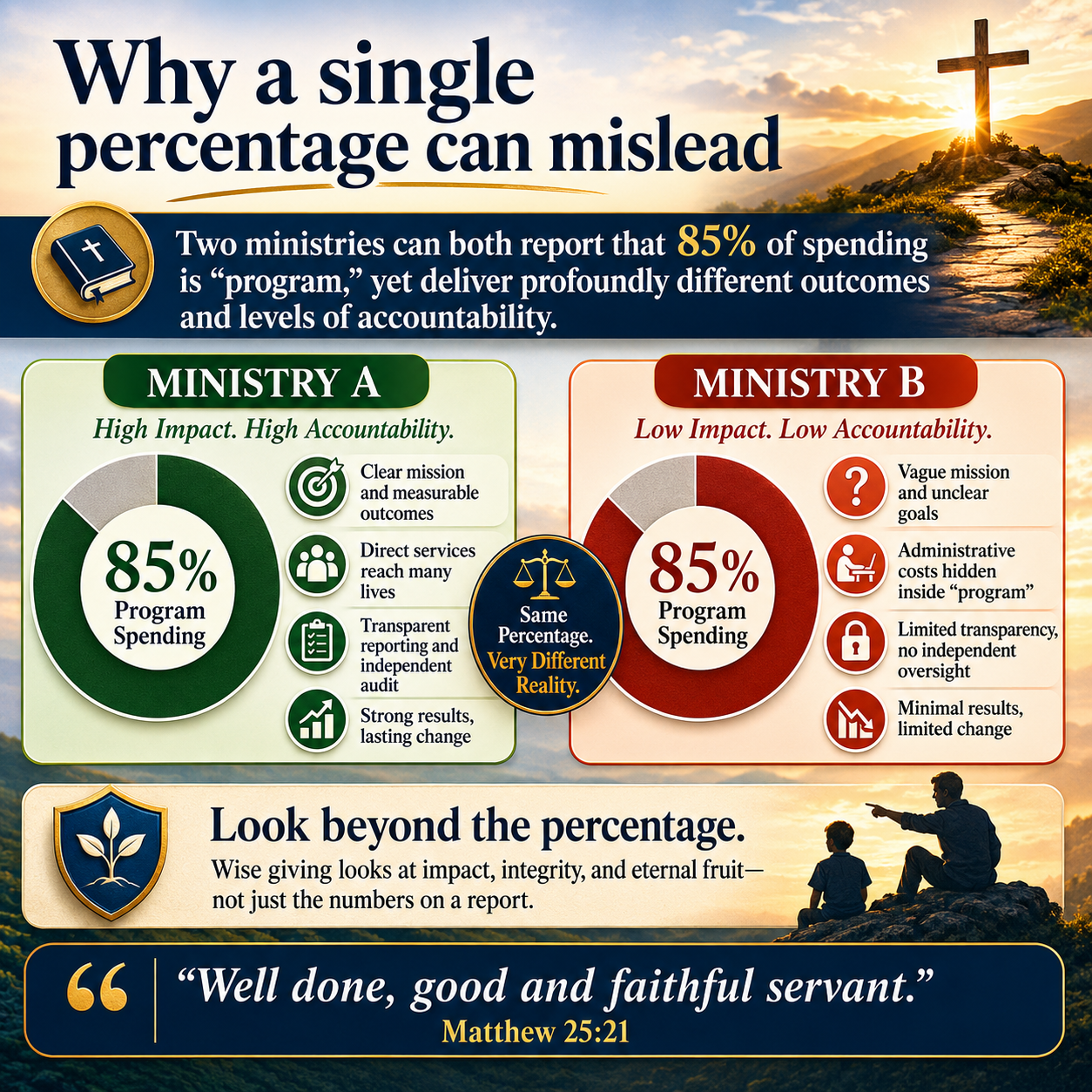
Why a single percentage can mislead
Two ministries can both report that 85% of spending is “program,” yet deliver profoundly different outcomes and levels of accountability. One may operate primarily as a grantmaker funding indigenous church networks; another may operate a complex logistics footprint across multiple countries. The first may have lower freight costs but higher diligence costs. The second may have higher visible delivery costs but also higher compliance exposure, security risk, and supply-chain complexity.
The nonprofit sector has wrestled publicly with the damage caused by simplistic overhead fixation. The leaders of Charity Navigator, Candid (then GuideStar), and the BBB Wise Giving Alliance urged donors to stop using overhead ratios as the primary measure of nonprofit performance in their “Overhead Myth” letter, emphasizing results, governance, and transparency as the more faithful questions of stewardship (Charity Navigator).

Reasonable ranges depend on the ministry model
Typical cost drivers in Bible distribution
Because “Bible distribution work” spans multiple activities, healthy ministries will fall into different expense patterns. Printing costs can be predictable; translation costs are front-loaded and lumpy; shipping can swing with fuel prices, border delays, and security conditions; and partner training can be staff-intensive.
What this means in practice is that donors should expect variation across years even within the same ministry. A year with heavy translation investment may show a different “share to distribution” than a year focused on shipping existing stock. Mature accountability names those differences rather than hiding them in averaged claims.
What we can say with confidence about ratios
We can say several things with confidence without pretending that one ratio fits all.

- If a ministry claims that nearly every donated dollar goes straight to Bibles, the claim deserves scrutiny. Real distribution at scale requires controls, compliance, partner vetting, and financial oversight that cost money.
- If a ministry’s program share is persistently low, donors should ask why. Inefficiency, fundraising pressure, or governance weaknesses can depress mission delivery.
- If a ministry’s program share is high but outcomes are unclear, donors should ask for evidence that the “program” is actually reaching intended recipients and being used as intended.
- If the ministry operates in high-risk contexts, donors should expect higher administrative costs tied to security, anti-diversion controls, and compliance.
- If the ministry is building translation or digital infrastructure, donors should expect multi-year investments that do not map neatly onto “Bibles delivered this quarter.”
For donors who want a grounded framework for evaluating such claims across ministries, our work at Most Trusted applies The Most Trusted Standard, which examines not only financial integrity but also governance, faith foundation, and demonstrable transparency and effectiveness.
What faithful accountability requires beyond overhead
Ask for audited statements and consistent program definitions
Christian donors should not be asked to choose between trust and verification. A credible Bible distribution ministry can provide recent audited financial statements, an IRS Form 990 if applicable, and a clear explanation of how it defines “program” for internal and external reporting. If the ministry is not required to file a Form 990, it can still practice 990-level transparency by publishing comparable financial summaries and audit reports.
A ministry that is careful here is not quenching generosity; it is honoring it. Scripture commends transparent administration of gifts precisely to avoid reproach. When Paul organized the collection for Jerusalem, he insisted on honorable handling “not only in the Lord’s sight but also in the sight of man” (2 Corinthians 8:21, ESV) (Bible Gateway).
Ask how the ministry protects the integrity of distribution
In many contexts, the main threat is not financial “overhead” but diversion: product being resold, routed to the wrong networks, or used as a tool of coercion rather than discipleship. Strong ministries describe their controls plainly: partner agreements, distribution records, spot checks, local church verification, and mechanisms for reporting misuse.
Christians genuinely disagree about the right balance between speed and control in mission contexts. Yet the disagreement should be conducted in the light. Claims like “we get Bibles out faster because we don’t waste money on bureaucracy” are sometimes cover for weak governance. The ministries that meet The Most Trusted Standard tend to speak differently: they describe the costs of integrity as part of the mission, not as an obstacle to it.
How to evaluate a ministry’s claim about the share that funds distribution
Use outcome questions, not only accounting questions
Accounting is necessary, but it is not sufficient. A program can be well-funded and still be ineffective, misdirected, or spiritually thin. Because Bible distribution is a means toward discipleship and church strengthening, donors should ask what outcomes the ministry is accountable for and how it learns when outcomes fall short.
Healthy outcome questions include: Where are the Bibles going? Through what local churches or networks? What training accompanies distribution, if any? What is the ministry’s theology of Scripture engagement? What evidence exists that recipients can and do read, hear, and understand the Word in their language and context?
Insist on clarity about restricted gifts and true costs
Some ministries market “$X sends a Bible” appeals. Those appeals can be legitimate if they are carefully defined. But donors should confirm whether the claim includes the full cost of the program (printing plus delivery plus field oversight), or whether it reflects only the marginal cost of an item while other donors subsidize the rest through unrestricted giving.
Restricting gifts to the last visible step can create real strain. The field has long recognized that starving core operations can weaken results. Stanford Social Innovation Review has described the “Nonprofit Starvation Cycle,” in which pressure to minimize overhead leads organizations to underinvest in systems required for effectiveness and accountability (Stanford Social Innovation Review).
Donors who want a deeper view of these accountability dynamics across Scripture distribution organizations can also review our coverage of Accountability and Transparency in Bible Distribution Ministries, where financial reporting questions are considered alongside governance, disclosure, and measurable effectiveness.
Why the question is spiritual as well as financial
Stewardship requires truthfulness about costs
There is a subtle spiritual temptation in this space: to treat low overhead as a proxy for holiness. Scripture does not endorse that equation. Faithfulness requires integrity, competence, and truthful speech. If a ministry cannot describe its costs honestly, donors should not assume the ministry will handle Scripture distribution honestly in contested contexts.
At the same time, donors should resist cynicism that treats all administration as waste. A distribution ministry that operates internationally must comply with financial regulations, protect against fraud, and steward complex partnerships. The administrative share that enables those protections can be part of “Bible distribution work” in the deeper sense—ensuring the Word reaches people without scandal or exploitation attached to it.
Effectiveness is not optional for Christian giving
Jesus commends wise stewardship, not merely sincere intention. The parable of the talents assumes accountability for what is entrusted and a realistic assessment of outcomes (Matthew 25:14–30) (Bible Gateway). Christian donors therefore have warrant to ask whether dollars entrusted to Bible distribution are producing durable fruit: Scripture access, Scripture engagement, local church strengthening, and discipleship depth.
For donors evaluating Bible distribution specifically, Bible Distribution Ministries is the broader context where we track recurring questions about translation, delivery models, partnerships, and evidence of impact.
FAQs for What share of donations funds Bible distribution work
Is there a standard percentage that should go to Bible distribution work?
No single percentage is standard across credible Bible distribution ministries, because “distribution work” can include different mixes of printing, translation, logistics, partner training, and field oversight. Donors should prioritize audited transparency and consistent definitions over chasing an isolated ratio, and should ask whether the reported share aligns with the ministry’s stated model and risk environment.
Should we avoid ministries with higher overhead if we want maximum Bibles delivered?
Not automatically. Higher administrative costs can reflect necessary investments in compliance, anti-diversion controls, governance, and partner diligence—especially in high-risk contexts. The better question is whether the ministry can demonstrate that its costs are reasonable, honestly reported, and connected to verifiable outcomes, rather than simply asserting that a low overhead number proves effectiveness.
Giving with confidence requires more than a percentage
The share of donations that funds Bible distribution work is worth asking about, but it is not the final measure of faithfulness. Christian donors should expect ministries to provide auditable financial clarity, transparent definitions, and evidence that distribution is secure, accountable, and spiritually purposeful. When those elements are present, a percentage becomes one useful indicator among many rather than a substitute for discernment.



