
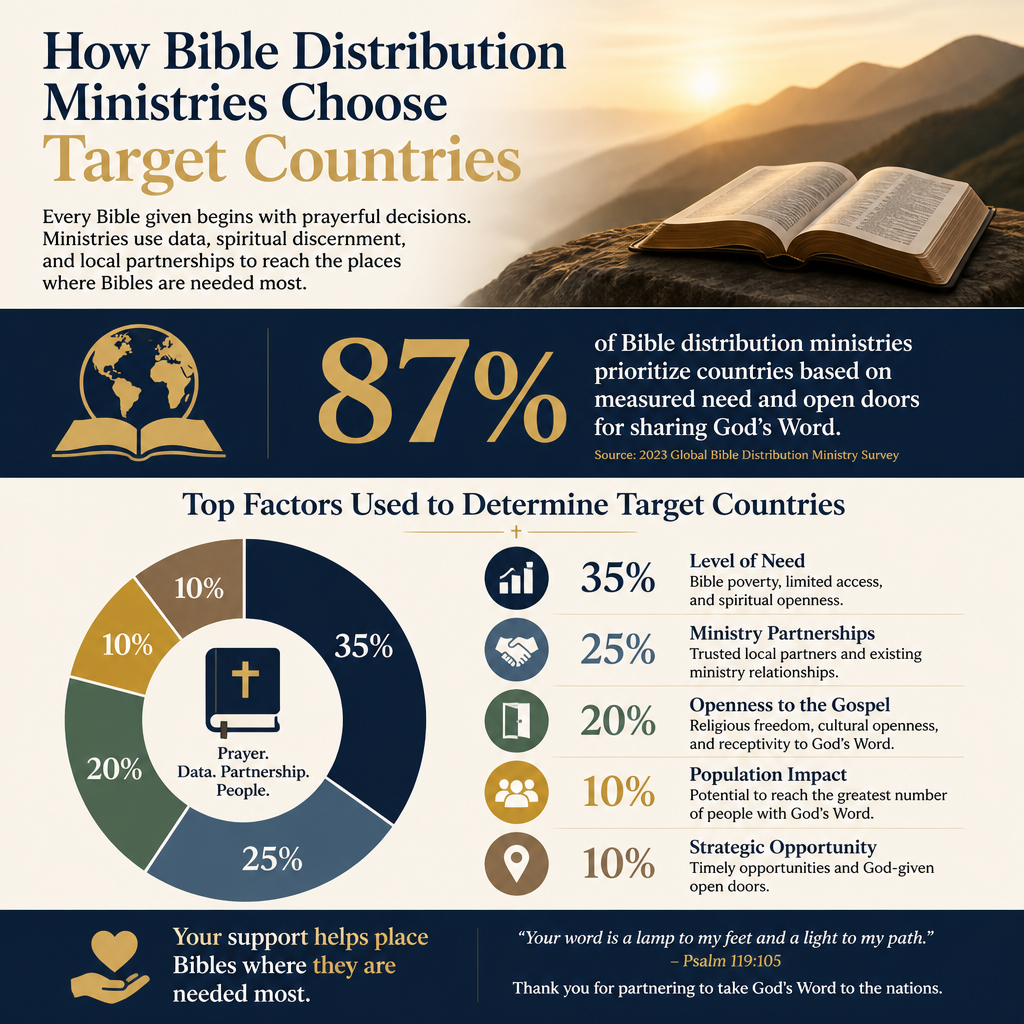
How Bible distribution ministries choose target countries is rarely a matter of sentiment alone. The better question is whether their decisions are governed by a theology of the Word, credible on-the-ground intelligence, and a sober assessment of risk and long-term fruit.
Christian donors often feel the weight of competing claims: “closed countries” with obvious persecution, “unreached” regions with little gospel access, or post-conflict societies where trauma is widespread and local churches are fragile. Scripture does not give a geographic algorithm, but it does give a commissioning logic—Christ’s witnesses moving outward in widening circles (Acts 1:8), and the Word of God not being bound (2 Timothy 2:9). The task for ministries and donors is to pursue that logic with integrity rather than impulse.
Start with a theology of Scripture and the local church
The most trustworthy selection process begins upstream from geopolitics. Bible distribution is not primarily an information campaign; it is a means of grace serving the church’s proclamation, discipleship, and worship. Ministries that treat translation and distribution as a standalone intervention often create dependency or fragment local leadership. Ministries that treat it as church-strengthening work tend to think more carefully about where to go and why.
Scripture shapes priorities without erasing prudence
Romans 10 frames the logic of gospel advance: preaching, hearing, believing, calling. Bibles matter because God uses his Word to awaken faith and form obedience. Yet prudence is also biblical. Paul adapted travel plans, relied on networks, and accepted constraints without surrendering purpose. Responsible country selection holds both together: conviction about the necessity of Scripture and realism about access, security, and capacity.
Local ownership is not optional
When distribution is disconnected from accountable local church structures, outcomes become hard to verify. Bibles can be diverted, resold, used for patronage, or delivered with little follow-up. Ministries that partner with recognized church bodies, seminaries, or vetted indigenous networks are not merely “more relational”; they are more accountable. In our verification work at Most Trusted, ministries that meet The Most Trusted Standard generally articulate how local leaders request, receive, and shepherd the use of Scripture rather than describing distribution as a one-way export.
Map the need with credible, transparent data
Country selection often begins with “need,” but need can be defined in ways that flatter a donor narrative. Responsible ministries define need with multiple indicators and disclose their assumptions: language access, legal constraints, the presence of the church, and practical barriers like cost and logistics.
Translation and language access remain the foundational constraint
Many donors assume the main obstacle is printing and shipping. In reality, translation work still sets the ceiling for distribution in many places. According to Wycliffe Global Alliance reporting on the global Bible translation task, a significant share of languages still lack any Scripture, and many more lack a full Bible, which shapes which countries can responsibly become distribution priorities at a given moment (Wycliffe Global Alliance).
What this means in practice is that a ministry may choose a country not because it is the most visible on the persecution map, but because a translation has reached a stage where distribution can meaningfully serve church growth, schooling, or oral-to-literacy transitions.
Persecution metrics must be handled with care
Many ministries rely on persecution indices to identify high-risk contexts. These tools can be useful, but donors should understand what they are and are not. The best-known index in evangelical circles, for example, is compiled by Open Doors and reflects a specific methodology and set of inputs (Open Doors). Such indices can highlight patterns of pressure on Christians, but they do not automatically tell a ministry whether Bible distribution is feasible, wise for local believers, or likely to produce lasting access.
The mature approach is to treat these measures as one layer of discernment, supplemented by local counsel and an explicit plan for security and follow-up.
Evaluate feasibility, risk, and unintended consequences
Country selection is also an ethics question. A ministry can be “bold” in ways that are merely reckless, and donors can unintentionally reward risk-taking that transfers the cost to local Christians. Scripture commends courage and also condemns presumption. In high-surveillance environments, a shipment of printed Bibles can endanger the very believers it is meant to serve if distribution channels are compromised.
Security planning is part of love of neighbor
Risk cannot be eliminated, but it can be managed and disclosed. Responsible ministries develop threat models, vet intermediaries, use compartmentalization, and avoid donor communications that expose tactics. Donors should not demand details that create risk; they should demand evidence that the ministry has competent governance and safeguards. This is one place where independent verification adds value: we look for governing oversight, documented policies, and a seriousness about protecting partners rather than dramatic storytelling.
Follow-up matters as much as delivery
Distribution without discipleship can create shallow metrics. A “Bible placed” is not the same as Scripture read, understood, and embedded in a worshiping community. Country selection should therefore be tied to realistic downstream capacity: trained leaders, literacy initiatives where needed, and durable church networks. The field has learned, across many forms of aid, that outputs are easier to count than outcomes. The When Helping Hurts framework, articulated by Corbett and Fikkert, has helped many Christian organizations recognize how well-intended interventions can undercut local initiative if they are not designed for dignity and long-term formation (When Helping Hurts).
Align country choices with stewardship and measurable effectiveness
Donors are right to ask whether resources are being deployed where they can bear fruit. Yet “effectiveness” in Bible distribution is not merely cost-per-unit. Scripture does not measure faithfulness by efficiency alone, and donors should resist simplistic scoring. At the same time, ministries must not hide behind spirituality to avoid accountability.
Sound stewardship asks better questions than lowest cost
Shipping Bibles to a reachable port can be cheaper than serving remote communities, minority languages, or displaced populations. If ministries select countries primarily by cost and ease, they may drift toward the path of least resistance. Better stewardship questions include: Is there a credible distribution network? Are recipients requesting Scripture? Will local churches be strengthened rather than sidelined? Can the ministry explain how its approach avoids waste, diversion, and dependency?
These questions sit close to the heart of How Bible Distribution Ministries Reach the World, where donors often discover that the most faithful work is also the least visible.
Practical signals donors can look for
- Documented criteria for country prioritization that go beyond “need” as a slogan
- Local partner validation, including how partners are vetted and held accountable
- Distribution and follow-up plans tied to churches, training, or literacy where relevant
- Risk governance, including board-level oversight for work in sensitive contexts
- Outcome evidence that is plausible for the context, not inflated by easy-to-count outputs
At Most Trusted, we evaluate ministries against The Most Trusted Standard, a 15-criteria framework spanning Faith Foundation, Financial Integrity, Governance and Leadership, and Transparency and Effectiveness. Country selection touches all four: theology shapes priorities; financial discipline shapes sustainability; governance shapes risk; transparency shapes whether donors can see what is true.
Distinguish between access, presence, and long-term formation
Many donors want to fund “unreached” work, and rightly so. Yet country selection becomes distorted when ministries treat a nation-state as the unit of spiritual reality. Within any country there may be highly evangelized urban centers and radically underserved minority-language regions. A wise ministry may enter a “reached” country precisely because its least-resourced provinces remain without Scripture in the heart language.
The unit of analysis is often the people group and language, not the passport
Responsible ministries talk in terms of language communities, literacy rates, migration corridors, and church networks. They also recognize that political borders change faster than discipleship ecosystems. Donors should listen for whether a ministry can explain why a particular country matters for a particular set of communities and how distribution will be sustained after an initial project cycle.
Human displacement increasingly shapes where Bibles are needed
War and economic instability are reshaping the map of Bible access. The United Nations High Commissioner for Refugees reports that the world has reached historically high levels of forced displacement in recent years, which affects where ministries prioritize Scripture for refugees and host communities (UNHCR). This does not automatically justify emergency distribution everywhere. It does, however, explain why some ministries increasingly think in terms of regional corridors—border areas, camps, diaspora churches—rather than only sovereign states.
Donors who care about both mercy and mission should ask how ministries avoid exploitative “crisis marketing” while still responding to genuine spiritual hunger among displaced people.
FAQs for How Bible distribution ministries choose target countries
Do Bible distribution ministries focus more on persecuted countries or unreached countries?
Many focus on both, but the categories do not always overlap neatly. A country can be highly restrictive yet have a substantial historic church presence, while another may have low overt persecution and still contain large language communities with little Scripture access. The more trustworthy ministries explain their criteria transparently and show how local partners shape priorities, rather than relying on a single label to justify every choice.
How can donors tell whether a ministry is overstating impact in a target country?
Donors should be cautious when a ministry reports only inputs—Bibles printed, shipped, or “distributed”—without credible evidence of receipt and use. Strong reporting includes verifiable distribution pathways, realistic outcome indicators, and clear limits on what can be disclosed for security. Independent evaluation can help. Most Trusted exists to assess whether a ministry’s claims, governance, and financial practices meet The Most Trusted Standard, so donors can give with confidence where evidence supports the story.
Choosing countries is a test of both conviction and credibility
Bible distribution is one of the church’s clearest instincts: to place the Word of God into the hands of people who hunger for it. Yet the way a ministry chooses target countries reveals whether that instinct is disciplined by theological seriousness, accountable partnerships, prudent risk management, and honest measurement. Donors serve the global church best when they fund ministries that can explain, with clarity and restraint, not only where they go, but why they go there and how they will remain faithful once the first shipment arrives.
For donors evaluating this work across the wider field of Bible Distribution Ministries, the central question remains steady: is the ministry’s country strategy ordered toward the flourishing of local churches under Scripture, or toward narratives that are easier to market than to verify?



