

When donors ask what questions donors should ask Bible distribution ministries, they are rarely questioning the value of Scripture. They are trying to honor Scripture by ensuring that a sacred gift is handled with reverence, delivered with wisdom, and reported with truth.
Bible distribution carries an obvious biblical weight. God’s word is “living and active” (Heb. 4:12), and the church is commanded to let “the word of Christ dwell in you richly” (Col. 3:16). But the ethics of sending, translating, printing, and placing Bibles across borders is not simple. It involves money, power, local churches, security risks, and the temptation to measure spiritual fruit with the wrong instruments.
1. Clarify the ministry model before evaluating the ministry claims
Bible distribution is not a single activity. Some ministries finance translation and literacy. Others print at scale. Others focus on last-mile delivery through churches, refugees ministries, prisons, or closed countries. The questions donors ask should match the model, because the risks and the evidence differ.
What is being distributed and why that format
Ask what the ministry is actually placing: full Bibles, New Testaments, selections, audio Scripture, apps, or literacy materials. In oral cultures or low-literacy contexts, audio Scripture and literacy programs may be more faithful to the goal of access than paper alone. A serious ministry should be able to explain why its chosen format serves the people it claims to serve, not merely what is easiest to count.
Who is doing the distribution on the ground
Ask whether the ministry distributes primarily through local churches and indigenous networks or through visiting teams and external partners. Donors do not have to demand a single “correct” approach, but they should insist on clarity. When local believers lead the placement and follow-up, the ministry is more likely to respect local language, pastoral realities, and security constraints.
For donors who want a broader view of how Bible distribution ministries typically operate, we maintain a directory-level perspective on Bible Distribution Ministries as a field, including recurring strengths and recurring failure points we see in verification work.

2. Test the theology and ecclesiology behind the logistics
Bible distribution can drift into a “drop-and-go” theory of discipleship: deliver texts, count units, report growth. Scripture itself pushes against that reduction. The Great Commission includes “teaching them to observe all that I have commanded you” (Matt. 28:20), which assumes communities of teaching, worship, and obedience.
How does the ministry relate to the local church
Ask how the ministry understands the role of the local church in making Scripture accessible and forming disciples. Do they partner with pastors? Do they align distribution with local preaching, catechesis, small groups, or literacy efforts? A ministry can remain specialized and still operate with a church-centered theology rather than a supply-chain mentality.
What theological commitments govern translation and distribution
Translation and distribution decisions carry doctrinal assumptions. Donors should ask what statement of faith governs the work, how the ministry handles contested issues like translation philosophy (formal equivalence, functional equivalence, meaning-based approaches), and what accountability exists when local partners request adaptations for clarity or cultural context. Christians genuinely disagree about some translation choices. The relevant question is whether the ministry is transparent about its convictions and willing to submit decisions to theological and scholarly review.
Where the ministry distributes in sensitive environments, ask how it balances boldness and prudence. Scripture commends courage, but it also commends wisdom (Prov. 13:16). A responsible ministry will be able to describe security protocols without turning operational secrecy into a blanket exemption from accountability.
3. Evaluate evidence of access and use, not only counts of items shipped
Counting printed or shipped units is not meaningless, but it is not the same as documenting access, engagement, or discipleship outcomes. Donors should press ministries toward evidence that is honest about what can and cannot be measured.
How does the ministry define success
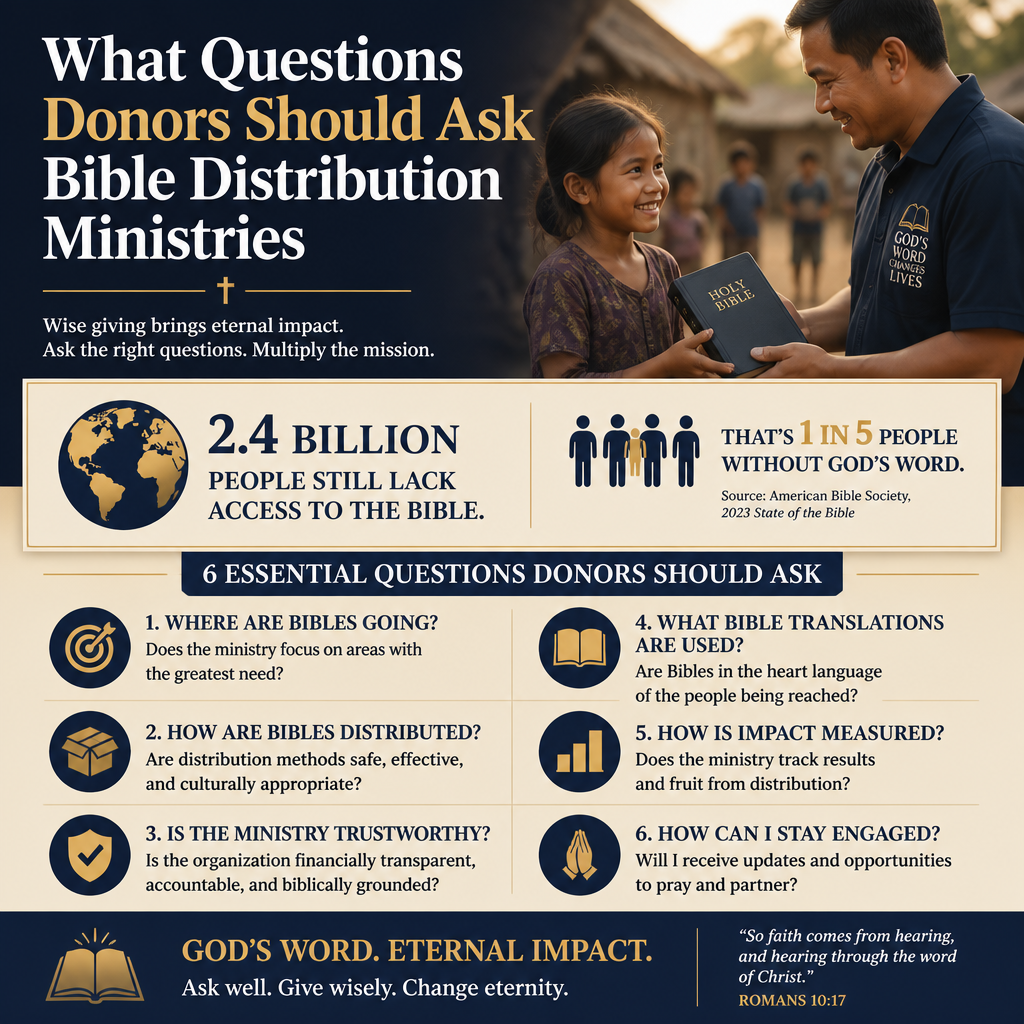
Ask for the ministry’s definition of success and the indicators it uses. “Bibles distributed” is an output. More mature definitions often include measures such as: proportion delivered to intended locations, proportion placed through churches with planned follow-up, literacy participation rates, or qualitative reporting from local leaders on use and obstacles. The ministry should also be willing to name what it does not know.
What does stewardship reporting look like in practice
Ask to see examples of project reports: what was promised, what happened, what changed, and how the ministry learned. A credible organization will not present every year as uninterrupted triumph. In our verification work at Most Trusted, ministries that meet The Most Trusted Standard tend to distinguish between outputs, outcomes, and testimony, and they avoid treating testimony as a substitute for reporting.
- What portion of distribution is independently verified through third-party partners or audits?
- How does the ministry prevent double counting across partners and projects?
- How does it document delivery in hard-to-access regions without endangering believers?
- What is the follow-up plan after placement, and who owns it locally?
- What happens when a shipment is delayed, seized, or diverted, and how is that reported to donors?
Donors should also remember that some of the most credible work will be the least photographable. Public “proof” can be ethically and operationally complicated when believers face surveillance or retaliation.
4. Ask financial questions that match the real cost drivers
Christian donors often want a simple ratio: “How much of my gift buys Bibles?” The desire for stewardship is sound, but the question can be naïve. Translation, paper, printing, shipping, warehousing, partner training, security, and accountability all cost money. The relevant issue is whether costs are explained, governed, and reported truthfully.
What does it cost per Bible and what is included in that figure
Ask for a definition of “cost per Bible.” Does it include translation? printing only? printing and shipping? local distribution and follow-up? A ministry should be able to provide ranges by geography and by format and explain what drives variance. If an organization advertises a universally low figure without specifying inclusions, donors should treat that as a request for clarification rather than a virtue.
For context on why simplistic overhead ratios can mislead donors, the sector has repeatedly cautioned against equating “low overhead” with effectiveness, including in the “Overhead Myth” statement issued by GuideStar, BBB Wise Giving Alliance, and Charity Navigator https://www.charitynavigator.org/about-us/press-releases/the-overhead-myth/.
What financial disclosures are available without special access
Ask whether the ministry publicly provides audited financial statements (when appropriate to size and complexity), Form 990s for U.S. nonprofits, and clear annual reports. For U.S. organizations, donors should know that Form 990s are intended for public transparency and are widely accessible through the IRS and nonprofit data platforms. The IRS describes Form 990’s public disclosure expectations and purpose as part of its exempt organizations guidance https://www.irs.gov/charities-non-profits/exempt-organizations-required-filings.
Donors should also ask about restricted giving: when a gift is designated for a specific distribution project, how does the organization account for it, and what happens if the project becomes infeasible? Responsible ministries maintain clear policies and communicate changes before reallocating restricted funds.
5. Scrutinize governance, safeguarding, and truthfulness under pressure
Bible distribution frequently operates under conditions that reward dramatic storytelling: persecution narratives, miraculous delivery accounts, and urgent appeals. Those stories can be true. They can also become fundraising instruments that outpace verification. Donors should ask questions that reward sobriety rather than sensationalism.
Who holds leadership accountable
Ask about the board: independence, term limits, financial expertise, theological accountability, and conflict-of-interest policies. When a ministry is founder-led, donors should ask how power is restrained and what succession planning looks like. Wise governance is not suspicion; it is a normal expression of Christian stewardship over influence and money.
How does the ministry protect people and tell the truth
Ask about safeguarding policies related to local partners, volunteers, and beneficiary privacy, especially where photos, names, and locations could expose believers to harm. Also ask how the ministry handles claims that cannot be safely documented. A credible organization will describe how it verifies internally, what it will not publish, and how it prevents fundraising from pressuring staff into exaggeration.
This is where donors often need the most support, because the line between necessary confidentiality and convenient opacity can be thin. Our work at Most Trusted applies The Most Trusted Standard across faith commitments, financial integrity, governance, and transparency so that donors can distinguish between appropriate discretion and avoidable secrecy. Many of these questions overlap with the broader expectations we outline for Accountability and Transparency in Bible Distribution Ministries.
FAQs for What questions donors should ask Bible distribution ministries
Is it reasonable to ask for measurable outcomes from Bible distribution?
Yes, if donors ask for the right kind of measurement. Ministries can often document delivery, partner networks, and access. Measuring spiritual transformation is more complex and frequently indirect. Responsible reporting distinguishes outputs from outcomes, uses credible proxies where appropriate, and resists turning testimony into a metric.
Should donors avoid ministries that operate with limited public information because of security concerns?
Not automatically. Some contexts require discretion to protect believers and local churches. The question is whether the ministry offers meaningful accountability through other means: governance oversight, audited or review-level financial reporting when appropriate, clear policies, and credible third-party partnerships. Security should narrow what is published, not eliminate accountability to donors and the church.
Giving that honors the Word and the people who receive it
Donors do not need to choose between urgency and wisdom. Bible distribution ministries deserve Christian generosity, and they also deserve Christian scrutiny shaped by love of truth. The best questions press ministries toward clarity: what they do, why they do it, how they govern it, and how they report it when plans fail as well as when they succeed.



