
Asking what outcomes signal effective orphan care ministries is not a search for impressive stories; it is a stewardship question. Christian donors are not simply funding programs. We are participating in God’s concern for the fatherless and the vulnerable, and Scripture treats that concern as a test of true worship and true justice (James 1:27).
The field has also learned that “orphan care” is morally urgent and operationally complex. Children can be harmed by well-intentioned interventions that separate families, institutionalize avoidable cases, or create incentives to keep beds full. Effective ministries therefore must be judged by outcomes that protect children, strengthen families, and can be verified with integrity rather than assumed from sincere intent.
1. The clearest outcome is family stability, not institutional growth
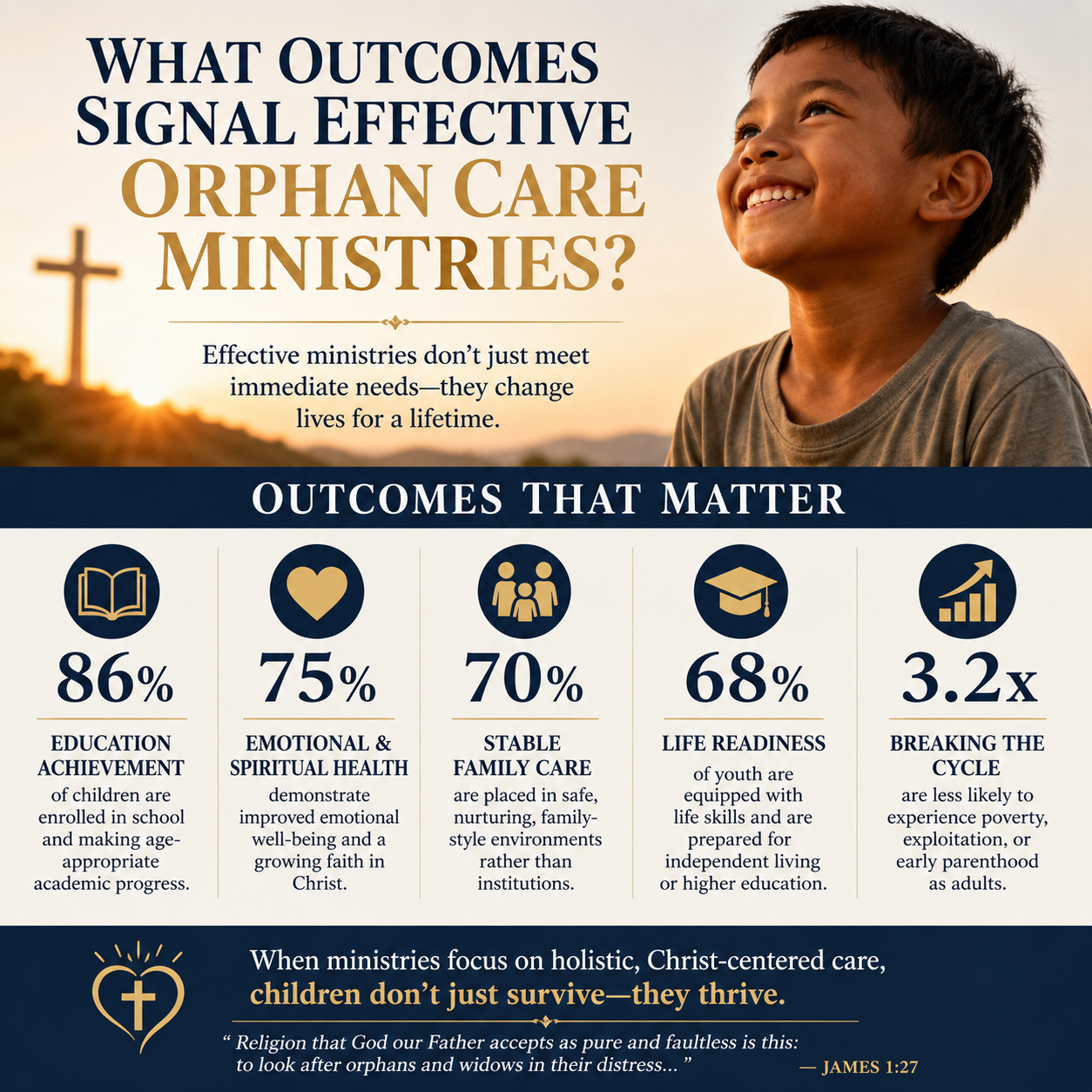
Family-based care is the north star
Across mature child welfare systems, the direction of travel is consistent: prioritize safe, stable family care over long-term institutionalization. Research has repeatedly documented the developmental harm associated with institutional care, particularly for young children, with measured effects on cognition, attachment, and long-term functioning. The World Health Organization has been explicit that institutional care should be a last resort and that family-based alternatives are preferable when safe and feasible.
What this means for donors is straightforward. Effective orphan care ministries will be able to show outcomes that increase the number of children safely living in families: reunification with parents when possible, placement with kin, foster care that is supported and supervised, and adoption practices that are ethical and legally sound.
Measurable markers donors can ask for
We recommend asking ministries for a simple, longitudinal picture: how many children entered care, why they entered, how long they stayed, and where they went afterward. “More children served” can conceal a troubling reality if the underlying drivers are preventable poverty, lack of local services, or recruitment dynamics that detach children from living relatives.
Effective outcomes in this category include reduced length of stay in residential programs, rising reunification rates where appropriate, and improved family functioning evidenced through follow-up visits and documented safety plans. Ministries should be able to state, plainly, what would cause them to say “no” to taking a child and how they support families so that “no” is not neglect but protection.

2. Protection outcomes must be documented, not assumed
Safeguarding is an outcome category
In Christian ministry, safeguarding is sometimes treated as a compliance exercise. In orphan care, safeguarding is an outcome: fewer incidents of abuse, exploitation, and trafficking risk; stronger reporting behavior; and demonstrably safer environments. Ministries serving vulnerable children should be able to show that protective systems are active—screening, training, supervision, incident reporting, and external accountability—rather than aspirational.
Christians genuinely disagree about how much public detail a ministry should disclose when incidents occur, especially when privacy law and child protection protocols constrain communication. Mature transparency, however, is not silence. It is honest disclosure of systems, independent oversight, and demonstrated responsiveness when something goes wrong.
What to look for in evidence
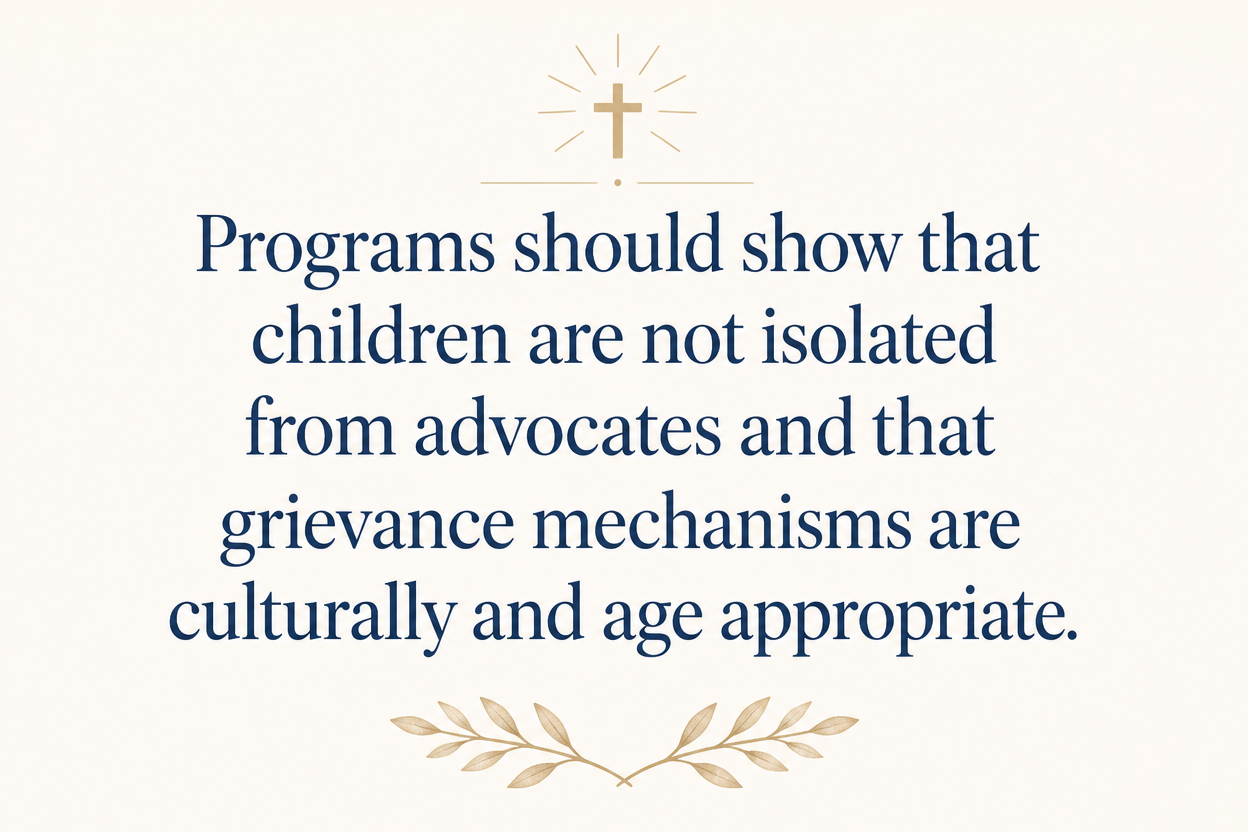
We recommend donors look for outcomes such as: timely reporting to local authorities when required, documented case management notes, regular safeguarding audits, and evidence that children have accessible ways to report concerns. Programs should show that children are not isolated from advocates and that grievance mechanisms are culturally and age appropriate.
Donors should also ask about volunteer policies. Many ministries have moved away from high-contact short-term volunteer models around residential care because of attachment disruption and safeguarding concerns. A ministry’s willingness to restrain donor-facing “experience” opportunities can be an indicator of seriousness rather than a lack of warmth.
3. Whole-child development outcomes should be specific and long-term
Education and health outcomes that do not stop at enrollment
Effective orphan care ministries should be able to articulate what thriving looks like beyond the language of “rescue.” That includes health status, educational progress, and developmental milestones measured over time. It is not enough to report that children are “in school.” Donors can ask for grade completion, attendance, literacy benchmarks, and transition outcomes for older youth.
Where ministries provide medical care, the outcomes should include continuity of care, vaccination coverage where relevant, and management of chronic conditions. When outcomes are reported, they should be bounded by what the ministry actually controls and should acknowledge what is shared with public systems.
Psychosocial and spiritual formation outcomes handled with integrity
Trauma-informed care is now a baseline expectation in many contexts, not a specialty. Effective outcomes may include stable caregiver relationships, reduced behavioral crises, improved emotion regulation skills, and access to counseling when indicated. Ministries should be careful not to reduce spiritual outcomes to coerced participation or numbers of professions. Christian formation is real, but it cannot be forced, and it should never be used to justify keeping children in harmful settings.
Donors can reasonably expect ministries to ground their work in a theology of dignity: children are not ministry “content,” and their stories are not fundraising assets. A credible ministry will have clear consent practices for photos and testimonies, and it will treat privacy as part of child protection.
4. Effective ministries reduce avoidable separation and address the poverty gap wisely
Prevention and family strengthening are not secondary
Many children labeled “orphans” are not without living parents; they are without stable care. The field has had to reckon with the reality that poverty, disability, stigma, and family crisis often drive separation more than true parental absence. Donors should prefer ministries that can show outcomes in prevention: families stabilized, crises de-escalated, children safely remaining at home, and kinship caregivers strengthened.
For Christian donors, this aligns with a biblically grounded ethic: we pursue mercy without creating new harms. The “When Helping Hurts” framework, articulated by Steve Corbett and Brian Fikkert, has sharpened the church’s understanding that aid can unintentionally undermine local capacity when it replaces responsibility or creates dependency. A ministry that can describe how it avoids these traps is often a ministry that can show better outcomes over time.
What this looks like in practice
Family strengthening often includes economic support, but mature ministries treat cash, goods, and fees as tools with guardrails. Donors can ask how the ministry determines eligibility, how it avoids favoritism, and how it measures whether material support is producing stability rather than short-term relief that fades. Ministries should be able to explain why assistance is designed the way it is and what evidence they use to adjust it.
Those evaluating programs in this area often consult frameworks used in child welfare and poverty alleviation, along with local government standards. For donors seeking a broader view of how these ministries function on the ground, our coverage of How Orphan Care Ministries Serve Children and Families addresses common models and where outcome measurement tends to break down.
5. The most trustworthy outcomes are paired with verifiable governance and transparency
Outcomes reporting can become its own form of marketing
In a crowded donor environment, outcome claims can be shaped by fundraising incentives. Ministries may highlight easily countable outputs while neglecting harder outcomes such as permanency, safety, and adult functioning. They may also underreport failures out of fear of reputational harm. Donors should not punish honesty; we should insist on it.
Effective orphan care ministries tend to couple their outcome claims with governance practices that make those claims credible: independent boards, clear conflict-of-interest policies, audited financials when feasible for the organization’s scale, and transparent reporting about program limits and risks. This is part of why Most Trusted exists. We evaluate ministries against The Most Trusted Standard, a 15-criteria framework across faith foundation, financial integrity, governance and leadership, and transparency and effectiveness, because outcomes without integrity are easy to manufacture.
A donor-ready set of outcome questions
When donors ask for clarity, ministries often respond well. The following questions are not adversarial; they are a form of stewardship:
- How many children moved into safe, stable family placements this year, and what follow-up confirms stability?
- What proportion of children served could have remained safely with family if the right support had been available?
- What safeguarding incidents occurred, what was reported to authorities, and what changed afterward?
- What are the educational and health outcomes tracked over at least 12 to 24 months?
- How does the ministry prevent perverse incentives to keep children in care or recruit new cases?
Where ministries can answer these questions with documentation and humility, donors are often looking at organizations prepared for long-term faithfulness rather than short-term acclaim. For a wider lens on this space, our work on Orphan Care Ministries reflects what we commonly see when ministries mature from compassionate urgency into accountable practice.
FAQs for What outcomes signal effective orphan care ministries
Should Christian donors avoid supporting orphanages entirely?
Not always. Some contexts still require short-term residential care for safety, medical need, or emergency protection, and some residential programs function as small, family-like homes with strong case management and a clear pathway to permanency. Donors should evaluate whether residential care is time-bound, case-managed, safeguarding-heavy, and oriented toward family placement rather than institutional expansion.
What is a realistic way to judge outcomes when ministries operate in hard contexts?
We should expect context-aware measurement, not perfection. A credible ministry will define what it can control, track a limited set of meaningful indicators consistently, and report both progress and constraints. The most reliable indicator is often not a single number but a pattern: stable family outcomes, documented safeguarding, honest reporting, and governance strong enough to withstand financial and reputational pressure.
Giving that protects children and honors the truth
Effective orphan care ministries are not those that elicit the strongest emotional response; they are those that can show, over time, that children are safer, more stable, and more rooted in enduring relationships. Christian donors can insist on outcomes that match Scripture’s concern for the vulnerable and also match what careful evidence has shown about child development and family systems. When ministries are willing to be measured, corrected, and held accountable, the giving entrusted to them is more likely to become the kind of mercy that does not wound the very children it seeks to serve.



