

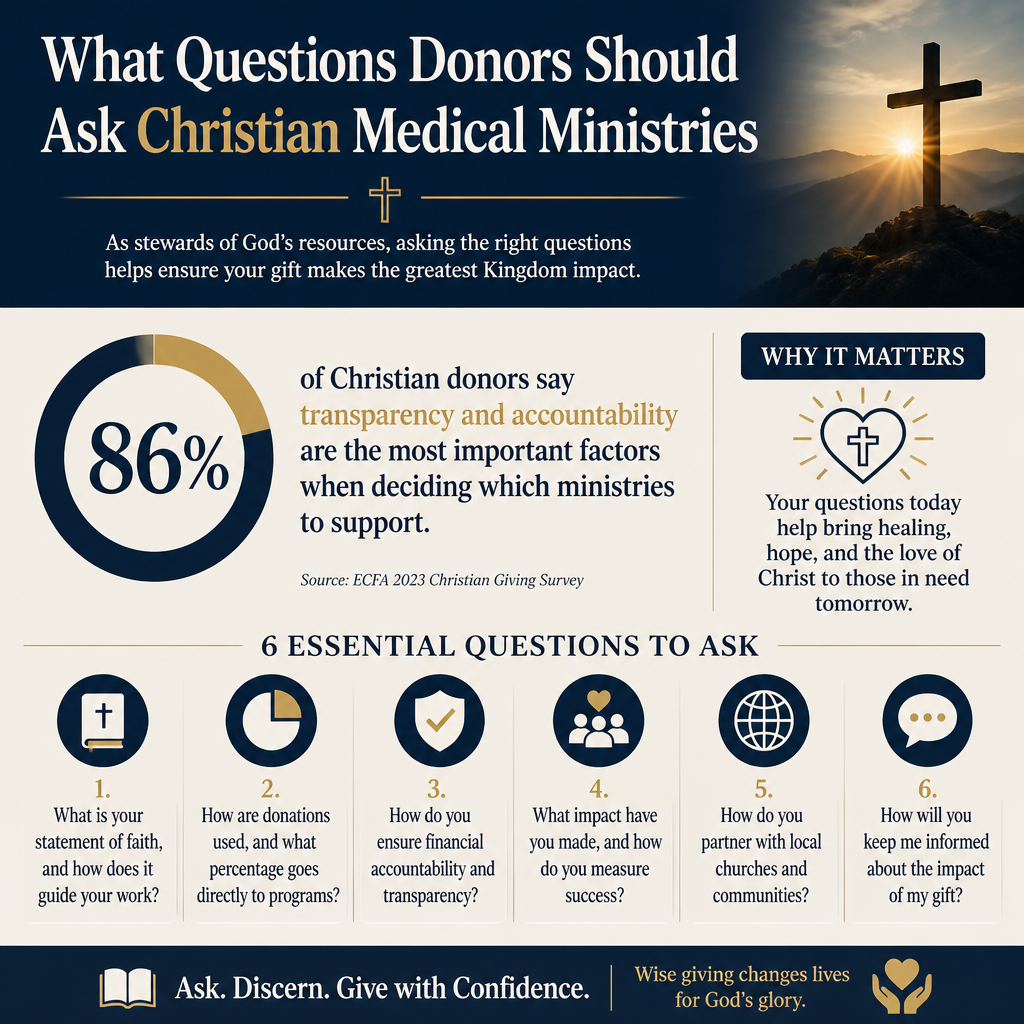
What questions donors should ask Christian medical ministries are not merely operational. They are spiritual stewardship questions shaped by Scripture’s insistence that mercy must be joined to truth, and that generosity must be exercised with discernment. Medical ministry can embody the compassion of Christ with unusual clarity, and it can also drift into patterns that confuse fundraising with faithfulness or publicity with impact.
Across our verification work at Most Trusted, we find that the strongest Christian medical ministries welcome hard questions because they understand accountability as a form of discipleship. They do not treat inquiry as suspicion. They treat it as part of the Church’s shared responsibility to honor the vulnerable, tell the truth, and handle resources in a manner worthy of the gospel.
1. Is this ministry clearly Christian in theology and practice
Christian medical work is never only about medicine, but it is also never less than medicine. A ministry can claim a Christian identity while operating with little theological clarity, or it can speak orthodox language while practicing forms of care that are ethically thin. Donors should ask for verifiable evidence that the ministry’s Christian confession shapes its governance, partnerships, and patient care.
Ask what the ministry means by Christian
“Christian” can signify anything from a historical affiliation to an explicit confession of the Nicene faith. We recommend asking for a statement of faith, but also asking how that statement governs actual decisions: hiring, training, patient dignity, evangelism boundaries, and collaboration with local churches. The New Testament’s concern is not branding but integrity: “we have renounced disgraceful, underhanded ways… we refuse to practice cunning or to tamper with God’s word” (2 Corinthians 4:2).
In practice, a responsible answer will include both conviction and restraint: conviction about Christ, restraint about coercion. Medical vulnerability creates an asymmetric power dynamic; Christian witness must never exploit it. Ministries should be able to articulate how they protect patient consent, privacy, and dignity while still bearing faithful testimony.
Ask how local churches are honored rather than bypassed
Medical projects that operate as parallel structures can unintentionally weaken local Christian institutions by concentrating money, talent, and decision-making in outside hands. Donors should ask whether the ministry partners with local churches and Christian health systems in ways that strengthen durable local capacity. The best answers name concrete mechanisms: local oversight, locally led triage criteria, local pastoral care, and long-term training commitments.
2. Who governs the ministry and how are decisions constrained
Medical ministry carries high reputational risk, high financial complexity, and high moral stakes. Governance is not paperwork; it is the human structure that makes repentance possible when incentives bend toward self-protection. Donors should ask questions that reveal whether authority is shared, documented, and accountable.
Ask what accountability looks like when the founder is central
Many Christian medical ministries begin with a physician, missionary, or visionary leader whose competence and courage catalyzed the work. That origin story can be a gift. It can also produce a culture in which no one can contradict the founder without fear. We recommend asking: Who can remove the CEO? Who approves compensation? What is the conflict-of-interest policy, and is it signed annually?
Stronger ministries can show board minutes, committee structures, and a real separation between governance and management. They can also articulate how spiritual authority is practiced without becoming spiritualized control.
Ask how patient safety and clinical ethics are overseen
Even when the ministry is not a hospital system, it is still responsible for clinical quality. Donors should ask whether there is a medical advisory board, how credentialing is verified, and whether the ministry follows recognized standards for safeguarding and patient privacy. In some settings, fully Western frameworks are difficult to implement; that complexity should be named rather than ignored. What matters is whether the ministry can demonstrate disciplined risk management and a habit of external counsel.
3. How does money move and what does financial integrity mean here
Christian donors have been trained to fixate on overhead ratios. That focus is understandable, but it is not sufficient for medical work where pharmaceuticals, equipment, logistics, and compliance create legitimate administrative cost. The harder question is whether the ministry’s financial story is coherent, transparent, and resistant to misuse.
Ask for audited statements and clear revenue concentration risks
We recommend asking for independent audited financial statements when the ministry is large enough to justify them, and at minimum a reviewed compilation with strong internal controls for smaller organizations. Ask how funds are handled in-country, how cash is minimized, how inventory is tracked, and whether there is segregation of duties for purchasing and disbursement.
Donors should also ask about donor concentration: if a single donor or a narrow donor base drives the budget, the ministry may face pressure to produce dramatic stories rather than sustainable outcomes. Transparent answers do not hide vulnerability; they show how the ministry plans responsibly.
Ask what fundraising promises imply for program decisions
Some medical ministries raise funds through child sponsorship, emergency appeals, or named patient campaigns. Those models can be legitimate, and they can also create incentives to prioritize what photographs well over what treats effectively. We recommend asking how the ministry prevents marketing needs from driving triage decisions. Ask whether restricted gifts are truly restricted, and how the ministry communicates when needs shift.
The Christian tradition has long warned that money is spiritually dangerous precisely because it is morally persuasive. Jesus’ teaching that “you cannot serve God and money” (Matthew 6:24) applies not only to individuals but to institutions when fundraising incentives become a hidden master.
4. What outcomes are measured and what truth is told about impact
Medical outcomes are complex. A faithful ministry is not required to claim more certainty than the field allows, but it is required to tell the truth. Donors should ask for evidence that the ministry distinguishes between outputs, outcomes, and long-term effects, and that it is willing to report both success and limitation.
Ask for outcomes appropriate to the ministry’s model
A mobile clinic, a surgical center, a maternal health program, and a medical supply distributor should not be evaluated by the same metrics. Outputs such as “patients served” can be meaningful, but they are not inherently proof of improved health. We recommend asking for a small set of outcomes the ministry can responsibly track: follow-up rates, adherence to treatment protocols, complication rates where applicable, referral completion, or local capacity indicators such as clinicians trained and retained.
When ministries do cite global health claims, donors should look for careful sourcing and appropriate humility. For example, the World Health Organization has documented that immunization is among the most cost-effective public health interventions, and its materials clarify both the gains and the persistent gaps in coverage World Health Organization. A ministry citing vaccination impact should be able to show how it coordinates with national health systems and avoids duplicating fragile supply chains.
Ask whether stories are representative and ethically gathered
Testimonies are part of Christian witness, but medical stories can easily become moral theater. Donors should ask how the ministry obtains informed consent for photos and narratives, how it protects patient identity, and whether it avoids presenting communities as helpless. Strong ministries can explain their safeguarding practices without defensiveness.
The field has had to reckon with how easily well-intentioned aid can displace local agency. The When Helping Hurts framework, articulated by Steve Corbett and Brian Fikkert, has helped many Christian organizations name these risks directly and redesign programs toward dignity and local ownership Moody Publishers.
- What outcomes do you track beyond patients served, and why those measures
- What is your follow-up plan for chronic conditions and post-operative care
- How do you handle adverse events, complaints, and incident reporting
- How do you obtain consent for stories, photos, and prayer requests
- What do you do when the data contradicts a favored narrative
5. What transparency should a donor reasonably expect
Transparency is not a demand for unlimited access. It is a commitment to truthful public communication, accessible governance and financial information, and responsiveness to credible questions. Christian ministries can face security constraints in certain countries, and donors should not pressure them to disclose details that endanger staff or patients. Yet security concerns are sometimes used to justify basic opacity. Mature transparency tells the difference.
Ask what the ministry publishes and what it withholds and why
We recommend expecting a ministry to publish, at minimum, leadership names, board membership, basic financial statements, program descriptions, and clear ways to raise concerns. If certain information is withheld, the ministry should be able to explain the rationale in concrete terms: patient privacy, partner protection, or local legal risk. Vague references to “sensitive work” should not substitute for accountability.
This is where a donor’s posture matters. The goal is not adversarial interrogation but faithful stewardship. For donors who want broader context on how medical ministries can credibly demonstrate accountability, we have compiled related analysis within Accountability and Transparency in Christian Medical Ministries.
Ask how the ministry invites external verification
Because donors cannot personally inspect every clinic, supply chain, or partnership, credible third-party signals matter. Independent audits, external evaluations, and documented safeguarding standards can reduce risk. At Most Trusted, we evaluate ministries against The Most Trusted Standard, a 15-criteria framework spanning Faith Foundation, Financial Integrity, Governance and Leadership, and Transparency and Effectiveness. The value is not a label; it is disciplined evidence that the ministry has built structures that can withstand both growth and scrutiny.
Donors who are considering a particular organization often benefit from comparing it within the broader landscape of Christian Medical Ministries, where differences in model, governance maturity, and transparency practices become clearer.
FAQs for What questions donors should ask Christian medical ministries
Should donors prioritize low overhead when evaluating a Christian medical ministry?
Not as a primary test. Medical work legitimately requires systems: compliance, training, inventory management, cold-chain logistics, and quality oversight. Donors should prioritize clarity and integrity: audited or responsibly prepared financials, appropriate reserves, strong controls, and truthful fundraising. Overhead can be a warning sign when it signals self-dealing or inefficiency, but it can also reflect necessary infrastructure for safe care.
How can a donor assess spiritual integrity without rewarding showy evangelism?
Ask how the ministry integrates Christian conviction with patient dignity. Look for clear theology, local church partnership, and explicit safeguards against coercion. A credible ministry can explain how it offers prayer, pastoral presence, or gospel witness in ways that honor consent and vulnerability, and it can show that its clinical decisions are not contingent on religious response.
Stewardship that honors both mercy and truth
Christian medical ministries stand near the heart of Matthew 25’s vision of mercy, where Christ identifies himself with the sick and the suffering. That proximity to sacred work does not reduce the need for accountability; it increases it. Donors should ask questions that illuminate theology, governance, financial integrity, outcomes, and transparency, because these are the places where love of neighbor becomes verifiable rather than assumed.
The most trustworthy ministries do not promise a world without complexity. They demonstrate, over time, that they are committed to truth-telling, patient dignity, and faithful stewardship even when it costs them in speed, simplicity, or fundraising advantage.



