

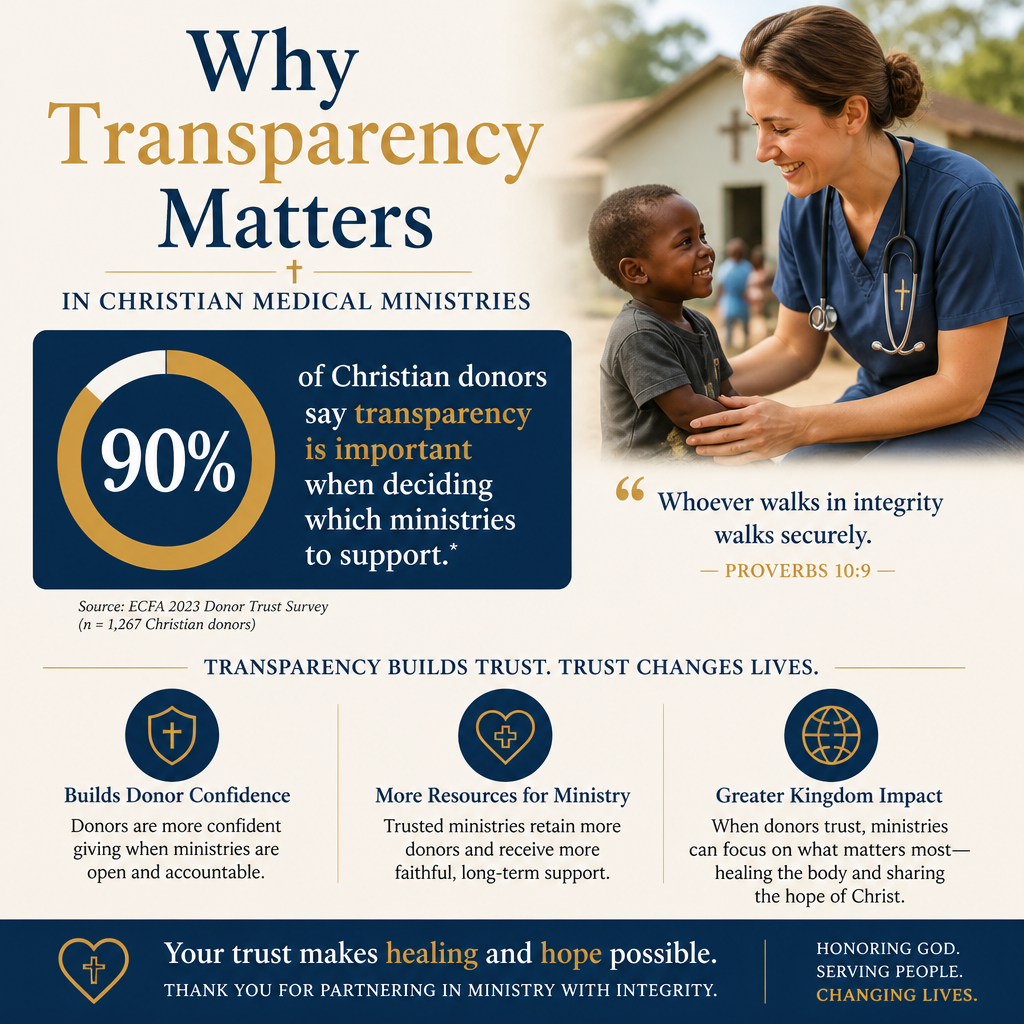
Why transparency matters in Christian medical ministries is not a secondary question of administration; it is a question of discipleship. When donors fund care for the sick, they are not only supporting outcomes they can see, but also entrusting resources to a moral community that claims to operate under the lordship of Christ.
Christian medical work often happens where need is acute and information is scarce: rural clinics, fragile health systems, disaster zones, persecuted contexts, and complex cross-cultural partnerships. That complexity can tempt both donors and ministries toward a kind of well-intentioned vagueness. Yet Scripture’s ethic moves in the opposite direction. “We aim at what is honorable not only in the Lord’s sight but also in the sight of man” (2 Corinthians 8:21). Transparency is part of that aim.
Transparency is a biblical practice before it is a nonprofit practice
Christian ministries do not operate merely under regulatory requirements or donor expectations. We claim a higher accountability: the fear of the Lord, love of neighbor, and the integrity that refuses to separate spiritual language from financial reality. In the New Testament, Paul organizes a collection for the poor with named companions and public accountability precisely to avoid suspicion and to protect the credibility of the gospel (2 Corinthians 8:16–24).
That logic applies directly to medical ministry. When a ministry says it provides surgeries, medicines, or maternal care “in Jesus’ name,” the claim is both spiritual and concrete. Donors are right to expect clarity about what was provided, at what cost, under what standards of safety and ethics, and with what verified results.
Medical mercy is uniquely vulnerable to moral shortcuts
Healthcare is not like distributing non-perishable goods. It involves clinical risk, licensure questions, drug supply chains, data privacy, and cultural power dynamics. The vulnerable person is often a patient with limited ability to consent, limited alternatives, and limited recourse if harm occurs. Transparency is one of the few practical defenses against the quiet drift from mercy to malpractice.
Stewardship includes the credibility of Christian witness
When a ministry refuses basic disclosure—board oversight, financial statements, program descriptions, adverse event policies—donors are placed in an impossible position: asked to trust spiritual claims while being denied ordinary evidence. This is not the posture of Christian stewardship. It is closer to presumption.

Donors are not buying a story, they are underwriting clinical responsibility
Many Christian donors have learned, sometimes painfully, that sincerity is not the same as competence. A compelling testimony does not guarantee careful procurement; a moving photo does not verify outcomes; a charismatic founder does not substitute for governance. Healthcare raises the stakes: mismanaged funds can become stockouts, delayed care, or substandard procedures.
Transparency does not reduce generosity, it directs it
Mature donors do not give to the most polished narrative. They give to faithful work that can be evaluated. Transparent ministries make it easier for donors to sustain support through hard seasons because they are not forced to guess what is happening when conditions change. That is especially important for medical ministries, where volatility—political instability, currency swings, outbreaks, shipping disruptions—can reshape a program in months.
The overhead question is real, and it is frequently misframed
Christians genuinely disagree about how to interpret “overhead,” and the field has had to reckon with the damage done by simplistic ratios. The widely cited “Overhead Myth” letter, signed by GuideStar, Charity Navigator, and BBB Wise Giving Alliance, argues that overhead ratios can mislead donors and can discourage investment in the systems that protect impact and accountability GuideStar. In medical ministry, those systems include clinical protocols, credential verification, cold-chain management, safeguarding policies, and independent audits.
What this means in practice is that a ministry spending responsibly on finance controls and reporting may be protecting patients and donors. A ministry that boasts of extremely low administration without evidence of strong controls may be courting preventable risk.
What credible transparency looks like in Christian medical ministries
Transparency is not a demand that every ministry publish every detail. Some operational specifics in persecuted regions or conflict zones must remain confidential. But confidentiality is not the same as secrecy, and security constraints do not eliminate the responsibility to provide verifiable evidence to appropriate parties.
The baseline disclosures serious donors should expect
Across our verification work at Most Trusted, the ministries that meet The Most Trusted Standard tend to treat transparency as a disciplined habit rather than an occasional campaign. Donors should be able to locate clear, current answers to questions such as:
- Who governs the ministry, and how does the board exercise oversight?
- Are financial statements available, and are they reviewed or audited by an independent firm when appropriate?
- What programs are actually delivered, in what locations, and with what partners?
- What safeguards protect patients, children, and other vulnerable people from harm and exploitation?
- How does the ministry measure outcomes, and how does it handle negative results or adverse events?
Outcome transparency must be honest about limits
Medical outcomes are hard to measure across borders, languages, and follow-up constraints. A ministry may not be able to track long-term patient outcomes at high rates in every setting, and pretending otherwise does not build trust. What donors should expect instead is methodological seriousness: defined indicators, plausible data collection, clear denominators, and candor about what is unknown.
Where patient privacy is concerned, transparency should be compatible with dignity. Case studies can be powerful, but not if they expose identities without meaningful consent or reduce patients to fundraising assets.
Transparency protects against common failure modes
Christian medical ministries face predictable pressures: fundraising cycles, urgent needs, charismatic leadership, and donor expectations shaped by dramatic narratives. Without transparent systems, those pressures can deform decision-making. Transparency is not a guarantee of health, but it is a strong indicator of whether a ministry has chosen accountability over image.
Misrepresentation of impact and the temptation to overclaim
Medical work lends itself to big numbers—patients seen, consultations conducted, medicines distributed. Those figures can be meaningful, but only if they are defined and verified. Counting “patients served” without distinguishing between a brief screening and a completed course of treatment can inflate apparent impact. Counting “surgeries performed” without reporting infection controls, follow-up rates, or provider credentials can conceal clinical risk.
Conflicts of interest and concentrated power
Healthcare procurement and partnerships can create conflicts: vendors, local intermediaries, referral networks, and clinical leaders whose decisions carry financial consequences. Donors should not assume these are rare; they are a normal governance challenge in complex work. Transparent policies—related-party disclosures, independent board review, clear compensation practices—are not bureaucratic adornments. They are guardrails.
For donors who want to explore these issues across the broader landscape of Christian healthcare work, we maintain a reference point for Christian Medical Ministries that reflects what we see across the field.
Transparency strengthens partnership between donors and ministries
Donors often fear that asking hard questions signals distrust or a lack of faith. But biblical faith is not credulity. Mature Christian giving joins generosity with discernment. When ministries practice transparency, they invite donors into principled partnership rather than transactional funding.
It sets expectations before a crisis forces the issue
Every medical ministry will face difficulties: leadership transitions, regulatory changes, supply disruptions, security incidents, or program setbacks. The question is not whether trouble will come, but whether donors will be told the truth when it does. Transparent ministries communicate setbacks with the same seriousness as successes, and they show how governance responded.
It clarifies what accountability means in faith-based work
Some ministries treat “faith-based” as a reason to resist evaluation, as if spiritual motivation makes ordinary scrutiny inappropriate. The opposite is closer to the New Testament. Christian leaders are held to stricter standards because they bear God’s name in public. That includes financial integrity, truthful reporting, and the humility to submit to oversight.
This is why we encourage donors to develop a consistent lens for Accountability and Transparency in Christian Medical Ministries rather than relying on impressions or reputations alone.
FAQs for Why transparency matters in Christian medical ministries
Does transparency endanger partners or patients in high-risk regions?
It can if it is careless. Responsible transparency distinguishes between operational security and organizational secrecy. Ministries can protect identities and locations while still providing donors with verified financial reporting, governance documentation, safeguarding policies, and credible evidence of work performed. When “security” becomes a blanket refusal to share any verifiable information, donors should treat that as a warning sign rather than a virtue.
What should donors do when a medical ministry will not share financial statements?
Donors should ask why, and whether the ministry can provide an alternative form of verifiable accountability, such as independent review by a qualified third party. If the refusal is categorical and persistent, the prudent course is to redirect giving to a ministry that welcomes scrutiny. Christian generosity is not obligated to fund avoidable opacity, especially in work that directly affects patient welfare.
Transparency is one of the clearest signals of trustworthiness
Christian medical ministries exist to honor Christ by serving the sick, often where care is least accessible. That calling deserves strong support. It also deserves sober accountability. Transparency matters because it protects patients, stewards donor resources, strengthens governance, and safeguards the public credibility of Christian witness. When a ministry is willing to be known as it is—financially, operationally, and ethically—it is far more likely to be doing the kind of quiet, disciplined good that endures.



