
What accountability standards mean for Christian medical ministries is not a technical question for specialists. It is a stewardship question for donors who want mercy to be carried out without compromise, confusion, or avoidable harm. Medical work places a ministry at the intersection of money, power, vulnerability, and life-and-death decisions, which is precisely where Christian integrity must be most visible.
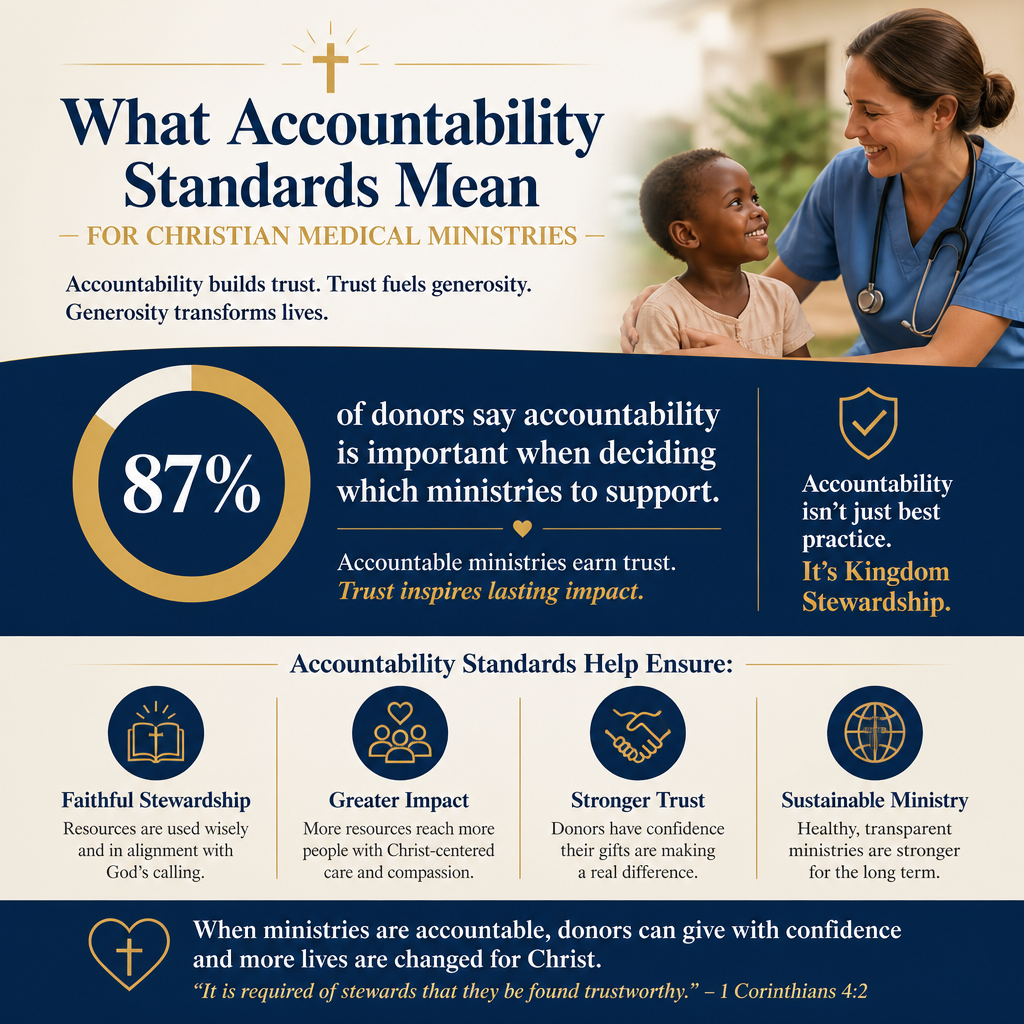
Christian donors tend to ask two questions at once: “Is this ministry faithful to Christ?” and “Is this ministry competent and trustworthy with what we give?” Scripture refuses to separate those questions. Jesus commends mercy to the sick and suffering, but he also condemns religious performance that hides injustice. Accountability is not a substitute for love; it is one of love’s practical forms when resources, authority, and risk are involved.
Accountability is part of Christian witness, not just compliance
Mercy ministry carries moral weight
Christian medical ministries often serve patients who cannot meaningfully shop for alternatives, negotiate terms, or verify quality. That asymmetry of power makes “do no harm” more than a clinical slogan. It becomes a Christian obligation to protect the vulnerable through disciplined governance, clear clinical boundaries, and honest reporting.
The New Testament’s insistence on integrity in handling resources is direct. Paul describes taking precautions so that “no one should blame us about this generous gift” because the team aimed to do what was right “not only in the Lord’s sight but also in the sight of man” (2 Corinthians 8:20–21). The logic is not cynical. It assumes that transparency can safeguard both mission and reputation, and that reputation matters because it affects trust, access, and the credibility of the gospel’s messengers.
Christian donors have learned to ask harder questions
Over the past two decades, Christian giving has matured in the face of public failures across the nonprofit sector. The concern is not that every ministry is suspect, but that good intentions do not reliably prevent misuse of funds, inflated claims, or unsafe practices. Mature accountability standards help donors distinguish between a sincere story and a verifiable ministry.
In our verification work at Most Trusted, we find that strong ministries typically treat accountability as part of discipleship. They view financial controls, conflict-of-interest policies, and outcome reporting as ordinary habits of faithfulness rather than defensive measures adopted under pressure.

What donors should mean by accountability in medical ministry
Four domains donors should expect to see addressed
Donors sometimes reduce accountability to a single ratio or a single document. In medical ministry, accountability is broader. It includes spiritual identity, financial integrity, governance, and evidence of real service delivered with appropriate clinical safeguards. Most Trusted evaluates ministries against The Most Trusted Standard, a 15-criteria framework across Faith Foundation, Financial Integrity, Governance and Leadership, and Transparency and Effectiveness.
The practical question is whether a ministry can show coherent answers in each domain. A well-run clinic, hospital support program, medical mission, or pregnancy care center will not be perfect, but it should be able to demonstrate that it has built structures that make integrity normal and misconduct difficult.
What accountability looks like in practice
The following are not exhaustive, but they represent the kinds of signals that matter in Christian medical work:
- Clear clinical scope and referral pathways that protect patients when needs exceed the ministry’s capacity
- Financial statements, budget discipline, and internal controls appropriate to the size and risk profile of the work
- An independent board that can exercise real oversight of executives and major decisions
- Written policies for conflicts of interest, safeguarding, and incident reporting
- Truthful communications that distinguish outcomes, outputs, and aspirations
Accountability does not mean a ministry must resemble a major health system. It means the ministry is honest about what it is, what it is not, and how it will act when something goes wrong.
Why medical ministry amplifies governance, safety, and truthfulness
High-trust ministry environments can hide high-risk failures
Christian medical ministries often operate in relational environments where trust is granted quickly because of shared faith, urgent need, and moving stories. That trust can become a vulnerability. Weak board oversight, unclear lines of authority, or an unchecked founder can place staff and patients at risk, even when the ministry’s intentions are sincere.
Good governance is not a secular intrusion into sacred work. It is a recognition of human fallenness and of the biblical pattern of shared leadership and accountability. Donors can look for evidence that a board meets regularly, records decisions, manages conflicts of interest, and is able to challenge leadership when needed.
Medical outcomes require special care in reporting
Medical ministries face pressure to quantify impact. Numbers can be helpful, but they can also mislead. “Patients served” can mean a one-time screening or a full episode of care. “Procedures performed” can describe life-saving surgeries or low-risk interventions. “Lives saved” is often not a medically defensible claim.
What this means in practice is that faithful transparency uses careful language and resists the temptation to turn complex care into simplistic marketing. When outcomes are uncertain, a ministry can still report with integrity by explaining what is measured, what is not measured, and why.
Donors should also recognize that some medical contexts make rigorous measurement difficult. In conflict zones and disaster response, records may be incomplete, and follow-up may be impossible. Accountability in those contexts looks less like perfection and more like disciplined decision-making, appropriate documentation, and sober honesty about limitations.
Financial integrity is more than overhead ratios
The overhead debate is settled in principle, but not in discipline
Donors have rightly grown wary of simplistic pressure to minimize “overhead.” In 2013, Charity Navigator, GuideStar, and the BBB Wise Giving Alliance warned that focusing on overhead ratios can be misleading and can incentivize unhealthy nonprofit behavior, including underinvestment in systems that protect mission and beneficiaries Charity Navigator.
That does not remove the donor’s responsibility to ask whether administrative spending is proportionate and necessary. It clarifies the standard: donors should ask whether spending choices strengthen program quality and integrity, not whether the ministry has driven support costs to unsustainable levels.
Donors should expect transparency that matches the complexity of the work
Medical ministry finances can be complicated: restricted gifts, in-kind pharmaceuticals, volunteer physician time, international partners, and equipment depreciation. A ministry can be both honest and difficult to interpret if it does not explain what its numbers mean. Mature transparency helps the reader understand how the ministry accounts for major categories of value and cost.
For ministries that fundraise in the United States, donors can often learn a great deal from public filings. Nonprofit tax forms are not a complete picture, but they are a starting point. The IRS makes many nonprofit filings available through its Tax Exempt Organization Search Internal Revenue Service.
The harder question is how a ministry handles financial pressure. A clinic that is perpetually underfunded may drift into risky shortcuts. A rapidly growing ministry may outpace its controls. Strong accountability standards help donors see whether a ministry has built capacity at the same pace as expansion.
How Most Trusted verification helps donors give with confidence
Standards clarify what faithful stewardship requires
Many donors do not have the time or technical background to assess board governance, financial controls, safeguarding policies, and communications claims across multiple ministries. Verification exists because the donor’s obligation to steward well is real, but the modern nonprofit environment is complex.
Most Trusted exists to help donors give with confidence. We evaluate Christian nonprofits against The Most Trusted Standard so that donors can see whether a ministry provides verifiable evidence of faithfulness, integrity, governance, transparency, and effectiveness appropriate to its calling and scale. This does not replace prayerful discernment; it supports it with credible, observable signals.
Where donors can go deeper
Donors who want to compare ministries within this field can review our coverage of Christian Medical Ministries, where we aim to clarify what responsible practice looks like across varied models of care.
When accountability questions are particularly pressing—board structure, financial disclosures, safeguarding, and public reporting—our work also sits within Accountability and Transparency in Christian Medical Ministries. The goal is not suspicion. The goal is confidence grounded in evidence.
FAQs for What accountability standards mean for Christian medical ministries
Do accountability standards imply distrust of Christian ministries?
No. Accountability standards assume two biblical realities at once: Christians are called to costly mercy, and human beings remain susceptible to temptation, self-deception, and misuse of power. Standards are one way we “take precautions” so that resources intended for healing and witness are handled honorably in public view (2 Corinthians 8:20–21).
What should we do if a medical ministry’s outcomes are hard to measure?
We should not demand a level of measurement a context cannot support, especially in crisis response or remote care. We should, however, expect the ministry to define what it does measure, to distinguish counts of services from clinical outcomes, and to communicate limits plainly. Honest reporting that explains uncertainty is often a stronger mark of integrity than impressive numbers presented without context.
Accountability standards serve mercy by making trust durable
Christian medical ministry exists because the sick matter to God and because Christ’s people are called to works of mercy that carry real cost. Accountability standards do not compete with that calling. They protect it, so that donors can give with steadiness, patients can receive care with safety and dignity, and the ministry’s public witness can rest on truth rather than sentiment.



