
Accountability and transparency in Christian medical ministries are not secondary virtues; they are part of the moral substance of mercy. When donors support surgery funds, rural clinics, maternal care, disaster response, or medicines for the poor, we are not only moving money. We are entrusting vulnerable patients to systems we cannot personally supervise, often across language barriers, governments, and medical infrastructure constraints.
Scripture treats such trust as weighty. Jesus ties judgment to care for the sick (Matthew 25:36), and the church has long understood works of mercy as inseparable from integrity. The harder question is how donors can discern integrity when a ministry’s stories are compelling, the need is real, and the operational complexity is high. Across our verification work at Most Trusted, we find that strong ministries do not ask donors to choose between compassion and evidence. They build practices that allow both.
Why accountability in medical ministry is uniquely demanding
Medical ministry sits at the intersection of clinical ethics, humanitarian logistics, and Christian witness. That combination creates distinctive risks. A ministry can be sincere and still make decisions that harm patients, mislead donors, or compromise local health systems. Mature accountability names these risks plainly and builds guardrails before a crisis forces the issue.
Patients are not a program metric
In Christian medical work, the “beneficiary” is not an abstract community but an embodied neighbor. That matters because the wrong incentives can quietly reshape care. Numbers-driven reporting may reward high-volume encounters rather than appropriate treatment, continuity of care, or follow-up. Evidence-based accountability therefore includes clinical standards, referral pathways, and safeguards against coercion—especially when evangelism and clinical care occur in the same setting.
Cross-border operations multiply stewardship risks
When funds cross borders, so do compliance obligations and corruption risks. Procurement, customs clearance, local subcontractors, and cash-based environments all increase exposure. Transparency does not require publicizing every operational detail, but it does require defensible controls: documented vendor selection, segregation of duties, audit trails, and clear approval thresholds for expenses that could be abused.
Short-term engagement creates incentives donors should examine
Short-term medical trips can serve patients well when they are integrated with local systems and clinical supervision. They can also distort local care when teams arrive without continuity, displace local providers, or prioritize volunteer experience over patient outcomes. Christians genuinely disagree about where the line falls, and contexts vary widely. What donors can insist on is clarity: how the ministry partners locally, who owns the clinical protocols, how follow-up occurs, and whether local health authorities recognize the work.

What credible transparency looks like in practice
Transparency is often reduced to a single document or a glossy annual report. Mature transparency is broader: it is a ministry’s willingness to make its claims testable and its decisions intelligible. Donors should expect clarity about theology, governance, finances, and results, but also about constraints and failures. A ministry that never names trade-offs is usually withholding something, even if unintentionally.
Clear claims, not only compelling stories
Testable claims are specific: what services were delivered, where, by whom, with what clinical oversight, and with what follow-up. Patient dignity should shape storytelling; anonymity and consent should not be optional. A ministry’s communications can be both reverent and accurate, resisting the temptation to turn suffering into fundraising copy. The Christian tradition calls this truthfulness, not merely “good marketing.”
Financial transparency that respects the Overhead Myth and still answers hard questions
Financial accountability is not a simplistic overhead ratio test. The sector’s leading evaluators have argued against treating overhead as the primary measure of effectiveness, noting that strong administration and evaluation can be signs of health rather than waste. Charity Navigator, Candid (formerly GuideStar), and the BBB Wise Giving Alliance made this case publicly in their joint statement on the “Overhead Myth” Charity Navigator.
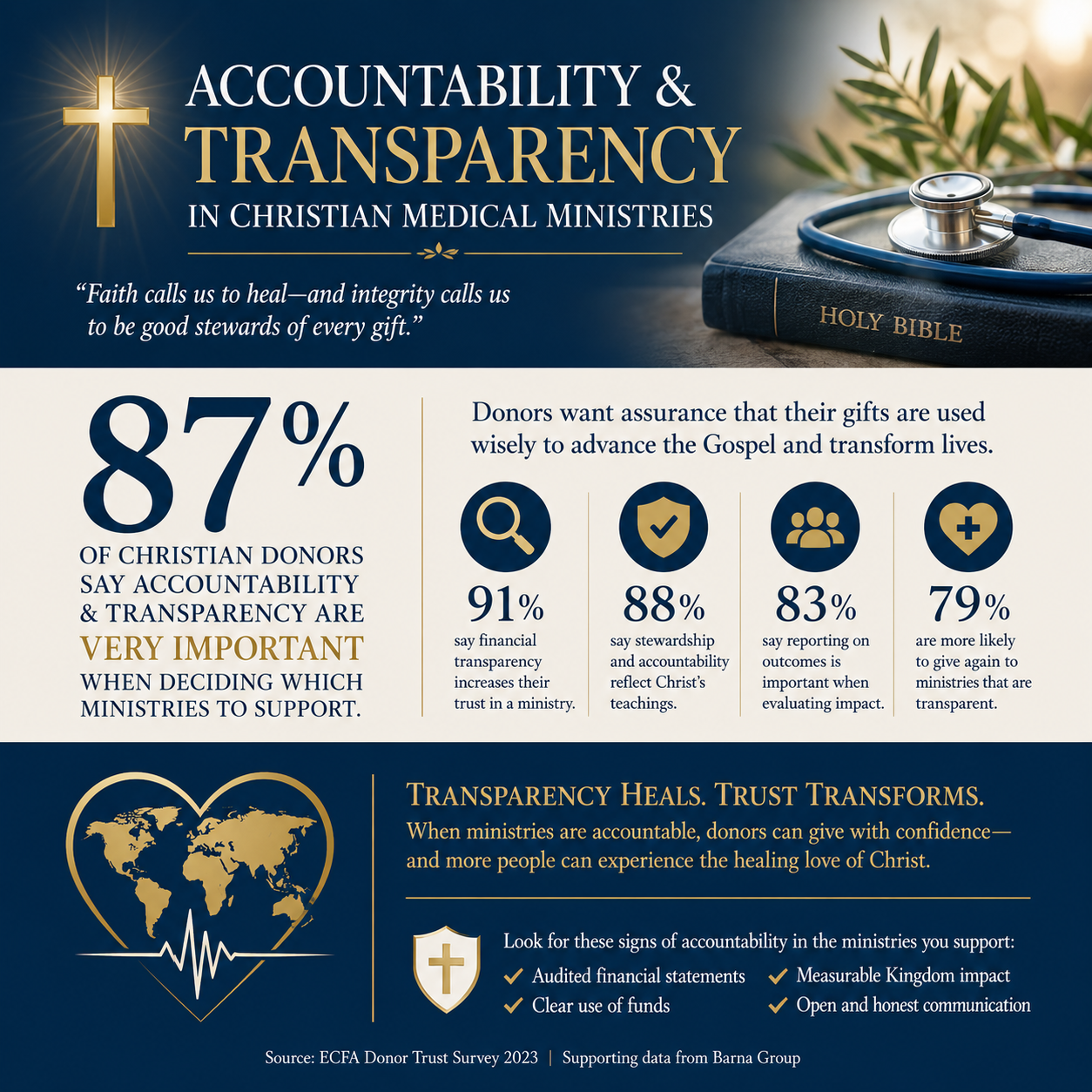
What this means in practice is that donors should look for audited financial statements when scale warrants it, consistent reporting of restricted and unrestricted funds, and transparent explanations for reserves, growth, and major program shifts. In medical work, donors should also expect clarity about in-kind donations (medicines, equipment), how they are valued, and how inventory is tracked. In-kind accounting can be legitimate and helpful, but it can also be a place where impact is overstated if controls are weak.
Governance that is visible and credible
Transparent governance includes a board that is identifiable, independent enough to provide oversight, and active in financial and ethical accountability. Donors should be able to see who governs, how conflicts of interest are handled, and whether the ministry has policies for whistleblowers, document retention, and related-party transactions. These are not technicalities. They are the institutional forms of the biblical insistence that leaders be “above reproach” (1 Timothy 3:2).
For donors who want to understand how these elements fit together across the broader landscape of healthcare missions, our work sits within the larger category of Christian Medical Ministries where theological commitments and operational realities meet under scrutiny.
Accountability standards donors can reasonably expect
Donors often ask for a single bright-line test: “Is this ministry legitimate?” Legitimacy is a starting point, not a finish line. A ministry can be legally registered and still be poorly governed, clinically careless, or opaque about results. The Most Trusted Standard is designed to meet donors at this more serious level of due diligence, evaluating ministries across 15 criteria spanning faith commitments, financial integrity, governance, and transparency with effectiveness.
Evidence of proper clinical oversight
Christian compassion does not replace clinical competence. Donors should ask whether licensed clinicians supervise care, how scope-of-practice is handled for volunteers, and what protocols govern high-risk services. In some contexts, ministries rely on local clinicians with visiting specialists supporting them; in others, expatriate staff provide continuity. Both can be responsible if oversight is clear and aligned with local law and ethical norms.
When a ministry provides medicines, donors should expect discipline around formularies, storage conditions, expiration tracking, and distribution records. In disaster settings, transparency should include how the ministry coordinates with local authorities and other responders to reduce duplication and prevent harm.
Policies that address spiritual care without coercion
Medical vulnerability can make patients easy to pressure, even unintentionally. Responsible Christian medical ministries articulate how they offer prayer, pastoral care, and gospel witness while honoring consent and avoiding quid pro quo dynamics. Donors should expect a ministry to state plainly that care is not conditioned on participation in religious activity, and that staff are trained to respect patient autonomy and local cultural realities.
Program effectiveness that goes beyond counting encounters
Counting consultations or procedures is not meaningless, but it is incomplete. Effectiveness in medical ministry includes measures of quality and continuity: follow-up rates, referral completion, patient education outcomes, and, when appropriate, clinical indicators aligned to the service provided. Not every ministry can gather sophisticated data in every setting, and donors should not demand measurement that crowds out care. But donors can ask whether the ministry has defined outcomes, learns from adverse events, and adjusts practice in light of evidence.
Many donors also want assurance that efforts do not undermine local health systems. The global health field has emphasized strengthening local capacity and partnering with local institutions rather than substituting for them. Where possible, donors can look for evidence of coordination with local clinics, hospitals, churches, and health authorities.
Protecting donor information and honoring the trust behind the gift
Medical ministries often steward sensitive data on two fronts: patient information and donor information. Donors rightly focus on whether their own personal and financial data are secure, but the integrity of a ministry’s data posture often reveals the maturity of its overall controls.
Reasonable data security practices donors can ask about
Donors can reasonably expect ministries to use reputable payment processors, secure donor databases, access controls, and clear policies for who can export or view donor records. A transparent ministry will describe its approach to privacy, data retention, and breach response without resorting to vague assurances. It should also avoid selling or trading donor lists, and it should state this plainly.
When ministries operate internationally, they may be subject to different data protection regimes, and they may also face heightened cyber risk. Donors do not need a ministry to sound like a technology firm, but they can expect basic competence and accountability at the board and leadership level.
Policy updates that are accessible and meaningful
Policies are only as trustworthy as their implementation. Still, a ministry that cannot publish clear policies is rarely implementing strong ones. Donors should look for accessible documentation on gift acceptance, restricted funds, privacy, conflicts of interest, and reporting practices. When policies change—particularly around recurring giving, data sharing, or program scope—responsible ministries inform donors in a timely way and provide a rationale that respects the donor’s intent.
How to ask questions without drifting into cynicism
Christian donors often feel a moral tension: questioning a ministry can feel like questioning the need itself. Scripture does not commend naiveté; it commends wisdom. Paul organized collections for the poor with visible accountability, appointing trusted representatives “to avoid any criticism of the way we administer this liberal gift” (2 Corinthians 8:20). That is not defensive management. It is an apostolic model for handling money entrusted for mercy.
The ministries that welcome scrutiny tend to treat donors as partners in stewardship rather than as funding sources to be managed. They can answer specific questions, provide documentation proportionate to their size, and speak candidly about risks, safeguards, and what they are still improving.
Stewardship that strengthens witness
Accountability and transparency in Christian medical ministries ultimately serve more than donor confidence. They protect patients, honor the church’s witness, and safeguard the credibility of gospel-propelled mercy. When ministries can show how funds are governed, how care is supervised, how outcomes are understood, and how trust is protected, donors are freed to give with conviction rather than anxiety.
At Most Trusted, we regard verification as a form of neighbor-love in institutional life: careful attention to what can be known, humility about what cannot, and insistence that Christian compassion deserves structures sturdy enough to carry it. The goal is not suspicion; it is stewardship that is worthy of the Name we bear.



