
The questions donors should ask Christian adoption ministries are not a test of cynicism. They are a form of love: love for children whose stories are not ours to simplify, love for birth families whose dignity must be protected, and love for adoptive families who need candor more than marketing. Scripture’s concern for the fatherless is not sentimental. It is practical, moral, and accountable: “Whoever is kind to the poor lends to the LORD” (Proverbs 19:17), and lending to the Lord is never a permission slip for carelessness.
The adoption field has also had to reckon with real failures. International adoption systems have, at times, been corrupted by financial incentives and weak oversight; domestic adoption can be distorted by coercive counseling, misleading “match” promises, or inadequate post-placement care. Christians genuinely disagree about how to weigh competing goods: urgency versus due diligence, privacy versus transparency, and family preservation versus adoption in cases where risk is difficult to interpret. Mature giving does not pretend those tensions are imaginary. It faces them and asks verifiable questions.
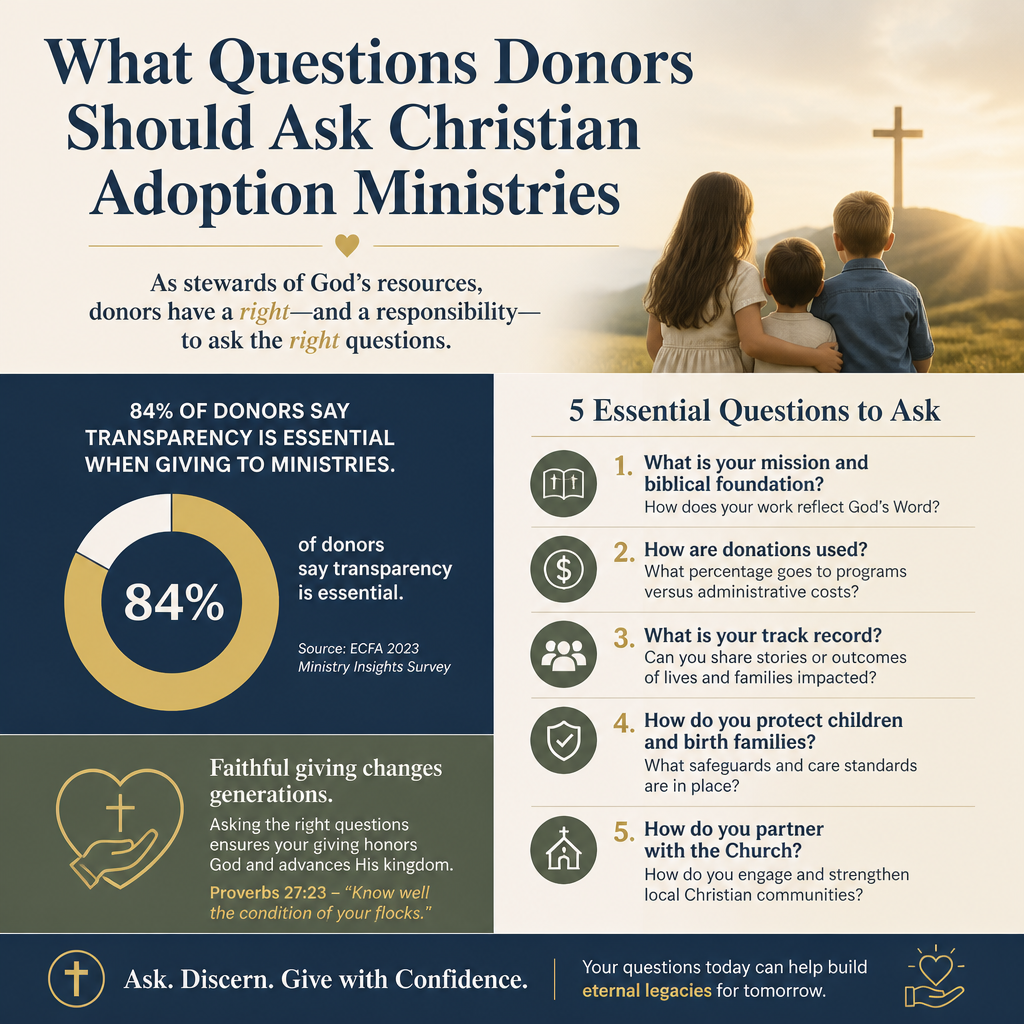
1. What does this ministry believe adoption is for
Ask for a theological account, not a slogan
Healthy ministries can articulate why they do what they do without reducing adoption to fundraising imagery. The New Testament uses adoption language to describe God’s saving work (“he predestined us for adoption to himself,” Ephesians 1:5), but that metaphor does not automatically sanctify every adoption practice. A credible ministry will distinguish clearly between the doctrine of adoption and the legal practice of adoption, and then show how Scripture shapes their ethics: truth-telling, protection of the vulnerable, and refusal to exploit suffering for publicity.
We recommend asking for a written statement describing how the ministry holds together three commitments: child protection, the dignity of birth parents, and the long-term health of adoptive families. Ministries that meet The Most Trusted Standard tend to be able to explain trade-offs plainly, without using spiritual language to avoid scrutiny.
Ask how they define success
Some ministries implicitly treat “placements completed” as the primary win. That can create pressure to move quickly, to minimize risk, or to downplay complex histories. Better ministries define success in ways that are harder to celebrate on social media: stable permanency, ethical practice, fewer disruptions, and durable support for families years after finalization.

2. How does this ministry prevent coercion and protect informed consent
Ask what safeguards exist when money and crisis intersect
Pregnancy and family crisis are moments of heightened vulnerability. Financial assistance, housing help, and counseling can be merciful. They can also become leverage if not structured carefully. Donors should ask whether the ministry has policies that separate material support from adoption decision-making, and whether birth parents receive counseling that includes genuine alternatives, including family preservation supports when appropriate.
In the United States, child welfare law has been shaped by the principle that children’s safety is paramount and that, where possible, families should be preserved or reunified. Federal policy reflects that emphasis through the Adoption and Safe Families Act framework and related child welfare guidance available through the U.S. Children’s Bureau at acf.hhs.gov.
Ask how they handle expectation-setting with adoptive families
A ministry can wrong adoptive parents by overselling certainty. “Match” language can imply a guarantee when the legal and emotional realities are far more fragile. Donors should ask what the ministry promises, what it refuses to promise, and how it communicates risk—medical unknowns, trauma history, legal complexity, and potential changes of plan.
- Do birth parents receive independent legal counsel, and who pays for it?
- What is the ministry’s policy on expectant-parent gifts and financial assistance?
- How are counseling notes documented and safeguarded?
- What training is required for staff and volunteers on coercion and ethical persuasion?
- What is the ministry’s policy for communication and updates in open adoption agreements?
3. What is their track record on child safety and ethical compliance
Ask what happens when something goes wrong
Every serious ministry should assume that hard cases will arise: allegations of abuse, suspected trafficking, falsified documents, disrupted placements, or unsafe living situations. Donors should ask for the ministry’s written child protection policy, incident reporting process, and escalation pathways. If the ministry works internationally, ask how it verifies that children are legally free for adoption and how it assesses the integrity of in-country partners.
There is a reason reputable ministries speak in terms of systems, not heroism. Strong systems include background checks, supervision standards, clear boundaries for volunteers, and mandatory reporting training aligned with local law. The U.S. Department of Health and Human Services maintains resources on mandatory reporting and child welfare responsibilities through hhs.gov.
Ask how they avoid perverse incentives
One of the most serious risks in adoption is the creation of incentives that treat children as supply. When funding rises with the number of placements or when partners are paid per-child, the system can drift toward recruitment rather than protection. Donors should ask how the ministry structures payments and partnerships, what it does to audit documentation, and whether it ever walks away from relationships that “produce results” but raise ethical concerns.
These are not abstract questions. The Hague Adoption Convention and U.S. implementing regulations were designed in part to address corruption risks by emphasizing subsidiarity, documentation, and safeguards. For donors, the point is not to become international law specialists; it is to ensure that ministries describe compliance as a moral obligation, not a bureaucratic nuisance. The U.S. Department of State provides Hague adoption information at travel.state.gov.
4. How transparent are they about money, governance, and conflicts of interest
Ask for financial clarity that respects both donors and families
Adoption-related work carries legitimate costs: licensed social work, home studies, trauma-informed counseling, legal services, training, and long-term support. Donors should not demand a simplistic “low overhead” narrative. The more appropriate question is whether the ministry is truthful, consistent, and appropriately accountable in how it reports finances.
We recommend requesting the most recent audited financial statements if the organization is large enough to justify an audit, and at minimum reviewing the organization’s Form 990 where applicable. The IRS provides access to nonprofit filings and exempt organization information at irs.gov.
Ask who has authority and who benefits
Many ethical failures are governance failures before they become news stories. Donors should ask who sits on the board, how often it meets, whether it has independent members, and how conflicts of interest are disclosed and managed. Adoption ministries can face particular conflict risks when agency leaders control vendor relationships, receive referral fees, or operate related for-profit services.
As a verification organization, Most Trusted evaluates ministries against The Most Trusted Standard across faith commitments, financial integrity, governance, and transparency. The aim is not to replace donor discernment, but to make basic claims testable: who governs, how money flows, and whether accountability is real rather than performative.
For donors seeking broader context on how accountability operates in this field, our coverage of Accountability and Transparency in Christian Adoption Ministries addresses recurring governance and reporting questions that surface across organizations.
5. How do they support families after placement and how do they measure outcomes
Ask what care looks like five years later
Adoption is not an event; it is a lifelong reality that interacts with trauma, identity, attachment, schooling, mental health, and extended family relationships. Donors should ask what post-placement services are provided and whether they are optional add-ons or integrated into the ministry’s model. Trauma-informed training for parents, access to counseling, respite care, and referral networks for specialized services are often where ministries either demonstrate seriousness or reveal that most resources are spent on front-end placement work.
Research on early adversity and institutional care has underscored the long-term developmental stakes for children. The Bucharest Early Intervention Project, for example, has been widely cited for its findings on the developmental effects of early institutionalization and the benefits of family-based care; background and publications can be accessed through Harvard’s Center on the Developing Child at developingchild.harvard.edu.
Ask what they measure and what they are willing to publish
Outcome measurement in adoption is complex. Privacy constraints are real, and simplistic metrics can be harmful. Still, ministries should be able to describe what they track and why: placement stability, disruption rates, timeliness of post-placement visits, utilization of support services, and satisfaction surveys that are designed to surface problems rather than solicit praise.
Donors should also ask whether the ministry has a clear policy for handling disruptions and dissolutions, including support for children and families and a commitment to learning rather than blame-shifting. Institutions that take sanctification seriously should not fear honest evaluation. The command to “speak the truth in love” (Ephesians 4:15) applies to organizational self-description as much as personal speech.
For donors evaluating where adoption ministry fits within a broader Christian commitment to vulnerable children and families, our work on Christian Adoption Ministries situates adoption alongside foster care, family preservation, and related models of care.
FAQs for What questions donors should ask Christian adoption ministries
Is it unspiritual to ask detailed questions about an adoption ministry
It is faithful stewardship to ask detailed questions. Scripture commends wise oversight of resources and warns against being “hasty” in judgment or action (Proverbs 19:2). Serious questions are not accusations; they are a way to ensure that compassion is joined to truth, especially when children and families bear the consequences of institutional decisions.
What documents should a donor expect a credible adoption ministry to provide
At minimum, donors should expect clear governance and financial disclosures, written policies on child safety and reporting, an explanation of services and fees, and a description of post-placement support. Where applicable, donors can request an audit, review IRS Form 990 filings, and ask for a conflict-of-interest policy and board roster. A ministry may appropriately protect private family information, but it should not treat basic accountability documents as proprietary.
Giving that honors children and tells the truth
Christian donors give to adoption ministries because we believe God sets the lonely in families and calls his people to protect the vulnerable. That conviction should produce more than urgency; it should produce carefulness. The most responsible questions are the ones that test incentives, verify safeguards, and require ministries to describe their work in ways that can be checked. Compassion that refuses scrutiny is not biblical compassion, and accountability that forgets mercy is not biblical accountability.



