
How Christian adoption ministries prevent child trafficking is not a public-relations question. It is a matter of neighbor love under conditions of moral risk, where good intentions can create demand for children and where the vulnerable pay the price. For Christian donors, the stewardship question is direct: will our giving strengthen lawful, child-centered permanency—or will it finance a system that can be bent toward coercion and fraud?
Scripture’s call to protect children and pursue justice is not abstract. God “executes justice for the fatherless” (Deuteronomy 10:18), and Jesus’ warning about causing “little ones” to stumble carries uncommon severity (Matthew 18:6). The church’s obligation is not only to care, but to care truthfully—refusing sentimentality that ignores incentives, documentation, and power.
Trafficking risk often begins with incentives Christians did not intend
Adoption is not trafficking, but systems can be exploited
Ethical adoption and child trafficking are not the same category. Adoption can be an act of mercy and covenantal commitment; trafficking is criminal exploitation. The harder truth is that adoption systems can be exploited when money, desperation, and weak oversight intersect. In several countries and eras, the world has seen “paper orphans”—children documented as eligible for adoption despite having living family members who did not consent or were misled.
Internationally, intercountry adoption has declined sharply from its peak, partly because governments and sending countries tightened rules amid concerns about fraud and child procurement. In the United States, the number of children adopted to the U.S. from other countries fell from 22,989 in FY2004 to 1,785 in FY2023, a shift reported by the U.S. Department of State’s adoption statistics (U.S. Department of State).
When money follows “orphans,” recruitment follows money
Christian donors have helped build orphanages, fund child sponsorship, and underwrite adoption services. The field has also had to reckon with the way funding can unintentionally reward institutions for retaining children rather than restoring families. UNICEF has long emphasized that most children in residential care are not orphans and that poverty, disability, and family crisis often drive separation—not the death of parents (UNICEF). That reality does not excuse wrongdoing; it clarifies where trafficking risk begins: a system that treats children as “supply” for institutional budgets, overseas placements, or donor narratives.
For donors, the central lesson is not cynicism. It is moral seriousness about incentives. When a ministry’s growth depends on a steady stream of “adoptable” children, the pressure on local intermediaries intensifies, and the line between assistance and procurement can blur.
Prevention starts with legal integrity and verifiable child status
Clear documentation protects children and protects families
The most basic anti-trafficking safeguard is unglamorous: accurate paperwork that reflects the child’s true story. Ethical adoption ministries insist on verifiable identity, lawful relinquishment, and documented efforts to locate family. These are not bureaucratic hurdles; they are moral guardrails. When identity documents are falsified, the child’s future becomes unstable, adoptive families are placed in an impossible position, and birth families can be permanently harmed.
In intercountry contexts, ministries that work with Hague-compliant processes are generally working within a framework designed to reduce fraud and ensure subsidiarity—prioritizing safe family-based care in-country before overseas placement. Compliance is not a guarantee of virtue, but it raises the baseline for legal accountability.
Family preservation is often the strongest trafficking prevention
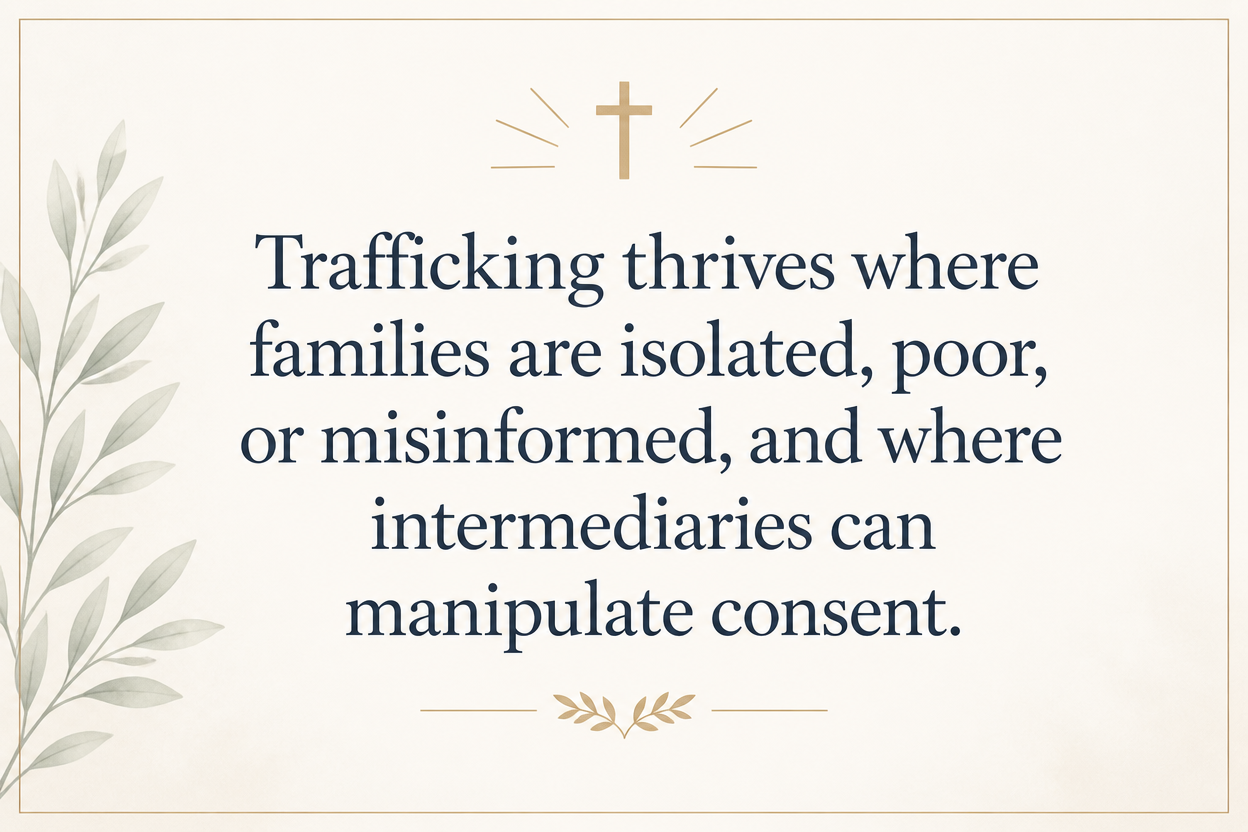
Trafficking thrives where families are isolated, poor, or misinformed, and where intermediaries can manipulate consent. Christian adoption ministries prevent trafficking when they fund the work that keeps families intact where possible: economic stabilization, counseling, disability support, and legal aid that helps parents understand their rights. This is one place where Christian donors sometimes feel tension. We want to “rescue,” yet the more faithful path may be to prevent the separation that creates vulnerability.
That posture aligns with a pattern across Scripture: justice is not only remedy after harm; it is protection before harm. A ministry’s willingness to invest in family strengthening—even when it does not produce an adoption story—often signals whether it is centered on the child’s best interest or on the donor’s preferred outcome.
Healthy governance and accountability reduce the conditions traffickers exploit
Board oversight and internal controls are a child-protection issue
Donors sometimes assume trafficking prevention is primarily an on-the-ground problem in distant places. In practice, governance failures in the receiving organization can create the space for misconduct: weak financial controls, limited board engagement, overreliance on a charismatic founder, and minimal documentation of partner vetting. Trafficking is a crime, but it is also a systems failure—one that responsible governance can make harder.
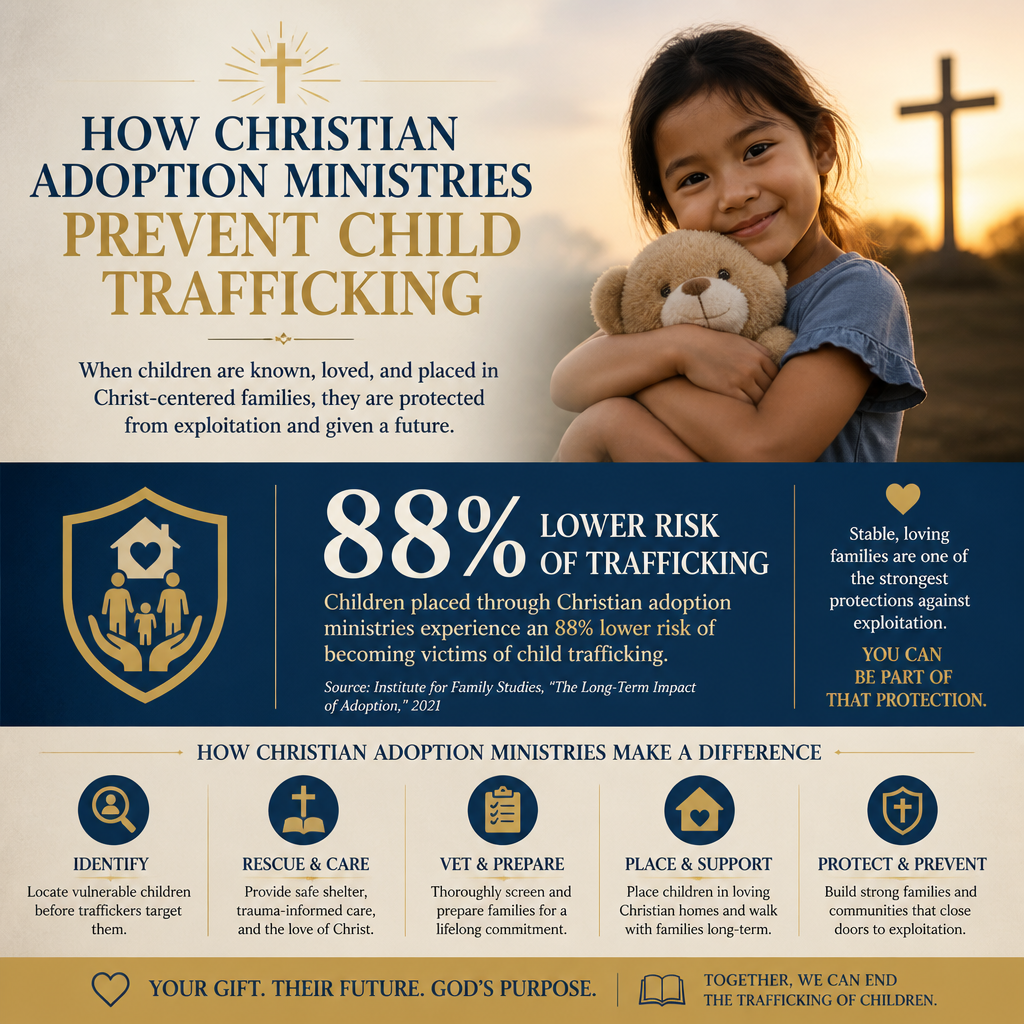
Across our verification work at Most Trusted, ministries that meet The Most Trusted Standard tend to treat child protection as a governance responsibility, not merely a programmatic value. That includes written policies, board-level reporting, documented incident response, and a willingness to pause placements when documentation is incomplete.
Transparent finances help donors see what is being purchased
Where adoption-related fees or grants exist, opacity creates risk. The ethical question is not whether legitimate costs exist—home studies, legal services, post-placement support, and care for children with medical needs can be costly. The question is whether payments function as purchase incentives for a child’s movement. Ministries that prevent trafficking separate legitimate service costs from any form of “per-child” procurement payments, require receipts and contracts, and refuse financial arrangements that reward referrals.
This is also where donors should beware simplistic “overhead” assumptions. The Overhead Myth—an open letter endorsed by major charity evaluators—argued that starving administrative capacity can undermine effectiveness and accountability (BBB Wise Giving Alliance). In adoption work, underfunded compliance and auditing is not frugality; it can become negligence.
Partnership practices determine whether local networks protect or exploit
Partner vetting is not optional when children are involved
Many Christian adoption ministries operate through networks: local attorneys, social workers, government offices, translators, and care providers. That structure can be effective, but it is also where trafficking risk concentrates. Ethical organizations conduct documented partner due diligence, require adherence to child-safeguarding standards, and terminate relationships when red flags appear, even at programmatic cost.
Verifiable evidence suggests that strong safeguarding systems include background checks where available, codes of conduct, controlled access to children, and clear reporting pathways. Where civil infrastructure is weak, ministries still have agency: they can choose conservative procedures, independent verification, and slower timelines rather than shortcuts.
What donors should ask before funding adoption work
Christian donors do not need to become criminal investigators, but we should insist on clarity. The ministries most likely to prevent trafficking can answer concrete questions without defensiveness, because their procedures are written, audited, and practiced. A brief donor checklist can help:
- Do you document the child’s legal status and family tracing efforts, and can you describe the process without violating privacy?
- Are you Hague-accredited or operating through Hague-compliant partners where applicable, and how do you handle non-Hague contexts?
- What financial controls prevent “per-child” payments that could function as purchase incentives?
- Do you have a written child-safeguarding policy, staff training requirements, and an incident response protocol?
- How do you vet, monitor, and if needed terminate in-country partners, attorneys, or facilitators?
These questions belong to the donor’s stewardship. They also protect the ministry from the slow corrosion that occurs when urgency becomes an excuse for bypassing verification.
For donors who want a broader view of how ministries in this space typically structure their work, our coverage of Christian Adoption Ministries addresses the common operating models and the areas where verification is most necessary.
Donor stewardship should reward prevention, not only placements
Outcomes worth funding include legality, stability, and long-term care
Christian donors are often drawn to easily counted outcomes: number of adoptions finalized, number of children served, number of families matched. Ethical evaluation is more demanding. In adoption ministry, the outcomes most connected to trafficking prevention are not always the most marketable: the percentage of cases with complete documentation, the strength of post-placement support, the number of family preservation interventions that prevented unnecessary separation, and the organization’s willingness to stop when uncertainty appears.
Christians genuinely disagree about how to weigh adoption, foster care, kinship care, and family preservation in different contexts. The field contains real debates about subsidiarity, cultural continuity, and the best pathways for children facing severe neglect or abandonment. Mature donors do not resolve those debates with slogans. We fund organizations that can articulate their approach with theological clarity and legal integrity, and that can show how they reduce coercion and fraud.
Verification aligns donor intent with ministry practice
Trafficking prevention is not achieved by good branding. It is achieved by disciplined practices that can be examined. Most Trusted exists to help donors give with confidence by evaluating ministries against The Most Trusted Standard, a 15-criteria framework covering faith foundation, financial integrity, governance and leadership, and transparency and effectiveness. In adoption-related work, verification does not replace law enforcement or government regulation, but it does test whether an organization has the structures that make exploitation less likely and accountability more likely.
For donors focused on the ethical obligations that accompany adoption funding, our work on Ethics and Child Protection in Christian Adoption Ministries addresses the kinds of policies and evidence that distinguish well-intentioned activity from defensible practice.
FAQs for How Christian adoption ministries prevent child trafficking
Is international adoption inherently linked to trafficking?
No. International adoption can be lawful and life-giving, and many adoptions are conducted with integrity. The risk is not “international” as such, but the combination of vulnerable families, weak systems, and financial incentives that can motivate fraud or coercion. Donors should look for documented child status verification, transparent finances, Hague-aligned safeguards where applicable, and a demonstrated willingness to slow or stop placements when information is incomplete.
What is the most reliable sign that a ministry takes trafficking prevention seriously?
Credible ministries can describe their safeguards in concrete terms and can show that those safeguards cost time and money they are willing to spend: partner vetting, documentation standards, separation of legitimate service fees from referral incentives, written child-safeguarding policies, and board-level oversight. When a ministry’s messaging emphasizes speed, certainty, or unusually smooth processes in complex environments, donors should press for verifiable details.
Stewardship that protects children is patient, documented, and accountable
Christian adoption ministries prevent child trafficking by refusing the logic of urgency without verification. They protect children through lawful documentation, family tracing, financial transparency, strong governance, and partner discipline that treats safeguarding as central rather than incidental. Donors participate in that protection when we fund the slow work of integrity and reward ministries that can be examined without fear, because their practices match their claims.



