
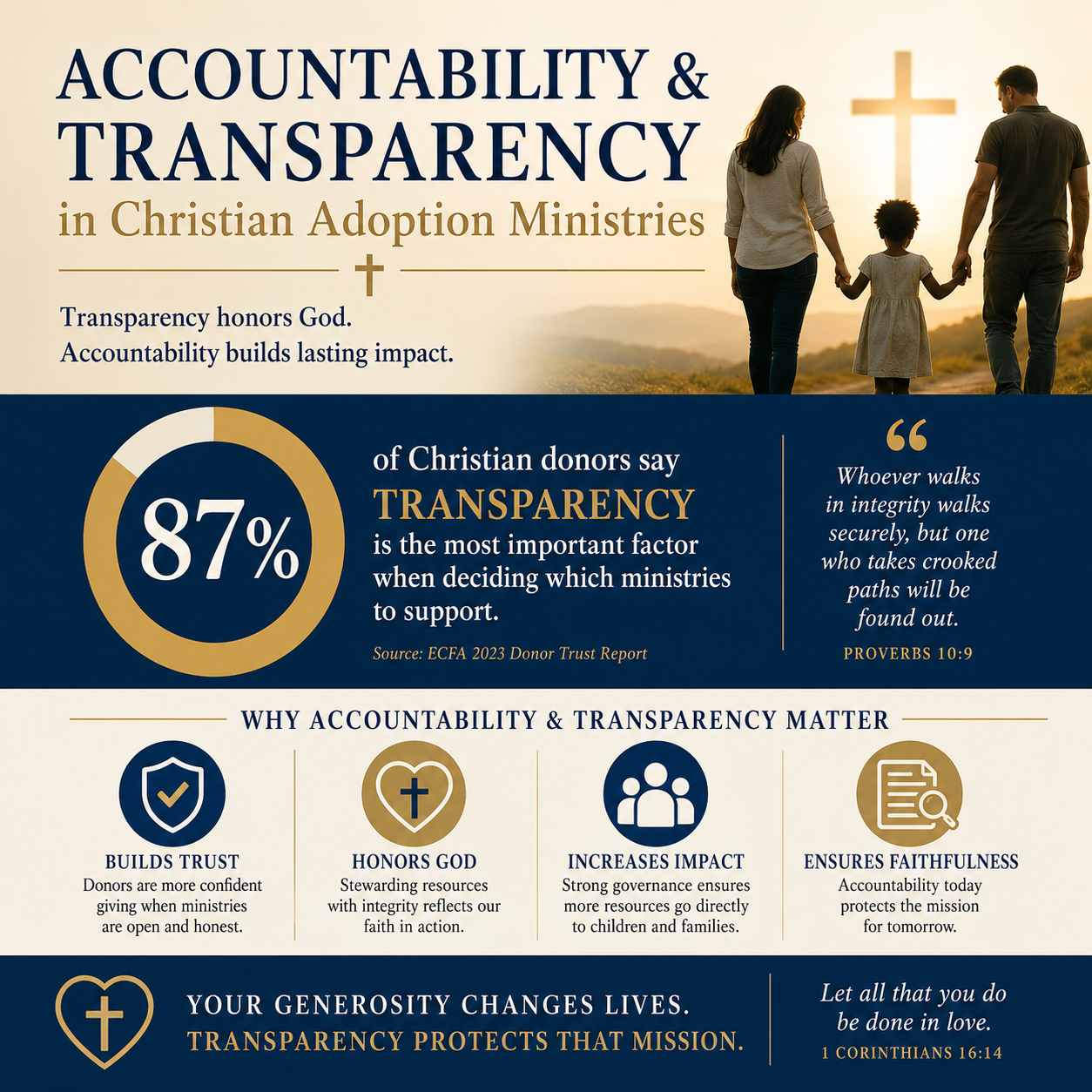
Accountability and transparency in Christian adoption ministries are not secondary virtues; they are part of the moral substance of orphan care. Donors are often asked to give in moments charged with compassion—an urgent home study fee, a sudden travel need, a family on the edge of collapse. The Christian impulse to act quickly is good. Yet Scripture binds generosity to truthful dealing, because the poor, the vulnerable, and the child without stable protection are easily exploited when money moves without light.
The harder reality is that adoption ministry sits at the intersection of trauma, law, cross-border regulation, and uneven power. Christians genuinely disagree about contested questions—intercountry adoption policy, the role of agencies and facilitators, and how to distinguish ethical adoption from child-finding markets. Precisely because the work is weighty, a donor’s confidence should rest on verifiable practices: clear financial controls, competent governance, and honest reporting of outcomes and failures. “We aim at what is honorable not only in the Lord’s sight but also in the sight of man” is not a public-relations line; it is an apostolic expectation for handling gifts (2 Corinthians 8:21).
Why adoption ministry requires a higher standard of public accountability
Christian adoption ministries frequently handle funds that are emotionally “pre-committed” in a donor’s mind: a child’s file, a family’s match, a plane ticket, a birth mother’s care. That intensity can tempt ministries to promise more certainty than the adoption process can deliver. Ethical accountability begins with resisting that temptation. A trustworthy ministry explains what it can control, what it cannot, and how donor funds will be stewarded if the expected outcome changes.
Adoption also involves significant information asymmetry. Donors rarely see legal contracts, referral documentation, or the chain of custody for fees paid abroad. Families may not be free to publish details because of privacy and safety concerns. This makes the ministry’s disclosures, controls, and third-party checks more—not less—important. When a ministry asks for trust while withholding basic financial and governance information, it is asking donors to bear a risk that belongs to leadership.
Transparency is a form of protection for the vulnerable
Transparency is commonly discussed as a donor right. In adoption, it is also a child-protection measure. Markets form wherever demand meets opaque supply. The U.S. Department of State has repeatedly warned prospective adoptive parents about adoption fraud and unethical practices in intercountry adoption, including falsified documents and improper inducements (U.S. Department of State). Ministries that cannot describe their safeguards against coercion, document fraud, and child-finding incentives are not merely under-communicating; they may be under-governing.
Spiritual language cannot substitute for controls
Christian organizations sometimes confuse sincerity with accountability. Scripture does not. Jesus’ repeated warnings about money and hypocrisy apply with particular force when vulnerable people are involved (Matthew 23). Ministries do not honor Christ by asking donors to suspend ordinary prudence. They honor Christ by building institutions that make wrongdoing harder, not easier, and by telling the truth when things go wrong.

Financial integrity donors can verify before giving
Many donors still ask, “What percentage goes to programs?” That question is understandable, but it is not sufficient. The nonprofit sector has had to reckon with the “overhead myth”—the mistaken belief that low administration automatically means high impact. Charity Navigator, Candid (GuideStar), and the BBB Wise Giving Alliance jointly argued that overhead ratios alone are a poor measure of nonprofit performance (Charity Navigator). In adoption ministry, under-investment in compliance, case management, and financial controls can increase risk for children and families.
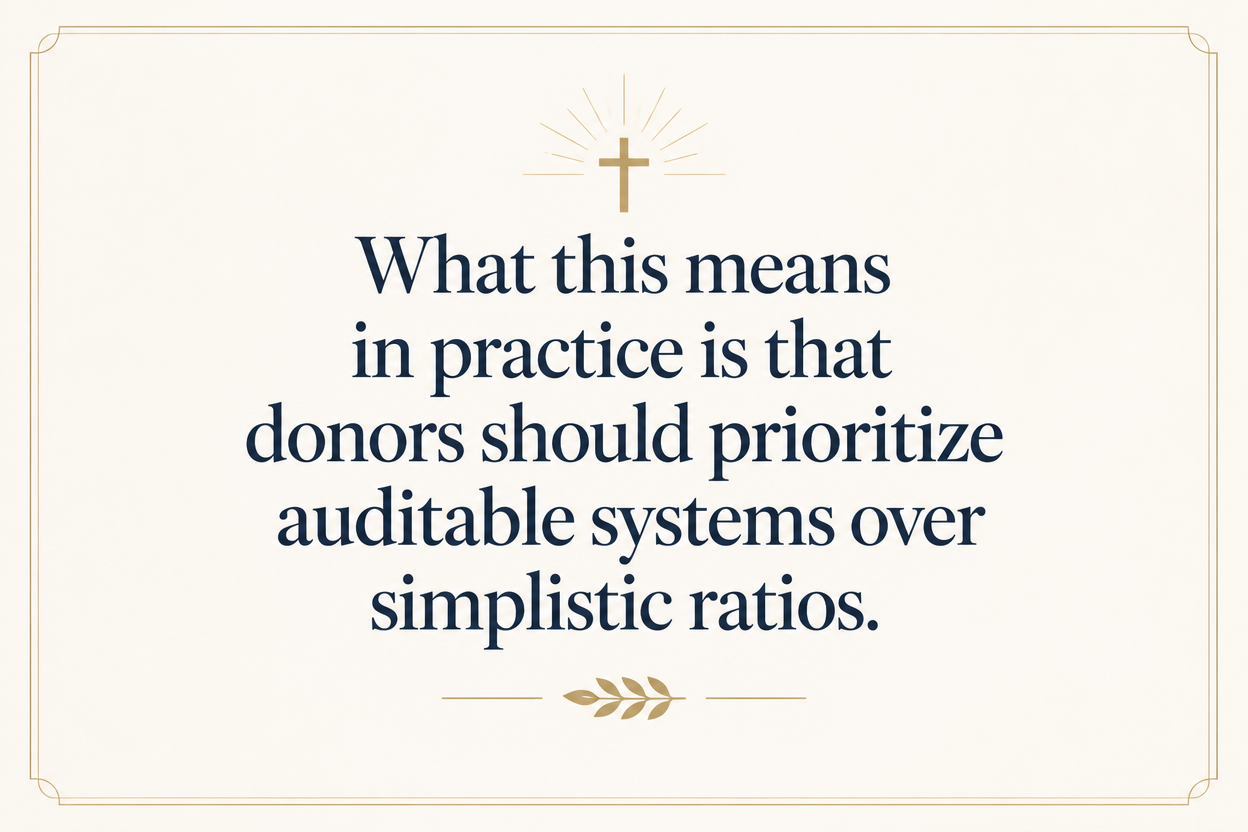
What this means in practice is that donors should prioritize auditable systems over simplistic ratios. Administrative costs may fund essential work: background checks for staff and volunteers, secure recordkeeping, legal review of foreign partners, and training in trauma-informed care. A ministry that presents administration as inherently suspect may be signaling that it lacks a mature understanding of risk.
Restricted gifts require written policies, not verbal assurances
Adoption donors often give restricted gifts: “for the Smith family’s adoption,” “for home study costs,” “for post-adoption counseling.” Restrictions are morally binding. A ministry should publish a restricted-gift policy that explains how it documents donor intent, how it tracks restricted funds in its accounting system, and what happens if the restriction cannot be fulfilled (for example, an adoption disruption, a denied visa, or a family’s withdrawal). The best policies also clarify that contributions to support a specific family may be tax-deductible only if the ministry retains full discretion and control, reflecting IRS expectations for charitable contributions.
Audits, reviews, and board oversight should match the scale of funds handled
External assurance takes different forms: an independent financial audit, a review, or agreed-upon procedures. The right level depends on revenue size, complexity, and risk exposure. Donors should look for evidence that leadership is not grading its own work: a reputable independent CPA firm, timely completion, and a board that receives the results directly. Where adoption work involves international transfers or partner payments, donors should expect written controls around approvals, documentation, anti-fraud safeguards, and periodic reconciliation.
Disclosures should help donors understand how money actually moves
A transparent adoption ministry does more than post a budget pie chart. It explains major revenue streams and cost drivers: client fees versus donations, how fees relate to actual services, and whether fundraising covers families who cannot afford full costs. It also clarifies any financial relationships with agencies, facilitators, or overseas partners. When donors cannot tell whether they are funding child welfare, underwriting an operational deficit, or offsetting fee revenue, confidence erodes for good reasons.
Governance and leadership practices that prevent avoidable harm
Financial transparency without governance strength is fragile. Adoption ministry can drift into founder-centered decision-making, especially when the work begins from a compelling personal calling. Calling is not a governance model. The New Testament assumes accountable leadership, tested character, and visible integrity (1 Timothy 3:1–13). For donors, the question is not whether leaders love adoption; it is whether the organization has structures that constrain poor judgment and surface problems early.
A competent, independent board is a primary safeguard
Board governance should be more than names on a website. Donors can look for signs of independence (not all close friends or family), relevant expertise (finance, law, child welfare, cross-cultural work), and documented practices (meeting frequency, committee work, conflict-of-interest disclosures). The strongest ministries treat conflicts of interest as normal risks to be managed, not accusations to be avoided. They require annual disclosure forms, recusal procedures, and clear documentation when related-party transactions exist.
Child safety and ethical practice must be explicit, enforced, and reviewed
Adoption ministries often operate alongside orphan care, family preservation, foster care support, or church-based hosting programs. Donors should look for child safety policies that are public and specific: screening, training, two-adult rules where appropriate, mandated reporting training, and protocols for allegations. For intercountry work, ethical practice should include guardrails against coercion and improper payments, transparent fee schedules, and due diligence on in-country partners. When a ministry’s public materials emphasize uplifting stories but are quiet about safeguards, that silence is information.
Outcome claims should be modest, evidence-based, and honest about trade-offs
Some aspects of adoption ministry are measurable: number of families served, counseling hours delivered, post-adoption supports provided, funds granted, and compliance milestones met. Other aspects require humility: long-term family stability, children’s trauma recovery trajectories, and the varied impacts of transracial and transcultural adoption. Ministries that speak as if every adoption is uncomplicated do not reflect the reality families face. Trustworthy leadership makes room for lament, complexity, and ongoing support rather than presenting adoption as a single victorious moment.
Transparency and effectiveness that respect donors and families alike
Transparency in adoption ministry must honor privacy. Children are not fundraising assets, and families are not obligated to share their hardest moments to justify a gift. Mature transparency communicates without exploiting: de-identified program reporting, clear financial statements, and plain explanations of what the ministry does and does not do. Donors should not have to choose between accountability and dignity.
Across our verification work at Most Trusted, the ministries that meet The Most Trusted Standard tend to treat transparency as a discipline rather than an occasional disclosure. They publish governing documents and policies when doing so will not compromise safety. They respond to hard questions without defensiveness. They provide consistent reporting that makes it possible to evaluate progress over time, not only during campaigns.
Nonprofit status is a starting point, not a finish line
Many donors begin by confirming 501(c)(3) status and reviewing Form 990 filings. That is prudent. It is also limited. A ministry can be properly registered and still operate with weak controls or unclear ethics. Donors should read Form 990s for governance signals: board composition, related-party transactions, fundraising practices, and whether the organization is current. For basic verification, donors can use the IRS Tax Exempt Organization Search (IRS) and then read the organization’s own disclosures with a careful eye.
Donor questions should be concrete and tied to documented answers
Adoption donors often hesitate to ask hard questions because the cause feels sacred. Yet careful questions are a form of love for families and children. Donors should ask for written policies and examples of reporting, not merely assurances. Sound questions include: How are restricted gifts tracked? What happens if a family’s situation changes? What external financial assurance is completed and when? What safeguards exist to prevent coercion or improper financial incentives? How does the ministry evaluate partner organizations abroad? Who on the board has authority to challenge leadership?
Effectiveness reporting should include both activity and learning
Because adoption touches deep wounds, effectiveness is not simply “placements” or “matches.” Donors should look for post-adoption supports, counseling referrals, trauma-informed training, and practical care for families. They should also look for evidence of learning: how the ministry adapts to regulatory changes, responds to ethical critiques in the field, and corrects course when a process fails. Organizations that never acknowledge failure may be withholding essential information—or may not have systems that detect it.
For readers who are evaluating organizations in this space more broadly, our coverage of Christian Adoption Ministries reflects the same conviction: care for the fatherless must be matched by integrity that can bear scrutiny.
Giving with confidence without surrendering discernment
Accountability and transparency in Christian adoption ministries do not exist to cool generosity; they exist to keep generosity aligned with truth. Scripture’s call to defend the vulnerable carries with it an obligation to handle money openly and to build institutions that resist both exploitation and self-deception. Donors can honor that call by giving to ministries that welcome scrutiny, document their practices, and demonstrate governance and financial integrity consistent with the gravity of the work. Where those marks are absent, restraint is not cynicism; it is stewardship.



