
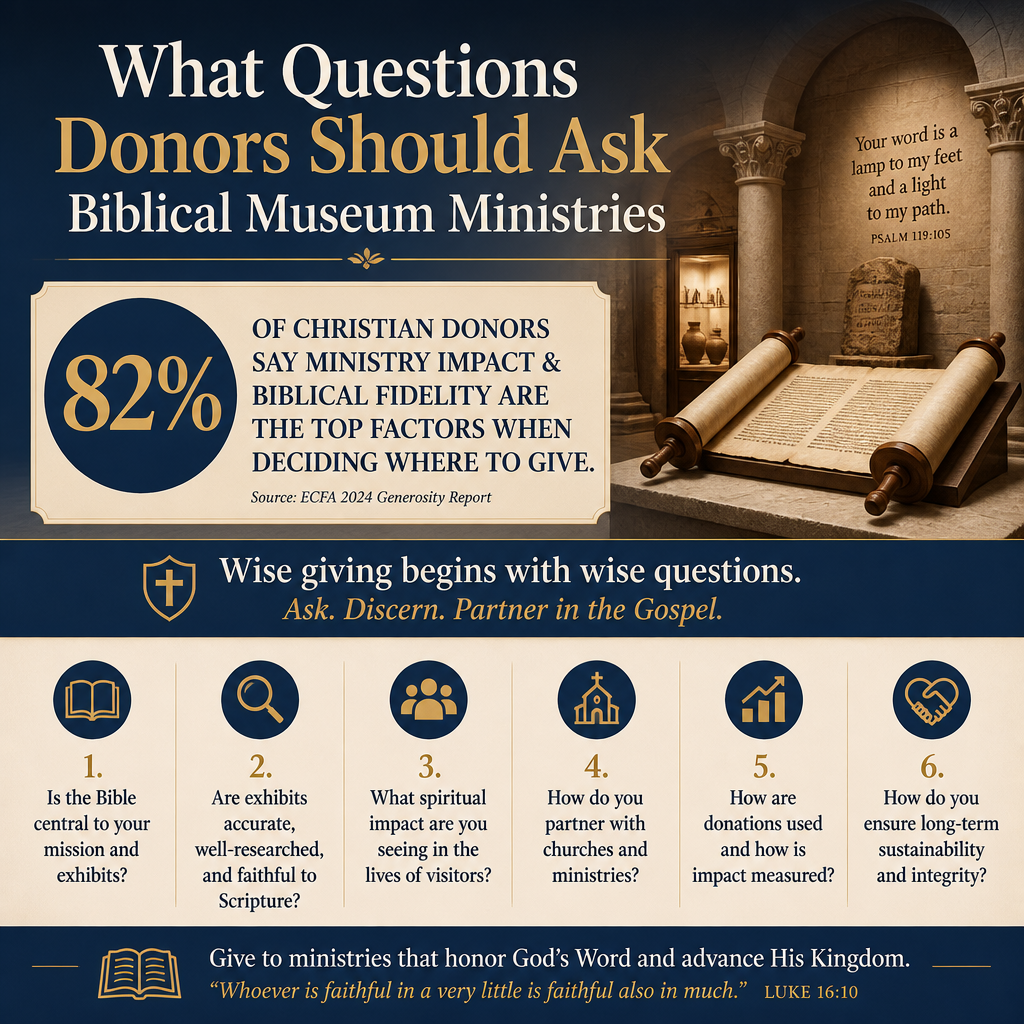
The questions donors should ask biblical museum ministries are not merely practical; they are moral. A museum that claims to serve the Church by presenting Scripture, history, and material culture takes on a distinctive responsibility to tell the truth carefully, to handle money honorably, and to form visitors in ways consistent with the gospel.
Biblical museums sit at an intersection of scholarship, evangelism, education, and public witness. That complexity creates both opportunity and risk. Donors who love the authority of Scripture and the credibility of Christian witness have good reason to ask disciplined questions before giving, especially when museums operate with high fixed costs, depend on restricted gifts, and communicate to audiences that include skeptics as well as believers.
1. What is the ministry claiming, and what counts as evidence
Ask for clarity on claims and categories
Many donor misunderstandings begin with a simple category error: a museum exhibit can be spiritually meaningful without being historically certain in every detail. Christian donors should ask what the ministry claims an artifact “is,” what it claims an artifact “shows,” and what it claims an artifact “proves.” A careful ministry distinguishes devotional significance from evidentiary weight and uses language that honors both faith and honest inquiry.
Christians genuinely disagree about how to frame contested questions in archaeology and textual history, and a biblical museum does not need to take maximalist positions to be faithful. Yet it should be explicit about where scholarly consensus exists, where it does not, and what is inferred rather than established. In our verification work at Most Trusted, we see that ministries with durable credibility tend to treat uncertainty as a normal feature of responsible scholarship, not as a threat to be managed.
Ask how the museum handles contested scholarship
Donors should listen for intellectual integrity: peer engagement, transparent sourcing, and a willingness to represent opposing views fairly before offering an argument. A museum may argue for a particular interpretation, but it should not require visitors to accept disputed claims as the price of belonging. The Church’s public witness suffers when Christian institutions are perceived as careless with evidence.
A related question is whether the museum distinguishes between primary sources, interpretive reconstructions, and artistic imagination. Museums often use reconstructions to help visitors picture the ancient world. The donor’s question is whether the museum labels reconstructions and explains the basis for them, rather than allowing impression to substitute for documentation.
2. Where do collections come from, and are they held ethically
Ask about provenance and acquisition standards
Provenance is not a technical footnote; it is a moral issue. The antiquities market has long been associated with looting and illicit trade, and biblical-era objects can be especially vulnerable to trafficking because demand is high and verification is difficult. Donors should ask what written policies govern acquisition, what documentation is required, and whether the museum refuses items lacking credible ownership history.
Responsible museums also explain how they comply with cultural property laws and international standards. UNESCO’s 1970 Convention is a widely recognized reference point in modern cultural property practice, and donors can ask whether the museum aligns its acquisition posture with its principles, not simply with what is legally defensible in a narrow sense. A ministry that speaks about holiness and truth should be willing to speak plainly about how it avoids benefiting from theft or exploitation.
Ask about authentication and outside review
Biblical artifacts are frequently forged. Donors should ask how authentication decisions are made, whether the museum relies on qualified external specialists, and what happens when items are questioned after acquisition. The strongest posture is not “we have never been challenged,” but “we have a process for testing, correction, and disclosure.”
When a museum publishes research or makes high-profile claims, donors can also ask whether the work is accessible for external scrutiny. Legitimate reasons exist to protect sensitive information, but the default for a public-facing educational ministry should be transparency where possible.
3. How does the ministry form visitors spiritually without manipulating them
Ask what kind of discipleship the museum intends
A biblical museum ministry is not a church, but it does teach. The donor’s question is what kind of formation the museum aims at: wonder, reverence, confidence in Scripture, compassion for the world behind the text, or something else. Donors should ask how the ministry’s educational goals align with the whole counsel of God rather than narrowing the Christian message to a single apologetic outcome.
Scripture commends truthful speech as a mark of God’s people. “Therefore, having put away falsehood, let each one of you speak the truth with his neighbor” (Ephesians 4:25). For a museum, this includes interpretive honesty, fair representation of sources, and careful avoidance of emotional pressure presented as evidence.
Ask how visitors are invited to respond
Many museums include gospel presentations, prayer spaces, or invitations to support ministry work. Donors should ask whether those invitations respect conscience and clarity. Is the gospel presented faithfully, or is it reduced to a slogan attached to a fundraising appeal? Are visitors given room to reflect, or is the experience designed to drive an immediate transaction?
Healthy ministries typically separate educational interpretation from donation prompts in ways that preserve trust. They can still invite generosity, but they do so without blurring the line between teaching and solicitation.
4. What financial realities shape the museum, and are they governed with integrity
Ask how the museum sustains high fixed costs
Museums carry structural financial pressures that many other ministries do not: facilities, conservation, security, climate control, insurance, and specialized staff. Donors should ask for a clear explanation of the cost model and how the museum avoids chronic crisis fundraising. The question is not whether overhead is “low,” but whether spending is honest, mission-aligned, and sustainable.
Christian donors should be wary of simplistic overhead narratives. Major nonprofit evaluators have warned against treating overhead ratios as a proxy for effectiveness; the “Overhead Myth” letter was jointly endorsed by Charity Navigator, GuideStar, and BBB Wise Giving Alliance to caution donors that underinvestment in administration can undermine results Charity Navigator.
Ask what governance protections exist
A museum ministry needs a board with real independence, relevant expertise, and the courage to ask difficult questions. Donors should ask about related-party transactions, executive compensation processes, conflict-of-interest disclosures, and whether audited financial statements are available. If a ministry will not share basic governance documents, donors should treat that as a substantive signal, not a minor inconvenience.
In accountability work, we find that ministries meeting The Most Trusted Standard generally treat governance as a stewardship responsibility before God, not as a legal hurdle. They expect controls, documentation, and independent oversight because Scripture calls leaders to be “above reproach” in both character and conduct (1 Timothy 3:2).
- Does the ministry publish audited financial statements or at least reviewed statements, and are they current?
- Is the board majority independent of the founder and paid staff?
- Are conflicts of interest disclosed and managed in writing?
- Is executive compensation set through an independent process using comparable data?
- Are restricted gifts tracked and honored with documented controls?
5. How does the ministry measure effectiveness without reducing ministry to metrics
Ask what success looks like beyond attendance
Attendance and ticket revenue matter, but they are not synonymous with spiritual fruit or educational quality. Donors should ask what the museum defines as effectiveness: learning outcomes, visitor comprehension, church partnerships, teacher training, digital reach, or some combination. A serious ministry will have a thoughtful answer that fits its calling.
At the same time, donors should resist the temptation to demand artificial precision. A museum cannot quantify conversion the way a clinic can quantify patients served. What it can do is evaluate visitor learning, track program participation, solicit structured feedback, and document responsible use of resources.
Ask how transparency is practiced in public, not only promised
The most credible ministries publish meaningful information proactively: collection policies, governance basics, annual reports, and clear explanations of major initiatives. They also correct mistakes publicly when needed. That posture does not guarantee perfection, but it signals a commitment to truthfulness that donors can recognize.
Donors who want a broader context for this kind of due diligence can review how we think about Biblical Museum Ministries as a ministry category, including common risk areas and credibility markers. And because transparency practices vary widely across institutions, many donors also benefit from our treatment of Accountability and Transparency in Biblical Museum Ministries as a distinct evaluative concern.
FAQs for What questions donors should ask biblical museum ministries
Should donors avoid biblical museum ministries because some artifacts are disputed?
No. Disputed artifacts and contested interpretations are part of the field, and responsible institutions can serve the Church well without claiming certainty where it does not exist. The donor’s task is to support ministries that label uncertainty honestly, use qualified expertise, and correct errors transparently when new evidence emerges.
What is the single most revealing document to request from a museum ministry?
Audited financial statements are often the most efficient starting point, because they reflect both financial integrity and governance discipline. If an audit is not available, donors can request the most recent reviewed statements, a current budget, and written policies on conflicts of interest, restricted gifts, and acquisition and provenance standards.
A donor posture worthy of the subject
Biblical museum ministries can strengthen confidence in Scripture, deepen historical understanding, and serve the Church’s public witness. They can also harm credibility when they are careless with evidence, casual about acquisition ethics, or opaque in governance. Donors best serve the kingdom by asking patient, serious questions that honor both faith and truth, then giving with conviction where stewardship and integrity are demonstrably present.



