

What Bible distribution ministries report to donors is not a marketing detail; it is part of the moral structure of Christian stewardship. When a ministry asks the church to fund the spread of Scripture, it is asking for trust around sacred work—work that carries spiritual urgency and logistical complexity at the same time. Donors are right to want reporting that is reverent about outcomes, honest about limits, and disciplined about evidence.
Across Bible distribution, the core tension is familiar: the gospel is not a commodity, yet distribution requires supply chains, local partners, security protocols, and measurable logistics. Mature donor reporting does not resolve that tension by reducing faith to metrics or by treating metrics as faithless. It names what can be counted, what cannot, and what a ministry is doing to remain truthful in both categories.
Reporting that begins with a theology of stewardship
Why donors should expect more than activity updates
The New Testament treats stewardship as an account rendered before God, not merely before people. Jesus’ parable of the talents assumes that entrusted resources invite scrutiny and evaluation (Matthew 25:14–30). Paul speaks of ministry as a stewardship of what has been received (1 Corinthians 4:1–2). In donor reporting, that framework presses ministries toward clarity: funds were entrusted for a purpose; what was done, what was learned, and what remains unresolved?
For Bible distribution ministries, the most basic reporting moves beyond “we shipped Bibles” to “we honored the intention of the gift.” That includes describing where Scripture went, through whom, under what safeguards, and with what credible indicators of use. It also includes stating what the ministry will not claim. Reporting that promises spiritual transformation as a guaranteed outcome often overreaches; reporting that refuses to describe any outcomes at all often evades accountability.
How The Most Trusted Standard frames donor expectations
At Most Trusted, we evaluate Christian nonprofits against The Most Trusted Standard, a 15-criteria framework that tests whether a ministry’s story, finances, leadership, and evidence can bear the weight donors place on them. In Bible distribution, the ministries that meet The Most Trusted Standard tend to treat donor reporting as a form of truth-telling: not a quarterly performance, but a consistent pattern of verifiable claims, constrained language, and traceable documentation.
That orientation matters because Bible distribution sits at the intersection of evangelism, humanitarian access, and political sensitivity. In some contexts, a careless sentence in a donor report can endanger local believers. In others, a carefully phrased report can still remain meaningful because it explains the ministry’s operating model and the controls that protect integrity.

What credible ministries report about outputs and logistics
Distribution volume, but with definitions that prevent confusion
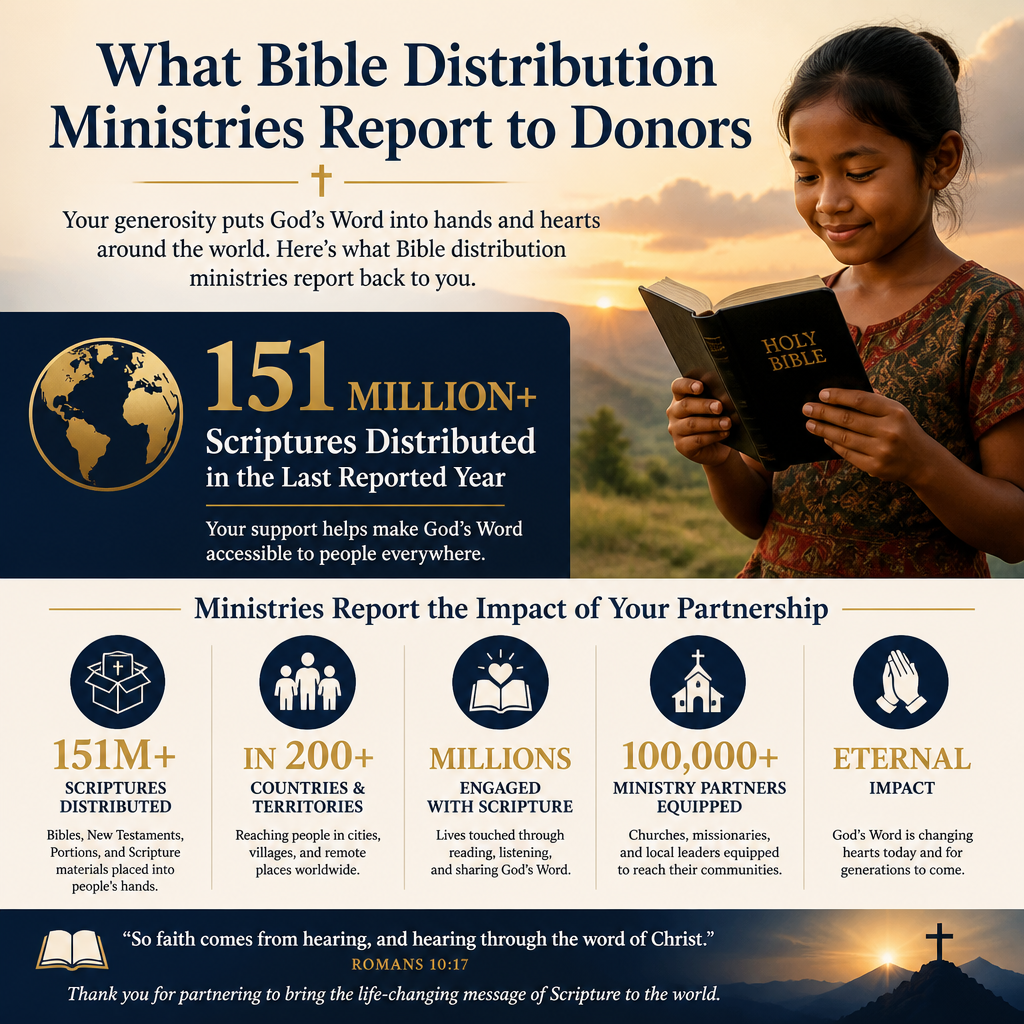
Donors commonly receive a number: Bibles printed, shipped, or distributed. The number matters, but only if it is defined. Credible ministries specify whether the figure represents units printed, units sent to partners, units placed with end recipients, or an estimate derived from partner reporting. They also distinguish between full Bibles, New Testaments, children’s Bibles, audio Bibles, braille Scripture, and Scripture portions, since these serve different purposes and costs.
When reporting includes shipping and fulfillment, donors should expect basic operational transparency: countries or regions served (sometimes at a level of generality for safety), distribution channels (church networks, schools, prisons, refugee settings), and the timelines and constraints that shaped delivery. Ministries with strong controls will also describe the chain of custody: who received the shipment, how receipt is documented, and what happens when a shipment is delayed, confiscated, or redirected.
Unit economics with integrity
Some ministries report “cost per Bible” or “cost per Scripture portion.” This can be useful, but it is easy to manipulate by excluding overhead, ignoring partner support, or collapsing fundamentally different contexts into one average. Donor reporting should clarify what is included in the cost figure: printing, translation, freight, warehousing, last-mile distribution, partner training, digital delivery, and security measures where required.
Wise donors also remember the caution raised by the “Overhead Myth” statement issued by GuideStar (now Candid), Charity Navigator, and the BBB Wise Giving Alliance: overhead ratios alone are a poor proxy for impact and can pressure nonprofits into underinvesting in the systems that protect results and integrity. See Candid for the statement and related context.
What this means in practice is that reporting should show both efficiency and adequacy: efficiency in procurement and distribution, and adequacy in governance, safeguarding, and monitoring. A Bible delivered cheaply but without credible controls may be a spiritual and financial loss.
What ministries should report about partners, access, and safeguarding
Partner selection and accountability
In most countries, Bible distribution is done through networks: denominations, church planters, local publishers, seminaries, prisons chaplaincies, and humanitarian partners. Donors should expect ministries to explain partner criteria and oversight. That includes due diligence on doctrinal alignment where relevant to the ministry’s mission, but also non-negotiables such as anti-corruption expectations, documentation standards, and safeguarding policies.
Partner reporting is not automatically unreliable, but it does require structure. Mature ministries describe how they collect partner data (distribution receipts, beneficiary sign-offs where appropriate, third-party confirmations, spot checks) and what they do when partner data conflicts with internal records. In higher-risk contexts, ministries may not be able to publish partner names; they can still describe categories of partners, accountability steps, and the controls that reduce the opportunity for diversion.
Security, risk, and the ethics of disclosure
Christian donors often want specificity: exact countries, named church networks, detailed testimonies. In restricted environments, that desire can collide with the duty to protect local believers. The field has had to reckon with the fact that donor transparency and operational security are sometimes in tension. Credible reporting names that tension rather than exploiting it as an excuse for vagueness.
Strong ministries will disclose their risk posture: how they classify sensitive locations, how they secure digital records, what training staff and partners receive, and what incident response looks like. When a ministry withholds details, donors deserve to know what can be shared safely and what documentation exists for independent verification. This is one reason donors often value third-party evaluation: it can increase confidence without increasing exposure.
What responsible ministries report about outcomes without overclaiming
From distribution to access and use
Counting units is not the same as documenting impact. The harder question is whether Scripture is actually accessible and used: placed in a language people read, distributed through trusted relationships, and accompanied by discipleship pathways where appropriate. Ministries that report responsibly will describe the theory of ministry: why distribution in a particular channel is expected to lead to Scripture engagement, and how that expectation is tested.
In some settings, outcomes can be assessed through follow-up surveys, Scripture engagement studies, or discipleship participation. In others, especially restricted regions, direct measurement may be limited. In those cases, responsible reporting will rely on a mix of evidence: documented placements, corroborated partner reports, and conservative language about spiritual fruit. The Psalms teach that God’s Word does not return void (Isaiah 55:11), but ministries are not licensed to treat that promise as permission for careless claims.
What donors should not be asked to accept
Donors should be cautious when reporting relies primarily on emotionally charged stories with no corroboration, or when it equates “Bibles distributed” with “people converted” as a standard formula. Conversions and spiritual renewal are real, and testimonies belong in the life of the church, but they are also easy to curate selectively. Credible reporting includes testimonies as illustrative rather than as the primary evidence base, and it clarifies how stories were obtained and vetted.
Christians genuinely disagree about what counts as legitimate outcome reporting in evangelism. Some prefer only logistical reporting to avoid instrumenting spiritual realities; others believe Scripture engagement and discipleship indicators should be measured wherever feasible. What sophisticated donors generally share is a desire for honesty: ministries should report what they know, how they know it, and what they do not know.
What donors can reasonably expect in a donor report
A short checklist of high-integrity reporting
Donors who support Bible distribution ministries can look for a consistent set of elements that signal mature accountability. A strong donor report typically includes:
- Clear definitions for what is being counted: printed, shipped, distributed, placed, or accessed digitally
- Geographic clarity at an appropriate level, with an explanation when details are withheld for security
- Partner accountability steps: selection criteria, documentation requirements, and oversight practices
- Financial transparency that connects revenue, expenses, and restricted funds to program activity
- Evidence discipline: sources for claims, conservative language, and a willingness to report setbacks
Where to go deeper as a donor
Donors who want a broader view of how Bible distribution fits within a ministry’s theology, operating model, and verification signals can situate individual reports within the wider landscape of Bible Distribution Ministries. That context helps donors compare claims across ministries without forcing every organization into the same reporting template.
For donors who want to evaluate the deeper accountability questions—governance, financial integrity, transparency, and appropriate evidence—our reporting expectations align with the concerns addressed in Accountability and Transparency in Bible Distribution Ministries. Ministries vary in maturity, but the basic responsibilities of truthful disclosure and disciplined stewardship do not change.
FAQs for What Bible distribution ministries report to donors
Should Bible distribution ministries report a cost per Bible?
It can be helpful if the ministry defines the metric carefully and does not use it as a substitute for broader accountability. Donors should ask what costs are included, how the ministry treats shared administrative expenses, and whether the figure distinguishes between materially different contexts such as domestic prison ministry, disaster relief distribution, and restricted-access regions.
How can donors evaluate impact when security prevents detailed reporting?
Donors can look for disciplined proxy evidence: documented shipments and receipts, clear partner accountability procedures, conservative claims about outcomes, and independent verification where feasible. Ministries serving sensitive contexts should be able to explain what documentation exists, how it is reviewed, and what safeguards prevent diversion, even if names and locations cannot be published publicly.
Reporting that strengthens trust and honors the mission
Bible distribution invites donors into work that is both holy and operationally demanding. When ministries report with precision, restraint, and verifiable evidence, they honor the church’s trust and strengthen the credibility of the mission itself. The goal is not to reduce Scripture to spreadsheets; it is to ensure that appeals made in God’s name are supported by truth, and that funds given in faith are stewarded with the seriousness Scripture requires.



