
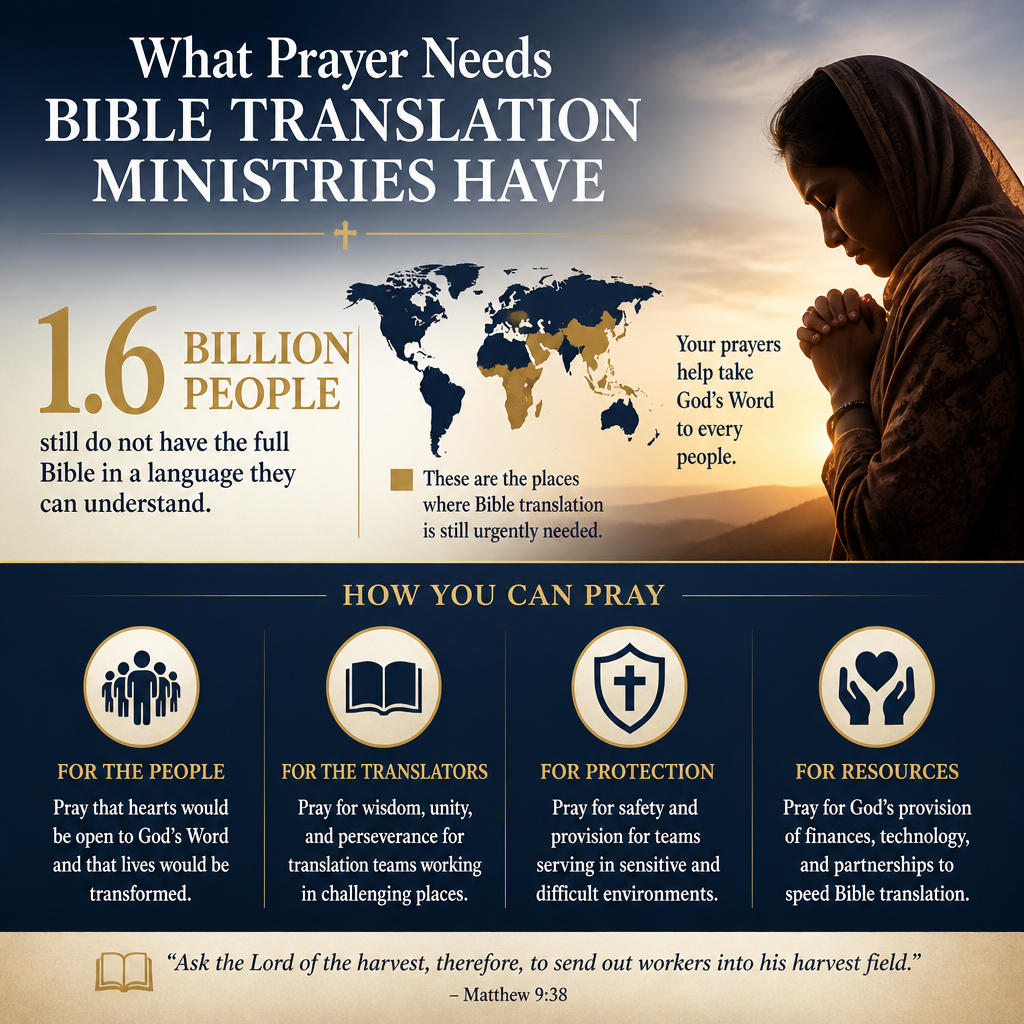
What prayer needs Bible translation ministries have is not a sentimental question. It is a stewardship question. Bible translation is among the longest-horizon, most complex forms of Great Commission work, and mature donors know that the cost is not only financial. The work presses on spiritual conflict, cross-cultural trust, and the slow disciplines of accuracy and accountability.
Scripture gives the frame. The risen Christ sends his church to teach the nations to observe all he has commanded (Matthew 28:19–20). That teaching requires comprehensible words, faithful meaning, and durable local ownership. Prayer is not an afterthought to the “real work.” It is the means by which God sustains faithfulness in workers, protects communities from harm, and turns translated words into living hearing.
Pray for spiritual resilience under sustained pressure
Bible translation ministries tend to operate at the intersection of language, culture, and contested spiritual ground. The pressure is rarely dramatic in public ways; it is often steady, private, and cumulative. The hazards include discouragement, isolation, conflict within teams, moral temptation, and fatigue from years of incremental progress.
Pray for workers to endure with integrity
Paul’s language about the “weapons of our warfare” and the need to “stand” (Ephesians 6:10–18) is not a metaphor for ordinary difficulty. It is a sober description of ministry that confronts darkness with truth. Translators and local partners may face overt hostility, but more often they face attrition: the gradual erosion of confidence that the work matters, that it will ever be finished, and that anyone will notice.
Pray for perseverance shaped by Scripture rather than personality. Pray for humility under critique, and courage to make unpopular decisions when accuracy and safety require them. Pray for leaders who refuse shortcuts that trade long-term credibility for short-term reporting.
Pray for families and quiet faithfulness
Many translation workers live with chronic displacement—geographic, cultural, and relational. Family systems absorb that weight. Children navigate identity tensions; spouses bear hidden loads of hospitality, language learning, and repeated goodbyes. The donor community can unintentionally intensify this by celebrating visible outputs while overlooking the ordinary faithfulness that sustains the work.
Pray that homes become places of stability rather than collateral damage. Pray for friendships deep enough to withstand distance, and for churches that pastor translation families as members rather than mascots.
Pray for local church ownership and wise partnerships
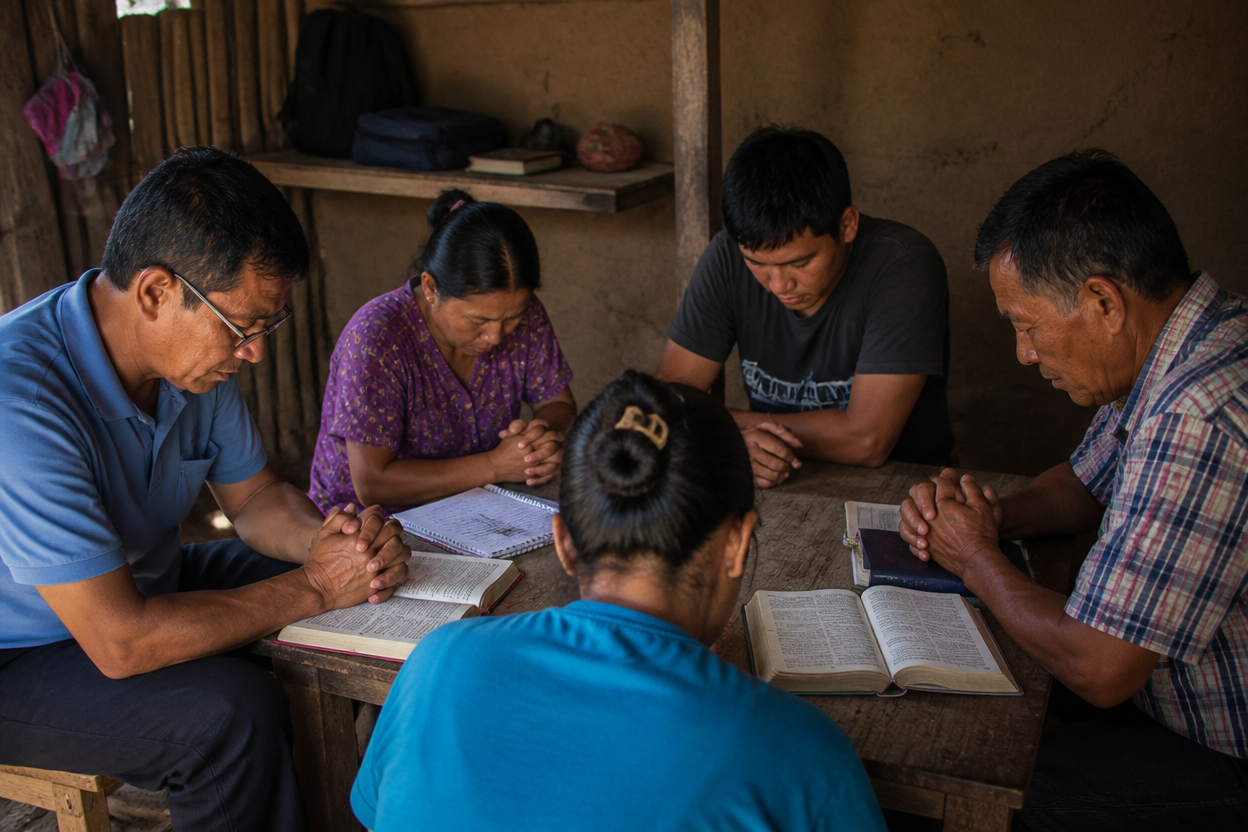
Translation that serves the church must be accountable to the church. At its best, Bible translation strengthens local leadership, equips preaching and discipleship, and dignifies languages often treated as invisible. At its worst, translation can become an imported product: linguistically impressive, socially disruptive, and ecclesially detached.
Pray for trust across cultures and institutions
Healthy partnerships require patience with difference. Western organizational habits—deadlines, deliverables, individual recognition—do not always map cleanly onto communal decision-making, honor dynamics, or security realities. Christians genuinely disagree about some of these judgments, including how quickly a translation should move, what level of consultation is sufficient, and who should make final decisions when disputes arise.
Pray for mutual submission shaped by Philippians 2:3–4: “in humility count others more significant than yourselves.” That does not mean surrendering standards. It means pursuing excellence without domination, and accountability without suspicion.
Pray for training that strengthens rather than replaces
The long-term question is not whether a project can be completed. The question is whether the local church will be strengthened to teach, correct, and disciple in that language for generations. That requires training, not only translation. It requires Scripture engagement, literacy where appropriate, and leadership development that does not create dependency.
Donors can pray specifically for local reviewers, pastors, and theologians to have time and courage to do careful work. When translation ministries honor those voices, the resulting text tends to be more accurate, more usable, and more trusted.
Pray for accuracy, clarity, and theological seriousness
The Bible is not a brand asset; it is God’s Word. That conviction raises the bar. Translation decisions carry doctrinal, pastoral, and ethical consequences. A phrase rendered imprecisely can mislead for decades. An overly technical translation can be admired and unused. An overly colloquial translation can lose theological depth.
Pray for fidelity in hard places of the text
Some translation decisions are spiritually and socially costly: terms for God, language around honor and shame, references to spirits and powers, and passages touching sexuality, violence, or ethnic hostility. These are not merely linguistic puzzles; they can invite opposition or create internal conflict.
Pray for teams to fear God more than reaction. Pray for courage to keep difficult texts difficult when Scripture intends to confront. Pray for gentleness and pastoral wisdom so that confrontation does not become needless offense.
Pray for reviewers and checks that catch avoidable error
High-quality translation relies on review loops: internal checking, community testing, consultant review, and theological input. Those processes cost time and money, and they can frustrate donors who understandably want visible progress. But review is part of love of neighbor. Poor translation can wound congregations and undermine trust in Scripture itself.
For donors who want a broader view of how this work fits within the wider ecosystem of ministries, we track and assess patterns across Bible Translation Ministries with attention to doctrinal clarity and operational credibility.
Pray for security, ethics, and the wise use of power
Bible translation often happens in contexts where public Christian activity is restricted, where minority language communities are politically vulnerable, or where data can be weaponized. The prayer needs here are both spiritual and practical. Security is not a lack of faith; it is a form of prudence.
Pray for protection without paranoia
Translation teams may manage sensitive information: names of local believers, location data, recordings, and community narratives. They must decide what to publish, what to obscure, and how to communicate with donors without exposing partners. Donors can help by honoring necessary discretion rather than demanding detail that increases risk.
Pray for leaders to make sober judgments under uncertainty. Pray for the restraint to avoid public storytelling that endangers local Christians. Pray for courage when the safest choice is also the most costly choice.
Pray for ethical community engagement
Language communities are not raw material for ministry success. They are neighbors. Ethical questions include consent, compensation for time, fair crediting of contributors, and the long-term implications of introducing written forms of a language. These decisions intersect with local politics and history.
One discipline donors can adopt is to pray through a small set of ethical guardrails and ask ministries to describe how they apply them. For example:
- Pray that local contributors are treated with dignity and fairly compensated where appropriate.
- Pray that consent is informed, ongoing, and not coerced by money or status.
- Pray that translation work strengthens local churches rather than bypassing them.
- Pray that leaders resist exaggerated impact claims that erode trust.
- Pray that ministries tell stories truthfully, even when the truth is slow progress.
Pray for financial integrity, transparent reporting, and truthful impact
Donors often ask for “efficiency,” but the more faithful question is whether a ministry is governed and managed in ways worthy of the gospel. Long projects with complex partnerships create genuine temptations: to over-promise timelines, to under-report obstacles, or to treat donors as an audience to be managed rather than partners to be respected.
Pray for governance that can say no
Translation ministries need boards and senior leaders who can hold the line on ethics, security, and theological integrity. That includes the ability to say no to funding that comes with unwise restrictions, and no to public communications that trade credibility for immediacy.
Across our verification work at Most Trusted, the ministries that meet The Most Trusted Standard tend to show the same pattern: they treat internal controls, independent oversight, and clear disclosures as part of Christian witness, not as secular bureaucracy.
Pray for honest measurement and patient donors
Impact in Bible translation is real, but it is not always easily captured by simplistic metrics. Completion dates slip for reasons that can be faithful: expanded community testing, improved checking, security disruptions, or leadership transitions that prevent harm. Donors can either reward truthfulness or punish it by withdrawing whenever plans change.
At the same time, donors have a legitimate right to clarity. Nonprofit reporting standards continue to mature, and Christian donors should expect audited financials, clear project accounting, and transparent descriptions of progress and setbacks. The IRS requires most nonprofits to make Form 990 available for public inspection, which provides one baseline of financial disclosure; see IRS guidance at irs.gov.
The broader nonprofit field has also challenged donors to avoid simplistic overhead assumptions. The “Overhead Myth” statement, signed by Charity Navigator, Candid (GuideStar), and the BBB Wise Giving Alliance, argues that administrative and fundraising ratios alone do not measure effectiveness; see charitynavigator.org. Translation work, with its training, review processes, and security needs, is a clear example of why mature analysis matters.
For donors who want to align prayer with wise partnership, we maintain editorial resources on Praying for and Partnering with Bible Translation Ministries that reflect the realities of both ministry and stewardship.
FAQs for What prayer needs Bible translation ministries have
Should we pray more for speed or for quality in Bible translation?
We should pray for faithfulness, which includes both urgency and care. Scripture commends zeal for God’s mission, but it also condemns careless handling of sacred things. In practice, praying for quality means praying for strong review processes, for humility under correction, and for the patience to do work that will shape churches for generations.
How can donors pray when ministries cannot share details for security reasons?
We can pray with specificity without demanding sensitive information. Pray for protection of local believers, for wisdom in communications, for unity within teams, and for the credibility to tell the truth about delays and setbacks. Donors can also ask ministries to describe their security posture in general terms—how decisions are made and who has oversight—without requesting names, locations, or identifiable stories.
Prayer that matches the weight of the work
What prayer needs Bible translation ministries have is ultimately the need every gospel work has: that God would keep his servants faithful, protect his church, and cause his Word to run and be honored. Mature donors can pray with open eyes—naming ethical tensions, governance requirements, and the slow disciplines of accuracy—because Christian realism is not cynicism. It is confidence that God uses ordinary obedience, sustained over time, to build a church that endures.



