
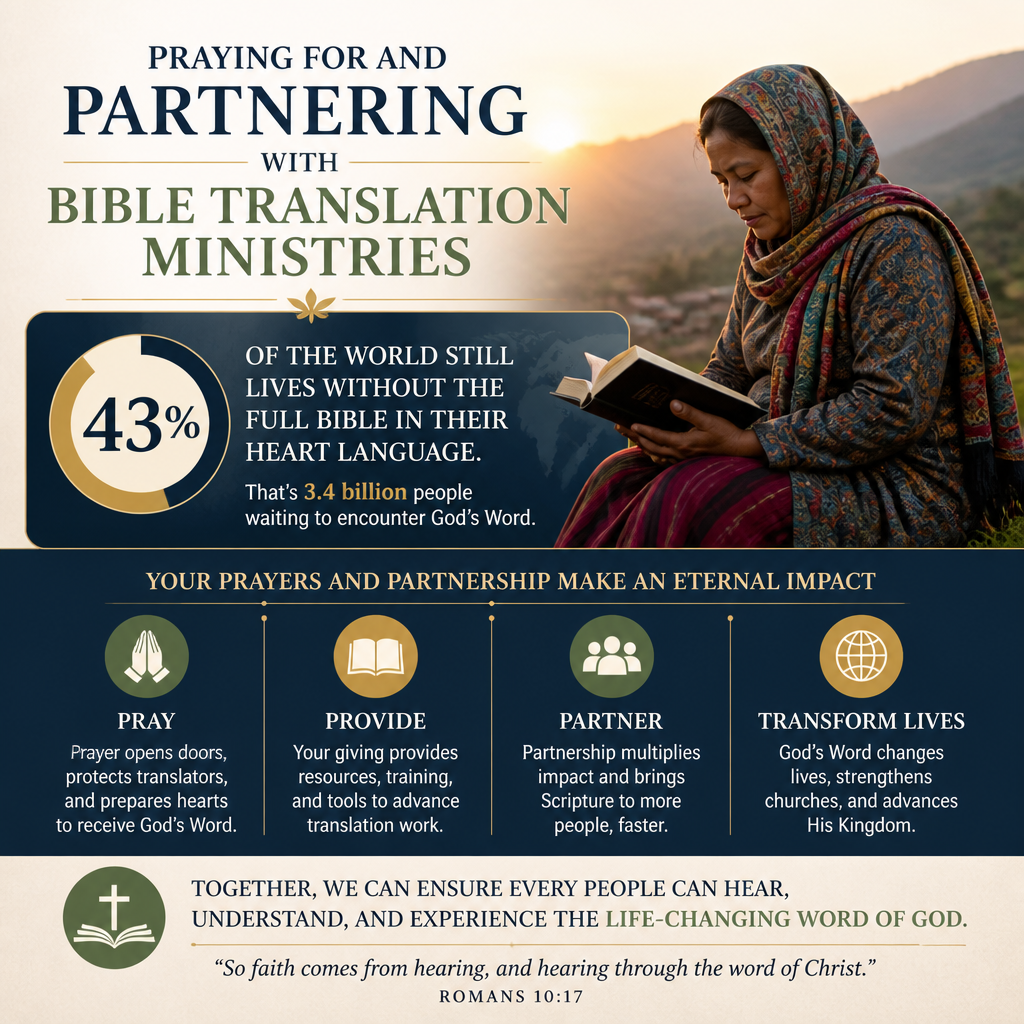
Praying for and partnering with Bible translation ministries is not philanthropic ornamentation. It is an act of obedience to the God who speaks, who binds himself to his Word, and who sends his church to make disciples of all nations. Christian donors often feel the weight of competing needs: urgent relief, local church commitments, and long-horizon translation work that can take years to bear visible fruit. The question is not whether Bible translation matters, but what faithful partnership looks like when the work is complex, costly, and spiritually contested.
Scripture places God’s self-revelation at the center of covenant life. Moses commanded Israel to keep God’s words “on your heart” and teach them diligently (Deuteronomy 6:6–7). Nehemiah’s renewal was marked by public reading and explanation of the Word (Nehemiah 8). The early church devoted itself to “the apostles’ teaching” (Acts 2:42). Bible translation ministries serve this long pattern: the people of God gathered around intelligible Scripture, not as a luxury but as ordinary spiritual sustenance.
Why prayer belongs at the center of Bible translation partnership
Bible translation is technical work, but it is never merely technical work. It sits at the intersection of linguistics, community trust, ecclesial formation, and spiritual opposition. Donors who treat translation as a simple production pipeline often become impatient when timelines extend or when milestones do not look like the metrics used in other nonprofit sectors. Prayer corrects our posture: it acknowledges that God opens hearts, sustains workers, and protects communities in ways no budget line can guarantee.
Pray for the slow work of faithfulness
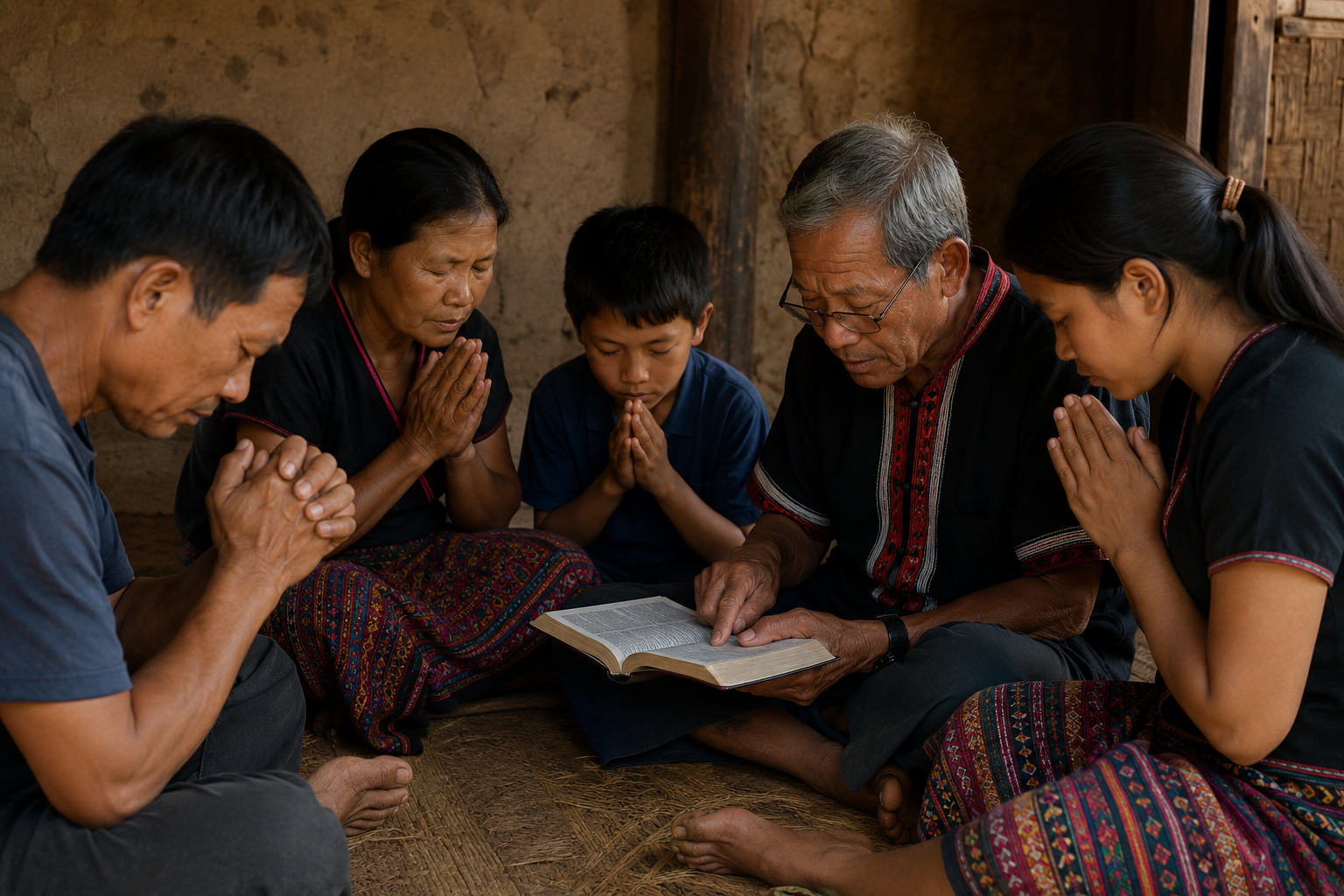
Translation teams face a steady accumulation of decisions: which dialect to prioritize, how to represent key theological terms, how to handle contested passages, and how to maintain consistency over years of drafts and reviews. The work can be vulnerable to discouragement, especially when progress is incremental. Donors can pray for perseverance that is shaped less by urgency and more by endurance. James frames steadfastness as God’s formative instrument, producing maturity rather than mere output (James 1:2–4).
Pray for local churches to own the Scriptures
Even a faithful translation can fail to nourish if it does not land within the life of the local church. Scripture is received in communities: read aloud, preached, sung, memorized, and used in pastoral care. Donors can pray that translated portions do not circulate as isolated booklets, but become the church’s shared vocabulary for worship and discipleship. This is where many translation initiatives place serious emphasis today: Scripture engagement, literacy, and church-based distribution that strengthens indigenous leadership rather than replacing it.
Pray for integrity in spiritual and organizational leadership
Because translation work often involves cross-cultural money flows and access to vulnerable communities, the moral burden on leadership is high. Pray for humility, transparent decision-making, and a refusal to manipulate outcomes for donor approval. Scripture’s warnings about leaders who “peddle the word of God for profit” (2 Corinthians 2:17) are not theoretical. Donors should want ministries that fear God more than they fear fundraising volatility.
What partnership looks like beyond writing a check
Most Christian donors are capable of more than episodic giving. Mature partnership includes sustained funding, informed expectations, and intercessory accountability. It also includes the willingness to support “unseen” capacities: governance, member care, security protocols, and data discipline. This can feel less spiritually vivid than sponsoring a translation milestone, yet it is often what keeps the work stable over a decade.
Commit to long-horizon funding with clear expectations
Translation projects can be derailed by short-term funding patterns. Ministries that rely on annual volatility may be forced into staffing disruptions or compressed timelines that increase quality risk. Donors can serve the work by making multi-year commitments tied to defined outcomes and transparent reporting. The aim is not to impose corporate control, but to align resourcing with the actual cadence of translation, review, and community testing.
Strengthen the sending structures
Churches and donors can partner by resourcing the support ecosystem around translators: pastoral care, counseling access, healthy rhythms of leave, and crisis response. Cross-cultural workers burn out, marriages strain, children carry the cost of mobility, and team conflict can quietly cripple productivity. Donors should not treat member care as overhead to be minimized. It is a stewardship investment that protects people made in God’s image and stabilizes ministry continuity.
Build disciplined learning into your partnership
Translation ministry has its own debates: the appropriate use of tools and AI, the relationship between oral translation and written forms, and questions about the best sequencing of literacy versus Scripture portions. Christians genuinely disagree about some of these strategies. Donors do not need to become linguists, but we should ask for thoughtful rationale, theological guardrails, and evidence of consultation with local church leaders. Credible ministries can explain their approach without contempt for alternative methods.
What this means in practice is that donors should evaluate ministries as institutions, not only as causes. Most Trusted exists to help donors give with confidence by examining ministries against The Most Trusted Standard, a 15-criteria framework across Faith Foundation, Financial Integrity, Governance and Leadership, and Transparency and Effectiveness. For donors seeking broader context on the landscape of Bible Translation Ministries, the central question is not “Which project moves us emotionally?” but “Which organizations demonstrate spiritual integrity and verifiable stewardship over time?”
How to assess Bible translation ministries with theological and fiduciary seriousness
Donors can approach translation work with the same spiritual sobriety they bring to preaching and discipleship, and the same fiduciary discipline they bring to other major stewardship decisions. Good intentions do not substitute for governance. Passion for Scripture does not cancel the need for accurate reporting. Both matter because the work bears God’s name and uses God’s people’s resources.
Faithfulness is more than doctrinal statements
A clear confession of faith and a high view of Scripture are baseline commitments in this field, not differentiators. Donors should also look for a lived ecclesiology: meaningful connection to local churches, respect for pastoral authority, and an approach to language communities that resists paternalism. Translation that sidelines the church may distribute texts without forming disciples. The New Testament pattern is not merely text dissemination but teaching, appointing elders, and building durable communities (Titus 1:5).
Financial integrity and transparency should be legible
Translation work often involves restricted gifts, multi-country transfers, and security concerns that can complicate disclosure. Complexity does not excuse opacity. Donors should expect timely financial statements, clear allocation practices, and credible audits where applicable. Many responsible nonprofits in the United States file Form 990s, which are publicly accessible through the IRS Tax Exempt Organization Search. Where security requires discretion, ministries can still explain categories of spending, controls against fraud, and board oversight in ways that are informative without endangering workers.
Impact claims should be specific and theologically coherent
Counting “languages reached” or “portions completed” can be useful, but those metrics can tempt ministries to prioritize speed over accuracy or adoption. Donors should ask for evidence of usage: partnerships with churches, Scripture engagement strategy, and realistic accounts of literacy constraints. The harder question is whether the ministry can articulate impact in ways that match Scripture’s own aims: understanding, obedience, worship, and church maturity. Donors can also watch for ministries that treat translation as the finish line rather than the beginning of long-term discipleship and theological formation.
Visiting projects, sponsoring teams, and forming donor groups with wisdom
Many donors feel drawn to visit a project or sponsor a translation team, and these can be meaningful forms of partnership when approached with restraint. The field has had to reckon with the unintended harm that can come from well-meant outside involvement: security exposure, cultural disruption, or shifting local decision-making toward donor expectations. A visit can serve the work, but only if the ministry wants it, the local church is honored, and the risk is responsibly managed.
When visits serve the work and when they do not
Visits tend to be most helpful when they are requested by the ministry for specific purposes: board governance, professional expertise, or carefully planned encouragement that does not disrupt workflows. They tend to be least helpful when donors arrive primarily to “see results,” create content, or introduce new priorities. Security and confidentiality should be treated as moral obligations, not inconveniences. If a ministry operates in restricted contexts, donors should expect limited access and should regard those limits as evidence of prudence rather than evasiveness.
What sponsorship should and should not mean
Sponsoring a translation team can be a faithful way to fund stable staffing and long-term presence. It can also become problematic if sponsorship language implies ownership, control of messaging, or a transactional expectation of frequent “deliverables.” The healthiest sponsorship arrangements define: the scope of support, the reporting cadence, the ministry’s authority to make technical decisions, and the donor’s role as a steward who asks disciplined questions without attempting to manage the work. Donors can also encourage ministries to avoid funding structures that pressure teams to overpromise timelines.
How to start a giving group without becoming a shadow board
Donor groups can do real good: they stabilize funding, broaden prayer, and create shared learning. They can also drift into informal governance, steering strategy without accountability. A wise giving group keeps boundaries clear. It agrees on theological aims, commits to ongoing prayer, adopts a due diligence process, and submits to the ministry’s board and executive leadership rather than competing with them. Where possible, donors should prefer organizations with boards that demonstrate independent oversight, documented policies, and transparent conflict-of-interest practices.
Faithful partnership that honors the Word and the church
Praying for and partnering with Bible translation ministries asks Christian donors to hold two commitments together: spiritual dependence and practical accountability. Prayer keeps our partnership rooted in the conviction that God gives the growth. Verification, governance, and transparency keep our giving anchored in stewardship that does not confuse sincerity with trustworthiness.
The ministries most worthy of long-term partnership tend to combine theological clarity with institutional maturity: they honor the church, tell the truth about risk and trade-offs, and report in ways donors can evaluate. When donors join that kind of work with steady prayer and disciplined generosity, we participate in a quiet but enduring mercy: making God’s Word understandable, usable, and treasured among peoples and places where it has too often been absent.



