
What post-prison reentry ministry includes is often misunderstood by well-intentioned donors. Many assume reentry begins after release and consists primarily of a job lead, a church welcome, and a few months of spiritual encouragement. In practice, reentry is a multi-year process that touches housing, work, family repair, addiction recovery, mental health, congregational belonging, and, often, ongoing legal obligations—while a returning citizen tries to live faithfully and steadily under real pressure.
Scripture does not treat people in prison as a separate moral category beyond the reach of ordinary Christian love. Jesus names prison ministry among the decisive works of mercy in Matthew 25, and Hebrews commands, “Remember those who are in prison, as though in prison with them” (Hebrews 13:3). Post-prison reentry support is not a departure from gospel proclamation; it is one of the places where proclamation must become credible through presence, truth-telling, and disciplined care.
Reentry is a long obedience after a hard interruption
Release day is not the finish line
A person may leave prison with a trash bag of belongings, a bus ticket, and a list of restrictions that shape daily life. The challenges are not only “social”; they are structural and relational. Many return to communities where housing is scarce, transportation is limited, wages are low, and family systems have adapted to years of absence. A serious ministry plans for the reality that the first 72 hours matter, but the first 72 weeks often matter more.
Why donors should resist simplistic outcomes
Christian donors are right to ask what fruit looks like. The tension is that reentry is rarely linear. “Success” may include months of stability followed by relapse, a brief re-incarceration for a technical violation, or a job loss that triggers old patterns. The ministries most worthy of trust do not romanticize transformation or manipulate testimony. They tell the truth about setbacks while insisting that perseverance, accountability, and grace remain meaningful Christian categories.
Verifiable evidence suggests the need for sustained support. The U.S. Department of Justice’s Bureau of Justice Statistics reported that a large share of released prisoners were arrested again within years of release, underscoring how common cycling back into the system can be without durable stabilizers (Bureau of Justice Statistics). Thoughtful reentry ministry is built for that long horizon.

Core components that credible reentry ministries typically provide
Spiritual formation that withstands ordinary pressures
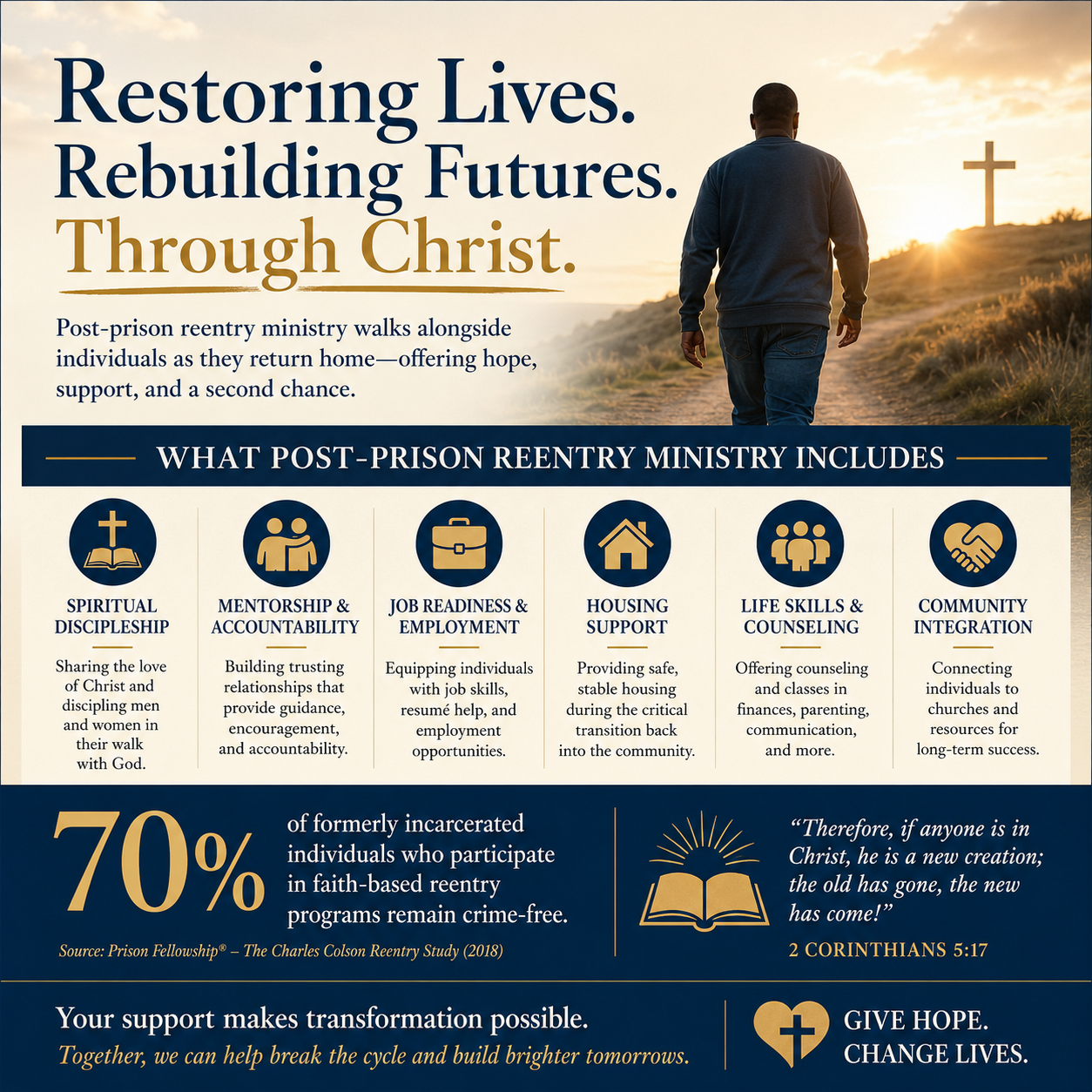
Post-prison discipleship is not a continuation of prison chapel with different scenery. It must be rooted in local church life, Scripture, and practices that can survive fatigue, temptation, and discouragement. Many returning citizens have experienced faith in intensely structured environments. Reentry ministry helps them translate that faith into unstructured daily decisions: paying bills, keeping appointments, resisting old networks, and learning to confess sin early rather than after collapse.
Stabilization supports that make discipleship plausible
Ministries vary in scope, but credible reentry work usually addresses basic destabilizers. The goal is not to replace personal responsibility; it is to remove predictable points of failure where a small crisis becomes a moral and legal catastrophe. In many communities, that means building partnerships with landlords, employers, recovery programs, and counseling providers, and knowing how to navigate supervision requirements.
- Housing pathways that are realistic about background checks and affordability
- Employment coaching tied to actual hiring relationships and skill-building
- Transportation solutions that keep work and supervision appointments feasible
- Recovery and mental health referrals with ongoing pastoral involvement
- Mentoring that combines warmth with clear boundaries and expectations
What this means for donors is that reentry ministry often looks “ordinary” from a distance. It is paperwork, rides, accountability texts, court reminders, budgeting help, and patient conversations with family members who do not feel safe yet. It is also prayer, worship, and the slow restoration of trust.
Mentoring and community are not optional add-ons
Relational poverty is real, and it is spiritually dangerous
Many returning citizens do not only lack money. They lack trustworthy relationships that can absorb stress without collapsing into control or abandonment. Christian mentoring at its best is neither saviorism nor surveillance. It is presence ordered by truth: someone who will show up, name reality, and keep calling a brother or sister toward repentance and hope.
Congregational integration requires preparation on both sides
Churches often want to “welcome returning citizens,” but few have thought through what welcome entails when trauma, addiction, and criminal history are involved. Wise reentry ministries help churches set appropriate expectations, establish safeguarding practices, and avoid naïve promises. The goal is not to lower moral standards; it is to apply them with pastoral clarity, recognizing that sanctification often occurs through supported responsibility, not through isolation.
Christians genuinely disagree about where the primary responsibility lies: the individual, the church, or public systems. A mature posture acknowledges that reentry requires all three. Government supervision sets constraints; employers and landlords shape real opportunity; churches and ministries provide moral formation, community, and practical help. Donors can strengthen the church’s role without pretending it is the only factor.
Family restoration and trauma care are central, not peripheral
Reentry includes repairing what incarceration disrupted
Incarceration often fractures marriages, parenting, and extended family ties. Reentry ministry includes helping a returning father or mother move from shame-driven promises to steady presence: showing up for children, honoring co-parents, and rebuilding credibility through time. Some relationships should be pursued cautiously or not at all when abuse is present. Ministries that take Scripture seriously will also take protection seriously.
Trauma-informed does not mean permissive
Many returning citizens carry trauma histories that predate incarceration: childhood abuse, community violence, addiction exposure, and chronic instability. Trauma-informed care recognizes how fear and hypervigilance shape decision-making, but it does not excuse harm. It clarifies the work: naming patterns, building emotional regulation, and establishing accountability structures that reduce risk to families and communities.
Donors should also recognize a practical implication: trauma-aware ministry usually requires trained staff, referral networks, and careful supervision of volunteers. It is not glamorous, and it is not cheap, but it is often the difference between short-term enthusiasm and durable restoration.
What strong ministries prove to donors through governance and transparency
Reentry work requires trust, and trust must be verified
Because reentry ministry deals with vulnerable people, sensitive information, and sometimes public funds or corrections partnerships, donors should expect a higher standard of governance and clarity. Good intentions are not a control environment. The most trustworthy organizations can show how decisions are made, how money is handled, how leaders are held accountable, and how participants are protected from manipulation or favoritism.
How Most Trusted evaluates reentry ministries
At Most Trusted, our verification work is designed to help Christian donors give with confidence, especially in complex fields where outcomes can be hard to measure cleanly. We evaluate ministries against The Most Trusted Standard, a 15-criteria framework covering faith foundation, financial integrity, governance and leadership, and transparency and effectiveness. In reentry, we pay particular attention to safeguarding practices, the clarity of program claims, the use of evidence-informed approaches, and whether the ministry’s theology supports both mercy and moral accountability.
Across our verification work, we observe that the ministries most likely to bear lasting fruit tend to do a few things consistently: they define their target population precisely, avoid inflated success rates, partner rather than duplicate, and maintain disciplined boundaries for staff and volunteers. They also resist the temptation to treat “overhead” as a moral failure. The sector has had to reckon with the “Overhead Myth” critique advanced by major nonprofit evaluators, which argues that administrative and fundraising ratios are poor proxies for impact (Candid GuideStar). In reentry, underinvestment in qualified staff and systems can become an ethical problem, not a virtue.
Donors who want broader context for the field can follow our coverage of Prison and Post-Prison Ministries, where we examine how Christian organizations engage incarceration, reentry, and local church partnership with due seriousness.
FAQs for What post-prison reentry ministry includes
What is the difference between prison ministry and post-prison reentry ministry?
Prison ministry focuses on discipleship, pastoral care, and evangelism inside correctional facilities, often within strict institutional constraints. Post-prison reentry ministry begins before release and extends into the community, addressing the social, legal, and relational realities that can destabilize a returning citizen. The two belong together, but they require different partnerships, safeguards, and measures of progress.
What should Christian donors look for before funding a reentry ministry?
Donors should look for theological clarity, disciplined governance, and honest reporting. Practically, that includes clear safeguarding policies, defined programs rather than vague promises, financial statements that can be understood, and leadership accountability that is more than informal trust. Within Post-Prison Reentry Support for Returning Citizens, we encourage donors to fund ministries that demonstrate steady partnerships with churches and community services and that can explain how they handle setbacks without distorting outcomes.
The work donors are actually funding
What post-prison reentry ministry includes is not merely a second chance offered at a distance. It is costly proximity, patient instruction, and structured support aimed at durable faithfulness. Christian donors who fund this work are investing in men and women made in God’s image, in families that need repair, and in churches learning to practice mercy with wisdom. The most credible ministries do not promise quick transformation; they commit to truthful love that holds long enough for real change to take root.



