
How post-prison ministry supports job readiness is not a secondary question for Christian donors; it is one of the clearest tests of whether reentry care is moving beyond crisis response toward durable restoration. A returning citizen may leave prison with genuine spiritual resolve, and yet still face barriers that make stable work difficult: documentation gaps, broken work history, legal restrictions, untreated trauma, strained relationships, and a labor market that often treats a record as a permanent disqualification.
Scripture does not allow the church to separate mercy from material reality. When Jesus identifies visiting those in prison as a mark of fidelity (Matthew 25:36), he is not commending sentiment. He is commending embodied love that meets real needs. In reentry, work is not a mere economic outcome; it is frequently the hinge on which housing, family stability, child support, and sobriety turn. Ministry that ignores job readiness often leaves men and women vulnerable to the same pressures that contributed to incarceration.
Job readiness begins before the first interview
Employment programs often focus on resumes and interviews because those are measurable. But most returning citizens are not first constrained by technique; they are constrained by readiness. This includes practical readiness—ID, transportation, clothing, internet access—and human readiness: emotional regulation, conflict skills, punctuality, and the ability to receive correction without escalation. Employers regularly describe these “soft skills” as the decisive factor for retention, even when a candidate has limited formal credentials.
The human cost of unemployment is not abstract
Work stabilizes life rhythms and offers lawful income, but it also confers dignity and social belonging. The absence of work, by contrast, is associated with higher rates of distress, instability, and relapse into survival strategies. The U.S. Bureau of Justice Statistics has long documented the scale of rearrest after release, underscoring why reentry supports that strengthen stability matter beyond the first weeks home. For a baseline view of national recidivism measures, see the Bureau of Justice Statistics site at https://bjs.ojp.gov/.
Theological formation and practical formation belong together
Christian ministry sometimes treats “discipleship” and “workforce development” as separate lanes. In Scripture, they are entwined. Paul’s instruction that believers should “work with your hands” so they may “not be dependent on anybody” and can “win the respect of outsiders” (1 Thessalonians 4:11–12) is not a prosperity slogan; it is a pastoral strategy for integrity, witness, and stability. For men and women reentering society, that counsel must be translated into concrete preparation, not merely affirmed in principle.

What faithful post-prison job readiness ministries actually do
Serious reentry ministries do more than arrange a job lead. They provide a scaffold that holds a person steady through the predictable points of failure: the first conflict with a supervisor, the first paycheck that triggers old spending patterns, the first background-check rejection, the first family emergency that threatens attendance. The ministries doing this well treat employment as a process, not an event.
Stability inputs that employers rarely see
Across our verification work at Most Trusted, we observe that the most effective post-prison ministries address several inputs simultaneously. When a program only addresses employment, a returning citizen may still lose work because of unstable housing, untreated addiction, or a parole requirement that conflicts with shift schedules. The more mature programs coordinate with parole, treatment providers, and employers in ways that reduce avoidable friction.
- Documentation and compliance: state ID, Social Security card, selective service issues, court fees, parole check-ins
- Daily discipline: punctuality, communication norms, managing fatigue and triggers
- Relational repair: learning to show up reliably for family, church, and work teams
- Financial formation: budgeting, handling first wages without spiraling into debt or impulsive spending
- Workplace conflict skills: responding to correction, de-escalation, and repairing mistakes
Job placement without retention is a weak outcome
Donors are sometimes presented with placement numbers as the primary measure of success. Placement matters, but retention and advancement are often better indicators of durable change. The field has had to reckon with how easily a job can be “counted” and how difficult it is to accompany someone through the first 90 days, when the pressure is highest and the old life is close at hand. Ministries that report outcomes responsibly will distinguish between placement, retention, and wage progression, and they will define their measures plainly.
How post-prison ministry reduces the barriers employers cite
Employers are not a monolith. Some are committed to second-chance hiring; others are cautious; some are restricted by insurance, licensing, or customer requirements. A ministry that supports job readiness must understand this ecosystem honestly rather than moralizing it. Returning citizens need advocates who can tell the truth about barriers and still move toward opportunity.
Addressing criminal records with truth and skill
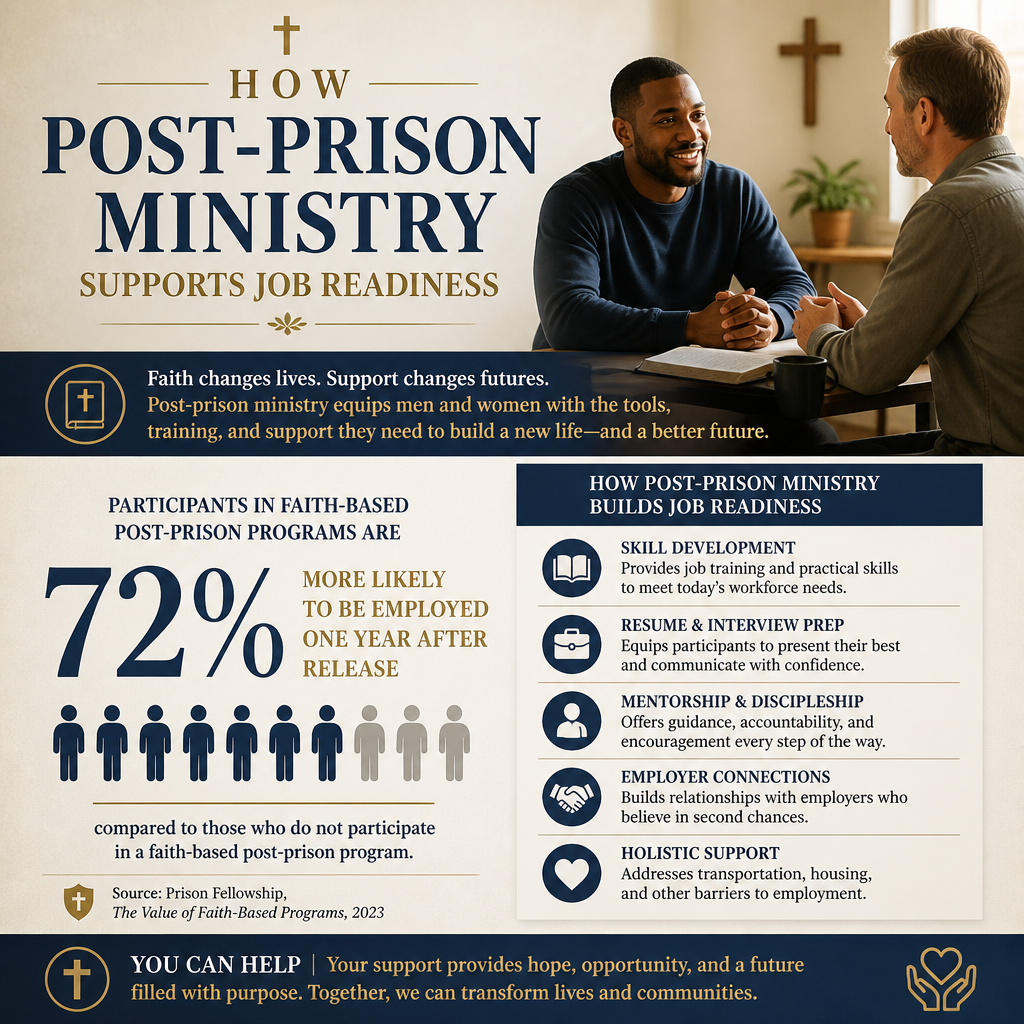
Many returning citizens lose opportunities not only because of a record, but because they do not know how to disclose it clearly, take responsibility without self-sabotage, and present a credible plan for reliability. Good programs teach disclosure statements, practice interviews with realistic employer questions, and coach participants to avoid either minimization or despair. This is not spin. It is disciplined truth-telling that aligns with Christian repentance: naming sin and harm without claiming that one’s future is determined by one’s worst day.
Second-chance hiring is growing, but it remains uneven
Nationally, a significant share of the adult population has some form of criminal record, which means employers and communities cannot treat reentry as a fringe concern. For background on the breadth of criminal record exposure in the United States, see the National Institute of Justice at https://nij.ojp.gov/. The practical implication is that job readiness ministries should cultivate employer partnerships in sectors where advancement is plausible, not only where hiring is easiest. It is also why donors should ask whether a ministry’s employment strategy is built on a few fragile relationships or on a diversified network that can withstand turnover and policy shifts.
Christians genuinely disagree about how much emphasis ministries should place on systemic reform versus direct service. What is difficult to dispute is that returning citizens often face both personal responsibility challenges and structural constraints. Wise ministries and wise donors resist the false choice. We can insist on accountability and also address barriers that predict failure.
What donor due diligence should prioritize in reentry workforce programs
Reentry work attracts strong stories and urgent appeals, and it should. But donors who want long-term fruit must look for ministries that can be trusted with complex money and complex lives. This is where independent verification matters: it helps donors distinguish between compassionate intent and operational maturity.
Questions that reveal program integrity
When evaluating post-prison job readiness work, we recommend focusing on evidence of faithful presence and competent administration. The ministries that meet The Most Trusted Standard tend to be clear about what they do, what they do not do, and how they measure change over time. They do not hide behind vague “transformation” language, and they do not treat people as numbers in a fundraising funnel.
Here are due-diligence questions sophisticated donors can ask without drifting into cynicism:
- Participant pathway: What is the step-by-step process from intake to employment to retention support?
- Employer partnerships: Are employers engaged in program design, or only in last-minute hiring asks?
- Risk management: How are relapse, housing loss, and parole violations handled without abandoning the person?
- Outcome definitions: How does the ministry define “job readiness,” “placement,” and “retention”?
- Church integration: Is the participant connected to a local congregation for long-term belonging?
Why transparency is a form of respect
Returning citizens are not served by ministries that exaggerate success or hide hard cases. Donors are not served by reporting that treats every participant as an uncomplicated victory. Effective reentry work is slow and often nonlinear; relapse and job loss happen even with faithful support. Transparent ministries report challenges alongside outcomes, explain what they are learning, and show how their governance and finances support the work rather than distract from it. Most Trusted exists to help donors give with confidence in that kind of integrity, by evaluating ministries against The Most Trusted Standard across faith commitments, financial stewardship, leadership, and candor about results.
For donors who want the broader context of incarceration-focused Christian work, our coverage of Prison and Post-Prison Ministries situates reentry employment support within the wider mandate of mercy and discipleship.
How donors can fund job readiness without weakening discipleship
Some donors fear that workforce programs can become secularized—competent at employment outcomes but thin in spiritual formation. That concern deserves respect. Christian reentry work is not a substitute for the gospel. It is an implication of the gospel, applied to the realities of work, money, temptation, and community.
Funding that strengthens the whole person
Healthy ministries avoid two extremes: a purely transactional jobs program with Bible verses attached, and a purely devotional program that treats employment as someone else’s problem. The best expressions integrate pastoral care, peer community, and practical training so that growth in Christ is visible in the habits that sustain work: truthfulness, perseverance, humility under authority, and concern for others.
Respecting the dignity of work without making it a savior
Work can be an arena of sanctification, but it is not ultimate. Donors can inadvertently pressure ministries to treat employment as the sole proof of success, which can lead to rushed placements or the quiet exclusion of participants who are harder to place. Funding structures that allow time for readiness—stabilizing housing, addressing addiction, repairing family relationships—often serve employment outcomes better in the long run. The question is not whether a ministry “believes in work,” but whether it has the patience and competence to shepherd people toward sustainable work.
Donors interested specifically in reentry services after release will also benefit from our coverage of Post-Prison Reentry Support for Returning Citizens, where job readiness sits alongside housing, mentoring, and community reintegration.
FAQs for How post-prison ministry supports job readiness
What makes job readiness ministry distinct from a secular workforce program?
Christian job readiness ministry treats work as part of moral and spiritual formation, not only income generation. It addresses character under pressure, reconciliation, and belonging in the body of Christ, while still respecting professional standards and employer expectations. The difference is not that Christian programs avoid practical training; it is that they locate practical training within discipleship and truthful accountability.
What outcomes should donors reasonably expect from post-prison job readiness programs?
Reasonable outcomes include documented participant engagement, job placements with clear definitions, retention support, and evidence of improved stability such as consistent attendance, reduced crises, and strengthened community ties. Because reentry paths are often nonlinear, responsible ministries will report both successes and setbacks, explain what they are learning, and avoid promising outcomes they cannot control.
A faithful vision of work for those coming home
Post-prison ministry supports job readiness when it treats employment as a concrete expression of restoration—anchored in truth, sustained by community, and strengthened by practical competence. For Christian donors, the aim is not simply to fund jobs, but to fund ministries that help returning citizens become stable neighbors, dependable coworkers, and formed disciples. That requires compassion with standards, patience with accountability, and giving guided by credible evidence.



