
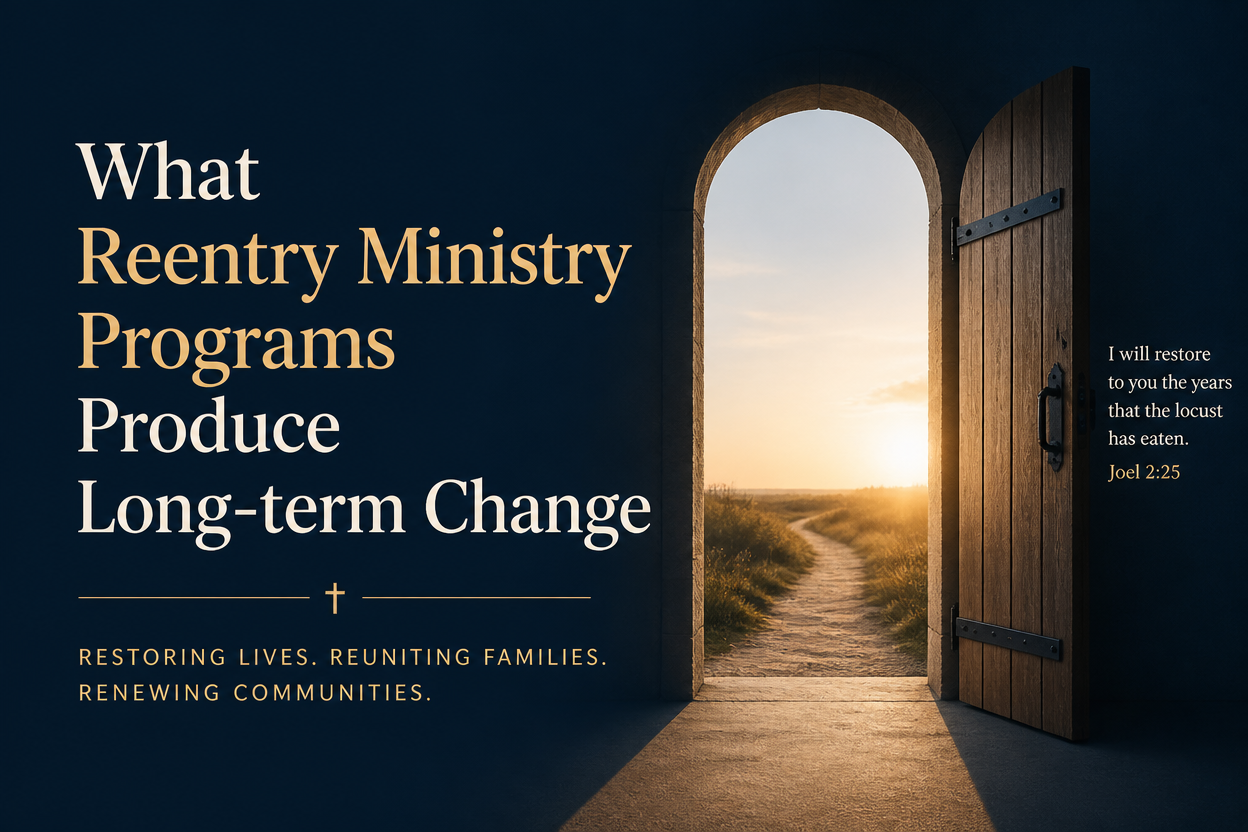
Donors asking what reentry ministry programs produce long-term change are asking a serious question about sanctification, justice, and stewardship. A man or woman coming home from prison is not only navigating housing, work, and supervision; they are also re-entering relationships, temptations, and pressures that often predate incarceration by decades.
Christian donors sometimes feel caught between two unsatisfying options: fund short-term relief that is easy to measure, or fund deep discipleship that is harder to quantify. Scripture refuses that false choice. The mercy Jesus commends in Matthew 25 is concrete, but it is never merely transactional; it is aimed at restoration, dignity, and perseverance.
Long-term change begins with a credible view of reentry
Reentry is a multi-year transition, not a one-time event
Reentry is a long arc. It is shaped by criminal records, debt, family systems, addiction histories, trauma, and the daily discipline of showing up. The data are sobering even before we discuss spiritual formation: people released from prison face elevated risks of homelessness, unemployment, relapse, and technical violations. Many programs fail not because the gospel is insufficient, but because a ministry treats reentry as a short onramp rather than a multi-year rebuilding process.
Christian donors also need to understand the public-safety context without fear or denial. The U.S. Department of Justice’s Bureau of Justice Statistics tracked state prisoners released in 2005 and found that a large share were arrested again within nine years, underscoring the scale of the challenge that communities and ministries are facing Bureau of Justice Statistics.
The ministry goal is not merely lower recidivism
Reduced reoffending matters. It is a neighbor-love outcome with direct implications for victims, families, and communities. But the church’s horizon is larger: reconciliation with God, repair where possible, truth-telling, stability, and faithful presence in a local congregation. Mature reentry ministry holds both realities together. It is possible to demand verifiable outcomes without narrowing the mission to whatever a state dashboard happens to track.

Programs that change trajectories pair discipleship with practical stability
Discipleship that is embodied, not merely instructional
Programs that produce durable change tend to treat discipleship as embodied apprenticeship. Bible study matters; so do accountable relationships, rhythms of work, and moral formation under pressure. When a returning citizen must decide whether to disclose a record to an employer, how to respond to a humiliating rejection, or whether to reconnect with a destructive peer group, the ministry’s formation model is being tested.
Christian donors can ask a clarifying question that many programs avoid: who is responsible for shepherding this person when motivation collapses? Long-term change is often less about inspirational content and more about durable pastoral oversight, credible mentoring, and a church community that can sustain the slow work of repentance and rebuilding.
Stability supports are not a distraction from the gospel
Housing, employment, transportation, and ID recovery are sometimes treated as “secular add-ons.” In practice, these are frequently the difference between a person keeping a job and returning to survival economics. Ministries that integrate practical stability with spiritual formation tend to be more realistic about temptation, desperation, and the fragility of early reentry.
Many donors have seen “help” that creates dependency rather than resilience. The When Helping Hurts framework, articulated by Steve Corbett and Brian Fikkert, has helped Christian funders ask whether assistance is restoring or undermining agency, dignity, and mutual responsibility When Helping Hurts. In reentry ministry, that distinction becomes urgent: the goal is not to manage someone’s life indefinitely, but to build capacity for faithful adulthood.
Relational credibility is the engine of reentry ministry
Programs with durable outcomes are relationship-dense
Reentry ministry is a credibility enterprise. Returning citizens are accustomed to systems that speak in scripts, make promises, and disappear. Programs that produce long-term change tend to be relationship-dense: they offer consistent contact, clear expectations, and leaders who understand the realities of supervision, trauma, and relapse patterns.
What this means in practice is that “scale” is not always the primary sign of health. Small ministries can be excellent if they are disciplined, accountable, and transparent. Large ministries can be excellent if they preserve human-level shepherding. Donors should be cautious about models that substitute content distribution for committed relationships.
Healthy ministries build bridges to the local church
Reentry programs can function as a temporary community, but they should not become a parallel church. Long-term change is strengthened when returning citizens are welcomed into ordinary congregational life: worship, communion, service, and friendships not organized around a person’s criminal history.
This is where donor expectations should become more specific. Does the program have a defined pathway into local churches, with trained leaders and clear safeguards? Does it prepare congregations to respond wisely to real risk, not imagined risk? Ministry that romanticizes redemption without prudent boundaries fails both the returning citizen and the vulnerable.
Evidence, accountability, and truth-telling separate serious programs from sentimental ones
Donors should expect measurable outcomes without reductionism
Christians genuinely disagree about which outcomes should be treated as primary in reentry: recidivism, employment, housing stability, sobriety, family reunification, church involvement, or all of the above. A credible ministry does not pretend the debates are simple. It chooses a coherent set of outcomes, defines them plainly, and reports them with integrity.
At Most Trusted, we exist because donors deserve more than marketing. We evaluate ministries against The Most Trusted Standard, a 15-criteria framework that examines Faith Foundation, Financial Integrity, Governance and Leadership, and Transparency and Effectiveness. In reentry work, transparency and effectiveness are not cosmetic virtues; they are a form of love for donors, participants, and communities.
What to look for when a ministry reports results
Metrics can be manipulated, but they can also clarify reality. Donors should favor ministries that report outcomes in ways that are honest about limits and clear about methods. When a program cites “recidivism,” donors can ask what that means: rearrest, reconviction, reincarceration, or technical violations. When a program cites “job placement,” donors can ask about retention and wage progression.
- Defined outcomes with plain-language terms and timeframes
- Independent oversight through an engaged board and documented policies
- Participant safeguards for vulnerable adults, children, and victims
- Financial clarity that explains how restricted funds are used
- Program fidelity showing what is delivered consistently, not occasionally
Donors should also resist a simplistic “overhead” test. The joint statement often called the Overhead Myth, signed by GuideStar, Charity Navigator, and BBB Wise Giving Alliance, cautioned that administrative ratios are a poor proxy for impact and can incentivize unhealthy underinvestment in capacity Charity Navigator. Reentry programs that provide housing, staff supervision, and long-term mentoring will rarely look “cheap” in accounting terms, and that is not inherently a problem.
Programs that endure align faith, governance, and community safety
Serious theology produces serious safeguarding
The gospel announces real transformation, but it does not deny human complexity. A ministry that expects holiness should also expect temptation, relapse, manipulation, and the persistence of patterns. Wise reentry programs build structures that anticipate these realities: clear conduct expectations, supervision plans, mandated reporting procedures, and careful boundaries around children and vulnerable adults.
Donors sometimes assume that “faith-based” automatically means “safe” and “effective.” It does not. Faith commitments must be paired with governance that can correct leaders, document decisions, and respond to incidents without concealment. Ministries that meet The Most Trusted Standard tend to be explicit about oversight, conflict-of-interest policies, and transparent reporting because they understand that integrity is part of witness.
Community partnerships strengthen long-term outcomes
Many returning citizens move through a web of probation requirements, treatment referrals, court debt, and housing constraints. Programs that last tend to develop functional partnerships with employers, housing providers, counselors, and sometimes corrections agencies—without surrendering their spiritual mission. The goal is not institutional approval; it is coherent care that reduces needless friction and helps participants keep commitments.
Donors evaluating this field benefit from understanding the broader landscape. For context on the wider ministry ecosystem, see Prison and Post-Prison Ministries. When the specific focus is the transition home—mentoring, housing stability, employment support, and congregational integration—see Post-Prison Reentry Support for Returning Citizens.
FAQs for What reentry ministry programs produce long-term change
Should Christian donors prioritize recidivism reduction above all other outcomes?
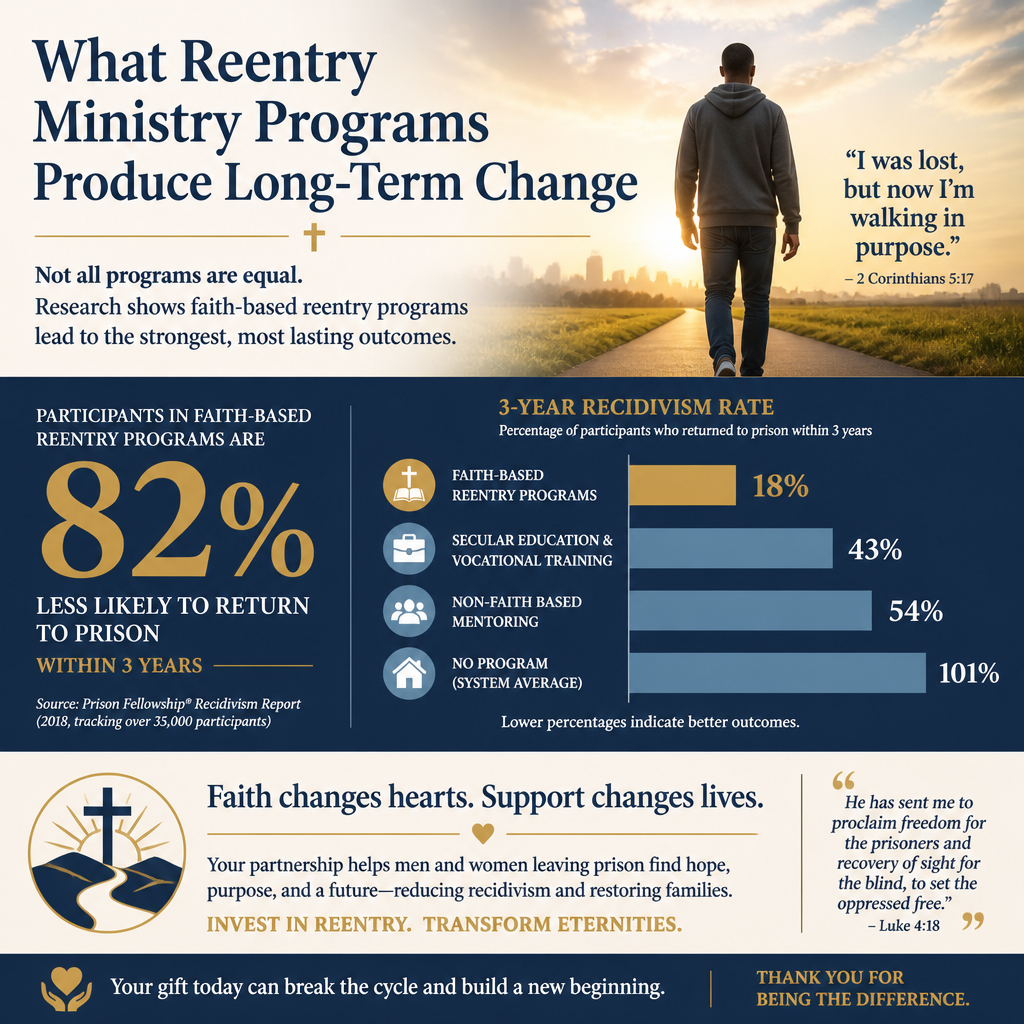
Recidivism reduction is a meaningful outcome because it represents fewer victims and greater community stability. But it is not the only faithful measure of long-term change. Donors can reasonably expect ministries to report public-safety relevant outcomes while also tracking indicators of stability and discipleship such as housing retention, employment retention, sobriety support engagement, restitution progress where applicable, and consistent church participation.
What is a responsible way to fund reentry ministry without creating dependency?
Responsible funding supports capacity that builds durable agency: trained mentors, case management tied to clear goals, transitional supports that taper, and accountability structures that expect participation. Donors can ask whether assistance is time-bound, whether participants contribute through work or service when possible, and whether the program’s theology of dignity is reflected in practices that restore responsibility rather than replace it.
Choosing programs that can carry the weight of the work
Reentry ministry programs produce long-term change when they are theologically serious, relationship-dense, and institutionally accountable. They disciple people through ordinary pressures, not only through extraordinary moments. And they tell the truth about outcomes, costs, and risk, trusting that Christian donors can bear complexity when it is presented with clarity.



