
Post-Prison Reentry Support for returning citizens is one of the most consequential places a donor can fund Christian mercy with durable public impact. The spiritual stakes are real, and so are the structural pressures that can quietly undo a person’s most sincere desire to begin again.
Scripture does not treat imprisonment as a marginal concern. When Jesus names visiting those in prison among the works of mercy in Matthew 25, he binds the credibility of our discipleship to embodied care for people others prefer to forget. Yet reentry is not only a moment of compassion; it is a long corridor of practical decisions—housing, work, treatment, church community, family repair—where instability compounds quickly. Donors who want their giving to bear fruit need to understand what reentry ministry actually requires, and how to recognize ministries that can carry the weight.
Why reentry is a discipleship issue and a public witness issue
Returning citizens often step out of prison with little margin for error. The first days and months can include supervision requirements, debt and fees, fragile family dynamics, limited employment options, and untreated trauma or addiction. The church’s calling here is not to romanticize transformation but to walk patiently in truth: the image of God remains, sin has real consequences, and grace is not sentimentality.
Reentry ministry sits at the intersection of justice, mercy, and prudence. Christians genuinely disagree about policy questions—sentencing, parole, prosecutorial discretion, and the right balance of accountability and rehabilitation. But Scripture leaves little room for indifference toward those who are poor, bound, or socially cast out. Reentry is where “remember those in prison, as though in prison with them” becomes concrete stewardship (Heb. 13:3).
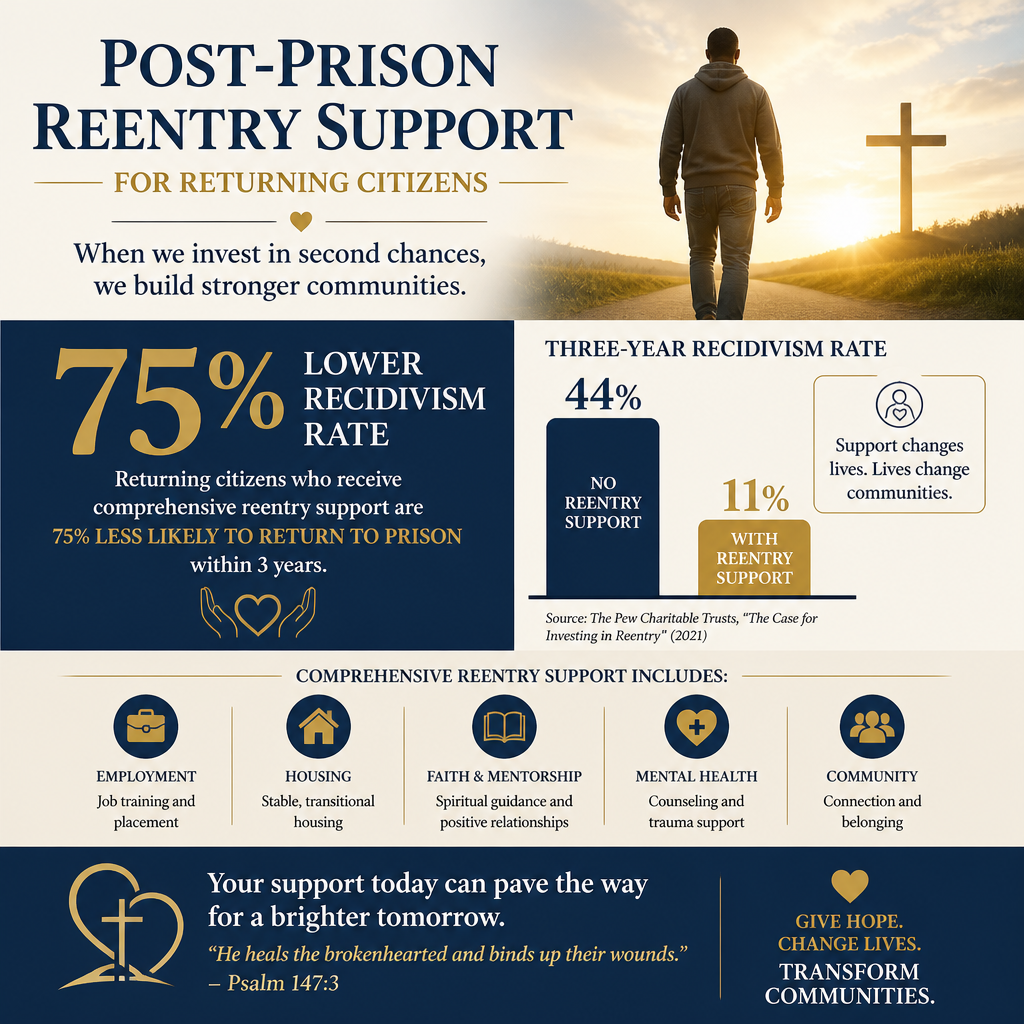
The scale of the challenge is also measurable. The U.S. Bureau of Justice Statistics reports that a large majority of people released from state prisons are arrested again within ten years of release, a sobering marker of how difficult stable reentry is in practice (U.S. Bureau of Justice Statistics). Donors should read that kind of number with care: rearrest is not the same as reconviction, and it does not isolate the role of housing markets, health systems, or supervision practices. Still, it underscores why shallow interventions often fail.

What effective post-prison reentry ministry actually includes
Reentry support that produces long-term change is typically not a single program but a coordinated set of commitments, delivered with consistency. Across our verification work at Most Trusted, we observe that ministries making durable progress tend to define reentry as a process rather than an event. They also distinguish clearly between what the ministry can provide directly and what must be built through partnerships with employers, landlords, churches, treatment providers, and public agencies.
Stable housing and a credible plan for the first ninety days
Housing is not merely one need among many; it is often the platform on which all other plans stand. Without a safe address, it is difficult to secure employment, comply with supervision, reunite with family, or maintain recovery. Many returning citizens face explicit restrictions about where they can live, and landlords may screen aggressively even when the offense is old.
Strong ministries do more than “help find housing.” They build concrete pathways: transitional housing with clear expectations, relationships with landlords willing to consider applicants fairly, assistance obtaining identification, and wraparound support that reduces evictions. They also set boundaries that protect residents and neighbors, including sober living policies when appropriate, curfews, and a clear response plan for relapse or rule-breaking.
Job readiness that reaches beyond resumes
Employment is a dignity issue and a stability issue. Donors should look for programs that address both skills and systems: interview preparation, work habits, conflict management, transportation planning, and a pipeline of employers who understand the population. The most responsible ministries are candid that not every job is immediately accessible, particularly for people with certain convictions or limited work history.
Some reentry organizations operate social enterprises to create “first jobs” with coaching. Others focus on placement and retention with employers. Either model can be faithful, but donors should ask what success means: not just getting hired, but remaining employed, increasing wages, and avoiding the spiral of short-term placements that end in discouragement.
Spiritual formation that is accountable and church-connected
Because reentry is a life reassembled, spiritual formation matters. Still, effective discipleship is not a substitute for mental health care, addiction treatment, or legal help. Healthy ministries hold these together without confusion: they preach repentance and hope, they practice truth-telling, and they connect participants to a local church that can offer ordinary belonging after the program ends.
Donors should pay attention to whether a ministry’s spiritual commitments are explicit and whether they honor conscience and human dignity. Forced professions of faith, coercive “conversion for benefits,” or vague spirituality that never names Christ both undermine credibility in different ways. The best work is clear, patient, and respectful.
Families, relapse, and the tensions donors must not ignore
Reentry support is often discussed as though it were primarily an individual journey. In practice, it is usually a family system under strain. Spouses and parents may have carried burdens for years; children may have learned to live without trust; and reunification can reopen wounds. Donors who care about healing should care about what ministries do with family complexity, not only what they do with participants.
Family reunification as careful repair, not instant restoration
Family reunification is sometimes appropriate and sometimes dangerous. Wise ministries avoid pressure tactics that rush victims or children into reconciliation. They coordinate with caseworkers, counselors, and when necessary, courts. They also understand that the first act of love may be accepting limits: supervised visitation, paced communication, and a long season of rebuilding credibility.
Programs that include parenting classes, family counseling referrals, and support groups for caregivers often do better than those that treat family needs as peripheral. Donors should look for language that respects the agency of spouses and children, and that refuses to spiritualize harm.
Relapse and recidivism as predictable risks with planned responses
Relapse—whether into substance use, destructive relationships, or criminal behavior—is not rare. A serious ministry plans for it. That planning includes sober supports, accountability structures, clinical referrals, and clear consequences that do not amount to abandonment. “Grace” in reentry is not the absence of standards; it is the presence of steadfast help alongside truthful boundaries.
The field has had to reckon with the reality that some participants will fail in visible ways. Donors should resist the temptation to judge a ministry solely by the absence of setbacks. A more faithful question is whether the ministry can demonstrate consistent practices that reduce risk over time, and whether it can name what it has learned without defensiveness.
When helping hurts in reentry contexts
Reentry work is vulnerable to forms of aid that unintentionally keep people dependent or disempowered. The When Helping Hurts framework articulated by Steve Corbett and Brian Fikkert has helped many Christian ministries see how paternalism can distort good intentions (When Helping Hurts). In reentry, that can look like indefinite handouts without a path to agency, or program models that center the ministry’s control more than the participant’s long-term integration into ordinary community life.
Responsible reentry support treats participants as moral agents. It offers practical assistance with a clear purpose: removing barriers, building competencies, and strengthening relationships that will remain when a program ends.
How donors can evaluate reentry ministries with confidence
Reentry ministries often communicate with compelling stories, and stories matter. But mature stewardship requires more than emotional resonance. Donors should ask how a ministry governs itself, how it handles money, how it measures outcomes, and how it safeguards vulnerable people. This is where Most Trusted’s work as an independent verification service can serve the church: we evaluate Christian nonprofits against The Most Trusted Standard, a 15-criteria framework spanning Faith Foundation, Financial Integrity, Governance and Leadership, and Transparency and Effectiveness.
Evidence of effectiveness without reductionism
Not everything that matters can be counted, and not everything that can be counted matters. Still, a credible reentry ministry should track meaningful indicators: housing stability, employment retention, program completion, relapse response, church connection, and recidivism measures defined carefully. Donors should press for clarity on definitions and time horizons. A “job placement” number without retention is often thin. A “recidivism rate” without a clear definition (rearrest vs. reconviction, local vs. national checks, follow-up period) can mislead.
We also encourage donors to value learning posture. Ministries that can name where outcomes are mixed, what they changed, and what partnerships strengthened results often prove more trustworthy than those that only report wins.
Governance, safeguarding, and partnerships that reduce harm
Reentry contexts include heightened safeguarding risks: power imbalances, financial vulnerability, and histories of trauma. Donors should look for clear safeguarding policies, background checks where appropriate, separation of financial controls, and training for staff and volunteers. Good governance is not bureaucratic overhead; it is the infrastructure of integrity.
Because reentry intersects with parole officers, courts, employers, treatment providers, and housing systems, partnerships matter. Strong ministries can explain how they coordinate with these entities without compromising their Christian convictions or participant dignity. Weak ministries often operate in isolation and interpret accountability as hostility.
Financial integrity and the temptation to fund narratives rather than systems
Some donors prefer to fund tangible items—beds, buses, job tools—because they feel concrete. Those gifts can be helpful, but reentry success typically depends on staffing, case management, and relational continuity that donors sometimes resist funding. The Overhead Myth letter signed by Charity Navigator, Candid, and the BBB Wise Giving Alliance argued that overhead ratios are a poor proxy for nonprofit performance and can distort donor decision-making (Candid). Reentry ministries are a prime example: underfunding staff and systems can increase risk to participants and the community.
We recommend donors evaluate budgets with moral seriousness: Are resources aligned with the ministry’s claims? Are there reserves appropriate to the risk profile? Are restricted gifts handled transparently? Are program costs honestly reported?
For donors seeking broader context on incarceration and ministry practice, our coverage of Prison and Post-Prison Ministries addresses how prison outreach and reentry support fit together in faithful Christian witness.
Giving that helps returning citizens endure the long road home
Post-prison reentry support is rarely dramatic. It is the steady work of accompaniment: a stable address, a job that lasts, a community that tells the truth, and a church that receives a person as more than a case file. The ministries most worthy of donor trust usually combine explicit Christian conviction with operational competence, honoring both grace and accountability.
Christian donors can give with confidence when they fund reentry work that is clear about risks, disciplined in governance, transparent in finances, and honest about outcomes. That kind of stewardship does not merely reduce failure; it dignifies the people Christ calls us to remember, and it strengthens the church’s public witness in a world eager to treat redemption as implausible.



