

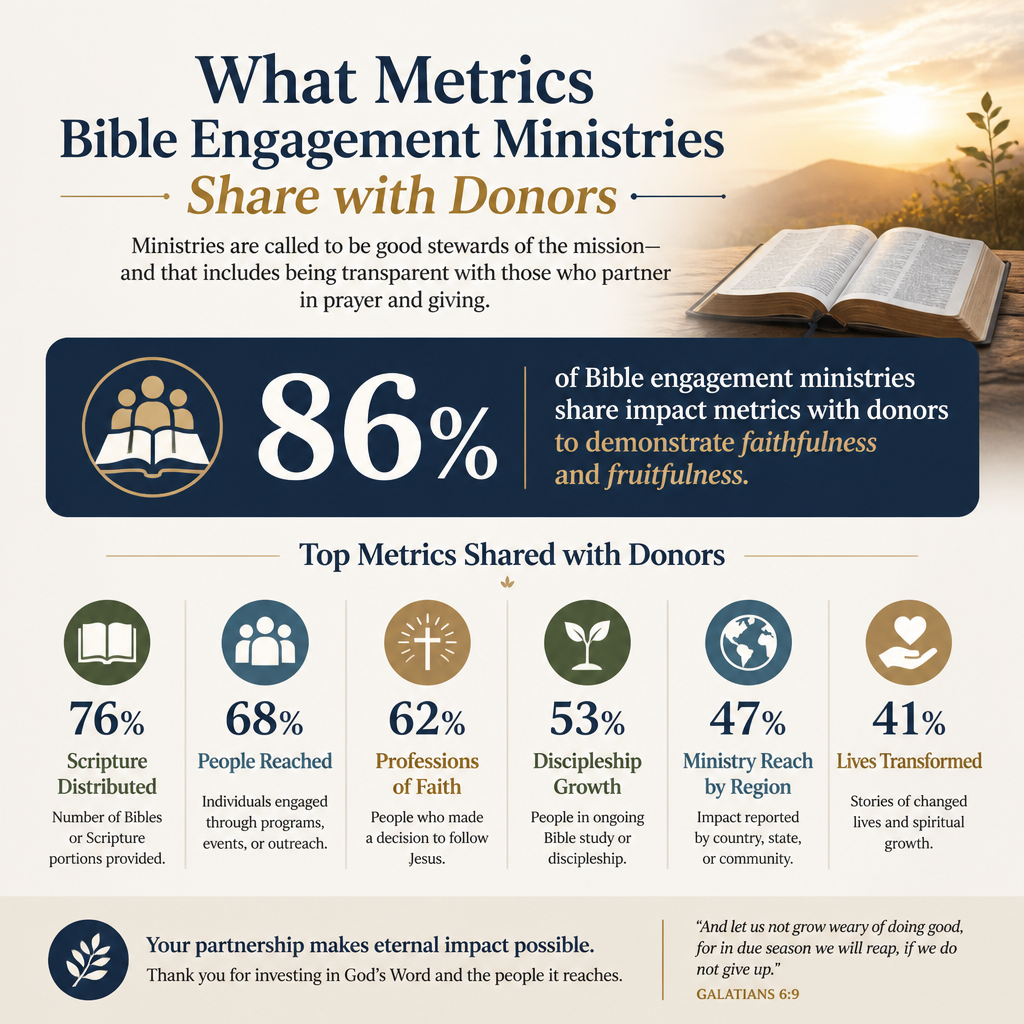
Donors regularly ask what metrics Bible engagement ministries share with donors because they want more than reassurance; they want an honest account of whether people are actually encountering Scripture and being formed by it. That desire is not reducible to institutional curiosity. Scripture itself treats fruit as a serious matter, and it warns against appearances that are impressive but hollow (Matthew 7:16–20).
At the same time, Bible engagement is not a simple input-output machine. A ministry can distribute a million Bibles and still fail to see durable discipleship. Another may reach fewer people but catalyze a pattern of Scripture intake that reshapes families and churches for decades. Mature Christian giving does not choose between faith and evidence; it asks for evidence that is appropriate to a spiritual work, and it receives that evidence with sobriety rather than triumphalism.
Why metrics matter for Bible engagement without replacing discipleship
Counting is not unspiritual but it can be incomplete
The New Testament does not treat spiritual work as beyond accounting. Luke describes the early church’s growth in concrete terms, including the number of people added (Acts 2:41). A ministry that refuses to measure anything is not automatically more faithful; it may simply be less transparent. Numbers can be a form of neighbor-love when they prevent self-deception and enable responsible stewardship.
Yet Bible engagement ministries also face a real tension: what is easiest to count is often least connected to long-term formation. A download, a social media view, or even a distributed Bible can be meaningful, but it does not necessarily represent reading, comprehension, obedience, or endurance. Christians who give carefully are not asking ministries to quantify the Holy Spirit. They are asking ministries to tell the truth about what they can and cannot know.
Donors are vulnerable to the wrong proxies
Modern philanthropy rewards growth signals: bigger audiences, more content, more countries, more partners. Those may reflect real Kingdom opportunity. They may also reflect incentives that favor breadth over depth. The field has had to reckon with the broader philanthropic “overhead” debate, including the 2013 letter signed by Charity Navigator, GuideStar, and BBB Wise Giving Alliance warning donors not to treat overhead ratios as the primary measure of a charity’s worth (Charity Navigator).
What this means in practice is that donors should expect a ministry to report both scale and substance. Scale clarifies reach. Substance clarifies whether reach is translating into actual engagement with the Word of God and the formation of Christian life. In our verification work at Most Trusted, we observe that ministries that meet The Most Trusted Standard tend to build reporting systems that can sustain both kinds of truth telling over time.

Core output metrics most Bible engagement ministries can report with integrity
Scripture access and distribution with verifiable definitions
The simplest category is access: how many Bibles, New Testaments, audio Bibles, or Scripture portions were produced and distributed, and through which channels. Donors should insist on clear definitions. “Distributed” should mean delivered into the hands of a recipient or partner with documented receipt, not merely shipped to a warehouse. “Translated” should distinguish between a completed New Testament, a full Bible, and preliminary drafts.
When translation is in view, donors can expect ministries to reference objective progress benchmarks such as completed books, consultant checks, and publication milestones. For context, a widely cited benchmark in the translation field is the scale of remaining language need tracked by organizations such as Wycliffe Global Alliance and its partners (Wycliffe Global Alliance). Ministries do not need to claim sole credit for global progress, but they should show how their projects fit within the broader ecosystem.
Program activity metrics that describe ministry operations
Activity metrics track what a ministry actually did: how many small groups were trained, how many church leaders were equipped, how many literacy classes were offered, how many prison Bible studies were facilitated, how many trauma-informed Scripture engagement sessions were delivered. These measures are not “impact,” but they are often prerequisites for impact, and they reveal whether a ministry is executing its stated strategy.
Donors should watch for a disciplined relationship between activity and strategy. If a ministry claims it is focused on unreached communities but reports only mass-market app installs, the story may be mismatched. If a ministry emphasizes depth but reports primarily on one-time event attendance, the same concern applies. Serious reporting does not require complex dashboards; it requires coherence.
Engagement and formation metrics donors should request with theological sobriety
Behavioral engagement with Scripture rather than mere exposure
Many Bible engagement ministries now report measures that move closer to actual use: Scripture reading frequency, completion of reading plans, retention over time, group meeting consistency, or engagement with guided study content. These are still proxies, but they are more meaningful than raw reach. Donors can reasonably ask whether such measures are observed directly, self-reported, or inferred from digital analytics, because each method has limitations.
Where surveys are used, credible ministries often benchmark against established research on Bible engagement. The American Bible Society’s annual State of the Bible report has become a common reference point for how Bible reading patterns shift in the United States (American Bible Society). Donors should not treat any single survey as infallible, but using shared definitions can reduce the temptation to invent flattering categories.
Formation outcomes that are harder to measure but not impossible to examine
The harder question is whether engagement is shaping discipleship: prayer, repentance, reconciliation, generosity, vocational faithfulness, church participation, and endurance under suffering. These outcomes resist simplistic quantification, and ministries should be cautious about claiming direct causal attribution. Still, donors can ask for evidence that is appropriate to the claim, especially when a ministry’s messaging implies transformation rather than access.
Responsible approaches include pre/post assessments for specific curricula, structured testimonies gathered with consent, pastoral or facilitator observations summarized with transparent methodology, and longitudinal follow-up with a defined cohort. The most credible reports tend to include both encouraging evidence and the limits of that evidence, including what is unknown and what has not yet been studied.
- Reading consistency: percentage of participants who sustain Scripture reading over a defined period
- Comprehension and confidence: changes in ability to interpret a passage with basic hermeneutical tools
- Community formation: retention in small groups and engagement in local church life
- Leader multiplication: new facilitators trained who continue leading after a set interval
- Life application indicators: self-reported and observed practices tied to a curriculum’s stated outcomes
What ministries should disclose about method, not only results
Definitions, denominators, and the quiet discipline of clarity
Numbers without definitions are vulnerable to interpretation. Donors should expect ministries to clarify denominators: of those who downloaded an app, how many created an account; of those who created an account, how many opened Scripture; of those who opened Scripture, how many returned weekly. The same discipline applies offline: of those who attended a training, how many completed it; of completers, how many actively led a group six months later.
Clarity is not merely technical. It is a moral act. Jesus condemns religious performance that seeks honor rather than truth (Matthew 6:1). Ministries that love truth will do the patient work of defining what they are claiming and what they are not. Across Bible Study and Engagement Ministries, donors will find wide variation in reporting maturity, often because measurement capacity is uneven. That reality should move donors toward discernment rather than cynicism.
Independent verification and governance signals that protect donors and beneficiaries
Even sincere leaders can drift into selective storytelling under funding pressure. Donors can reduce that risk by paying attention to governance and transparency practices: audited financials, conflict-of-interest policies, board independence, and public reporting that invites scrutiny rather than avoiding it. These features do not prove spiritual fruit, but they materially reduce the likelihood that fruit claims are masking dysfunction.
Most Trusted exists to help donors give with confidence by evaluating ministries against The Most Trusted Standard, a 15-criteria framework spanning Faith Foundation, Financial Integrity, Governance and Leadership, and Transparency and Effectiveness. A ministry’s metrics are more trustworthy when they sit inside a broader architecture of accountability. When that architecture is absent, even attractive impact stories should be received with restraint.
How donors can interpret metrics without demanding the wrong kind of certainty
Ask for coherence between theology of ministry and theory of change
Bible engagement ministries sit within different ecclesial convictions. Some work primarily through local churches; others work through schools, prisons, refugee resettlement partners, or digital distribution. Christians genuinely disagree about questions such as the proper relationship between parachurch initiatives and the local church, or whether digital engagement can sustain durable discipleship without embodied community. Metrics should be interpreted within that theological and strategic context.
Donors can ask a straightforward question: does the ministry’s reporting match its theology? If a ministry claims the local church is essential, it should report church partnerships, pastoral training outcomes, and integration into congregational life. If a ministry claims to serve spiritually isolated believers, it should report on follow-up pathways and community formation appropriate to that context.
Look for honesty about trade-offs and negative findings
Serious measurement includes inconvenient discoveries: a curriculum that did not work in a certain context, a retention rate lower than hoped, a cohort that needed more support, a partnership that failed. Ministries that never report disappointments are not necessarily thriving; they may simply be curating. Donors should reward candor because it strengthens the field.
For donors who want to go deeper on evaluation practices across this space, How Bible Study and Engagement Ministries Measure Impact addresses common measurement approaches and the accountability questions that mature givers tend to ask. The goal is not skepticism for its own sake. It is stewardship that honors God, protects vulnerable people from being used as fundraising proof, and supports ministries that tell the truth.
FAQs for What metrics Bible engagement ministries share with donors
What are the most credible metrics for Bible engagement ministries to share with donors?
The most credible reporting usually combines (1) access and activity measures, such as Scripture distributed and leaders trained, with (2) engagement measures that indicate use over time, such as reading plan completion or group retention, and (3) carefully framed formation indicators tied to a specific program. Credibility depends less on the impressiveness of the number and more on definitions, denominators, and whether the ministry explains what the metric can and cannot prove.
Should donors expect Bible engagement ministries to prove spiritual transformation?
Donors should not demand a level of causal proof that collapses discipleship into a laboratory outcome. But donors can expect disciplined evidence that a ministry’s work is plausibly contributing to Scripture engagement and Christian formation. That includes transparent methods, independent governance and financial accountability, and reporting that acknowledges limitations rather than implying certainty that no ministry can possess.
Stewardship that honors the Word and the truth
The best metrics Bible engagement ministries share with donors do not attempt to replace the mysterious work of God in the human heart. They do something more modest and more necessary: they tell the truth about reach, engagement, and formation with clear definitions and accountable methods. Donors who give in this spirit are not buying numbers. They are strengthening ministries that handle both Scripture and stewardship with reverence.



