

How Bible study ministries measure spiritual growth is a question of stewardship before it is a question of technique. Donors are not asking ministries to quantify the Holy Spirit. We are asking whether a ministry is attending carefully to the formation it claims to serve, and whether its leaders will speak truthfully about what can and cannot be verified.
Scripture itself resists shallow measurement. Jesus warned against public righteousness performed “to be seen by others” (Matthew 6), yet the New Testament also names discernible fruit, tested doctrine, and observable patterns of life as marks of genuine discipleship (Matthew 7:16; 1 John). The donor’s challenge is to support ministries that pursue spiritual formation with theological seriousness and practical honesty, rather than with marketing claims.
Spiritual growth is real, and it is not always measurable on our preferred timelines
Theological clarity matters more than metric sophistication
When Christian leaders speak about growth, they should be able to say what they mean. The New Testament uses categories such as faith, love, holiness, perseverance, and knowledge of God, but it does not reduce discipleship to one dimension. Paul’s prayer in Colossians is expansive: being filled with the knowledge of God’s will, bearing fruit in every good work, growing in the knowledge of God, and being strengthened for endurance (Colossians 1:9–11). A ministry that defines “growth” only as content consumption, emotional experience, or numerical participation is already narrowing the biblical frame.
Christians genuinely disagree about the best language for the center of spiritual maturity: some emphasize doctrinal formation; others emphasize affective formation; others emphasize practices of obedience and mercy. A donor does not need a ministry to settle every debate, but should expect a coherent theology of change that governs how the ministry teaches, supports leaders, and evaluates outcomes.
Discipleship has both hidden roots and visible fruit
Some of the most important spiritual work is subterranean: conviction of sin, renewed desire for God, repentance that is not performative, the quiet rebuilding of a marriage, the slow reordering of financial life. These are not easily captured by surveys, and ministries should not pretend otherwise. Yet Scripture also assumes that true faith becomes visible in time. James refuses the claim of a faith that never expresses itself in deeds (James 2:17). Jesus speaks of fruit that can be recognized, even if it takes seasons to appear (Matthew 7:16–20).
What this means in practice is that rigorous ministries measure a blend of inputs, outputs, and outcomes while acknowledging that outcomes mature over time and can be uneven. A donor should be wary of ministries that only report enthusiasm and attendance, and equally wary of ministries that promise unusually rapid, linear transformation.

The best measurement starts with a credible theory of formation
Programs produce activity; formation requires a pathway
Many Bible study ministries can describe what they do. Fewer can explain how their activities are expected to form people into Christlikeness in a specific context. A credible pathway names the ministry’s intended transformation, identifies the primary means it uses (Scripture engagement, community, practice, mentoring), and clarifies what “progress” looks like at different stages.
Across our verification work at Most Trusted, we observe that ministries with the healthiest approaches do not confuse scale with depth. They can describe how a participant moves from first exposure to Scripture, to regular engagement, to integration into the life of the church, to a sustained pattern of obedience and service. When that pathway is missing, measurement tends to become either sentimental storytelling or abstract dashboards.
Measurement should serve discipleship, not replace it
The harder question is not whether a ministry can count. It is whether the ministry’s measures strengthen pastoral responsibility. In a local congregation, shepherds “keep watch over your souls, as those who will have to give an account” (Hebrews 13:17). Para-church Bible study ministries should treat their measurement with similar sobriety. The point is not surveillance; it is care.
Concrete indicators can help leaders notice drift: groups that meet but never pray, participants who consume content but remain isolated, facilitators who are overwhelmed, or studies that raise questions without providing pathways to counsel and local church connection. Measurement that leads to better shepherding is a form of love.
What credible metrics can and cannot tell a donor
Useful indicators include practice, understanding, and communal life
Spiritual growth has multiple dimensions, and a single metric will not carry the load. We recommend that donors look for a small set of indicators that correspond to a ministry’s theory of formation and are gathered with reasonable integrity. Common indicators include sustained Scripture engagement, growth in biblical literacy, increased participation in Christian community, and concrete steps of obedience.
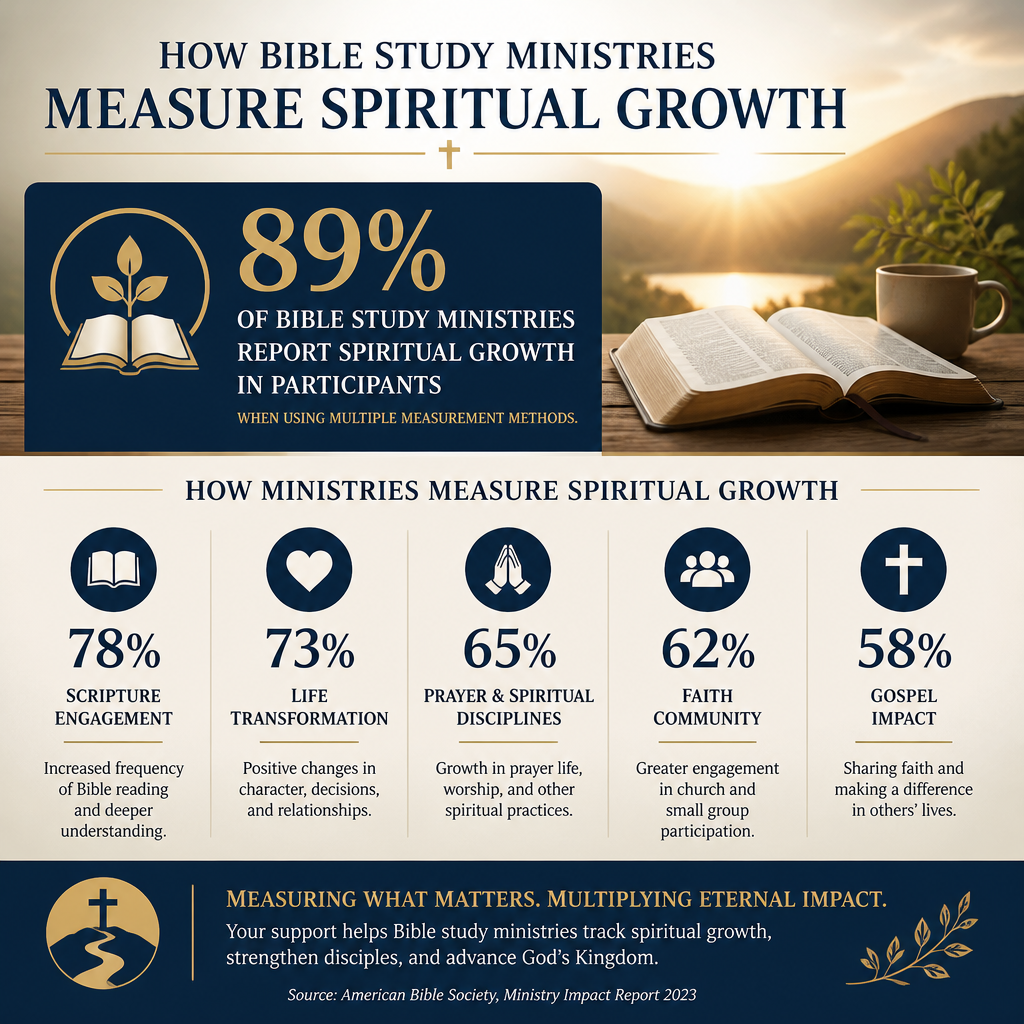
Many ministries now use tools that attempt to assess engagement and formation patterns. Some donors will encounter Bible engagement research as a contextual reference point. For example, the American Bible Society’s annual report has documented patterns of Scripture use and disengagement over time, which can help ministries frame the missional challenge they serve.American Bible Society
Context is not the same as impact. A national trend line can explain urgency, but it cannot verify that a given ministry is forming disciples. The most credible ministries make this distinction explicit, and they avoid using broad cultural data as proof of their own effectiveness.
Why self-report data is limited, and still worth collecting
Most Bible study ministries rely heavily on self-reported outcomes: surveys of confidence in reading Scripture, frequency of Scripture use, perceived closeness to God, or changes in prayer habits. Self-report is imperfect. Social desirability bias is real in church contexts, especially when participants want to please a leader or justify their own time investment.
Yet self-report is not meaningless. It can identify direction of change and highlight areas where participants are struggling. Ministries can strengthen credibility by using consistent questions over time, collecting baseline data early, separating survey administration from direct leadership pressure, and reporting results with appropriate modesty. The donor’s signal to watch for is not “perfect data,” but transparency about limitations.
- Baseline and follow-up rather than one-time testimonials
- Consistency of definitions for “engaged,” “active,” and “completed”
- Disaggregation by cohort, geography, or language when relevant
- Clear treatment of attrition and non-response
- Evidence of learning loops where findings change training or curriculum
Healthy ministries resist both overclaiming and underreporting
Overclaiming is a theological and governance problem
When ministries claim to “transform lives” without explaining what they mean or how they know, they are not only making a communications mistake. They are courting a spiritual danger: bearing false witness about God’s work in order to secure funding. Mature leaders can speak about fruit with gratitude and restraint, giving God glory without turning sanctification into a marketing asset.
Donors should watch for red flags: implausibly high success rates, vague claims that cannot be audited, or stories used as representative when they are exceptional. Responsible reporting requires governance practices that constrain exaggeration: board oversight, documented methodology, and a culture where staff can raise concerns without retaliation. These are not peripheral to discipleship; they are part of it.
Underreporting can hide drift and protect comfort
The opposite error is to avoid measurement because “only God can judge hearts.” That statement is true and can still become a refuge from accountability. Scripture expects leaders to be faithful stewards of what is entrusted to them (1 Corinthians 4:2). A ministry that cannot say whether its groups are meeting, whether leaders are trained, whether participants return, or whether safeguarding practices are followed is not honoring stewardship.
For donors comparing ministries within Bible Study and Engagement Ministries, credible reporting often looks modest. It does not promise revival on demand. It demonstrates fidelity: clear aims, disciplined operations, and a willingness to disclose what is not working as expected.
How donors can evaluate measurement under The Most Trusted Standard
What verification seeks that impact reports often miss
Many ministries publish impact reports that are sincere but selective. Verification is a different discipline. Most Trusted evaluates ministries against The Most Trusted Standard, a 15-criteria framework spanning Faith Foundation, Financial Integrity, Governance and Leadership, and Transparency and Effectiveness. The aim is not to reward sophisticated graphics. The aim is to establish whether a ministry is structurally trustworthy and whether its claims are presented with integrity.
In practice, that means donors can ask questions that connect spiritual fruit to organizational reality. Who sets doctrinal accountability for curriculum? How are leaders trained and supervised? How are complaints handled? What portion of reported outcomes are drawn from systematic data versus curated stories? What is the ministry’s relationship to local churches in the places it serves?
Signals of maturity in how growth is measured
Ministries that meet The Most Trusted Standard tend to show a disciplined relationship between theology, method, and reporting. They acknowledge that growth is multidimensional and that outcomes vary by context. They report both reach and depth, and they resist using one to mask the absence of the other. They invite scrutiny because they believe truth serves the church.
For donors seeking a closer comparison of approaches within How Bible Study and Engagement Ministries Measure Impact, the clearest signal is consistency: the same definitions, the same timeframes, the same willingness to report limits, and the same accountability structures year after year.
FAQs for How Bible study ministries measure spiritual growth
Can a Bible study ministry measure spiritual growth without reducing it to numbers?
Yes, if measurement is tethered to a biblical account of discipleship and presented with restraint. Credible ministries use a mix of quantitative indicators (participation over time, completion rates, leader training coverage) and qualitative evidence (structured interviews, pastoral observations, documented stories). They also state clearly what their data cannot prove, especially when the most important changes are internal and long-term.
What should donors distrust in impact claims about spiritual growth?
Donors should be cautious about unusually high success rates without methodology, vague language that cannot be tested, and stories presented as if they are statistically representative. It is also wise to question ministries that use broad cultural research as proof of their own impact. Mature reporting distinguishes between the need in the field and the outcomes the ministry can reasonably verify.
Measured with humility, reported with truth
Spiritual growth is not a commodity, and Christian ministries should not speak as if sanctification were a predictable product. Yet faithful stewardship requires more than good intentions. Bible study ministries best serve the church when they define growth biblically, measure what can be measured without pretense, and build governance structures that protect truthfulness. Donors, in turn, can give with greater confidence when impact claims are matched by transparent methods and accountable leadership.



