
The best way to give to Christian adoption ministries is to fund what keeps children safe, families stable, and the church’s witness credible. That requires more than warm-hearted impulse. Adoption sits at the intersection of trauma, law, money, and pastoral care, and donors have the power to strengthen or distort the work.
Scripture is unambiguous about God’s concern for children without protection. The same Bible that commands generosity also condemns partiality, dishonest scales, and harm done under spiritual language. For Christian donors, the question is not whether to care, but how to give in a way that does not create perverse incentives, burden vulnerable families, or reward ministries that cannot be trusted with children’s lives.
Begin with a clear moral aim and a realistic theory of change
Adoption is not the only faithful outcome
Christian donors sometimes treat adoption as the highest form of orphan care, but the Bible’s emphasis is broader: protection, justice, and belonging. In modern child welfare practice, many children need permanent families through adoption. Others can be safely supported through family preservation, kinship care, or reunification. A ministry that speaks as if adoption is always the default outcome often signals that it has not reckoned with the complexities of poverty, coercion risk, and the long arc of trauma.
What this means in practice is that strong Christian adoption ministries can articulate the conditions under which adoption is appropriate and the conditions under which it is not. They can explain how they avoid financial or spiritual pressure on birth families. They can name the real grief that adoption includes, even when it is the right decision.
Resist incentives that reward “more adoptions” instead of safer outcomes
Donor funding can unintentionally reward volume over integrity. When a ministry’s revenue depends on increasing placements, the mission quietly shifts from serving families to supplying outcomes. Christians genuinely disagree about how to weigh “finding families” against “slowing down for due diligence,” but the field has had to reckon with scandals that stem from haste, weak documentation, or a lack of independent oversight.
One sober data point should recalibrate the conversation: in the United States, the largest share of children who enter foster care do so because of neglect, a category that often overlaps with poverty and inadequate support rather than deliberate cruelty. The federal government’s AFCARS reports consistently show neglect as the most commonly reported removal circumstance, which underscores why prevention and family strengthening belong in any mature orphan care strategy. U.S. Department of Health and Human Services, Administration for Children and Families

Give to ministries that safeguard children and honor both sets of parents
Child protection systems are not optional
A donor’s first responsibility is to avoid funding harm. Christian adoption work involves children with trauma histories, families under stress, and staff with access to sensitive information and vulnerable people. Ministries should have credible child-safety policies, background checks appropriate to role, reporting protocols aligned with applicable law, and an organizational culture where concerns can be raised without retaliation.
We recommend asking for evidence of safeguards rather than accepting general assurances. Policies should be written, implemented, and audited. Training should be documented. Allegations should be handled with independence and seriousness. The church’s failures in adjacent fields have taught us that pious language can coexist with weak controls.
Ethical care for birth families requires more than “compassion”
Ethical adoption ministries treat birth parents as image-bearers, not obstacles. That includes plain-language informed consent, appropriate legal counsel, and a refusal to confuse poverty with unfitness. Donors should be cautious about any ministry that fundraises using birth-family stories while providing little clarity about consent and post-placement support.
Many donors have also learned to ask about the ministry’s posture toward adoptees as they grow. Trauma-informed care is not a trend. It is a recognition that separation and loss, even when necessary, have lifelong effects. Ministries that budget for counseling resources, support groups, and post-adoption services communicate that they are planning for the whole story, not only the placement.
Fund transparency and governance, not merely compelling narratives
Financial integrity is a form of neighbor-love
Adoption involves money flows that can easily be misunderstood: home studies, legal fees, agency expenses, and program subsidies. Mature ministries explain how funds move, what is restricted versus unrestricted, and how they prevent conflicts of interest. They also avoid manipulative fundraising that turns children into marketing assets.
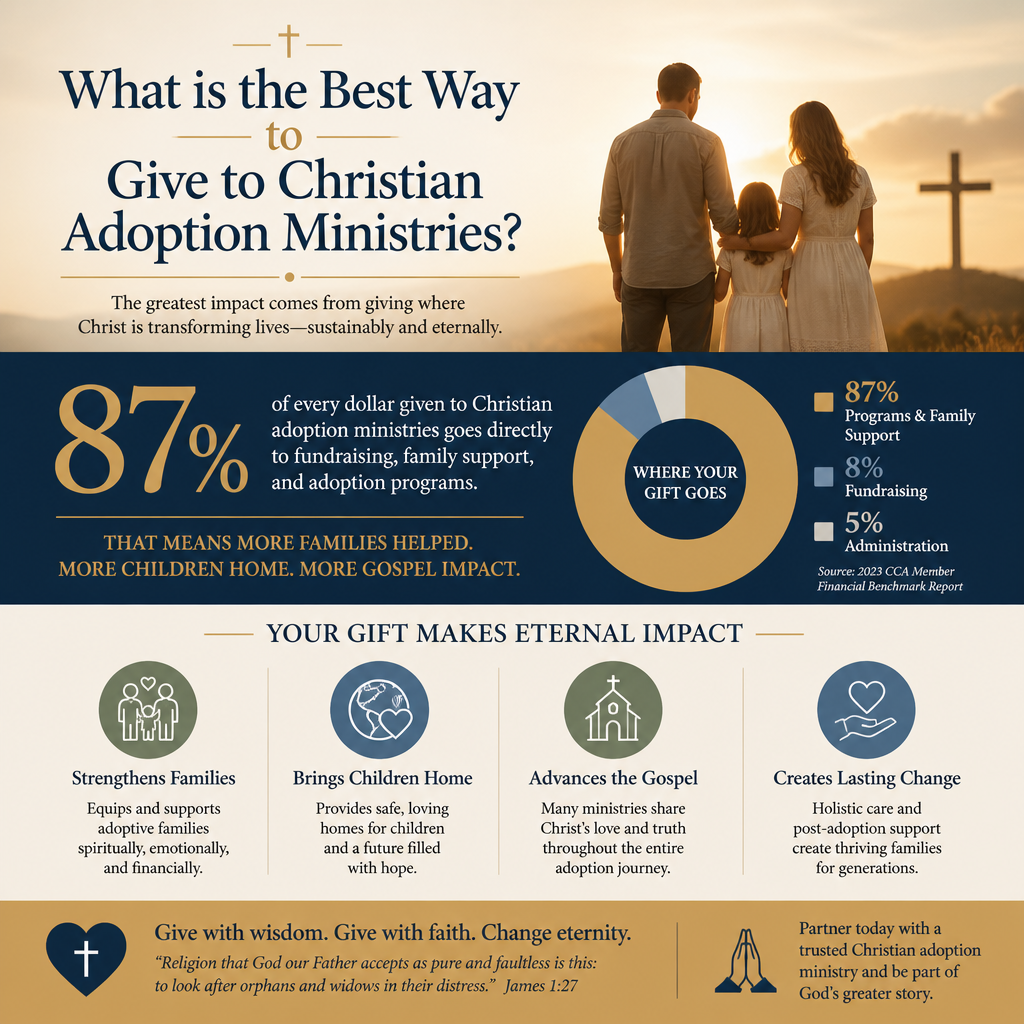
Across our verification work at Most Trusted, we observe that ministries capable of clear financial disclosure tend to be the same ministries that handle complex pastoral and legal realities with sobriety. Transparency is not an aesthetic preference. It is a signal that leadership expects accountability.
Governance separates compassion from control
A strong board is not a technicality; it is one of the primary protections for children, families, staff, and donors. Donors should look for boards that are independent enough to supervise the chief executive, informed enough to ask hard questions, and spiritually mature enough to resist the temptation to confuse loyalty with silence.
It is also worth refusing the simplistic “low overhead” instinct. Serious child welfare work requires qualified staff, legal compliance, training, and monitoring. The nonprofit sector’s leading evaluators have repeatedly warned donors against treating administrative costs as a proxy for effectiveness. Charity Navigator
Support the full ecology of orphan care, not only adoption placements
Prevention and family strengthening often carry the greatest leverage
Adoption is sometimes necessary and beautiful, but it is rarely the first intervention. Many families need economic stabilization, addiction treatment, mental health care, parenting support, or advocacy within the child welfare system. Christian donors can fund ministries that keep children safe while keeping families intact when possible.
This is where giving can become more strategically Christian: not because it is “efficient,” but because it mirrors God’s concern for justice and repair. The harder question is whether donors will fund the slow work—case management, counseling partnerships, respite care, and long-term discipleship—that does not produce immediate celebratory photographs but can prevent unnecessary separation.
Adoption ministries should know their limits and partners
No single organization can do everything well. The healthiest ministries acknowledge what they do not do and name the organizations they coordinate with: licensed agencies, trauma counselors, local churches, and legal counsel. Donors should be wary of ministries that operate as closed systems, especially when they are handling international cases or cross-cultural placements.
For donors seeking a broader view of responsible engagement, our editorial work on Christian Adoption Ministries places adoption in the larger context of child protection, family strengthening, and Christian accountability.
Use a verification framework that matches the stakes
Ask for evidence aligned with The Most Trusted Standard
Adoption touches the lives of children in permanent ways. Donors should evaluate ministries with a framework that is weighty enough for the subject. Most Trusted exists to help donors give with confidence by evaluating Christian nonprofits against The Most Trusted Standard, a 15-criteria framework spanning faith foundation, financial integrity, governance and leadership, and transparency and effectiveness.
Practically, this means donors should expect ministries to document their doctrine and ministry practices, publish accessible financial information, demonstrate independent oversight, and report outcomes honestly. Ministries that meet The Most Trusted Standard tend to treat transparency as discipleship: a refusal to hide what should be brought into the light.
A short donor checklist for wise adoption giving
- Clear child-safety policies, reporting protocols, and training records
- Specific practices to protect birth-parent consent and prevent coercion
- Post-adoption services and trauma-informed supports for families and adoptees
- Financial disclosures that explain restricted funds and program cost structure
- Independent governance with meaningful oversight of leadership decisions
Christians do not need to become child-welfare professionals to give wisely. But we do need to insist on verifiable integrity, especially when an organization’s work depends on public trust and affects children who cannot protect themselves.
Donors who want a narrower focus on disciplined giving practices can also review our perspective on How to Give Wisely to Christian Adoption Ministries as a category of donor decision-making rather than a single emotional choice.
FAQs for What is the best way to give to Christian adoption ministries
Should donors prioritize adoption grants for families or giving to adoption ministries?
Both can be faithful, but they answer different needs. Direct grants to families can reduce financial barriers and may prevent families from taking on unsustainable debt, but they require careful administration and clear eligibility criteria. Giving to ministries can strengthen systems—training, post-adoption care, ethical safeguards, and casework—that individual grants cannot provide. We recommend supporting whichever option offers stronger accountability, clearer protections for vulnerable parties, and a demonstrated commitment to long-term care rather than one-time placement.
What are warning signs that an adoption ministry may not be trustworthy?
Common warning signs include vague financial reporting, resistance to independent oversight, pressure-heavy fundraising that uses children’s stories without clear consent practices, and an emphasis on “numbers of adoptions” without corresponding evidence of child safety and post-adoption support. Donors should also be cautious when an organization cannot explain how it prevents coercion, how it handles complaints, or how it cooperates with legal and clinical professionals. The presence of these signs does not prove misconduct, but it does justify withholding funding until credible evidence is provided.
A faithful way forward for adoption giving
The best way to give to Christian adoption ministries is to fund work that is as careful as it is compassionate. Christian donors can honor God’s heart for the fatherless by supporting ministries that protect children, respect birth families, strengthen adoptive families for the long haul, and submit their finances and governance to scrutiny. When giving is guided by truth as well as mercy, the church’s care becomes not only generous, but trustworthy.



