
Christian adoption ministries accept stock donations because appreciated securities can fund the ministry’s work more efficiently than a cash gift for many donors, while also protecting operational stability in a mission space that is both biblically weighty and administratively complex. Donors often assume a ministry prefers checks because they are simple. In practice, many adoption and orphan-care organizations have learned that non-cash giving can be an act of stewardship that preserves more of the donor’s gift for the care of children and the support of families.
Scripture’s concern for the fatherless is not sentimental; it is covenantal. God identifies himself as “Father of the fatherless” (Psalm 68:5), and James places care for orphans and widows near the heart of faithful religion (James 1:27). Yet the modern adoption ecosystem includes legal compliance, trauma-informed family support, and long time horizons. Ministries that accept stock are not signaling financial sophistication for its own sake. They are responding to the practical realities of funding steady, accountable care in a field where mistakes carry real human cost.
Stock gifts often increase the effective size of a donor’s gift
Appreciated securities can reduce tax friction for the donor
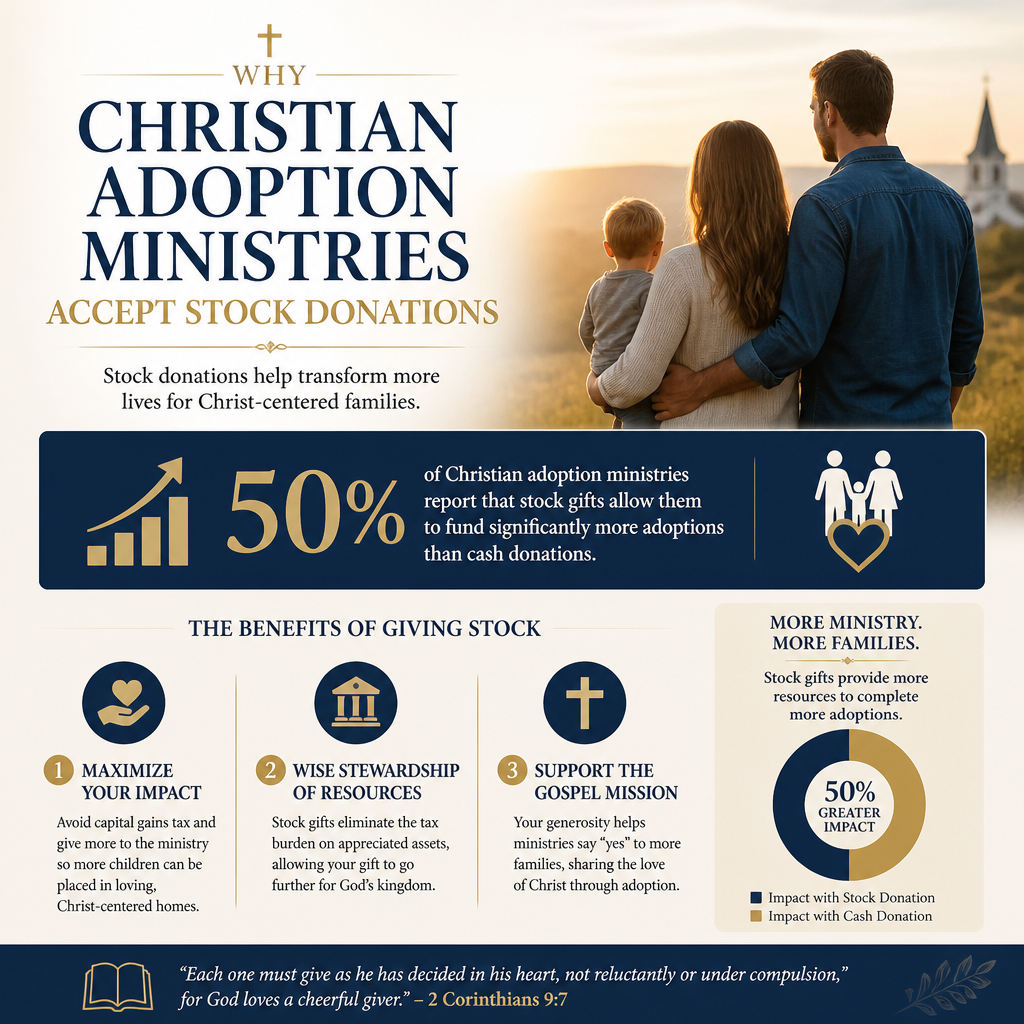
For many mature donors, the strongest case for giving stock is not novelty; it is stewardship. When a donor gives appreciated stock held long-term directly to a qualified nonprofit, the donor can generally avoid capital gains tax and may be eligible to deduct the fair market value, subject to IRS limitations. Those mechanics belong to the tax code, not to marketing, and donors should confirm specifics with a qualified tax professional. But the underlying principle is straightforward: fewer dollars lost to tax friction can mean more dollars directed to mission.
This matters in adoption work because budgets are not primarily about glossy expansion; they are about covering unglamorous necessities—licensed social work staff, counseling networks, documentation systems, protective policies, and post-adoption support that lasts well beyond a placement. When an adoption ministry can receive a larger net gift through stock rather than cash, it is not merely “raising more.” It is funding the hidden infrastructure that keeps the ministry safe and durable.
Donors are increasingly holding wealth in brokerage accounts, not checking accounts
Many households with capacity for significant giving have accumulated assets in the market over decades. Cash flow may be tight even when net worth is not. The Federal Reserve’s Survey of Consumer Finances consistently shows that higher-wealth households hold a meaningful share of their assets in corporate equities and mutual funds rather than in liquid cash. See the Federal Reserve’s summary materials on the Survey of Consumer Finances.
What this means in practice is that ministries that can receive stock make it possible for a donor to give from where wealth actually resides. In our verification work at Most Trusted, we have observed that ministries able to receive non-cash gifts tend to serve donors with clearer processes, stronger documentation, and fewer last-minute workarounds that create avoidable risk.

Adoption ministry finances are lumpy, and stock gifts can stabilize cash flow
Programs carry long timelines and uneven revenue
Adoption and family-support ministries face irregular expense patterns. One month may be dominated by intake and assessment. Another may require bursts of travel, legal coordination, or emergency assistance for a family at risk of disruption. Donor giving, however, often arrives seasonally. Non-cash gifts, including stock, can help diversify the timing and structure of revenue.
This is not an argument for ministries to speculate. The prudent practice is typically to liquidate donated stock according to a board-approved gift acceptance policy, turning it into spendable cash with a clear audit trail. The point is not market exposure; it is a reliable way to receive major gifts when a donor’s best asset for giving is not cash.
Sound policies protect both the donor and the ministry
Christians genuinely disagree about how much financial sophistication belongs in ministry. Some worry that complex giving vehicles can distract from prayerful generosity. That concern should be taken seriously. The corrective is not to refuse complexity in every form, but to submit it to governance and transparency. A ministry that accepts stock should have a written policy that addresses who can approve a gift, how securities are handled, when they are sold, and how acknowledgments are communicated.

These practices sit close to what we examine under The Most Trusted Standard, particularly around financial controls and board oversight. A ministry that cannot explain its stock gift process in plain language should not expect donors to assume competence simply because the gift type sounds sophisticated.
Stock acceptance is often a proxy for operational maturity
It requires competent administration and clean compliance
To accept stock, a ministry needs a brokerage account configured for charitable receipt, internal accounting controls, and coordination between development and finance. That does not make the ministry holy. It does make the ministry accountable to a higher level of administrative discipline than “mail a check.” In adoption work, discipline matters because vulnerable children and families are involved, and errors are not merely financial.
Organizations with stronger governance tend to treat non-cash gifts as one expression of a broader posture: clear reporting, honest fundraising, and compliance that can withstand scrutiny. Donors seeking confidence in this sector often start by orienting themselves to the wider landscape of Christian Adoption Ministries, then evaluating the specific organization’s policies and disclosures.
It can widen access to major-gift generosity without pressuring donors
Some donors want to give significantly but fear that a large cash gift will force lifestyle disruption or create anxiety about future needs. Stock giving can be a gentler path to sacrificial generosity because it uses appreciated assets rather than payroll income. This can be particularly relevant for retirees with required living expenses and limited earned income.
Theological seriousness does not require donors to ignore prudence. Jesus commends wise stewardship even as he warns against storing up treasure on earth (Matthew 6:19–21). The point is not to protect comfort at all costs, but to give in a way that is both generous and responsible before God.
Wise donors ask how stock gifts are handled, not only whether they are accepted
Questions that reveal integrity and competence
Not every ministry that accepts stock will handle it well. Acceptance is only a doorway; policies and practices determine whether the gift advances the mission without introducing avoidable risk. Before initiating a transfer, donors should request clarity on process, documentation, and reporting.
- Does the ministry have a written gift acceptance policy that addresses marketable securities?
- Who is authorized to provide transfer instructions and confirm receipt?
- What is the ministry’s typical practice for liquidation timing after receipt?
- How will the gift be acknowledged for donor records, and what valuation language will be used?
- Will the ministry restrict the gift, and if so, how will restrictions be documented and reported?
These are not adversarial questions. They are the ordinary due diligence of Christian stewardship, akin to “counting the cost” (Luke 14:28) and ensuring that giving is done “decently and in order” (1 Corinthians 14:40). A trustworthy ministry will not treat such questions as suspicion; it will treat them as discipleship in responsible generosity.
Restrictions require special care in adoption work
Adoption ministry can tempt donors toward highly restricted gifts—understandably, because specific stories are compelling. Yet over-restriction can distort program priorities or create administrative burden. The “Overhead Myth” statement, signed by leaders including BBB Wise Giving Alliance, Charity Navigator, and GuideStar, argues that simplistic expense ratios can mislead donors and can pressure nonprofits toward unhealthy underinvestment in administration. See BBB Wise Giving Alliance’s posting of the Overhead Myth.
In adoption and family preservation, the healthier question is often whether the ministry can demonstrate outcomes, safeguards, and responsible leadership—not whether every dollar can be traced to a single visible activity. Mature ministries will explain how they balance donor intent with the operational needs of ethical, effective work.
Stock giving fits within a broader commitment to accountable Christian generosity
Adoption funding is moral work, not merely transactional work
Stock donations can feel technical, and donors sometimes worry that technical giving is spiritually thin. Scripture does not oppose wise administration; it opposes the love of money, the concealment of injustice, and the use of religious language to sanctify self-interest. The question is whether financial tools serve mercy and truth. For donors, that means giving with prayerful clarity and with eyes open to the realities on the ground.
The adoption and orphan-care movement has had to reckon with hard lessons: institutionalization harms children, incentives can be corrupted, and well-funded programs can still produce poor outcomes if accountability is weak. The When Helping Hurts framework, articulated by Steve Corbett and Brian Fikkert, has helped many Christian organizations think more carefully about dignity, dependency, and the difference between relief and development. See the authors’ overview at When Helping Hurts.
Verification helps donors connect generosity to trustworthy practice
Most donors cannot personally audit a ministry’s controls, governance, theology, and reporting. That is one reason Most Trusted exists. We evaluate Christian nonprofits against The Most Trusted Standard, a 15-criteria framework covering faith foundation, financial integrity, governance and leadership, and transparency and effectiveness. In adoption ministry, these criteria are not abstract; they are directly connected to child safety, family stability, and ethical practice.
Donors who want to give stock wisely should place the gift decision inside a wider posture of diligence. The practical questions about transfer instructions and liquidation should be matched by deeper questions about board accountability, safeguarding policies, program claims, and how outcomes are measured. Many donors find it helpful to approach giving through the lens of How to Give Wisely to Christian Adoption Ministries, where financial decisions are treated as part of discipleship, not merely as tactics.
FAQs for Why Christian adoption ministries accept stock donations
Will a stock gift actually help an adoption ministry more than cash?
Often it can, because appreciated stock may allow a donor to give more without incurring capital gains tax that would be due if the donor sold the asset first. The ministry typically sells the stock and uses the proceeds for operations. The ministry’s benefit is usually the larger net gift; the donor’s benefit is often greater tax efficiency. Because personal circumstances vary, donors should confirm implications with a qualified tax advisor.
Is it risky for an adoption ministry to accept stock?
It can be if the ministry lacks policies and financial controls. The primary risk is not that stock exists, but that procedures are unclear: who can authorize receipt, how promptly securities are liquidated, and how the gift is recorded. A ministry with board oversight, clean accounting, and transparent reporting can accept stock responsibly without introducing unnecessary complexity.
A gift form that should serve mercy and truth
Christian adoption ministries accept stock donations because the form of the gift can preserve more resources for the work and can support stable funding in a demanding, high-stakes field. Stock giving is not a substitute for careful discernment about an organization’s ethics, theology, and outcomes. It is one instrument of stewardship, best offered and received with clear policies, transparent reporting, and the settled conviction that generosity is meant to bless children and strengthen families in the fear of God.



