

Giving wisely to Christian adoption ministries requires more than compassion. It requires moral clarity about what adoption is, and practical discernment about what our dollars actually fund. Scripture’s care for the fatherless is explicit, but it also assumes a God who “executes justice for the fatherless and the widow” (Deut. 10:18). Justice and mercy belong together in Christian giving, especially in a field where incentives can unintentionally distort decision-making.
Adoption ministry sits at the intersection of evangelism, family formation, trauma care, and international and domestic law. Christians genuinely disagree about some of the best approaches—especially around international adoption trends, reunification efforts, and the boundaries between humanitarian relief and child placement. Wise giving does not demand cynicism; it demands verification, measured expectations, and a willingness to support work that protects children and honors birth families without romanticizing any part of the process.
Begin with theology that honors children and tells the truth about power
The New Testament does not present adoption as a sentimental metaphor. Paul uses adoption language to describe God’s deliberate, costly welcome of outsiders into his household (Eph. 1:5). That frame matters because it corrects two common errors in donor thinking: treating adoption primarily as a feel-good rescue story, or treating it as a simple transfer of custody that ends moral responsibility once papers are signed.
Most faithful adoption ministries will say plainly that adoption begins with loss. Even in the best circumstances, a child is separated from a first family, first language, and first place. Christian donors can hold two truths at once: adoption can be a profound good, and it can carry lifelong grief that requires honest pastoral and clinical care. Ministries that refuse complexity often create pressure—on adoptive parents to perform gratitude, on children to suppress grief, and on birth families to disappear from the story.
Do not confuse “orphan care” with “orphanage support”
The global orphan care movement has matured in part because credible research has documented the harm of institutionalization for children. The most defensible consensus across child development literature is that family-based care is generally preferable to long-term institutional care, especially for young children. Donor dollars that unintentionally keep beds full can work against that aim.
For donors who want a careful, field-informed view of the broader landscape, we maintain a central page on Christian Adoption Ministries where the major models and risks tend to show up in predictable ways.
Recognize that incentives shape outcomes
Adoption involves multiple parties with unequal power: children, birth parents, adoptive parents, agencies, lawyers, facilitators, courts, and donors. When money flows through these relationships, incentives matter. Ethical ministries build safeguards: clear separation between charitable funds and any fee-for-service adoption work, documented consent practices, and transparent accounting that withstands outside scrutiny. A ministry can be sincerely Christian and still be structurally vulnerable to conflicts of interest if it has not built disciplined barriers.

Evaluate ministry models by what they prevent, not only what they provide
Many donors first ask, “How many adoptions did they complete?” That is understandable, but it is not sufficient. A better first question is, “What harms does this ministry reliably prevent?” In adoption work, the most important outcomes are often negative outcomes avoided: coerced relinquishments, trafficking risks, falsified documents, re-homing, unaddressed trauma, and financial stress that compromises the stability of an adoptive home.
Healthy ministries treat family preservation and adoption as related, not competing
Christians sometimes frame family preservation as an enemy of adoption, as though honoring birth families diminishes the legitimacy of adoptive families. In practice, the strongest ministries usually fund both—because the same theology of human dignity that supports adoption also supports keeping children safely with their families when possible. This does not mean adoption is “failure.” It means ministries should show evidence that they do not treat adoption as the default solution when economic support, counseling, or kinship placement could keep a family intact.
In international contexts, donors should expect ministries to explain how they align with the Hague Adoption Convention principles and local child welfare systems. We do not need technical legal detail, but we do need to see that a ministry is not operating as a parallel market.
Post-adoption support is not optional if a ministry claims long-term care
Adoption is not a single event; it is a lifelong reality. Wise donors should look for ministries that budget and plan for post-adoption services: trauma-informed counseling referrals, parent coaching, respite care networks, support groups, educational advocacy, and crisis response for disruption risk. A ministry that raises money on the front end but disappears after placement is telling donors, in effect, that the “success” is the placement itself.
Where ministries provide clinical services, donors should expect appropriate licensure, supervision, and safeguarding policies. Where they do not provide clinical services, donors should expect strong referral partnerships and a demonstrated understanding of trauma and attachment.
Give with financial wisdom that matches the ministry’s real cost structure
Adoption work is expensive because it is compliance-heavy, people-intensive, and ethically constrained. Background checks, home studies, legal review, translation, social work, and post-placement reporting are not overhead in a dismissive sense; they are the cost of doing this work without harming children. Donors should be wary of simplistic ratios that imply virtue is measured by administrative austerity.
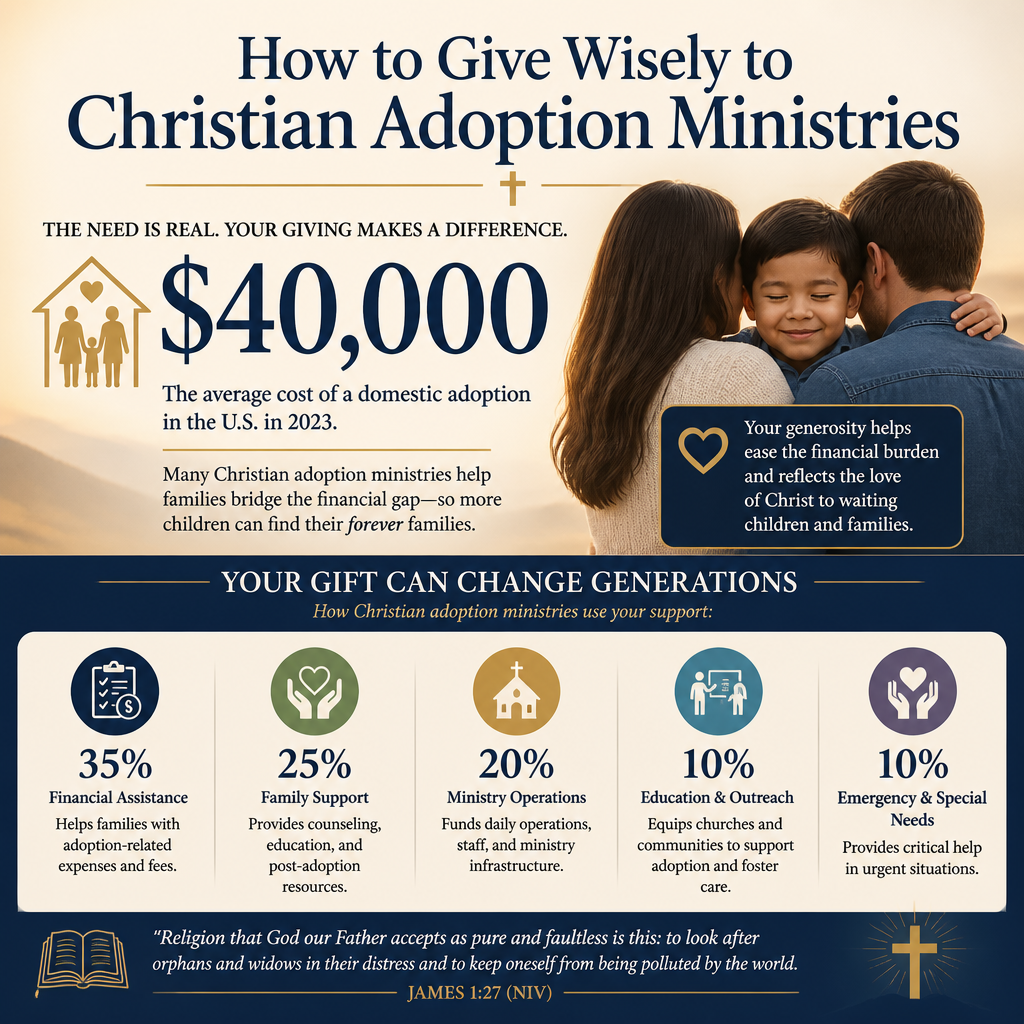
Many credible charity evaluators have publicly corrected the “low overhead = good charity” assumption. Charity Navigator, GuideStar (Candid), and BBB Wise Giving Alliance jointly warned donors against using overhead alone as a primary measure of nonprofit performance, emphasizing results, transparency, and governance instead (Charity Navigator).
Understand what recurring giving actually stabilizes
Recurring gifts are particularly valuable in adoption-related work because they stabilize the services that are hardest to fund with one-time, emotionally-driven giving: case management, counseling access, birth parent support, and post-adoption care. One-time gifts often surge around a specific family’s fundraising page; monthly gifts keep the ministry’s less-visible obligations funded after the public attention moves on.
Donors should still ask how recurring revenue is allocated. Responsible ministries can describe, in plain terms, which programs are most dependent on predictable cash flow and what safeguards exist for restricted gifts.
Stock gifts and year-end timing are stewardship decisions, not gimmicks
Some ministries accept gifts of appreciated stock because it can be tax-efficient for donors and can increase the net value of a gift by avoiding capital gains taxes. For donors with significant appreciated assets, giving stock can be a disciplined way to increase generosity without increasing out-of-pocket cash. This is not unique to adoption ministries, but adoption donors may see it more often because giving tends to be concentrated among families with larger year-end planning decisions.
Year-end giving can be especially meaningful in this field because agency timelines and care commitments extend well beyond a calendar year. Wise donors avoid the trap of funding only visible “placements” in December. They ask what year-end gifts do for the ministry’s ongoing obligations—especially post-placement reporting, family support, and program evaluation.
Apply The Most Trusted Standard to adoption ministries before you fund stories
Adoption ministries often have compelling narratives and unusually emotional donor touchpoints. That is precisely why verification matters. Across our work at Most Trusted, the ministries that meet The Most Trusted Standard tend to share two traits: they can explain their theological commitments without weaponizing them, and they can provide documentation that their finances, governance, and safeguarding practices match their public claims.
Faith foundation should shape practice, not only messaging
Christian adoption ministries rightly name the imago Dei, the church’s calling to care for vulnerable children, and God’s heart for the fatherless. We recommend asking how those convictions show up operationally: How do they protect birth parents from coercion? How do they handle disputed consent? What is their posture toward reunification and kinship care? A ministry’s faith statement is meaningful, but the test is whether Christian doctrine restrains power rather than sanctifies it.
Financial integrity and governance are child-protection issues
In adoption work, weak controls are not merely accounting problems; they are risk factors for ethical failure. Donors should look for audited financial statements when appropriate, clear separation of restricted and unrestricted funds, and board oversight that is not dominated by insiders. Ministries should be able to explain any relationships with affiliated for-profit entities, contractors, or partner agencies in ways that a prudent donor can understand.
Matching gifts, for example, can be a legitimate way to accelerate funding for under-supported work. They can also be used to manufacture urgency or obscure true fundraising needs. Responsible ministries disclose the source and conditions of a match, the time window, and whether the match applies to unrestricted or restricted funding.
Transparency and effectiveness must include hard outcomes, not only grateful testimonials
Testimonials have a place, but adoption donors should also ask for measurable indicators that respect privacy and avoid commodifying children. Depending on the ministry model, credible reporting might include: number of families served with post-adoption supports, disruption rates (defined carefully), counseling access, birth parent services delivered, and compliance outcomes. Ministries should be willing to report what did not go well and what they changed as a result. That kind of candor is a mark of maturity in a field that has had to repent of mistakes in past decades.
Wise giving that strengthens families and protects children
How to give wisely to Christian adoption ministries is ultimately a question of alignment: aligning our generosity with God’s justice, and aligning our trust with evidence. The donor’s task is not to fund the most stirring story, but to fund the most faithful work—work that keeps children safe, honors birth families, strengthens adoptive families for the long haul, and operates with governance and transparency that can withstand scrutiny.
When donors apply that discipline, adoption giving becomes what it ought to be: an act of Christian mercy shaped by truth, ordered by integrity, and directed toward the quiet, durable good of children flourishing in families.



