

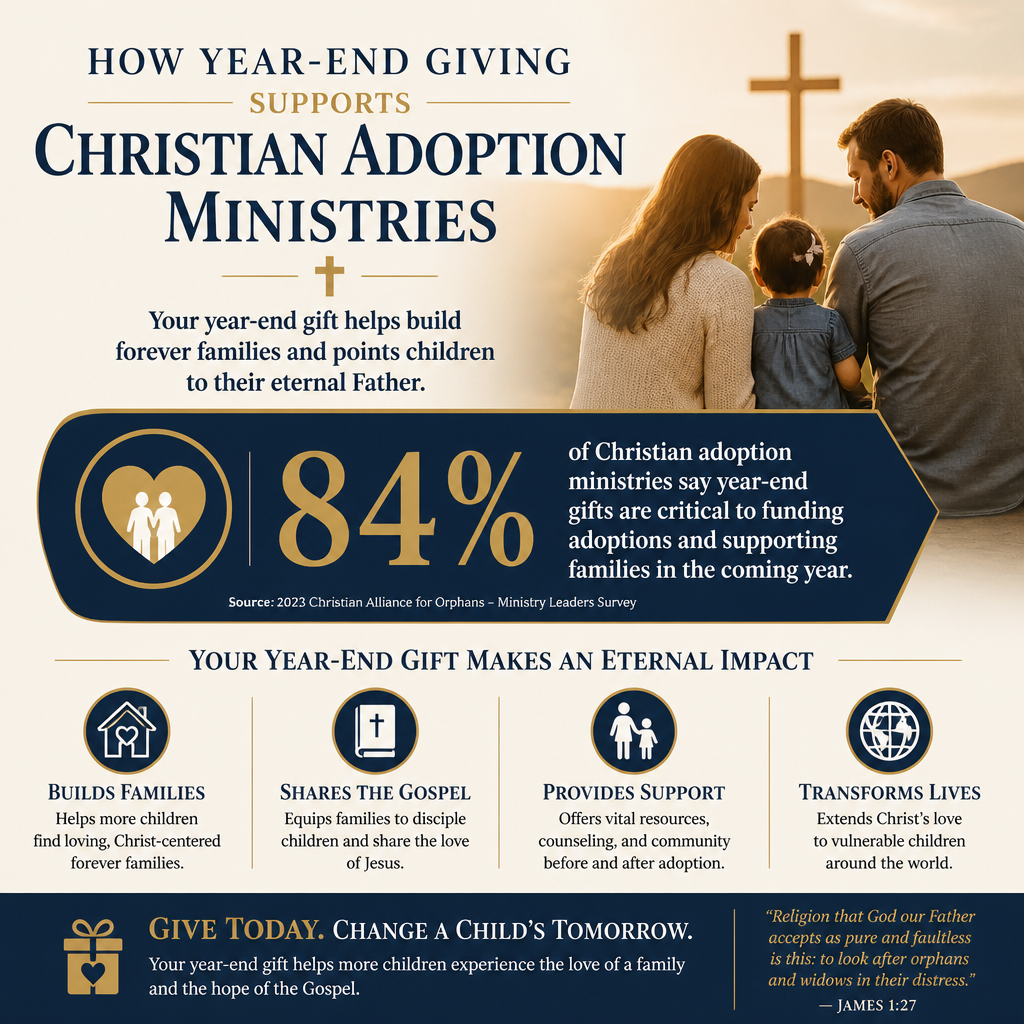
How year-end giving supports Christian adoption ministries is not primarily a question of seasonal fundraising tactics. It is a question of whether donors will fund the parts of adoption ministry that are least visible and most consequential: ethical practice, long-term family support, and the patient work of serving birth families with dignity. Scripture’s concern for children without safe parental care is clear, and so is Scripture’s insistence that our giving be wise, just, and ordered toward genuine neighbor-love.
Year-end is also when donor emotion, tax planning, and marketing intensity converge. That combination can strengthen faithful ministries, but it can also reward organizations that tell a simplified story. Mature Christian donors feel the tension: we want to respond to real need without underwriting practices that pressure families, treat children as outcomes, or confuse speed with faithfulness.
Year-end giving shapes what adoption ministries can do in the coming year
Budgets follow donor behavior
Most nonprofits receive a disproportionate share of giving late in the year, and adoption-related ministries are no exception. The National Philanthropic Trust reports that roughly a third of annual giving occurs in the last three months, with a meaningful portion in December itself National Philanthropic Trust. When giving arrives in a concentrated window, boards and executive teams often build next year’s commitments around what happens in November and December.
What this means in practice is that year-end gifts do more than “help the ministry finish strong.” They determine whether a ministry can keep experienced social workers, fund trauma-informed counseling, maintain compliance staff, and sustain post-placement support. These are the costs that protect families and children, but they rarely fit neatly into a single compelling photograph.
Restricted gifts can help or quietly distort
Christian donors often prefer designated gifts: “for a waiting family,” “for a particular country,” “for agency fees.” Sometimes that specificity is appropriate. Yet adoption ministry is an ecosystem. Over-restricting funds can leave the unglamorous work underfunded, including ethical safeguards and follow-up care.
The harder question is whether a ministry’s year-end appeal trains donors to value outcomes over integrity. Christians genuinely disagree about what responsible restriction looks like, but mature stewardship asks whether the organization is honest about its true cost structure and whether it will decline money that could push it toward questionable practice.

Healthy year-end funding underwrites ethics and child protection
Adoption ministry carries real moral risk
Because adoption intersects with poverty, crisis pregnancy, migration, and government systems, it is vulnerable to coercion and corruption. Even when an adoption is legal, it may not be just. A ministry can comply with paperwork while still participating in patterns that separate families who could have remained intact with adequate support.
For donors, this is not a reason to retreat from orphan care. It is a reason to fund ministries that tell the truth about complexity and have verifiable safeguards: clear policies on birth-parent consent, careful partner due diligence, and reporting that does not treat children as inventory.
What good safeguards cost at year-end
Child protection practices require sustained investment. A credible program will fund background checks, training, incident reporting systems, data security, and independent oversight. It will also pay for staff who can say “no” when a referral seems expedited, incomplete, or inconsistent.
Across our verification work at Most Trusted, the ministries that meet The Most Trusted Standard tend to describe these safeguards in concrete terms and demonstrate governance oversight, financial integrity, and transparency about outcomes and limits. They are less likely to promise what they cannot control, and more likely to show their work.
Year-end can stabilize the long middle of adoption ministry
Adoption does not end at placement
The public imagination often treats adoption as a finish line. Christian families who have adopted know better. Attachment challenges, identity formation, grief, and trauma can intensify after the paperwork is done. Post-adoption services are not an optional add-on; they are part of the moral obligation we assume when we advocate for adoption.
Research and clinical consensus increasingly emphasize that children with histories of loss benefit from trauma-informed parenting and support. The American Academy of Pediatrics has outlined the prevalence and impact of early childhood adversity and the importance of trauma-informed care in pediatric and family systems American Academy of Pediatrics. Donors may not fund “therapy sessions” with the same enthusiasm as “bringing a child home,” yet this is where many families either find stability or fracture under strain.
A disciplined year-end gift builds capacity, not dependency
Some ministries become trapped in what Stanford Social Innovation Review has described as the “nonprofit starvation cycle,” where pressure to keep overhead low leads to underinvestment in infrastructure and ultimately weaker results Stanford Social Innovation Review. Adoption ministries are particularly vulnerable because the work is administratively heavy and legally complex.
Year-end donors can either intensify that cycle or interrupt it. Funding that allows for strong finance teams, secure recordkeeping, staff supervision, and measured growth can protect children and families in ways that no single heartwarming story can capture.
Wise year-end giving matches biblical compassion with verifiable trust
What donors should look for beyond the appeal letter
Christian donors are right to be moved by Scripture’s repeated call to defend the vulnerable. Yet biblical compassion does not ask us to suspend judgment. The same tradition that commands generosity also condemns partiality, dishonest scales, and exploitation of the powerless.
One practical discipline is to read a year-end appeal alongside evidence: audited financials when available, clear governance disclosures, measurable program reporting, and a candid articulation of what the ministry can and cannot promise. This is where independent verification can serve the church by reducing information asymmetry between donors and organizations.
- Clarity about the ministry’s model: domestic adoption support, foster care mobilization, family preservation, or international work
- Specific child-safety and ethical policies, including partner screening and consent practices
- Financial reporting that is understandable and consistent year to year
- Board governance that reflects independence and real oversight
- Transparency about outcomes, including challenges and limitations
How Most Trusted fits into the donor’s discernment
Most Trusted exists because donors should not have to choose between compassion and confidence. We evaluate ministries against The Most Trusted Standard, a 15-criteria framework spanning faith foundation, financial integrity, governance and leadership, and transparency and effectiveness. Verification does not replace pastoral discernment, but it can reduce the risk that year-end generosity funds ministries whose practices would not withstand scrutiny.
For donors seeking a broader understanding of the landscape, our coverage of Christian Adoption Ministries addresses the theological mandate alongside the operational realities that shape responsible care.
Practical year-end strategies that honor families, birth parents, and children
Give in ways that strengthen the whole mission
Year-end giving is often framed as a deadline. Christians can treat it instead as a recommitment to steady, accountable mercy. In adoption ministry, that usually means funding the “long faithfulness” expenses: staff competence, post-placement care, and prevention where possible.
Christians genuinely disagree about the right balance between adoption and family preservation, and different contexts require different judgments. Still, ministries should be able to explain how they avoid perverse incentives, how they support birth families, and how they ensure that adoption is pursued as a child-centered last resort when reunification is not safe or feasible.
Ask questions that a trustworthy ministry will welcome
Year-end is a legitimate time to ask for clarity. A ministry that is prepared to answer is not necessarily perfect, but it is likely governed. Consider asking how the organization defines success, how it measures post-adoption stability, what guardrails prevent coercion, and what percentage of its work is devoted to post-placement support and family preservation where relevant.
Donors who want a more detailed decision framework can consult How to Give Wisely to Christian Adoption Ministries, which outlines evaluation categories that often distinguish disciplined stewardship from impulse giving.
FAQs for How year-end giving supports Christian adoption ministries
Is year-end giving mainly about tax benefits for donors?
Tax considerations can be a responsible part of stewardship, but they are not the primary reason year-end giving matters for adoption ministries. The concentration of donations late in the year often determines staffing, program capacity, and the ability to fund ethical safeguards and post-adoption support. The strongest ministries treat tax-aware generosity as an opportunity to fund long-term faithfulness rather than short-term optics.
Should donors restrict gifts to a specific child or adoptive family?
Sometimes a designated gift is appropriate, especially when the ministry can ensure it does not create pressure or inequity. Still, over-restriction can underfund the very systems that protect children: compliance, supervision, trauma-informed care, and long-term follow-up. A prudent approach is to restrict only when the ministry can explain how designated gifts fit within a child-centered, ethically governed model.
Year-end generosity can fund adoption work that endures scrutiny
Year-end giving supports Christian adoption ministries best when it strengthens the invisible integrity of the work: ethical practice, accountable governance, and durable care for families after placement. Donors do not honor the fatherless by rewarding ministries that cannot explain their safeguards or document their stewardship. We honor the call more fully when our generosity is both compassionate and verifiable, ordered toward what is true, just, and protective of the vulnerable.



